Simultaneous Equations (HSC SSCE Mathematics Standard): Revision Notes
📚Revision Notes
Simultaneous Equations
What are simultaneous equations?
Simultaneous equations are a pair of equations that we solve together to find values that satisfy both equations at the same time. When we graph two straight lines on the same set of axes, they will meet at one point unless they are parallel (running in the same direction and never meeting).
The point where two lines cross is called the point of intersection. This point gives us the solution to both equations - the x and y values that work in both equations simultaneously.
Note
Think of the intersection point as the "meeting place" where both equations agree. The coordinates of this point satisfy both equations at once, which is why we call it the simultaneous solution.
Solving simultaneous equations graphically
The graphical method
When we solve simultaneous equations graphically, we are finding where two lines intersect by drawing them on the same graph. The coordinates of this intersection point are our solution.
Important
SOLVING A PAIR OF SIMULTANEOUS EQUATIONS GRAPHICALLY
-
Draw a number plane with clearly labelled axes.
-
Graph both linear equations on the same number plane.
-
Find and read the coordinates of the point where the two straight lines intersect.
-
Interpret what the point of intersection means in practical situations.
Using the gradient-intercept form
To sketch each line quickly, we use the gradient-intercept form of a linear equation:
where:
- is the gradient (the coefficient of )
- is the y-intercept (the constant term where the line crosses the y-axis)
The gradient tells us how steep the line is and which direction it slopes. The y-intercept tells us where to start the line on the vertical axis.
Note
Memory aid: Think "GI Joe" - Gradient and Intercept to graph! The gradient () controls the slope, while the intercept () shows where the line crosses the y-axis.
Using tables of values
An alternative method to find the point of intersection is to create a table of values for each equation. We choose several x values, calculate the corresponding y values for each equation, then look for where the same x and y values appear in both tables. This matching pair of coordinates is our solution.
Note
Tip: When using tables, look for the "Same Same" values - where both the x and y coordinates match in both tables. This is your simultaneous solution!
Worked example: Finding solutions with both methods
Example
Worked Example: Finding Solutions Graphically and with Tables
Let's find the simultaneous solution of and .
Method 1: Graphical solution
First, identify the gradient and y-intercept for each line:
For :
- Gradient is
- y-intercept is
For :
- Gradient is
- y-intercept is
Draw both lines on the same number plane:
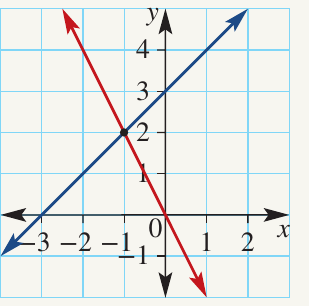
The point where the two lines intersect is .
Therefore, the simultaneous solution is and .
Method 2: Table of values
Create a table for using values of :
Create a table for using the same values:
Looking at both tables, we can see that when , both equations give . This confirms our graphical solution.
The simultaneous solution is and .
Simultaneous equations as models
When we use linear functions to describe real-world situations, the point where the graphs intersect often has important practical meaning. This is called using simultaneous equations as models.
Note
SIMULTANEOUS EQUATIONS AS MODELS
Simultaneous equation models use two linear functions to describe a practical situation, and the point of intersection is often the solution to a problem.
For example, in business, when we graph income against costs, the intersection point represents the break-even point - where a business changes from making a loss to making a profit.
Worked example: Break-even analysis
Example
Worked Example: Break-Even Point in Business
Zaina buys and sells books. The income from selling books follows the formula , where is the number of books sold. The costs associated with selling books follow the formula .
Part a: What is the income when 6 books are sold?
Substitute into the income formula:
The income for six books is $96.
Part b: What are the costs when 6 books are sold?
Substitute into the costs formula:
The costs for six books is $72.
Part c: Draw both graphs on the same number plane.
For :
- Gradient is
- Vertical intercept is
For :
- Gradient is
- Vertical intercept is
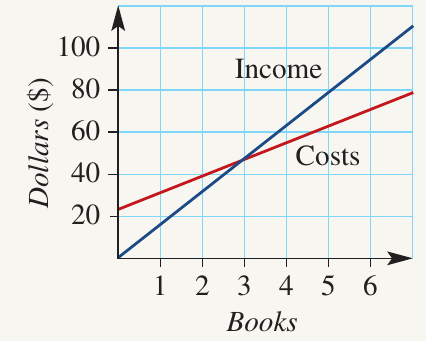
Part d: How many books need to be sold for costs to equal income?
From the graph, we can see the two lines intersect at the point .
This means when , the income equals the costs. Therefore, 3 books need to be sold to break even.
Important
At the break-even point, income exactly equals costs. Before this point, the business is making a loss. After this point, the business is making a profit. This is why finding the intersection point is so valuable in business applications!
Worked example: Solving word problems
Example
Worked Example: Setting Up Equations from Word Problems
Isabella's Mathematics mark exceeded her English mark by 15. She scored a total of 145 for both tests. Find Isabella's marks in each subject by plotting intersecting graphs.
Step 1: Set up the equations
Let the Mathematics mark be and the English mark be .
From "Mathematics mark exceeded English mark by 15":
From "total of 145 for both tests":
Rearranging the second equation:
Step 2: Identify gradient and intercept for each line
For :
- Gradient is
- Vertical intercept is
For :
- Gradient is
- Vertical intercept is
Step 3: Graph both lines and find the intersection
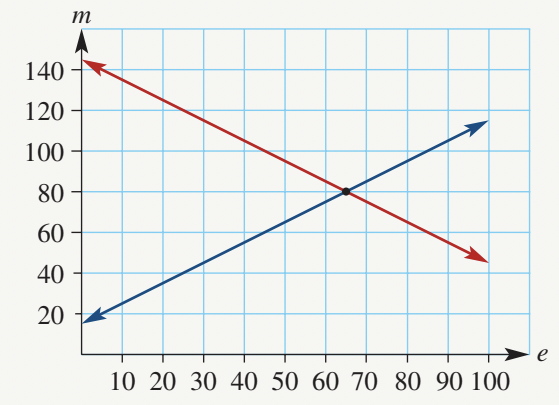
The intersection point is , which means and .
Step 4: Interpret the solution
Isabella scored 65 in English and 80 in Mathematics.
We can check this: ✓ and ✓
Note
Tip for word problems: Always define your variables clearly at the start. Read the problem carefully to identify the two relationships, then translate each sentence into an equation. The intersection point will give you the answer!
Remember!
Summary
Key Points to Remember:
-
Simultaneous equations are solved together to find values that work in both equations at the same time.
-
The point of intersection of two lines gives the simultaneous solution - the coordinates where both equations are true.
-
To graph a line quickly, use gradient-intercept form () to identify the gradient and y-intercept.
-
You can find solutions either by graphing both lines and reading the intersection point, or by using tables of values to find matching coordinates.
-
In real-world problems, the point of intersection has practical meaning - such as a break-even point in business or the solution to a word problem.