Living with the Bomb (HSC SSCE Modern History): Revision Notes
📚Revision Notes
Living with the Bomb
The development and proliferation of nuclear weapons fundamentally changed how ordinary people lived during the Cold War period. This note explores how civilians adapted to the constant threat of nuclear war, the global spread of nuclear weapons technology, and the devastating humanitarian consequences of nuclear testing programs around the world.
The costs of the nuclear arms race
The nuclear arms race between the United States and Soviet Union came at an enormous economic and social cost to both superpowers. In the United States, the focus on military spending meant that domestic problems like poverty, crime, infrastructure decay and failing schools received inadequate attention and funding.
Note
According to historian Richard Rhodes, the nuclear arms race and militarisation of the American economy resulted in "ramshackle cities, broken bridges, failing schools, entrenched poverty, impeded life expectancy, and a menacing and secretive national security state". The war economy essentially consumed the civilian economy, with estimates suggesting at least US$1.6 trillion would be needed just to repair basic infrastructure deficiencies.
The Soviet Union paid an even heavier price. The nuclear arms race, combined with other dysfunctional economic policies, virtually bankrupted the communist superpower. By the time Soviet leader Mikhail Gorbachev negotiated with US President Ronald Reagan at Reykjavík in 1986, he desperately needed a nuclear arms agreement to save the Soviet economy. After the Cold War ended, the Russian Federation struggled with a corrupt capitalist economy that failed to meet basic needs whilst wealthy oligarchs accumulated vast fortunes.
Important
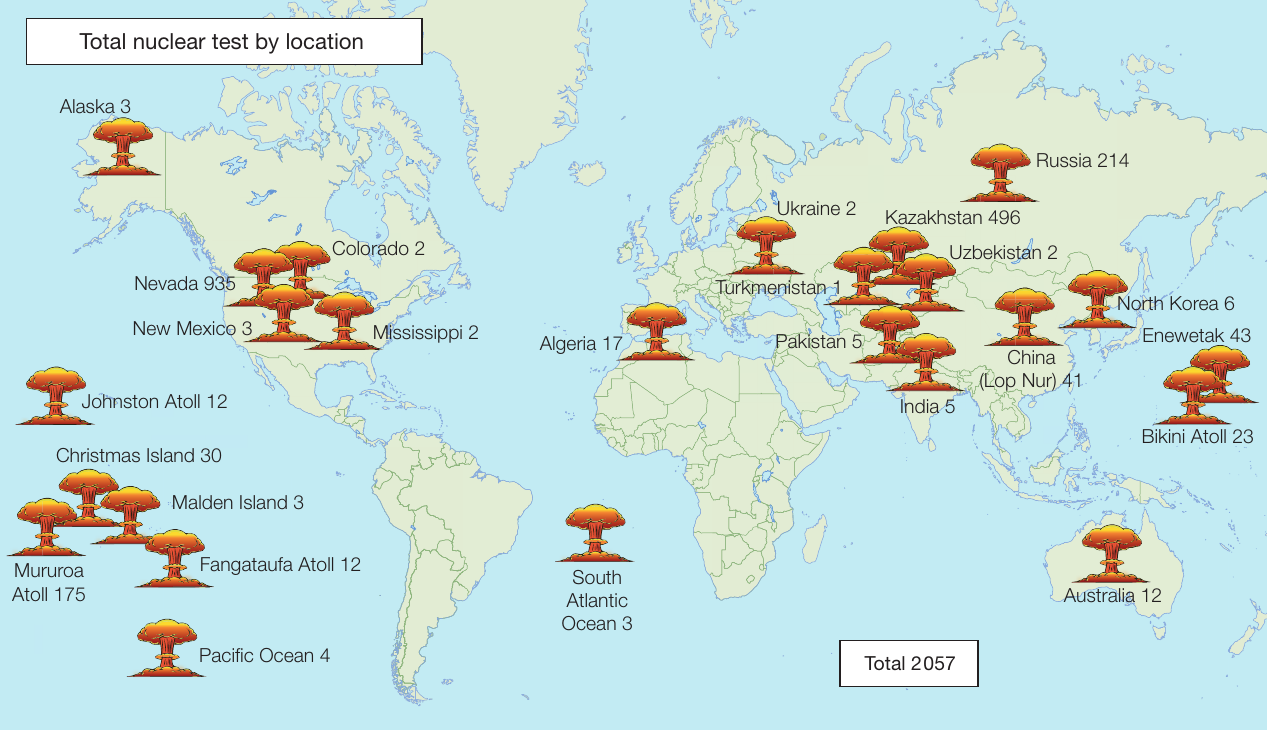
Beyond the superpowers, the rest of the world also paid a significant price through 46 years of constant fear and the humanitarian impact of 2056 nuclear weapons tests conducted globally by the end of 2017. These tests spread radioactive contamination across many locations, with 219 tests conducted in the atmosphere distributing radioactive dust worldwide. This toll added to the devastation already inflicted on Hiroshima and Nagasaki.
Civil defence programs
Educational programs and protective measures
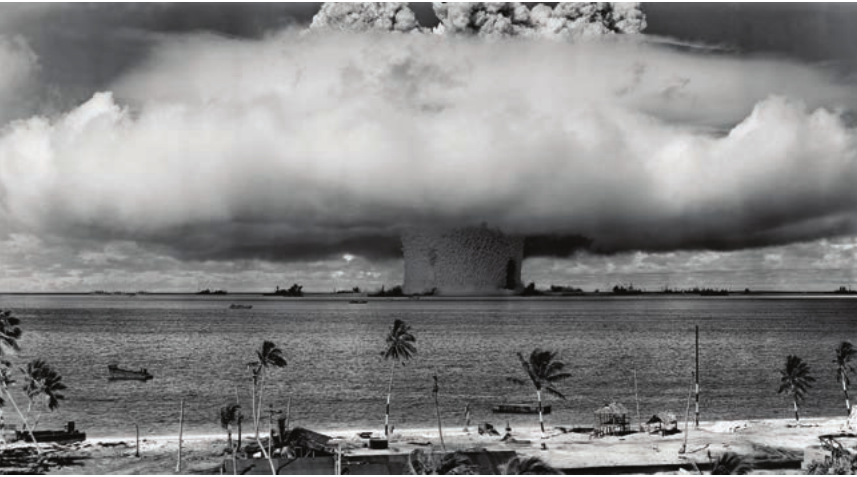
As world leaders embarked on the nuclear arms race during the 1950s, ordinary people had to learn to live with the constant threat of nuclear attack. The growing fear generated by memories of Hiroshima and the massive hydrogen bomb tests conducted in the atmosphere over the Pacific Ocean and Kazakhstan convinced successive US presidents that civil defence programs were necessary to ease public concern.
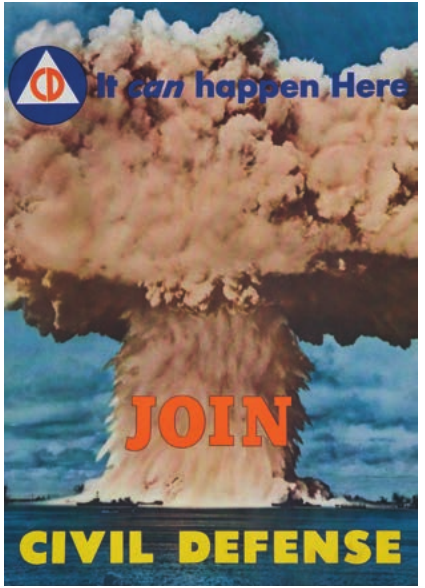
Governments invested massive amounts of money in civil defence plans and educational programs. Schools conducted regular civil defence drills, teaching children to "duck and cover" under their desks. Communities received instruction on building makeshift fallout shelters, were told to stockpile emergency supplies, and given advice on surviving in a post-nuclear attack world.
Fallout shelters
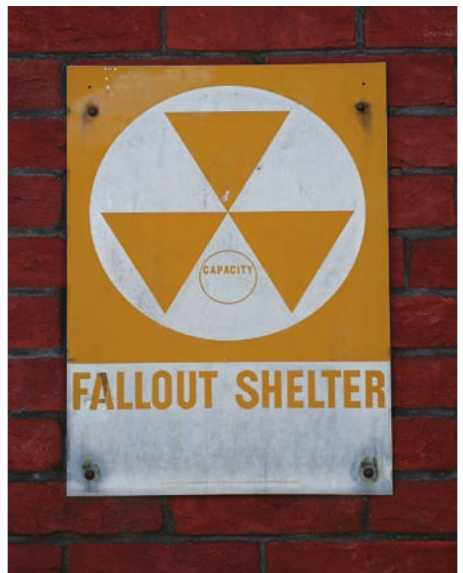
The civil defence movement promoted the construction of fallout shelters to protect citizens from radioactive fallout following a nuclear attack. These ranged from purpose-built underground bunkers to improvised shelters in basements or backyards. Governments designated underground levels of certain buildings as community shelters and posted distinctive fallout shelter signs to identify safe locations.
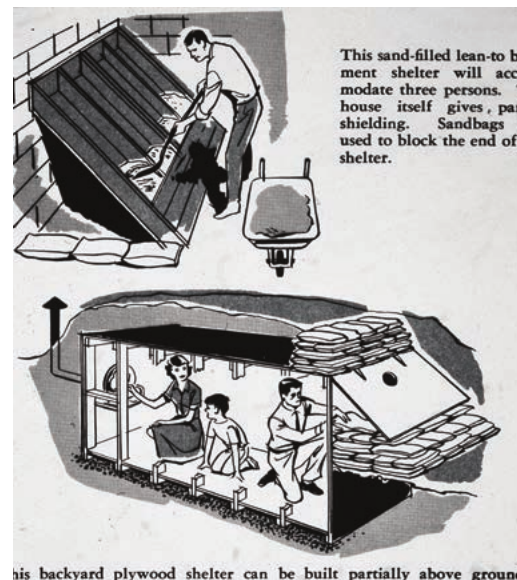
The illustrations above show typical civil defence advice for constructing home shelters, including a sand-filled lean-to basement shelter and an underground plywood shelter with sandbag protection.
Important
However, the effectiveness of such measures against actual nuclear weapons was highly questionable. These simple shelters would provide little protection against the immense heat, blast waves, and radiation from modern nuclear weapons.
Civil defence films
Governments produced numerous educational films to instruct the public on nuclear survival. Key examples included:
| Film | Date | Country | Purpose |
|---|---|---|---|
| Survival under atomic attack | 1951 | US | Early Cold War survival advice |
| Protect and Survive | 1976 | UK | Civil defence instructions |
| Should Disaster Strike | 1987 | UK | Later Cold War preparedness |
These films provided advice on recognising warning signs, finding shelter, protecting against radiation, and surviving the aftermath of nuclear attack. However, much of this guidance proved inadequate given the actual destructive power of nuclear weapons.
The decline of civil defence
Films from the 1980s dramatically changed public perception of nuclear war survival. Productions like the US film The Day After (1983), the UK film Threads (1984), and the documentary Atomic Café (1982) effectively killed off nuclear civil defence programs by showing the realistic consequences of nuclear war. These films demonstrated that a nuclear war could not be meaningfully survived and would not be worth surviving.
Note
The Nuclear Winter Theory
A crucial turning point came when scientist Carl Sagan introduced the concept of nuclear winter during a panel discussion following the national screening of The Day After. This scientific theory explained how even 100 cities hit with nuclear bombs would send enough soot and debris into the atmosphere to block out the sun for months, causing plummeting temperatures that would destroy all agricultural production globally.
With this more realistic understanding, the old civil defence plans and educational materials seemed absurd. By the end of the 1980s, governments found it impossible to develop credible civil defence plans that could withstand expert scrutiny. The designation of fallout shelters was quietly abandoned in most countries.
Nuclear proliferation
The nuclear arms race extended far beyond the two superpowers. By 2011, nine nations had developed nuclear weapons capabilities. This spread of nuclear weapons technology and capabilities is known as nuclear proliferation.
Countries joining the nuclear club
The timeline of nuclear weapons development shows:
- United States (1945): First to develop and use atomic weapons
- Soviet Union (1949): Developed weapons to counter US power
- Britain (1952): Sought independent deterrent despite US opposition
- France (1960): Pursued independent Force de dissuasion program
- China (1964): Became first Asian nuclear weapons state
- Israel (1967): Developed undeclared nuclear arsenal to deter Arab neighbours
- India (1974): Conducted "peaceful nuclear explosion"
- Pakistan (1998): Developed weapons to counter India
- North Korea (2006): Most recent declared nuclear weapons state
Note
Every nation that acquired nuclear weapons did so with the motivation of deterring other countries from attacking them. As Jonathan Schell observed, "every deterrer was once a proliferator, and every proliferator has become a deterrer". No country has ever been invited to join the nuclear club - all "entered by breaking down the door". According to Schell, "it is above all fear – or, to use the proper word in context, terror – that links one arsenal to another, creating the chain that connects them all".
The Nuclear Non-Proliferation Treaty
After World War II, the United States initially sought to prevent even its closest allies, Britain and Canada, from developing nuclear weapons. The McMahon Act of 1946 established US monopoly over nuclear technology, refusing to share information even with wartime allies due to suspicions about Soviet spies in Britain.
However, Britain remained determined to develop independent nuclear capability. After successfully testing their first bomb in 1952 (conducted in Australia), the United States reluctantly accepted Britain into the nuclear club. Cooperation resumed in 1958 with the US-UK Mutual Defence Agreement.
When China acquired nuclear weapons in 1964, US President Lyndon Johnson became concerned that increasing proliferation would make the world more unstable. The United States found the Soviet Union shared this concern.
Important
In 1968, the five nuclear weapons states signed the Nuclear Non-Proliferation Treaty (NPT), which aimed to prevent the spread of nuclear weapons to additional countries whilst promoting peaceful uses of nuclear technology. The NPT represented a major achievement in international arms control, though several countries (including Israel, India, and Pakistan) never signed it.
Nuclear testing around the world
Scale and locations of testing
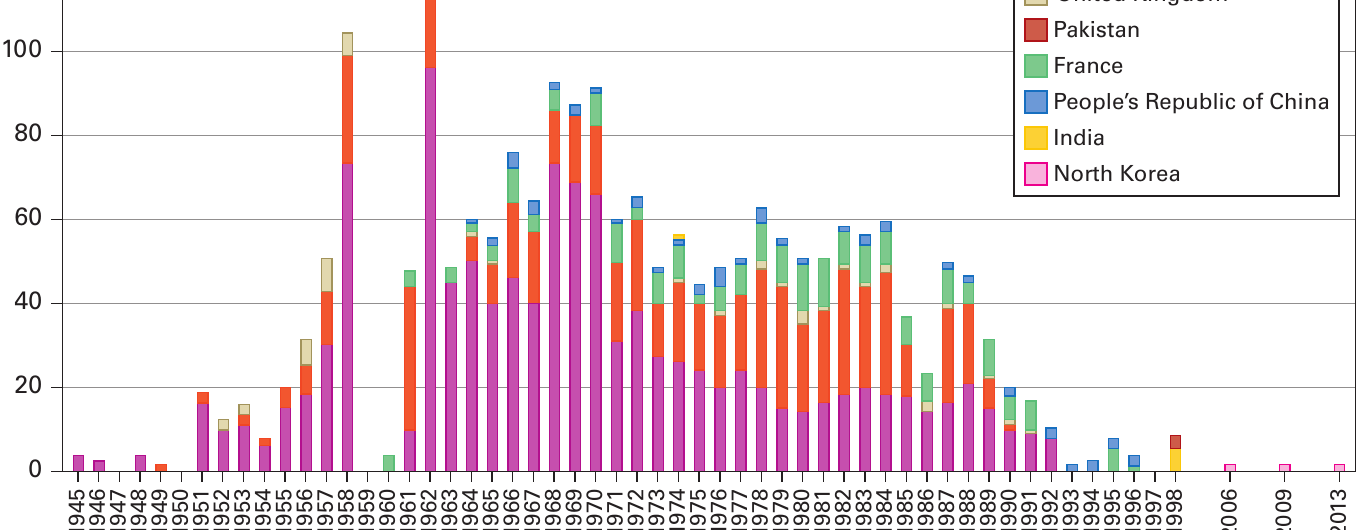
From 1945 to 2017, a total of 2057 nuclear weapons tests were conducted worldwide. The chart above shows the distribution of testing over time, with peak activity occurring in the early 1960s before the Partial Test Ban Treaty of 1963 banned atmospheric testing.
Major testing locations included:
- Nevada, USA: 935 tests
- Kazakhstan (Soviet): 496 tests
- Russia: 214 tests
- Mururoa Atoll, French Polynesia: 175 tests
- Bikini Atoll, Marshall Islands: 23 tests
- Australia: 12 tests
Note
From the first nuclear test in 1945 until Pakistan's tests in 1998, there was never a period longer than 22 months without nuclear testing somewhere in the world. The period from June 1998 to October 2006 marked the longest interval without acknowledged nuclear tests.
Humanitarian and environmental impact
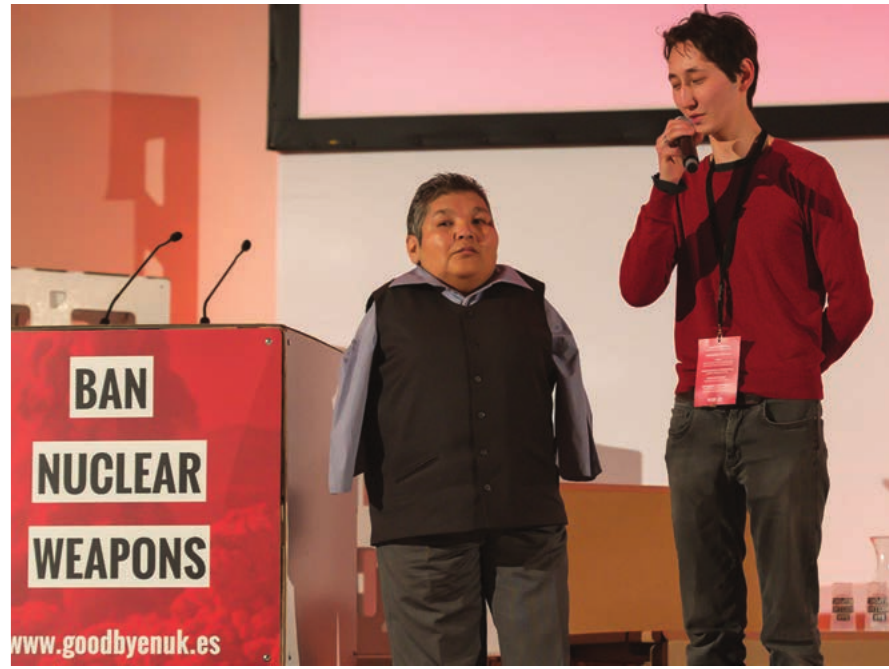
Nuclear weapons tests caused severe humanitarian and environmental consequences in testing locations. Many local populations continue suffering the effects decades later. The worldwide spread of radioactive dust from 219 atmospheric tests conducted before 1963 had indeterminate global health impacts.
Note
One of the first major successes of the nuclear disarmament movement was the 1963 Partial Test Ban Treaty, which prohibited nuclear weapons tests in the atmosphere, outer space, and underwater. This treaty partly addressed fears about global radioactive contamination, though underground testing continued.
British nuclear testing in Australia
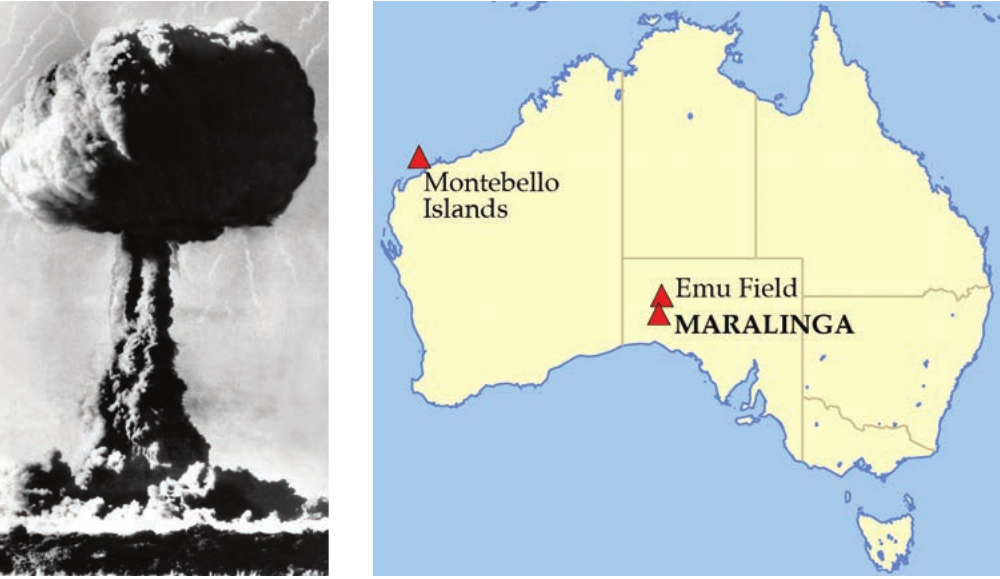
Australia became directly involved in the Nuclear Age through hosting British nuclear weapons tests. After the US McMahon Act of 1946 prevented sharing nuclear technology with Britain, the British government determined to develop independent nuclear capability. Canada refused to host nuclear tests due to environmental concerns, so Britain turned to Australia.
Prime Minister Robert Menzies quickly granted permission via telegram, allowing Britain to use Australian land and uranium for their nuclear program. The British justified this using the concept of "Empire Defence" - the idea that British nuclear weapons and bombers based throughout Commonwealth countries would defend against Soviet attack. However, this concept became obsolete when US-British nuclear cooperation resumed in 1958.
Britain conducted 12 nuclear tests in Australia between 1952 and 1963:
- Three tests at Montebello Islands (off Western Australia)
- Two tests at Emu Field (South Australia)
- Seven tests at Maralinga (South Australia)
Beyond these major tests, hundreds of "minor trials" were conducted at Maralinga involving plutonium and other radioactive materials. These experiments contaminated large areas of land.
Impact on Indigenous Australians
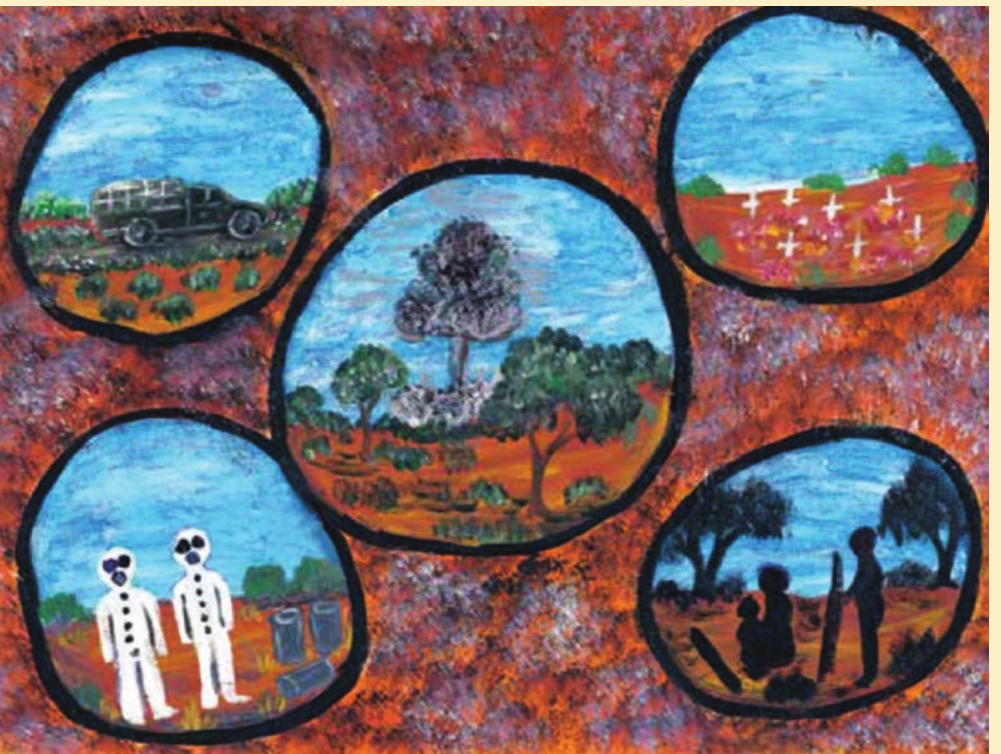
Important
The nuclear testing program had devastating consequences for Aboriginal people living in and around the test sites. Many Aboriginal people knew nothing about the tests or their dangers. They were exposed to radioactive fallout and contamination that caused serious health problems including cancers, birth defects, and other radiation-related illnesses.
The artwork above by Pitjantjatjara artist Yvonne Edwards depicts five stages of the Maralinga story, showing the impact on Aboriginal communities. The painting illustrates traditional life, the arrival of testing infrastructure, the explosions, contamination, and the lasting effects on Indigenous people and their land.
One significant figure was Yami Lester, a Yankunytjatjara elder who was blinded as a child by the "black mist" from nuclear fallout. He became a prominent advocate for recognition of the suffering caused by nuclear testing. The word "Maralinga" comes from the Garik people and means "field of thunder" or "place of thunder".
Impact on service personnel
The British nuclear testing program employed approximately 22,000 Australian service personnel and civilians at various test sites. Many of these workers were exposed to dangerous levels of radiation without adequate protection or warning. Service personnel suffered increased rates of cancer and other radiation-related illnesses, though securing compensation and recognition proved difficult for many years.
The 1984 Royal Commission
Growing concern about the health and environmental impacts led to the establishment of a Royal Commission in 1984 to investigate the British nuclear tests in Australia.
Note
The Commission's findings revealed:
- Inadequate safety measures during testing
- Failure to properly inform or protect Aboriginal people
- Extensive contamination at test sites
- Ongoing health impacts on personnel and local populations
- Need for comprehensive cleanup operations
Following the Royal Commission, cleanup efforts began at Maralinga, though complete remediation proved impossible. The British and Australian governments eventually provided compensation to some affected individuals, though many felt this was inadequate given the scale of suffering caused.
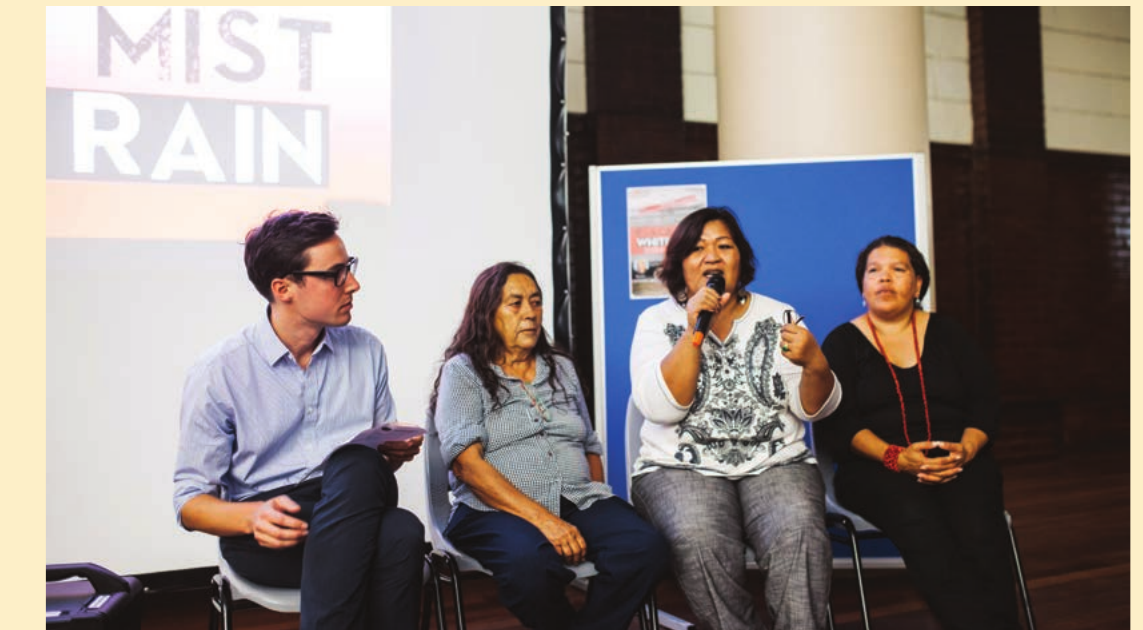
Indigenous women like Sue Coleman-Haseldine and Karina Lester have continued advocating for recognition of nuclear testing impacts, speaking at events worldwide about how these tests affected their families and communities.
French testing in the Pacific
France conducted 201 nuclear tests in total: 17 in the Algerian desert and 193 in French Polynesia in the south-west Pacific, primarily at Mururoa Atoll and Fangataufa Atoll.
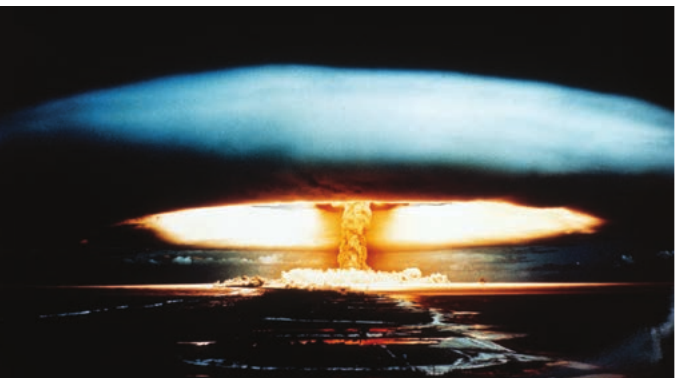
For decades, France claimed their tests were "clean" with minimal health and environmental impacts.
Important
However, declassified military documents released in 2017 revealed that Tahitians were exposed to plutonium fallout 500 times over official safety limits. This explained the extremely high rates of thyroid cancer and leukaemia among the 23,000 veterans and civilians employed on the tests, as well as among the 127,000 residents of French Polynesia. Despite 800 people lodging compensation claims, only 11 had received any payment by 2017.
International response to French testing
French nuclear testing generated widespread international opposition. Both Australia and New Zealand took legal action against France at the International Court of Justice (ICJ). On 23 June 1973, the ICJ condemned French atmospheric nuclear testing. Although France initially ignored this ruling, mounting international pressure forced it to cease atmospheric testing in 1974 and move to underground tests.
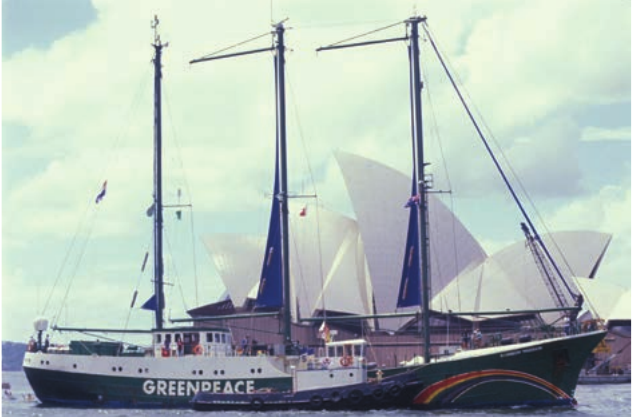
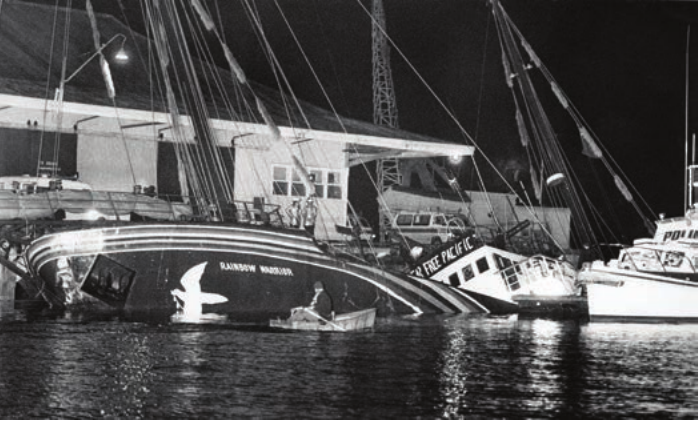
Environmental organisation Greenpeace led activist campaigns against French testing in the Pacific. Their flagship vessel, the Rainbow Warrior, was conducting protest activities when disaster struck.
Example
The Rainbow Warrior Bombing
On the night of 10 July 1985, whilst moored in Auckland Harbour, two explosions ripped through the Rainbow Warrior's hull, killing crew member Fernando Pereira. Investigations revealed that French intelligence agents had planted the bombs in an act of state terrorism designed to prevent Greenpeace protests against nuclear testing.
Two French agents were caught, charged with murder, and sentenced to 10 years imprisonment. This bombing severely damaged France's international reputation and deteriorated relations with New Zealand. France blocked New Zealand's access to European markets whilst New Zealand boycotted French products. Eventually a compromise was reached involving compensation payments and the agents supposedly serving sentences in Tahiti - though both received early releases.
The failure of the United States and Britain to strongly condemn this French act of terrorism contributed to New Zealand pursuing a more independent foreign policy, particularly regarding nuclear issues.
New Zealand's nuclear-free policy
After years of debate over US nuclear-powered and nuclear-armed naval ships visiting New Zealand ports, the Labour government passed the New Zealand Nuclear Free Zone, Disarmament, and Arms Control Act in 1987. This legislation prohibited nuclear weapons and nuclear-powered vessels from entering New Zealand waters.
Note
The United States responded by downgrading New Zealand's status as an ally in the ANZUS treaty. Prime Minister David Lange stated this was "the price we are prepared to pay" for maintaining New Zealand's nuclear-free stance. New Zealand has maintained this position and remained at the forefront of global nuclear disarmament efforts ever since.
Summary
Key Points to Remember:
-
Civil defence programs in the 1950s-1970s attempted to prepare civilians for nuclear war through drills, shelters, and educational films, but realistic 1980s media revealed these measures would be largely ineffective against actual nuclear weapons.
-
Nuclear proliferation saw nine countries develop nuclear weapons by 2011, with each seeking to deter potential attackers. The 1968 Nuclear Non-Proliferation Treaty attempted to limit the spread of nuclear weapons.
-
Over 2000 nuclear tests were conducted globally between 1945 and 2017, with devastating humanitarian and environmental consequences for local populations, particularly at sites in Kazakhstan, the Pacific Islands, and Australia.
-
British nuclear testing in Australia (1952-1963) severely impacted Aboriginal communities and service personnel through radiation exposure, with health consequences continuing for decades. The 1984 Royal Commission exposed inadequate safety measures and led to cleanup efforts.
-
International responses to nuclear testing included legal challenges, environmental activism (notably by Greenpeace), and New Zealand's pioneering nuclear-free legislation, demonstrating growing global opposition to nuclear weapons and testing.