The Initial Consolidation of Nazi Power, 1933–34 (HSC SSCE Modern History): Revision Notes
📚Revision Notes
The Initial Consolidation of Nazi Power, 1933–34
Hitler's appointment as Chancellor
On 30 January 1933, the Nazi Party achieved what seemed impossible. A political party that had received less than 3 per cent of the vote in the spring of 1928 had now gained control of the German government. Hitler's appointment as Chancellor triggered wild celebrations among Nazi supporters. Former party members who had left began returning, and the SA (Sturmabteilung, or Brownshirts) held torchlight parades across Germany.
Important
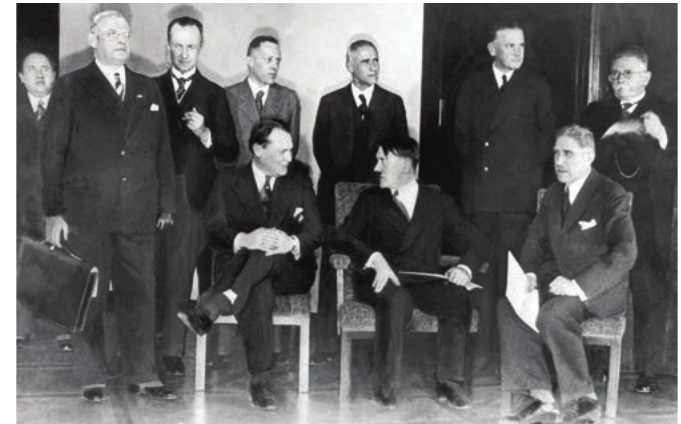
The composition of Hitler's first Cabinet was strategically limited. Only three Nazis held positions in the new government, while conservatives believed they could control Hitler and use him as a popular figurehead. This seemingly weak position would prove deceptive, as Hitler rapidly consolidated power over the following eighteen months.
The three Nazi positions were:
- Adolf Hitler as Chancellor
- Hermann Goering as Reich Commissar for the Ministry of the Interior of Prussia
- Wilhelm Frick as Minister of the Interior (giving him control over the police for Germany as a whole)
Franz von Papen, a conservative politician, was appointed Vice-Chancellor. The conservatives believed they could control Hitler and use him to drum up popular support whilst making the real political decisions themselves.
Gleichschaltung: the Nazification of Germany
Once in power, the Nazis implemented their policy of Gleichschaltung. This German term translates as 'coordination' or 'consolidation' of control, but it really meant the systematic Nazification of German politics and society. The aim was to create a situation where all of German society would respond to instructions from the Nazi leadership, embodied by Hitler.
Note
Key term: Gleichschaltung refers to the process of Nazification by which Hitler successively established a system of totalitarian control and coordination over all aspects of German society.
This process worked in two ways. It was not simply imposed from above by the government. Instead, enthusiastic Nazis throughout Germany took initiative at the local level, infiltrating and taking over their communities. This grassroots enthusiasm combined with top-down directives to transform German society.
Hitler's initial strategy
Initially, Hitler acted cautiously. He did not want to alarm anyone or create the impression that a Nazi coup had taken place. He feared that President Hindenburg might change his mind about the appointment, so he behaved carefully in Cabinet meetings. The conservatives, particularly von Papen, believed Hitler would simply be a popular figurehead whilst they retained real power.
However, Hitler was determined on two key political decisions:
- The Reichstag must be dissolved
- New elections must be called
Von Papen reluctantly agreed to new elections scheduled for 5 March 1933, despite concerns that this would give the NSDAP an opportunity to win a majority and govern alone.
Early moves against opposition
Before the election campaign began, the Nazis moved to restrict their main political opposition, the Communist Party (KPD). The atmosphere in Germany was tense, with fears of civil war and a possible Communist uprising against the Nazis.
Emergency decree of 4 February 1933
The Communists called for a general strike on 31 January, the day after Hitler's appointment. Hitler used this as justification to persuade Hindenburg to issue an emergency decree that took effect on 4 February. This decree, issued 'for the protection of the German people', gave Hitler the power to:
- Ban political meetings of rival parties
- Close down newspapers of political opponents, especially the Communists
Prussian decree of 5 February 1933
On 5 February 1933, another emergency decree dissolved all elected bodies in Prussia (a major German state). All power was transferred to the new national government. This was crucial because it placed the government in charge of the judiciary and police throughout Prussia. Fourteen police chiefs in Prussia were forced to resign and were replaced by Nazi supporters and conservatives. Local and regional officials were gradually forced out.
Note
The government had effectively banned political activity by left-wing parties, whether Social Democrats or Communists. Their newspapers were shut down, and the SA was given free rein to terrorise left-wing opponents. The SA thugs who had spent years fighting Communists and Social Democrats in the streets now effectively had official permission to continue their violence.
The Reichstag Fire
On the evening of 27-28 February 1933, a dramatic event changed the course of German history. In the middle of the night, the Reichstag building in Berlin caught fire.
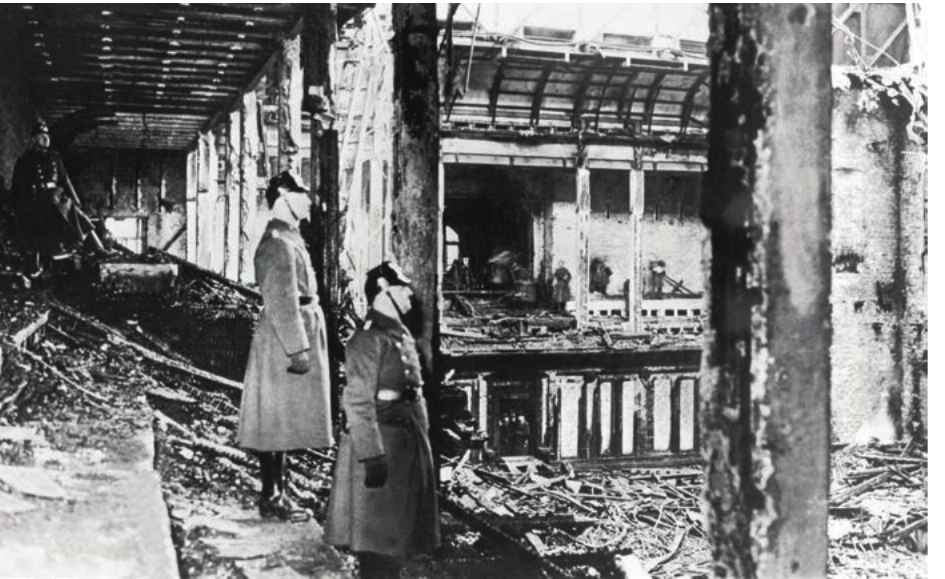
The Nazis immediately claimed this was the beginning of a Communist revolution. However, police found only one person in the burning building: a Dutchman named Martinus van der Lubbe who smelled strongly of kerosene. Van der Lubbe was mentally deficient and had some loose connections to the Dutch Communist Party, but investigators could find no links to the German Communists.
The Reichstag Fire Decree
In the middle of the night, the Nazis drafted the 'Reichstag Fire Decree' for the protection of the people and the state, ostensibly 'to guard against Communist acts of violence endangering the state'. This decree fundamentally transformed German governance by:
- Ending all civil rights guaranteed by the Weimar Constitution
- Abolishing freedom of the press
- Removing freedom of expression
- Eliminating freedom of association
- Ending the secrecy of mail and telephone communications
Important
The Constitutional Foundation of Nazi Terror
The Reichstag Fire Decree became the constitutional basis for all subsequent Nazi actions. It gave the government the authority to destroy their enemies without legal restraint. This single decree effectively suspended the Weimar Constitution and provided the legal framework for Nazi totalitarianism.
Crackdown on opposition
On 2 March, Hermann Goering, Germany's chief law enforcement officer, made the Nazi objective clear: 'to expunge the pestilence of communism, and all along the line, we are moving on to the attack'.
Within 48 hours of the Reichstag fire, hundreds of top Communist officials were arrested and imprisoned. The police targeted anyone they wanted, anyone they believed might be connected to communism. Social Democrats were also arrested, particularly mid-level party bureaucrats, though not the top leaders. As Goering stated, 'We'll cut them all off at the knees'.
The March 1933 election
The election on 5 March took place in an atmosphere of intimidation. The Nazis were running against a left-wing opposition that had been severely weakened by arrests and harassment of party members and leaders.
Despite these advantages, the NSDAP failed to win an outright majority. The results were:
- NSDAP: 44 per cent
- Conservative parties (allied with von Papen): 8 per cent
- Combined Nazi-conservative coalition: 52 per cent (a majority)
Although the NSDAP did not achieve a majority on its own, it successfully banned the Communist Party from taking their seats, consolidating their control over the decision-making process.
The Enabling Act
On 21 March 1933, Hitler was formally sworn in as Chancellor in an elaborate ceremony at the Garrison Church in Potsdam. This location and ceremony were carefully chosen for symbolic reasons. Hindenburg attended in his military uniform from World War I, representing the high command of the German Army. Hitler deliberately wore civilian clothes and bowed respectfully to Hindenburg, conveying the message that he wanted to restore traditional German honour. This was designed to show that the NSDAP was not a party of revolutionary radicals but rather represented German traditional values.
In his speech accepting the position of Chancellor, Hitler called for a new law: the Enabling Act. This act would give the government power to enact legislation for a five-year period without requiring Hindenburg's permission under Article 48 of the Weimar Constitution.
Note
Key term: The Enabling Act was a 1933 Weimar Constitution amendment that gave the German Cabinet (in effect, Chancellor Adolf Hitler) the power to enact laws without the involvement of the Reichstag.
With the Communists banned, Hitler had the two-thirds majority in the Reichstag needed to pass the Enabling Act on 21 March. This has been called the 'suicide note of the German Parliament' because it effectively gave Hitler complete legal authority in Germany. The impression of legality was important for Nazi consolidation of power.
Further consolidation measures in 1933
Over the following six months, the Nazis aggressively pursued their Gleichschaltung policy. The speed and thoroughness of this transformation was remarkable, as institution after institution fell under Nazi control.
Control of labour unions
The Nazis declared May Day (1 May) a national holiday to celebrate German labour. That same night, storm troopers seized union offices across the country. Goering used this as justification to argue that Germany needed greater protection and an auxiliary police force to deal with the turmoil.
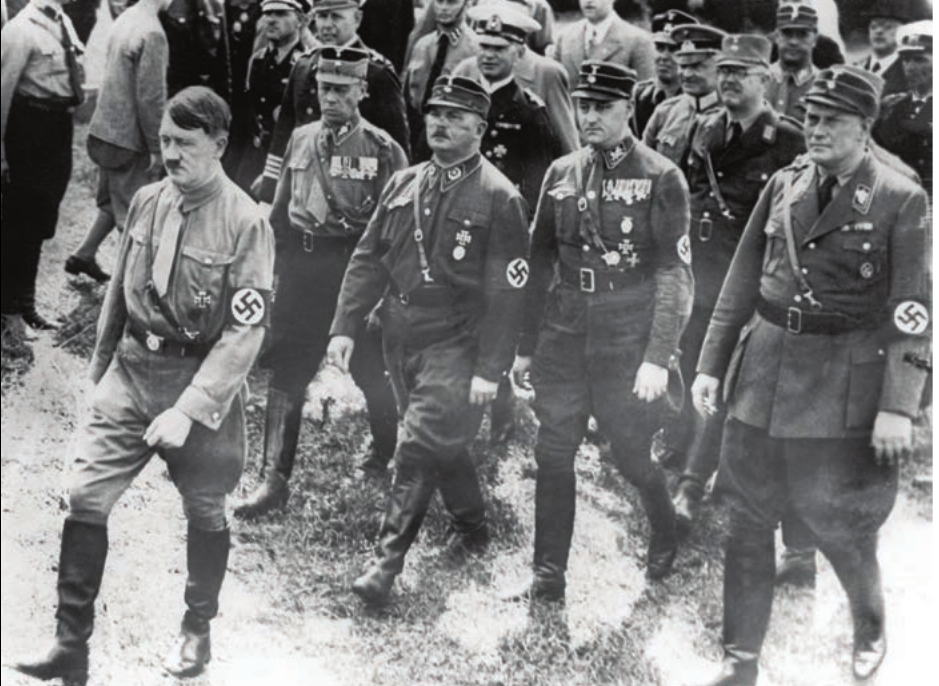
The SA as auxiliary police
All over Germany, SA members were sworn in as an auxiliary police force. In addition to their swastika armband on the left arm, they wore a white armband on the right to show they were now officially police. This legitimised SA terror and violence against perceived enemies of the state.
Banning of political parties
On 14 July 1933, the Nazis introduced a law banning all political parties other than the NSDAP. Germany officially became a one-party state.
Control of institutions and media
One by one, key institutions fell under National Socialist control:
- The press
- Radio broadcasting
- Schools and universities
- The Gestapo (Nazi secret police, established in November 1933)
Note
Key term: The Gestapo was the Nazi secret police, established in November 1933 and highly influential in spreading terror throughout Germany and maintaining Nazi power.
Concordat with the Vatican
In a significant political victory, the NSDAP signed a concordat (agreement) with the Vatican. This was extremely important because Catholics represented the largest potential source of opposition to the regime. In the concordat:
- The Nazis promised not to interfere with the Church or ban its organisations
- In return, the Catholic Church dropped its ban on Nazi Party membership
Note
By the end of 1933, the Nazis had systematically eliminated or neutralised virtually all potential opposition. Trade unions were destroyed, political parties banned, the media controlled, and even the Church had been brought into accommodation with the regime. Only the Army and President Hindenburg remained as potential obstacles to absolute Nazi power.
The SA problem
By the end of 1933, only two potential threats to Nazi power remained: the Army and President Hindenburg himself. For Hitler to fully consolidate power, he needed the support of both the Army and big business. Both groups despised the SA and their aggressive talk about social revolution.
Important
The Growing SA Crisis
The situation was increasingly problematic:
- The SA had over one million members
- The regular Army had only 100,000 members
- The SA wanted to become the primary military force in Germany
- The Army saw the SA as undisciplined thugs
- Business leaders feared SA radicalism
Hitler demonstrated his willingness to use ruthless violence when Hindenburg indicated he was considering placing the country under military rule and removing Hitler if the SA crisis was not quickly resolved.
The Night of the Long Knives
On 30 June 1934, Hitler organised the SS (Schutzstaffel, or Blackshirts) to murder SA leaders and other political opponents. This event became known as the Night of the Long Knives.
Note
Key term: The Schutzstaffel (SS) was a major paramilitary organisation operating in Nazi Germany. Unlike the SA, the SS were highly disciplined and loyal directly to Hitler.
Hitler recognised that whilst the SA had helped the NSDAP come to power, they had now become a liability. The era of disorder and chaos needed to end. The Night of the Long Knives saw the destruction of the brutal, disorderly SA and its replacement by Hitler's elite bodyguard organisation, the black-uniformed SS.
The purge
The killing operation had the code-name 'Hummingbird'. Targets included:
- Ernst Rohm, the head of the SA (arrested and later killed)
- Other SA leaders
- Conservative political rivals
- Von Papen's secretary and speech writer (both murdered)
- General von Schleicher (former Chancellor who had opposed Hitler's appointment) and his wife (both gunned down)
The official death toll was 74, but over 1,000 people were arrested. The actual number killed remains disputed by historians.
Hitler's justification and public reaction
Hitler explained to the Cabinet and Reichstag that his actions were necessary to prevent a treasonable plot. Public reactions were initially mixed. Many Germans struggled to understand the violence. However, over time, general approval emerged. The SA's violence had been unpopular, and their disorderly conduct had alarmed many ordinary Germans as well as the Army. Their destruction seemed to promise greater stability, which was what many Germans had voted for in the first place.
Death of Hindenburg and Hitler becomes Führer
On 2 August 1934, President Hindenburg died. This removed the final barrier to Hitler's absolute power.
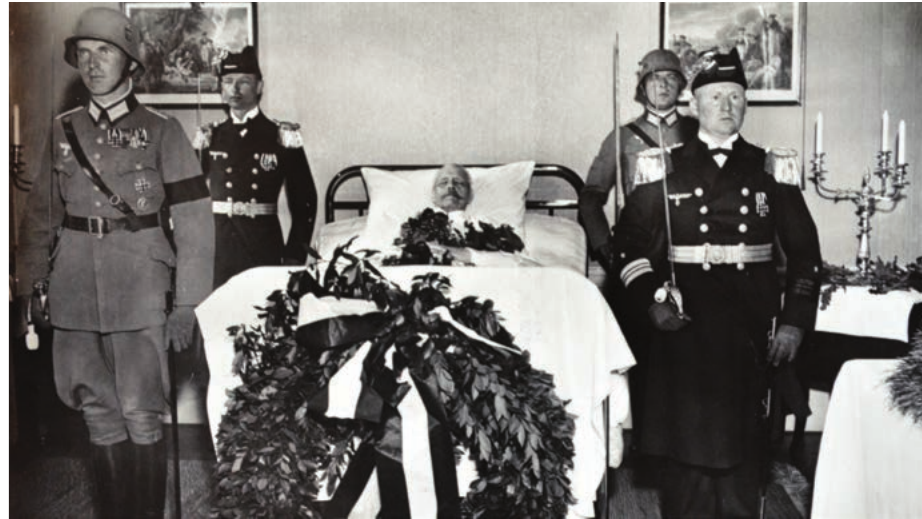
Following Hindenburg's death, Hitler took decisive action:
- He assumed the offices of both President and Chancellor
- The Army swore an oath of allegiance directly to Adolf Hitler personally (not to the Constitution)
- Hitler officially became der Führer (the Leader) of all Germany
Important
The oath sworn by the German Army was unprecedented and significant. By swearing loyalty to Hitler personally rather than to the Constitution or the state, the Army bound itself to the Nazi regime in a way that made opposition or resistance extraordinarily difficult. This personal oath would later create profound moral dilemmas for military officers who came to oppose Hitler's policies.
The totalitarian state achieved
By the summer of 1934, the Nazis had established the foundations of a totalitarian state. A totalitarian state is one that claims complete control over the individual. The NSDAP now had total control with no sources of organised opposition remaining:
- All political parties except the NSDAP were banned
- The trade unions were destroyed
- The press and radio were controlled
- The SA had been neutralised
- The Army had sworn loyalty to Hitler personally
- The Church had agreed to non-interference
- The Gestapo provided the mechanism for terror and control
The Nazis, a party with totalitarian aspirations, now had the power structure to implement their vision for Germany.
Summary
Key Points to Remember:
-
Hitler's appointment as Chancellor on 30 January 1933 began the Nazi consolidation of power, though only three Nazis were in the initial Cabinet
-
Gleichschaltung (coordination) was the systematic process of Nazifying all aspects of German society through both government action and grassroots Nazi enthusiasm
-
The Reichstag Fire (27-28 February 1933) provided the pretext for the Reichstag Fire Decree, which suspended civil rights and allowed mass arrests of Communists and Social Democrats
-
The Enabling Act (21 March 1933) gave Hitler dictatorial powers to pass laws without the Reichstag, effectively ending parliamentary democracy in Germany
-
Throughout 1933, the Nazis systematically eliminated all opposition: banning political parties, seizing control of unions, taking over media and education, and establishing the Gestapo
-
The Night of the Long Knives (30 June 1934) saw Hitler purge the SA leadership to secure Army and business support, marking the end of the 'revolutionary' phase
-
The death of Hindenburg on 2 August 1934 allowed Hitler to combine the offices of President and Chancellor, becoming der Führer with absolute power, whilst the Army swore personal loyalty to him
-
By summer 1934, Nazi Germany had become a totalitarian state with all sources of organised opposition eliminated