The Nature of Nazi Ideology (HSC SSCE Modern History): Revision Notes
📚Revision Notes
The Nature of Nazi Ideology
Core principles of Nazi ideology
At the heart of Nazi ideology were two fundamental beliefs: racism and anti-Semitism. These ideas shaped every aspect of Nazi policy and their vision for Germany's future.
Note
Anti-Semitism refers to discrimination, prejudice or hostility towards Jews. For the Nazis, this went far beyond simple prejudice - it became central to their entire worldview and political programme.
Social Darwinism was a nineteenth-century theory that applied Charles Darwin's ideas about evolution and natural selection from the natural world to human societies. Hitler embraced this brutal philosophy, viewing the world as a place of constant struggle between different races and peoples. He believed that races were locked in an endless war for survival, with only the strongest destined to triumph.
Important
This worldview led the Nazis to believe they must actively pursue racial strategies to ensure German victory in what they saw as an inevitable conflict. The struggle was partly about Lebensraum, or 'living space' - Hitler's term for Germany's supposed need to expand eastward to claim territory for the Reich's growing population.
The concept of the Aryan race
The Nazis claimed that a superior 'Aryan' race existed, and they aimed to recreate and strengthen this race within Germany. According to Nazi ideology, Germans were the finest surviving examples of this Aryan race.
The Nazis described their ideal Aryans as possessing specific characteristics:
- Physical appearance: blond hair and tall stature
- Moral qualities: honesty and goodness
- Creative abilities: representing all that was innovative and culturally productive
- Health and vitality
Important
This racist ideology required the Nazis to create an opposite stereotype - an enemy against which the Aryan ideal could be contrasted. For the Nazis, Jews represented this demonic opposite.
It is crucial to understand that these racial theories had no scientific basis whatsoever. They were dangerous pseudoscientific myths used to justify persecution and violence.
Nazi stereotypes of Jewish people
The Nazis portrayed Jewish people in deeply prejudiced and harmful ways:
- As parasites on other societies
- As incapable of creating their own culture
- As contaminating influences on other peoples
- As eternal enemies of everything the Aryan race supposedly stood for
These vicious stereotypes formed the foundation for the persecution and violence that would follow.
Volksgemeinschaft: The people's community
The Nazis promised to create a unified racial society in Germany, which they called Volksgemeinschaft - the 'people's community'. This concept was central to Nazi ideology and propaganda.
The Volksgemeinschaft was envisioned as a racial utopia where rough equality existed among those deemed racially acceptable. According to Nazi thinking, this community would be more than just a political union - it would be a mystical connection of people bound by race, blood, and soil. Every individual would know their place within the larger whole, and every aspect of life would serve the good of the community.
Note
The Three Stages of Volksgemeinschaft
The Nazis claimed this utopia would be achieved through three stages:
- Purification of the German people within the country
- Elimination of the Jewish minority
- Aggressive expansion abroad to secure Lebensraum
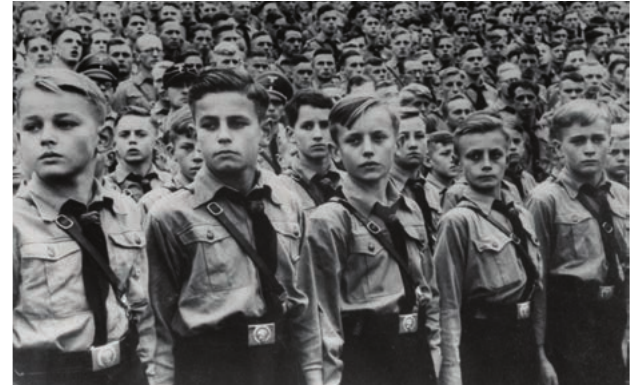
The Hitler Youth Movement exemplified how the Nazis sought to build the Volksgemeinschaft. This organisation, based on the idea that Germany's future depended on properly developing and training children, aimed to integrate young boys into the Nazi national community and prepare them to lead the Third Reich.
What the Nazis opposed
Nazi ideology was defined not only by what it promoted, but also by what it rejected. The Nazis positioned themselves in opposition to many aspects of modern society:
Democracy - The Nazis viewed democratic government as weak and overly individualistic. They believed it failed to provide the strong, unified leadership that Germany needed.
Marxism - Although the Nazis used the word 'socialist' in their party name, they opposed Marxist socialism. They claimed to represent a truer form of German socialism that wasn't based on materialism or class struggle.
Pacifism - The Nazis rejected peaceful approaches to international relations, believing conflict was natural and necessary.
Individualism - Individual rights and freedoms were considered self-serving and harmful to the unity of the Volk (people). The Nazis believed individuals should serve the community, not pursue personal interests.
Capitalism - The Nazis opposed what they saw as the selfish and exploitative nature of capitalist economics, though they maintained private property and business.
Rationality and intellectualism - The Nazis dismissed intellectual life and 'soulless rationality', preferring emotion, instinct, and action over careful thought and debate.
What the Nazis valued
In place of these rejected ideas, the Nazis promoted their own values:
A strong state - The Nazis believed the state should stand above individuals and exercise total control over society. Individual interests were subordinate to state interests.
Military mobilisation - The Nazis valued military organisation and preparedness, seeing these as expressions of national strength and discipline.
War - Rather than viewing war as a tragedy to be avoided, the Nazis saw it as healthy for the nation. They believed warfare tested and strengthened a people, weeding out weakness and proving racial superiority.
Important
These values reflected the Nazis' fundamental belief in struggle and conflict as the driving forces of history. Their ideology was built around the ability to dominate other peoples and societies, treating expansion and conquest as natural and desirable.
Summary
Key Points to Remember:
- Nazi ideology centred on racism and anti-Semitism, viewing the world through a social Darwinist lens of constant racial struggle
- The Nazis promoted the myth of a superior Aryan race and contrasted this with viciously stereotyped portrayals of Jewish people
- Volksgemeinschaft (the people's community) was the Nazi vision of a racially unified society achieved through purification and expansion
- The Nazis opposed democracy, Marxism, pacifism, individualism, capitalism, and intellectualism
- They valued a strong state, military mobilisation, and war as means of achieving racial dominance and securing Lebensraum