Peacemaking (HSC SSCE Modern History): Revision Notes
📚Revision Notes
Peacemaking
Introduction: making peace after World War I
The peace treaties that ended World War I represented a monumental effort to reshape international relations and prevent future conflicts. Understanding these treaties remains relevant today because the peacemakers of 1919 grappled with many of the same challenges we face in the twenty-first century: maintaining international peace and security, resolving disputes between nations, protecting minority rights, and strengthening international law.
The Paris Peace Conference of 1919 was the largest international gathering in history up to that time. It brought together 32 diplomatic delegations comprising over 500 diplomats, representing approximately 75 per cent of the world's population. This scale far exceeded previous international conferences such as the 1648 Treaty of Westphalia or the 1815 Congress of Vienna.
Note
Treaty of Westphalia: a peace agreement signed in 1648 that ended 30 years of warfare in Europe. It is widely regarded as marking the beginning of the modern era and establishing the concept of the nation-state as we understand it today.
Important
The peacemakers faced a significant challenge in balancing competing interests. Throughout World War I, the Allied governments had signed secret treaties outlining their war aims - essentially shopping lists of territories and concessions they hoped to gain. These secret agreements often contradicted the high-minded public declarations made to their own populations and the international community, such as US President Woodrow Wilson's Fourteen Points speech. The peacemakers had to reconcile these contradictory commitments whilst attempting to create conditions for lasting peace.
Propaganda: information, especially of a biased or misleading nature, used to promote a political cause or point of view.
The peace settlement has been debated continuously from before the treaties were signed right through to the present day. Even during the war, peace groups like Britain's Union of Democratic Control (UDC) argued that the final settlement should not be a peace of vengeance, as this would only lead to further wars. Instead, they advocated for a just settlement that addressed the root causes of conflict.
The peacemaking process
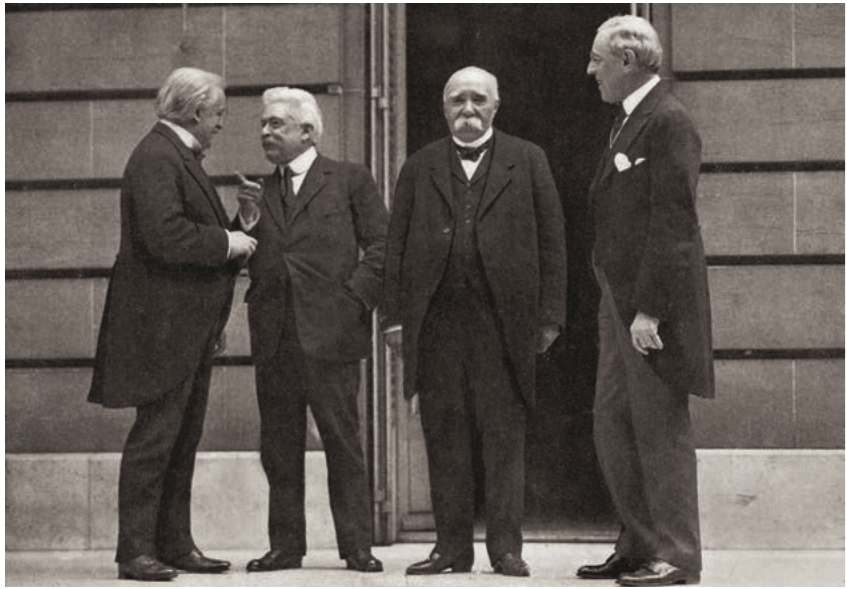
The Paris Peace Conference officially began in January 1919. Initially, a Council of Ten directed the negotiations, consisting of the leaders of the four major victorious powers (United States, Britain, France, and Italy) along with their foreign ministers and two Japanese representatives. This Council met 72 times between 18 January and late March 1919, establishing 58 specialised subcommittees to examine various issues in detail.
However, progress on the major questions proved frustratingly slow. The really significant decisions remained unresolved. Consequently, in late March 1919, the group was streamlined to just four individuals - the leaders of the United States, Britain, France, and Italy. This smaller group, which became known as the Big Four, worked at an intense pace for six weeks and accomplished a remarkable amount.
Note
The transition from the Council of Ten to the Big Four represented a crucial shift in the peacemaking process. When the larger council's deliberations became bogged down, the four leaders took direct control and accelerated decision-making dramatically.
Key events timeline
| Date | Event |
|---|---|
| 11 November 1918 | Armistice signed by German and Allied delegations |
| 13 December 1918 | US President Wilson receives hero's welcome in Paris |
| 3 February 1919 | League of Nations negotiations commence |
| 7 May 1919 | Germany presented with the Treaty of Versailles |
| 28 June 1919 | Treaty of Versailles signed by Germany |
| 10 September 1919 | Treaty of Saint-Germain signed by Austria |
| 27 November 1919 | Treaty of Neuilly-sur-Seine signed by Bulgaria |
| 5 June 1920 | Treaty of Trianon signed by Hungary |
| 10 August 1920 | Treaty of Sèvres signed by Turkey |
| 5 May 1921 | Reparations amount announced |
The Big Four
The four leaders who dominated the peacemaking process each brought different perspectives, priorities, and domestic pressures to the negotiations. Understanding their individual positions helps explain why the treaties took the form they did.
President Woodrow Wilson (United States)
Wilson arrived at the Paris Peace Conference with considerable moral authority amongst the Big Four. After years of devastating warfare, the American President appeared to offer a hopeful vision for the future, centred on his concept of a League of Nations. Wilson maintained a certain distance from the other Allied leaders by insisting that the United States was an "Associated Power" rather than one of the Allies, emphasising America's distinct position and idealistic war aims.
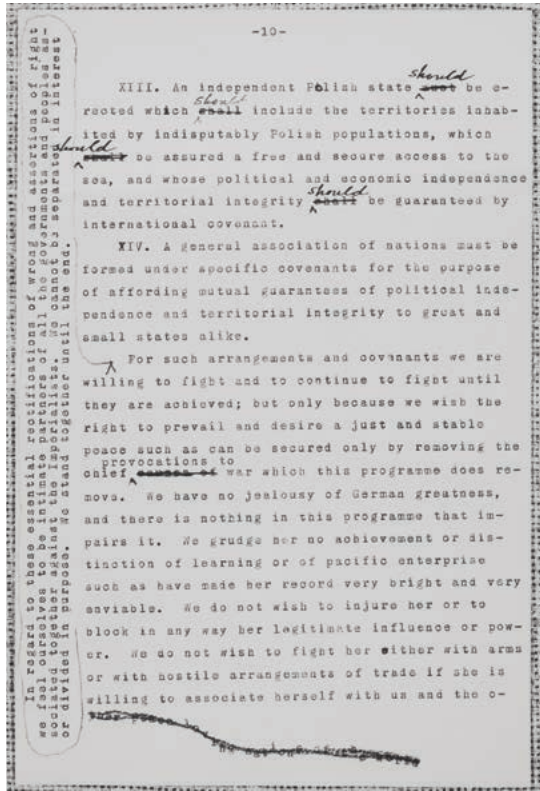
Wilson's primary objective was establishing an international organisation to prevent future conflicts. Since 1915, progressive groups in Europe and America had promoted the idea of a "general association of nations" as a mechanism for maintaining peace. During his 1916 presidential election campaign, Wilson committed his Democratic Party to creating such a league. His famous Fourteen Points speech to the US Congress on 8 January 1918 included the establishment of this international body as its fourteenth point.
Prime Minister David Lloyd George (Britain)
Lloyd George became British Prime Minister in December 1916 at the head of a right-wing coalition government. This coalition, known as the "Knock-Out Blow" government, was determined to fight the war to total victory and rejected any talk of a negotiated peace. This political background created pressure on Lloyd George during the peace negotiations.
Note
Whilst Lloyd George's personal instincts sometimes favoured moderation, he faced intense pressure from hard-right factions within his party not to show leniency towards Germany. This domestic political situation constrained his negotiating position and influenced Britain's stance on various issues, particularly regarding the treatment of Germany.
Prime Minister Georges Clemenceau (France)
The French Prime Minister had earned a reputation for being tough and uncompromising. His overriding concern was ensuring France's future security against potential German aggression. Clemenceau recognised that Germany possessed natural advantages over France in terms of population size, industrial capacity, and geopolitical position in Europe. Therefore, he sought to impose significant limitations on Germany's power to prevent it from posing a future threat to French security.
Prime Minister Vittorio Orlando (Italy)
Italy had remained neutral when World War I began, but the Allied powers persuaded Italy to enter the war in 1915 by promising territorial rewards detailed in a secret treaty. However, the war proved extremely costly for Italy. Italian forces suffered massive casualties whilst making only modest territorial gains. Orlando came to the Paris Peace Conference expecting to receive the territorial compensation he believed was due to Italy for its wartime sacrifices.
The League of Nations
Creating the League of Nations was one of President Wilson's main reasons for bringing the United States into World War I as a combatant on the Allied side in April 1917. The concept had gained widespread support amongst progressive groups as a means of preventing future wars.
When Wilson delivered his Fourteen Points speech in January 1918, he signalled his intention to pursue this revolutionary proposal. From that moment, the Fourteen Points became the de facto war aims of the Allied and Associated Powers, even though they had not been formally agreed upon by all the Allied governments.
Note
Upon arriving at the Paris peace talks, Wilson immediately pushed to make discussions about creating an international organisation the first item on the agenda. A special committee was established on 25 January 1919 to design the League. Working with remarkable speed, this committee held its first meeting on 3 February and produced a draft covenant just 11 days later.
Wilson insisted that the Covenant of the League of Nations be incorporated directly into the Treaty of Versailles. The Covenant appears as Part 1 of the Treaty, detailed across 26 articles. While many different plans and proposals for a League of Nations had circulated during the final years of World War I, the Covenant that emerged from the Paris negotiations reflected primarily Wilson's ideas, with some contributions from the British delegation.
Achieving the creation of the League of Nations represented a major victory for President Wilson at the beginning of the peacemaking process. However, the remainder of the negotiations would prove far more challenging and contentious.
The Treaty of Versailles (28 June 1919)
Important
On 7 May 1919, the German delegation was presented with the Treaty of Versailles and expected to sign it immediately. The treaty was presented as a fait accompli - a done deal that Germany had no power to modify or reject. The Germans refused to sign, and Philipp Scheidemann, the head of Germany's first democratically elected government, resigned in protest.
The Allied powers refused to negotiate or compromise on the treaty's terms. Meanwhile, the British and American naval blockade of Germany continued, preventing the importation of vital materials and food supplies. The Allies established a deadline for German acceptance and threatened to invade from the west if Germany continued to refuse.
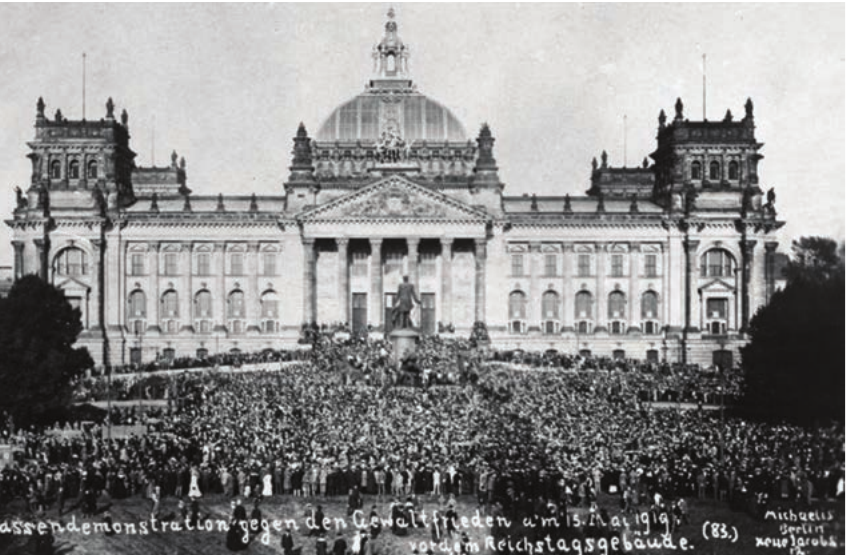
German President Friedrich Ebert consulted with his generals about whether the German Army could successfully defend against an Allied invasion. When informed that resistance would be futile, Ebert had General Groener convey this harsh reality to the German Government. The German National Assembly then voted 237 to 138 in favour of signing the treaty. Two German government ministers, Hermann Müller and Johannes Bell, travelled to Versailles and signed the Treaty on behalf of Germany on 28 June 1919.
Main terms of the Treaty of Versailles
The treaty imposed severe restrictions and obligations on Germany:
Territorial losses: Germany lost 13 per cent of its pre-war territory. These losses occurred in the east, north, and west, transferring land to neighbouring countries including Poland, France, Belgium, and Denmark.
The Rhineland: This strategically important region was demilitarised, meaning Germany could not station military forces there. An Allied occupation army would remain in the Rhineland for 15 years.
Prohibition on union with Austria: Germany was explicitly forbidden from joining with Austria, preventing the creation of a larger German-speaking nation.
Colonial territories: Germany lost all of its overseas colonies, which were distributed amongst the Allied powers.
Military restrictions: The German Army was limited to 100,000 volunteer soldiers. Conscription (compulsory military service) was forbidden. Germany was prohibited from owning tanks, submarines, or military aircraft. The German Navy was restricted to just six battleships.
Reparations: Germany was required to pay reparations to compensate the Allied nations for war damages. The specific amount would be determined later by a Reparations Commission.
Note
Exam tip: When discussing the Treaty of Versailles, be specific about the types of restrictions imposed. Examiners look for detailed knowledge of territorial, military, and financial terms rather than general statements about the treaty being "harsh."
Other peace treaties (1919-1920)
While the Treaty of Versailles receives most historical attention, it was actually part of a comprehensive package of peace settlements. The Allied powers negotiated separate treaties with each of the defeated Central Powers.
| Treaty | Date Signed | Country Concerned |
|---|---|---|
| Versailles | 28 June 1919 | Germany |
| Saint-Germain | 10 September 1919 | Austria |
| Neuilly-sur-Seine | 27 November 1919 | Bulgaria |
| Trianon | 4 June 1920 | Hungary |
| Sèvres | 10 August 1920 | Turkey |
Treaty of St Germain (10 September 1919)
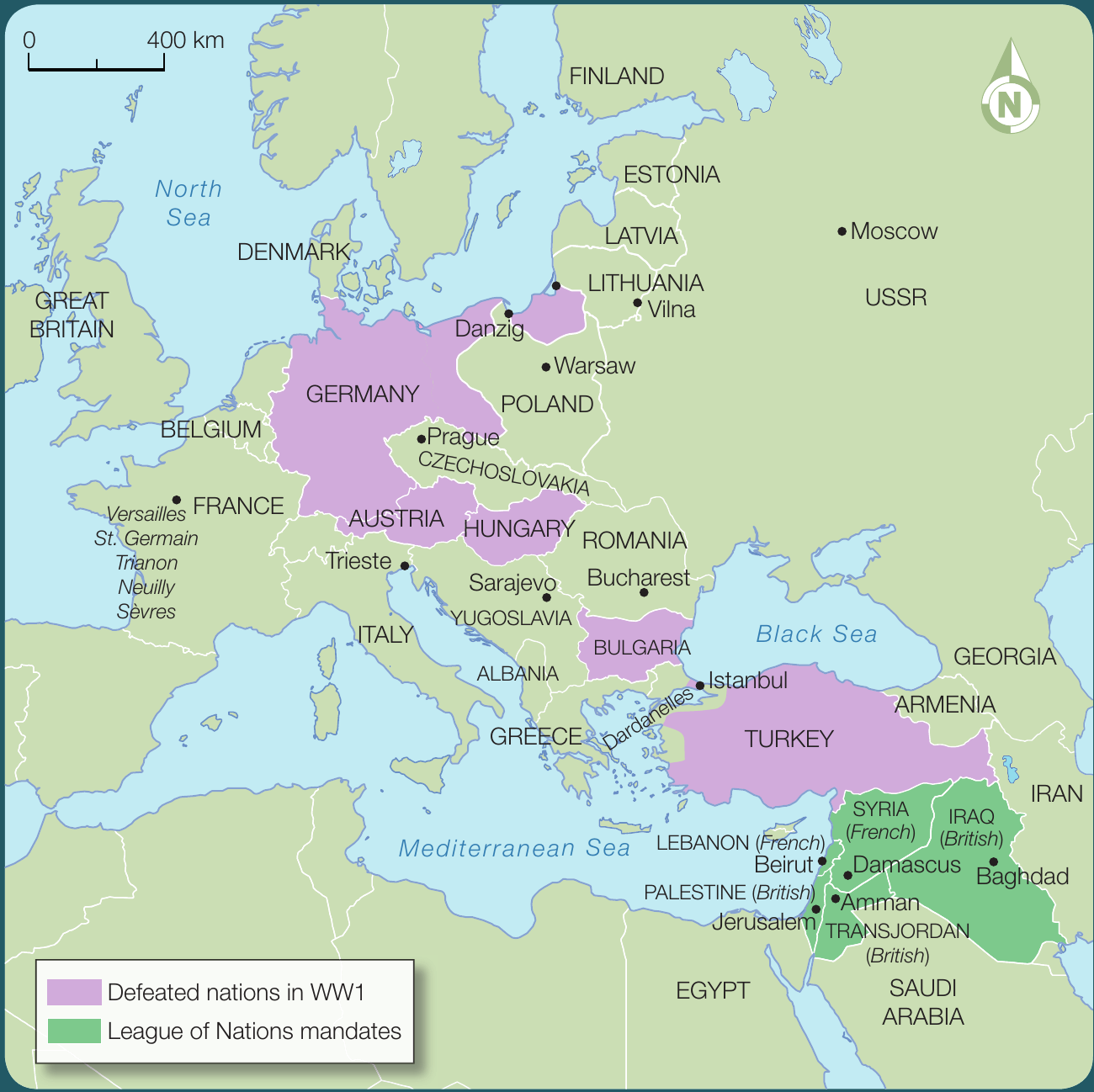
This treaty with Austria formally recognised that Austria and Hungary would exist as separate, independent nations following the dissolution of the Austro-Hungarian Empire. Austria was compelled to surrender territory to Czechoslovakia, Yugoslavia, Poland, and Italy. These territorial losses reduced Austria to a small nation with questionable economic viability. Despite this precarious situation, Austria was forbidden from uniting with Germany. The Austrian armed forces were drastically reduced in size, and Austria was required to pay reparations to the Allied nations.
Treaty of Sèvres (10 August 1920)
This treaty dealt with Turkey and the former Ottoman Empire. It confiscated most of Turkey's European-held territory. The Ottoman Empire was dismantled, with most former Ottoman lands in the Middle East going to Britain and France to be administered as mandates of the League of Nations. The Dardanelles Strait was placed under League of Nations control, and French, British, and Italian troops were authorised to occupy parts of Turkey itself.
Note
Mandate: an area of land given to a country by the League of Nations to govern, typically following a peace agreement. The governing country was theoretically preparing the territory for eventual self-government.
Treaty of Trianon (14 June 1920)
This agreement with Hungary confiscated portions of Hungarian territory, which were transferred to neighbouring Romania, Czechoslovakia, and Yugoslavia. Hungary was obligated to pay reparations to the Allied nations. The Hungarian army was limited to just 35,000 personnel.
Treaty of Neuilly (27 November 1920)
This treaty with Bulgaria resulted in the loss of Bulgarian territory to neighbouring Yugoslavia and Greece. The Bulgarian army was restricted to 20,000 personnel, and Bulgaria was required to pay reparations to the Allied nations.
Note
All five peace treaties followed a similar pattern: territorial losses to neighbouring countries, severe military restrictions, and reparations obligations. This comprehensive approach aimed to prevent any of the defeated Central Powers from posing a future military threat.
Reparations
Important
The question of reparations proved particularly sensitive and controversial. At Lloyd George's suggestion, the Big Four decided to delay announcing the exact amount Germany would be required to pay. When the Treaty of Versailles was presented on 7 May 1919, Article 231 informed the German delegation that they would pay reparations, but the specific sum was not disclosed.
Reparations: payments made by a defeated nation after a war to compensate for damages or expenses it caused to other nations.
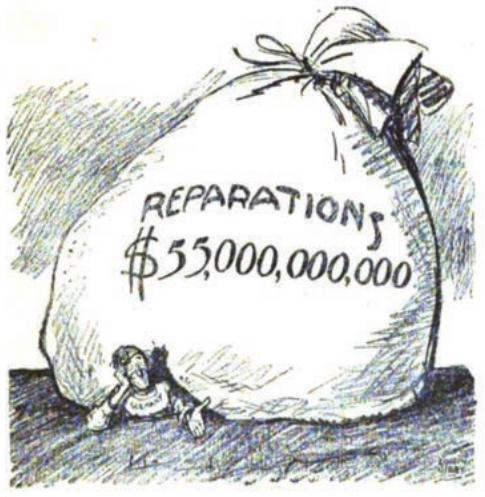
On 5 May 1921, the Reparations Commission finally announced its decision: Germany would pay 132 billion gold marks (approximately US$33 billion). This announcement triggered outrage across all sections of German society. Right-wing political groups experienced a resurgence in support, and the announcement led to the collapse of yet another German coalition government.
Hastily, a new coalition government formed and agreed to accept the reparations figure - another humiliation for Germany at the hands of the Allied governments. The first humiliation had been the Treaty of Versailles itself; reparations represented the second. Germany felt humiliated on both occasions because they had no meaningful say in these decisions. The implicit threat remained: sign or face invasion.
It was hardly surprising that the German Government proved reluctant to make the annual reparation payments. Germany made its first payment but requested a moratorium (temporary suspension) in late 1921 to ease domestic financial pressures. This pattern of reluctant compliance and requests for payment relief would continue to create international tensions throughout the 1920s.
Remember!
Summary
Key Points to Remember:
-
The Big Four leaders - Woodrow Wilson (US), David Lloyd George (Britain), Georges Clemenceau (France), and Vittorio Orlando (Italy) - made the key decisions at the Paris Peace Conference, each bringing different priorities and domestic pressures.
-
The League of Nations was President Wilson's primary objective. Created through intense negotiations in early 1919, its Covenant was incorporated into the Treaty of Versailles as Part 1.
-
The Treaty of Versailles (28 June 1919) imposed harsh terms on Germany, including loss of 13% of territory, severe military restrictions, and reparations. Germany was forced to sign under threat of invasion.
-
Four additional peace treaties were signed with Austria (St Germain), Bulgaria (Neuilly), Hungary (Trianon), and Turkey (Sèvres), each involving territorial losses, military restrictions, and reparations.
-
Reparations of 132 billion gold marks (US$33 billion) were announced in May 1921, causing widespread outrage in Germany, government collapse, and strengthening right-wing political movements. The reparations issue would continue to create international tensions throughout the 1920s.