Locating and Interrogating a Range of Sources (HSC SSCE Modern History): Revision Notes
📚Revision Notes
Locating and Interrogating a Range of Sources
Understanding historical sources
When conducting historical research, historians rely on sources to gather evidence and build their arguments. A source is any written or non-written material that can help us investigate the past. This includes documents, letters, photographs, political cartoons, newspaper articles, and much more. Historians examine these sources carefully to extract evidence that answers specific historical questions or supports particular interpretations of events.
The key to effective historical inquiry is not just finding sources, but knowing how to interrogate them properly. This means asking critical questions about each source to determine what it can tell us and how reliable that information is.
Note
The ability to interrogate sources critically is what distinguishes historical thinking from simply reading about the past. Historians don't just accept information at face value – they question, analyse, and cross-reference every piece of evidence.
The four key components of source analysis
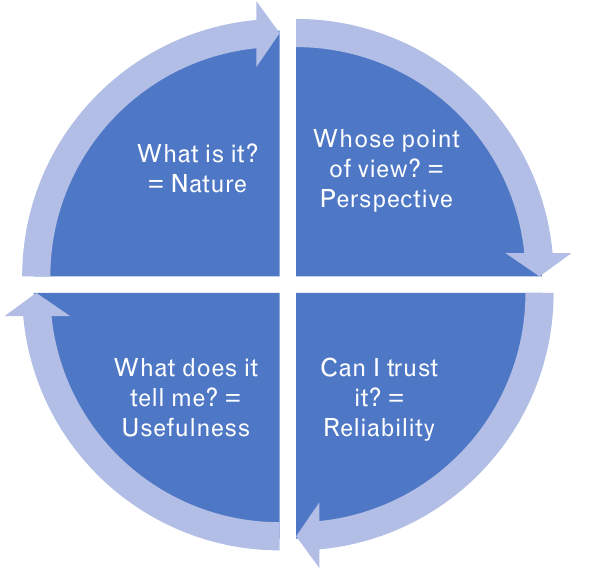
Historians use a systematic approach to analyse sources. There are four essential components you need to consider when examining any historical source: nature, perspective, reliability, and usefulness. These four elements work together as a framework for understanding what a source can tell us about the past.
Note
Think of these four components as a checklist that you should apply to every source you encounter. This systematic approach ensures you don't miss important aspects of source analysis and helps you develop consistent analytical skills.
Let's explore each of these components in detail.
Nature of the source
The first step in analysing any source is to identify its nature. This involves determining whether you're dealing with a primary source or a secondary source.
Primary sources are materials created at the time of the events being studied. These include artefacts, autobiographies, diaries, documents, manuscripts, recordings, and other sources of information produced by people who directly experienced or participated in the events. For example, a soldier's diary from World War I would be a primary source for studying that conflict.
Secondary sources are materials created later by someone who did not directly experience the events. These sources are typically written by historians or researchers who have studied primary sources and other evidence. A history book written in 2020 about World War I would be a secondary source.
You also need to consider the provenance of the source – where it comes from, who created it, and when it was produced. Understanding a source's origin helps you assess its value and reliability.
Note
Understanding the Primary/Secondary Distinction
The classification isn't always straightforward. A memoir written 50 years after an event is still considered primary because the author experienced the events firsthand, even though it was created long after. Context matters: a newspaper article from 1914 about World War I is primary, but a newspaper article from 2020 about World War I is secondary.
Perspective of the source
Every source presents information from a particular point of view. When analysing perspective, you're trying to understand whose viewpoint is being represented and what might influence that viewpoint.
To determine a source's perspective, ask yourself these key questions:
- Who wrote or created the source?
- What type of source is it? (letter, speech, newspaper article, photograph, etc.)
- Who was the intended audience?
- Could this be an example of propaganda?
- What is the nationality or background of the author?
The perspective matters because it influences what information is included, what is left out, and how events are portrayed. For instance, a British newspaper article about a battle will likely present events differently from a German newspaper article about the same battle.
Important
Understanding Perspective is Critical
No source is completely objective. Every creator of a source – whether writing a diary entry, painting a picture, or taking a photograph – makes choices about what to include and how to present it. These choices are influenced by their background, beliefs, audience, and purpose. Recognizing this is essential for accurate historical analysis.
Reliability of the source
Reliability is closely connected to perspective and is often the most challenging aspect of source analysis. When assessing reliability, you're determining whether the source can be trusted by a historian – in other words, how accurately does it represent historical reality?
To evaluate a source's reliability, consider these important questions:
- Can I trust this source? Why or why not?
- What is the historical context in which this source was created?
- Does the information in this source match up with other sources? (This is called corroboration)
- Who was the intended audience, and what was the author's motive for creating this source?
- Does the source contain emotive language that might indicate bias?
Important
Important Note About Reliability Judgements
Making a judgement about reliability is not always straightforward. When assessing sources, you should usually conclude with one of these three statements:
- The source is reliable because...
- The source is somewhat reliable because...
- The source is unreliable because...
Very rarely is a source completely unreliable. More commonly, a source might be 'somewhat reliable', meaning some elements can be trusted while others may be misleading or biased.
Example
Worked Example: Evaluating a WWI Propaganda Poster
Consider a World War I propaganda poster encouraging British men to enlist and fight against Germany.
Reliability Assessment: The reliability of this source may be compromised because of its visual representations and emotive language designed to persuade people. The poster was created with a specific purpose – to recruit soldiers – which means it likely exaggerates threats and glorifies military service.
However: It remains reliable as evidence of the types of propaganda techniques used in Britain during World War I and the government's recruitment methods. The poster accurately reflects government messaging strategies and public attitudes of the period.
Conclusion: The source is somewhat reliable – unreliable for factual information about the war itself, but highly reliable for understanding propaganda and recruitment practices.
Usefulness of the source
The usefulness of a source refers to the specific information it provides and how valuable this information is for answering your research question. When evaluating usefulness, ask yourself: what does this source tell me?
Think about how the source would be valuable to a historian studying a particular topic or period. Be explicit when arguing the usefulness of a source – clearly explain what specific information it provides and why that information matters.
Note
A source might be highly useful even if it's not completely reliable. For example, propaganda posters are useful for understanding government messaging and public attitudes, even though they present a biased view of events. Don't confuse reliability with usefulness – they are separate (though related) components of analysis.
Analysing visual sources and iconography
Visual sources such as photographs, paintings, cartoons, and posters are valuable forms of historical evidence. However, they can be particularly challenging to interpret. Iconography refers to the visual images and symbols used in a work of art, as well as the study and interpretation of these images.
Why visual sources can be difficult
Historical visual sources may be difficult to understand for several reasons:
- They may depict people or events you're unfamiliar with
- They may use symbols whose meanings are obscure or have changed over time
- They may employ humour, caricature, or satire that can be confusing
- Cultural context from the past may not be immediately obvious to modern viewers
Important
Visual sources require you to "read" images the same way you read text. Every element in a visual source – from clothing choices to facial expressions to background details – has been deliberately included by the creator and may carry meaning. Don't rush your analysis of visual sources; take time to examine every detail.
Framework for analysing visual evidence
The best approach to working with visual sources is to break down the key components systematically. Look at each element of the image and consider what it represents and why the creator included it.
When analysing a visual source, consider:
- Composition: How is the image arranged? What is in the foreground and background?
- Symbols and iconography: What objects, clothing, or symbols appear? What do they represent?
- Facial expressions and body language: What emotions or attitudes do the figures display?
- Text or captions: What words accompany the image? How do they influence its meaning?
- Context: When was this created? What historical events does it relate to?
Example analysis: Political cartoon from 1873
![Rare Cartoon - 1873 FRANCO-GERMANY WAR [Franco-Prussian] FRANCE WAR IMDEMNITY | eBay UK](https://i.ebayimg.com/images/g/cN0AAOSwo99gAJ-K/s-l400.jpg)
This political cartoon from Punch magazine (27 September 1873) shows two female figures representing Germany and France after the Franco-Prussian War. Let's break down the visual elements:
Example
Worked Example: Deconstructing Political Cartoon Iconography
Germany's representation:
- She wears military dress and carries a sword, showing her as the strong victor
- A bulging bag represents war reparations (200 million pounds) Germany extracted from France
- She faces away from France, indicating she's moving on victoriously
- However, she looks back over her shoulder with an aggressive expression, showing continued hostility
- A flag draped over her shoulder symbolises her physical strength and power as a nation
France's representation:
- Her defensive pose (crossed arms) and stripped military attire show her powerlessness after defeat
- She wears a crown rather than military headgear, appearing more like a princess than a military power
- Her facial expression shows anger and resentment, with a furrowed brow indicating determination for revenge
- Her lowered status in the international community is visually represented by her lack of military credibility
Caption analysis: The dialogue "Au Revoir!" (Goodbye!) from Germany and France's response "Ha! We shall meet again!" reinforces the theme of ongoing tension and France's desire for revenge, foreshadowing future conflict.
Historical usefulness: This cartoon is highly useful for historians studying Franco-German relations in the 1870s, as it reveals contemporary British perceptions of the power dynamic between the two nations and anticipates future tensions that would eventually contribute to World War I.
Developing your source analysis skills
Working with sources becomes easier with practice. Start by systematically applying the four-component framework (nature, perspective, reliability, usefulness) to every source you encounter. Over time, you'll develop the ability to quickly identify key features and assess what a source can tell you about the past.
When writing source analyses:
- Always identify the type of source (primary or secondary) and explain its significance
- Clearly state whose perspective is represented and why this matters
- Make explicit judgements about reliability with supporting evidence
- Explain specifically what information the source provides and why it's valuable
- Compare multiple sources when possible to identify corroboration or contradictions
- Consider both what the source says and what it doesn't say
Important
Exam Tip: Address All Parts of the Question
When answering exam questions about sources, make sure you address all parts of the question. If asked to consider both perspective and reliability of two sources, you must discuss both elements for both sources. Use specific evidence from the sources to support your analysis rather than making general statements. Examiners are looking for detailed, evidence-based analysis, not vague observations.
Summary
Key Points to Remember:
-
Sources are the foundation of historical inquiry: Historians use written and non-written materials to extract evidence and answer historical questions.
-
Apply the four-component framework systematically: Always consider nature, perspective, reliability, and usefulness when analysing any historical source.
-
Reliability exists on a spectrum: Most sources are 'somewhat reliable' rather than completely reliable or unreliable. Be nuanced in your judgements and explain your reasoning.
-
Visual sources require careful deconstruction: Break down iconography, symbols, composition, and context to understand what visual sources reveal about the past.
-
Practice makes perfect: Your source analysis skills will improve significantly with regular practice. Apply the framework consistently to develop your expertise as a historian.