The Legacy of the Cuban Revolution (HSC SSCE Modern History): Revision Notes
📚Revision Notes
The Legacy of the Cuban Revolution
Introduction
When Fidel Castro died on 26 November 2016, nearly 58 years after establishing Cuba's socialist state, the world's reaction revealed deeply divided opinions about his legacy. In Havana, thousands lined the streets in a government-organised procession, showing mixed emotions in a society recognised by Human Rights Watch as one of the world's most repressive. Meanwhile, Cuban refugees in the United States celebrated openly, dancing in the streets and chanting 'Cuba Libre!' (Free Cuba). These contrasting reactions highlighted a fundamental question: was Castro a romantic revolutionary who fought for social justice, or a power-driven tyrant who oppressed his people?
Note
The stark contrast in reactions to Castro's death - mourning in Havana versus celebrations in Miami - demonstrates how the same historical figure can be viewed through completely opposite lenses depending on personal experience and political perspective.
Understanding the divided perspectives
Castro's death exposed significant double standards in how people evaluate historical figures. Our judgement of political leaders often depends on whether their actions aligned with our own interests or values, and we may overlook injustices when they suit our purposes.
Important
Historical figures are rarely wholly good or evil. Understanding Castro's legacy requires examining both his achievements and his failures, whilst recognising that different groups experienced his rule very differently.
Critics from the left have long celebrated Castro's overthrow of the corrupt Batista regime and his resistance to American imperialism. However, they have sometimes overlooked the death squads and human rights violations. The focus on revolutionary romanticism has obscured Castro's failure to deliver his promised political reforms, causing significant harm to ordinary Cubans.
Similarly, Western conservatives who condemn Castro's oppressive regime cannot ignore their own governments' involvement in human rights abuses. When President Obama stated that 'America will always stand for human rights around the world' after Castro's death, British comedian Frankie Boyd pointed out the irony: 'You've got a torture camp in Cuba' (referring to Guantanamo Bay). This highlights how political positions can lead to selective moral judgements.
Note
The Double Standard Problem
Both political left and right demonstrate inconsistency when evaluating Castro:
- Left-wing critics celebrate the revolution whilst ignoring human rights violations
- Right-wing critics condemn Castro's abuses whilst overlooking their own governments' similar actions
- This selective judgement reveals how ideology shapes historical interpretation
Social media discussions reflect how Castro was simultaneously loved and hated by Cubans. This division makes sense when we understand that people's perspectives are shaped by their personal experiences of advantage or disadvantage under his government.
The romantic revolutionary view
Supporters of Castro emphasise several significant achievements during his leadership:
Healthcare achievements
Despite Cuba's crushing poverty, Castro created one of the world's most egalitarian healthcare systems. This means healthcare was distributed equally across society, regardless of wealth or social status. Cuban life expectancy and infant mortality rates matched those of the world's richest nations. Cuba achieved the highest number of doctors per capita (per person) in the world, demonstrating a genuine commitment to public health.
Note
Understanding Egalitarian Systems
An egalitarian system promotes equality and fairness by ensuring resources are distributed equally across society, rather than being concentrated among the wealthy or privileged classes. In Cuba's healthcare context, this meant world-class medical care was available to all citizens, from rural farmers to urban professionals.
Education improvements
Castro's government successfully reduced illiteracy rates and increased school retention. These educational reforms gave many Cubans opportunities they would not have had under previous governments, particularly those from poor rural backgrounds.
International solidarity
Castro established the 'Solidarity Aid' programme, demonstrating Cuba's commitment to helping other developing nations. For example, in 2006 Cuba sent 300 doctors to East Timor and received almost 1,000 young East Timorese students for medical training in Havana. This represented a significant investment of Cuban resources in supporting global health and education.
Military support in Africa
Castro's most celebrated international achievement occurred in Africa. Starting in 1975, after Angola gained independence from Portugal, more than 200,000 Cuban soldiers served in the country over more than a decade. They fought successfully alongside a Moscow-backed faction against forces supported by South Africa. This Cuban military involvement played a crucial role in the broader struggle against apartheid.
Nelson Mandela, South Africa's anti-apartheid leader, credited Castro's military support as instrumental in helping to end apartheid. The relationship between Castro and Mandela became symbolic of solidarity between revolutionary movements in Latin America and Africa.
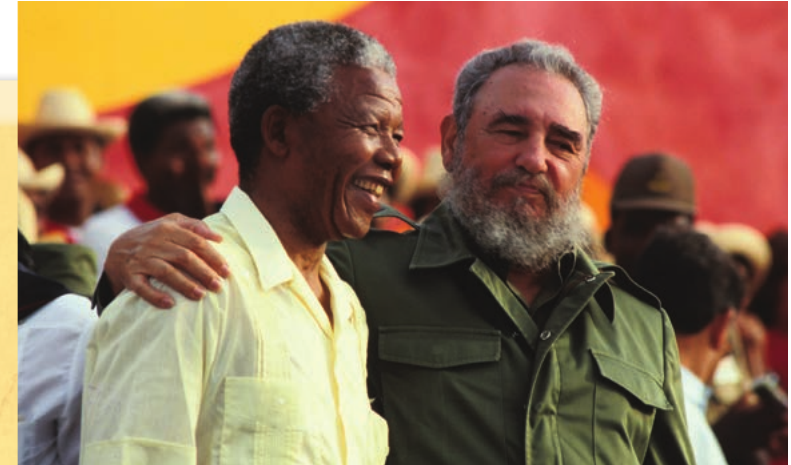
Castro also dispatched Cuban troops to fight Western-backed regimes throughout Latin America and sent doctors to treat poor populations worldwide. Supporters viewed these actions as genuine revolutionary internationalism, exporting the principles of the Cuban Revolution to support oppressed peoples globally.
The power-driven tyrant view
Critics emphasise Castro's oppressive actions and the severe problems created by his government:
Human rights violations
After seizing power, Castro conducted what critics describe as a 'bloody rampage'. His government executed hundreds of officials from the previous regime. Beyond these initial executions, Castro's government persecuted various groups including homosexual Cubans, historians, journalists and activists. The regime established a pattern of extrajudicial executions (killings without proper legal trial), show trials (trials where the verdict is predetermined), and systematic repression of dissent.
Important
Key Term: Show Trials
Show trials were court proceedings where the outcome was decided in advance, designed to publicly humiliate opponents and discourage opposition rather than deliver genuine justice. These became a hallmark of Castro's approach to political opponents, serving as propaganda tools rather than legitimate legal processes.
The Cuban Missile Crisis
Castro's decision to allow Soviet nuclear missiles in Cuba in 1962 provoked the terrifying Cuban Missile Crisis, bringing the world to the brink of nuclear war. Critics argue this demonstrated Castro's recklessness and willingness to gamble with millions of lives to maintain his power and challenge the United States.
Note
Brinkmanship and the Missile Crisis
Brinkmanship is 'the art or practice of pursuing a dangerous policy to the limits of safety before stopping, especially in politics'. Castro's decision to host Soviet missiles epitomised this approach, taking the world dangerously close to nuclear catastrophe for political and strategic gain.
Mass emigration
More than one million Cubans fled the country during Castro's first 15 years in power. Many risked their lives crossing the Straits of Florida in makeshift rafts, choosing dangerous escape attempts over life under Castro's government. The New York Times described Castro as 'the master of image and myth', suggesting his reputation exceeded reality. This mass exodus demonstrated widespread dissatisfaction with conditions in Cuba.
Economic failures
Cuba's economy deteriorated dramatically under Castro's leadership. When he took power in 1959, Cuba had one of Latin America's strongest economies. By the 21st century, the average monthly income for government employees was just $20. Collectivisation (the government takeover of agricultural land and production) ruined Cuban agriculture. Food rations became sparse, and ordinary Cubans struggled to access basic necessities.
Note
Exam Tip: Evaluating Economic Legacy
When evaluating Castro's economic legacy, consider both the impact of Cuban government policies and the effects of the United States trade embargo, which significantly restricted Cuba's economic development. A balanced analysis must acknowledge both internal policy failures and external economic pressures.
Meanwhile, Castro reportedly owned 20 homes and a private island, accumulating personal wealth whilst his people suffered. By 2006, his net worth from controlling state-owned companies was estimated at $900 million, demonstrating the corruption typical of dictatorships.
Important
The Stark Contradiction
Consider this paradox: Cuba produced world-class doctors and exported medical care globally, yet the average Cuban government worker earned only $20 per month. Castro accumulated $900 million whilst his citizens survived on food rations. This contradiction lies at the heart of the debate about his legacy.
Restrictions on civil liberties
Castro appointed himself President-for-life, eliminating democratic accountability. His government abolished Christmas as an official holiday and banned freedom of speech and the free press. People in Havana became prisoners in their own city, lacking many basic needs such as plumbing and sanitation. The contrast was particularly stark: whilst Cuba sent doctors and medicines to help other Latin American countries, ordinary Cubans in central Havana lacked the same basic services and protections.
Historical complexity and judgement
The debate about Castro's legacy reveals important lessons about how we interpret history. Both political perspectives demonstrate inconsistencies in their moral judgements:
- Leftist supporters sometimes romanticise the revolution whilst ignoring genuine suffering caused by political repression
- Conservative critics condemn Castro's human rights abuses whilst ignoring similar violations by governments they support
- People's assessments often depend on their personal circumstances under Castro's rule
Important
Exam Tip: Writing About Controversial Historical Figures
When writing about controversial historical figures, always present multiple perspectives and acknowledge the complexity of historical judgement. Avoid oversimplified conclusions that make them entirely heroic or entirely villainous. Strong historical analysis recognises that:
- Context matters significantly
- Different groups experienced the same events differently
- Personal and political biases shape historical interpretation
- Evidence can support multiple valid interpretations
The mixed reactions to Castro's death reflect a fundamental truth: people's historical perspectives are shaped by personal advantage or disadvantage. Cubans who benefited from free healthcare and education remembered him differently from those who lost family members to executions or fled the country seeking freedom and opportunity.
Understanding Castro's legacy requires acknowledging both his genuine achievements in healthcare and education, and his severe violations of human rights and political freedoms. Neither perspective alone captures the full historical reality of his nearly six-decade rule.
Summary
Key Points to Remember
Castro's death in 2016 revealed sharply divided opinions, with celebrations among Cuban refugees contrasting with government-organised mourning in Havana.
Supporters emphasise achievements including:
- An egalitarian healthcare system with world-leading doctor-to-population ratios
- Reduced illiteracy and increased educational opportunities
- International solidarity programmes providing medical aid to developing nations
- Military support for African liberation movements, particularly against apartheid
Critics highlight failures including:
- Human rights violations including executions, show trials, and persecution of dissidents
- Severe restrictions on civil liberties including freedom of speech, press, and movement
- Economic collapse leaving average incomes at $20 monthly whilst Castro accumulated $900 million
- Mass emigration of over one million Cubans fleeing the regime
Historical interpretation requires recognising:
- Castro's relationship with Nelson Mandela symbolised his role in the anti-apartheid struggle
- The contrast between aid sent abroad and poor conditions within Cuba itself
- Both genuine complexities in his legacy and the tendency for political viewpoints to create double standards
- Personal experience under the regime heavily influences individual perspectives on Castro's legacy