The Decline and Fall of the Romanov Dynasty (HSC SSCE Modern History): Revision Notes
📚Revision Notes
The Transfer of Power and the Execution of the Romanovs
Introduction
The period from February 1917 to July 1918 witnessed dramatic political changes in Russia. The centuries-old Romanov Dynasty collapsed, replaced first by a democratic Provisional Government and then by Bolshevik rule. This turbulent period ended with the execution of the entire Romanov family, marking the permanent end of tsarism in Russia.
Note
This eighteen-month period represents one of the most rapid and dramatic political transformations in modern history, fundamentally reshaping Russia and influencing global politics for the remainder of the 20th century.
The February 1917 Revolution
Background: Rasputin's murder
By late 1916, Rasputin's influence over the royal family had become deeply troubling to Russian aristocrats. On 16 December 1916, Prince Felix Yusupov lured Rasputin to his palace with false promises. Despite being fed poisoned wine and cakes containing enough cyanide to kill several men, Rasputin survived. Yusupov then shot him multiple times before disposing of his body in the River Neva.
Important
Rasputin's Death Changed Nothing
However, Rasputin's death did little to improve Russia's political or economic situation, as the problems were already deeply embedded in the system. His murder was symbolic of aristocratic desperation but could not reverse the underlying crisis facing the regime.
Understanding the Russian calendar
Note
Converting Russian Dates
Russia used the Julian calendar (Old Style) until 24 January 1918, when it adopted the Gregorian calendar (New Style). To convert Old Style dates to New Style dates, add 13 days.
For example, the February Revolution began on 23 February 1917 Old Style, which was 8 March 1917 New Style. This explains why some sources refer to different dates for the same events.
The outbreak of revolution
Economic hardship sparked social revolution in Russia through a series of protests beginning in February 1917.
The crisis began on 18 February 1917 when factory managers at the Putilov Steel Works, Petrograd's largest factory, locked out 20,000 workers following a pay dispute. In solidarity, the remaining workers went on strike, and political activism spread throughout the factory.
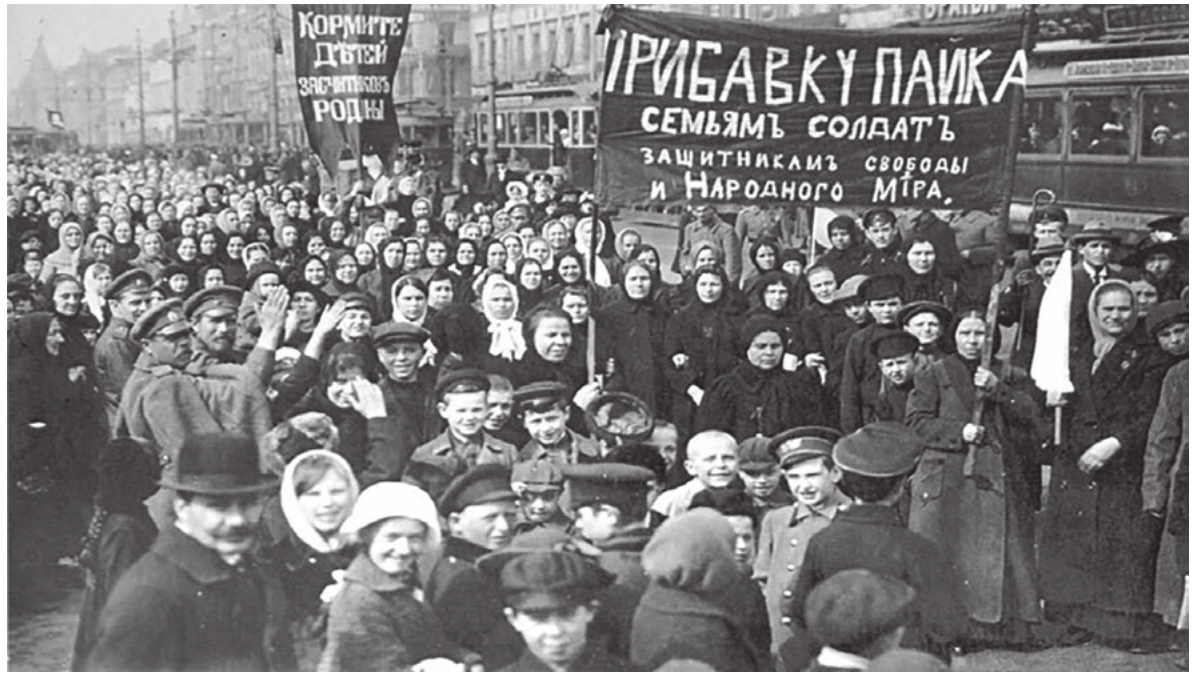
On 23 February, International Women's Day, thousands of female textile workers in Petrograd shut down their factories and called for others to join them in the streets. Bread shortages had become critical, and this became the main focus of the strike. The crowds grew to 90,000 people as demonstrators moved toward the city centre, breaking shop windows and overturning trams.
By 25 February, Petrograd had virtually shut down. The protesters' demands expanded from 'Bread' to include 'Down with the War' and 'Down with the Autocracy'. White-collar workers, teachers and other groups joined the movement.
Nicholas II believed the people still fundamentally loved him and ordered the head of the Petrograd garrison to restore order. On the first day, soldiers followed orders and fired on the crowds. However, on 27 February, facing armed workers ready to fight, the situation changed dramatically.
Note
The Critical Turning Point
According to historian Eric Hobsbawm, the regime's fragility was revealed when even the traditionally loyal Cossacks hesitated, then refused to attack the crowds, and began to fraternise with demonstrators. This moment when soldiers refused to fire on protesters marked the point of no return for the tsarist regime.
Civil authority collapsed completely, and the streets became scenes of revolutionary defiance. One conservative Duma leader, Shulgin, described these days as a nightmare with no clear beginning, middle or ending - everything jumbled together.
Nicholas II's abdication
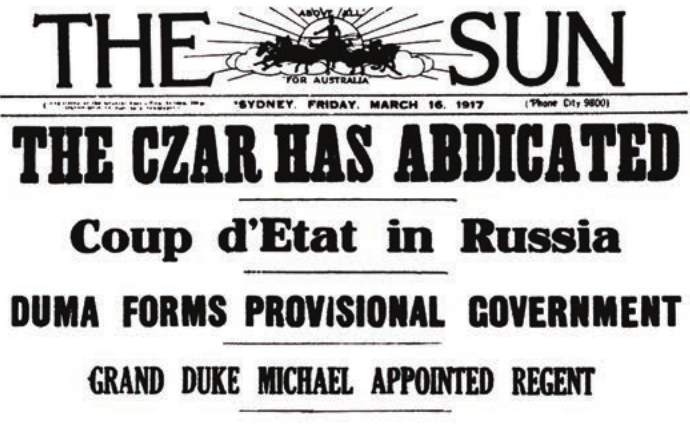
In the chaos, the government collapsed. Nicholas continued trying to use the old mechanisms of tsarist power, but his telegrams went undelivered. Leading citizens, Duma officials and even senior generals called upon Nicholas to abdicate. They argued that the only way to restore unity and continue fighting the war was for Nicholas to resign.
Mikhail Rodzianko, President of the Duma, sent an urgent letter to the Tsar on 11 March 1917 describing the dire situation. He reported that the capital was in anarchy, the government paralysed, transport broken down, and food and fuel supplies completely disorganised. Discontent was widespread and growing, with troops firing at each other in the streets. Rodzianko emphasised the urgent need for someone enjoying the country's confidence to form a new government, warning that hesitation was fatal.
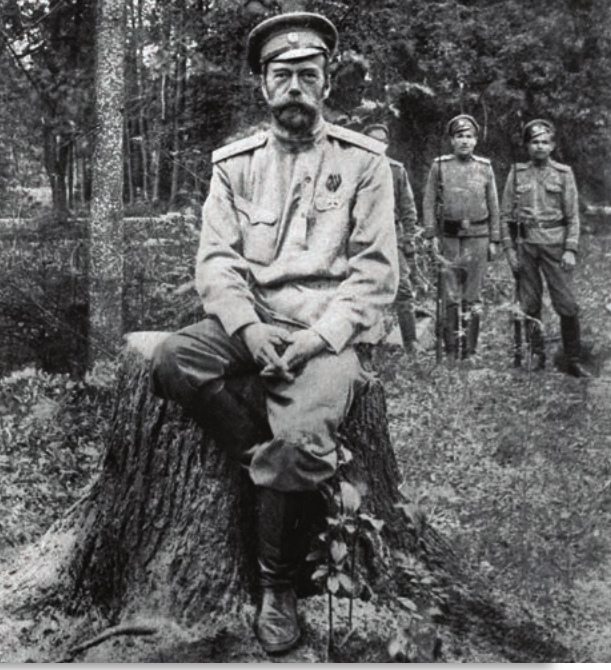
On 2 March 1917, Nicholas finally accepted the inevitable and abdicated. He wrote a manifesto expressing hope that this decision would end the disorder and bring unity to Russia. In his mind, this was the Tsar's last act of service to his people and nation.
Important
The Power Vacuum Crisis
However, the manifesto was never released to the public. The form of Nicholas's abdication symbolised the confused political situation created by the February Revolution. Formally, Nicholas passed power not to the Duma (which he had dissolved) but to his brother, Grand Duke Michael, who refused the throne.
Therefore, power had not been transferred to any new authority but had simply been abandoned. The question throughout 1917 became: who would and could seize this abandoned authority?
Historical debate: Nicholas II's responsibility
Historians continue to debate the extent of Nicholas II's responsibility for the dynasty's collapse. Three main perspectives have emerged:
Perspective 1 argues that Nicholas was fundamentally weak and unsuited to rule. Historian Orlando Figes suggests Nicholas created a vacuum of power at the centre of government - he was determined to rule from the throne yet incapable of exercising power, creating 'autocracy without an autocrat'. The work of government had become too vast and complex for one person, making autocracy itself outdated.
Perspective 2 focuses on Nicholas's wartime mistakes. Historian JN Westwood notes that after two years of war with no apparent results, Russians questioned whether the country was being properly led. Many believed there were officials who wanted Germany to win or were in German pay. Most Russians didn't condemn the war itself, only how it was being prosecuted.
Perspective 3 takes a more sympathetic view. Dominic Lieven argues that Nicholas was not stupid but tended to understand many viewpoints and wavered between them. The dangers Russia faced were enormous. Nicholas loved his country and served it loyally to the best of his ability, but he was a kind, sensitive, generous and initially naive man. These traumatic years required something very different and would probably have destroyed any man on the throne.
The Provisional Government (March-October 1917)
Formation and dual power
Nicholas II's government was replaced by an unusual system of hesitant and divided authority. Middle-class and upper-class liberals formed the Provisional Government, controlling the machinery of state, but their real authority was limited. Some limitations came from their own political doubts about the legitimacy of their position. External limitations came from competing power held by Soviets (councils) of Workers' and Soldiers' Deputies.
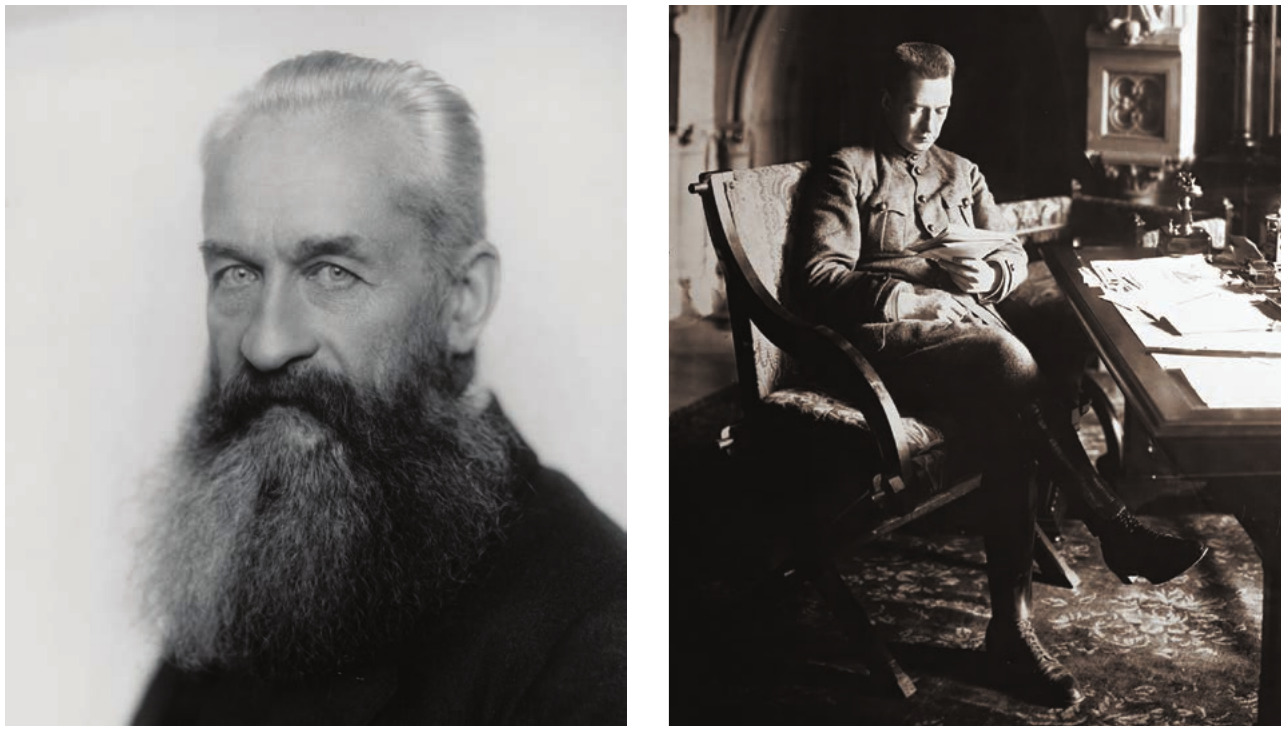
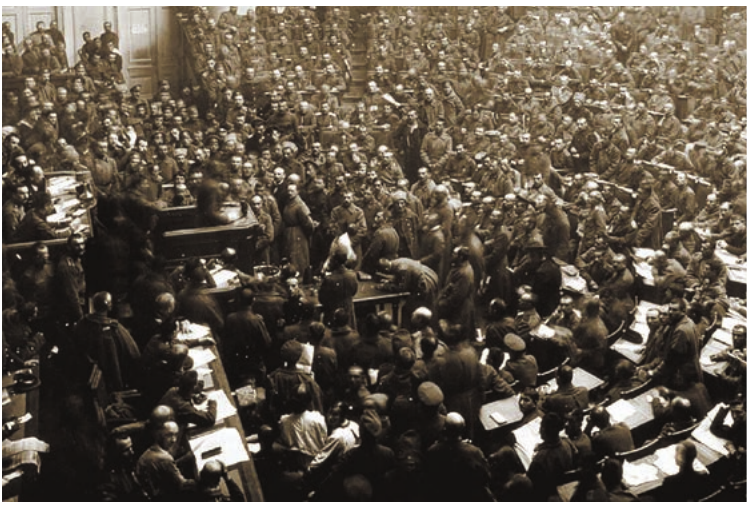
These Soviets sprang up in almost every city, as they had in 1905. They were elected by workers in factories and soldiers in barracks, especially in Petrograd with its large garrison. The Petrograd Soviet emerged as a national body competing with the Provisional Government.
One day after its formation, it published Soviet Order No. 1, which severely limited the Provisional Government's power by stating that no military orders should be obeyed unless also approved by the Soviet.
Note
Understanding Dual Power
This situation was called dual power - two competing structures of authority coexisting in the capital.
As Alexander Kerensky himself explained:
- The Provisional Government had authority without power - it controlled the state apparatus
- The Soviet had power without authority - it had real civic authority because it was considered the people's representatives (workers, peasants, soldiers) and could control their actions in streets, factories and at the front
This was a fundamentally unstable arrangement that could not last indefinitely.
Achievements of the Provisional Government
Despite its weaknesses, the Provisional Government was deeply committed to democracy and achieved impressive reforms:
- Civil liberties: Declared complete freedom of speech, press, assembly, association and the right to strike. Everything partly declared in 1905 but always limited was now absolute.
- Political prisoners: Released thousands of political prisoners and exiles from detention.
- Police reforms: Abolished the old police system and, most importantly, the Tsar's secret political police (the Okhrana).
- Humane reforms: Abolished flogging (which was still legal in Russia), exile to Siberia and the death penalty.
- Equality: Removed legal restrictions on individual rights based on nationality or religion.
- Social reforms: Enacted measures such as an eight-hour working day in industry. Promised quick land reform and began preparing for a democratic constitutional political system. Declared that women would have voting rights in subsequent elections.
Reasons for failure
Despite these achievements, the Provisional Government collapsed after less than eight months in power. Four main reasons explain this failure:
Reason 1: Refusal to withdraw from the war
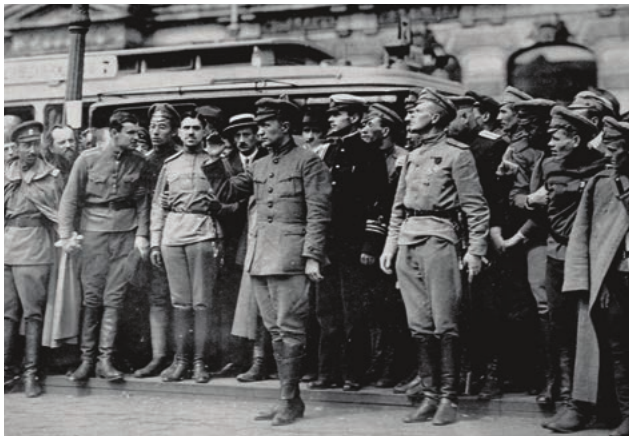
The government refused to withdraw troops from World War I because this meant abandoning its democratic allies. The liberals saw themselves as bringing Russia into mainstream European democratic civilisation. They believed this was a democratic war of democratic countries (Russia had now become democratic) against authoritarian states like Germany and Austria.
Important
The Fatal Decision
However, this decision proved deeply unpopular with war-weary Russians who had suffered enormous casualties. The continuation of the war undermined all other reforms and drained the government's credibility with soldiers and ordinary citizens.
Reason 2: Refusal to sanction peasant land seizures
Peasants weren't waiting for official approval - they were already seizing land they believed was rightfully theirs. The government accepted the principle of land reform and believed land should be radically redistributed. However, they insisted on the rule of law and legality.
They demanded peasants wait until complex legal procedures were completed and a Constituent Assembly established. This was a moral principle for the Provisional Government - they believed it necessary to balance the interests of all classes, peasants and landlords. This legalistic approach frustrated peasants who wanted immediate change.
Reason 3: Inability to improve the economic situation
The government failed to stop economic decline. As a liberal government, it was hesitant to use state compulsion to control prices or ensure production. This reflected their intellectual beliefs about the proper relationship between government and economy. Therefore, they felt they had to work with employers to find solutions, which proved ineffective.
Reason 4: The Bolshevik challenge
Bolshevik involvement in the February Revolution had been limited, with most Bolshevik leaders exiled to Europe or Siberia. However, the Provisional Government's decision to release all political prisoners allowed leaders to return publicly to Russia. The Bolsheviks succeeded due to their organisation, popularity and ability to capitalise on the Provisional Government's flaws and weaknesses.
Example
Comparing Leadership: Kerensky vs Lenin
The table above summarises the key differences between Kerensky's mistakes and Lenin's victories during this crucial period:
Kerensky's Failures:
- Decision to continue the war
- Military failure of the June Offensive
- Inability to solve economic problems
- Symbolic missteps (like moving into the Tsar's bedroom)
Lenin's Successes:
- Delivered powerful speeches
- Published the influential April Theses demanding 'Peace! Bread! Land!' and 'All Power to the Soviets'
- Recruited Leon Trotsky to the Bolsheviks
- Successfully persuaded Bolshevik leaders to participate in the October Revolution takeover of Petrograd
This contrast in leadership effectiveness directly contributed to the Provisional Government's downfall.
The October Revolution 1917
Lenin's return and leadership
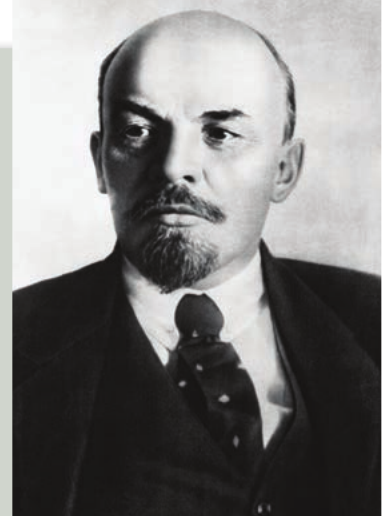
Vladimir Lenin (real name Vladimir Ilich Ulyanov, 1870-1924) was a revolutionary, political writer and leader of the Bolshevik Party. Born into a middle-class family in Simbirsk, Lenin became involved in revolutionary activities following his older brother's execution for attempting to assassinate Alexander III.
In 1895, he helped establish the St Petersburg Union of Struggle for the Liberation of the Working Class. Lenin mainly lived abroad in Munich, London, Geneva and Paris. At a 1903 meeting of the Russian Social-Democratic Workers' Party, when the party split over questions of organisation and strategy, Lenin led the Bolshevik faction.
In October 1917, Lenin returned to Petrograd from his hiding place in Finland. The Bolshevik leaders agreed to stage an armed uprising against the Provisional Government. Leon Trotsky, the Bolshevik Chairman of the Petrograd Soviet, drew up plans to seize power. The leadership of both Lenin and Trotsky proved decisive in the revolution's success.
Note
Crucially, the army said it would support the Bolsheviks in an armed takeover against the Provisional Government. Without military support or neutrality, the Bolshevik revolution would have been impossible.
The seizure of power
By the night of 24 October, the Red Guards (soldiers under the Bolsheviks) were well armed and ready for action. During the night, they began taking control of the most important locations in Petrograd.
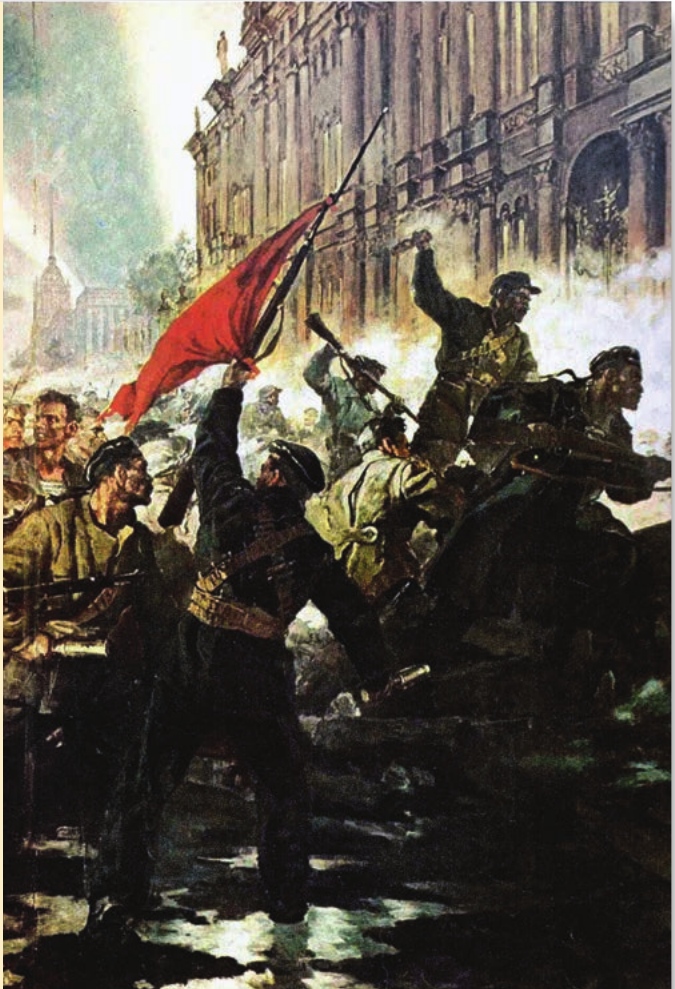
The Provisional Government had its headquarters in the Winter Palace, guarded only by army cadets and the Women's Battalion. On the evening of 25 October, a cruiser ship called the Aurora, which Bolshevik sailors had captured, sailed up the River Neva and fired blank shells at the Winter Palace.
Example
The Fall of the Winter Palace
The storming of the Winter Palace demonstrated the weakness of the Provisional Government's position:
Step 1: The Aurora fired blank shells to signal the attack
Step 2: Red Guards advanced on the poorly defended palace
Step 3: Defenders surrendered without significant fighting
Step 4: The Bolsheviks overthrew Kerensky's last cabinet of ministers
Result: At the Second All-Russian Congress of Soviets, the Bolsheviks declared the founding of a new government - the world's first socialist state.
This was a defining moment in modern history.
The Execution of the Romanovs
Imprisonment after abdication
Following the February Revolution of 1917 and Nicholas's abdication, the royal family was imprisoned in different locations across Russia. After the October Revolution, within the context of a bitter civil war, there was indecision among high-ranking Bolsheviks about what to do with the Tsar and his family.
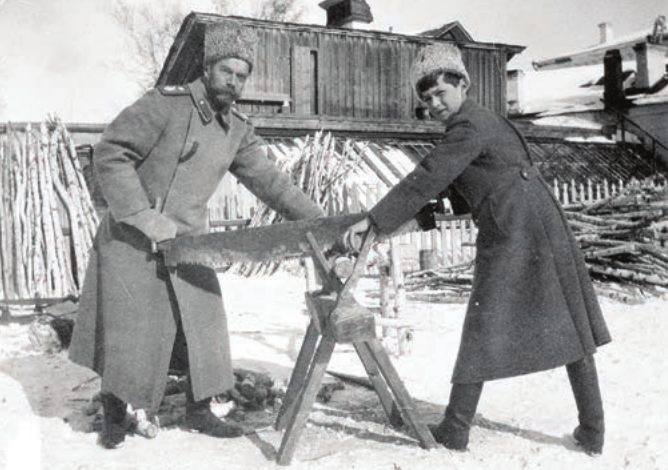
Trotsky wanted to hold a large show trial to humiliate the former Tsar, while other leading Bolsheviks wanted to eliminate Nicholas permanently. There is debate over whether Lenin gave the order to execute the ex-Tsar. However, according to historian Orlando Figes, consultations with Lenin took place and the idea was accepted in principle without a firm date being set.
Important
The Fear of Rescue
Some of Lenin's advisers feared the Romanovs might be rescued by advancing monarchist forces and used as a rallying symbol against communism. This fear of the royal family becoming a focal point for anti-Bolshevik forces ultimately sealed their fate.
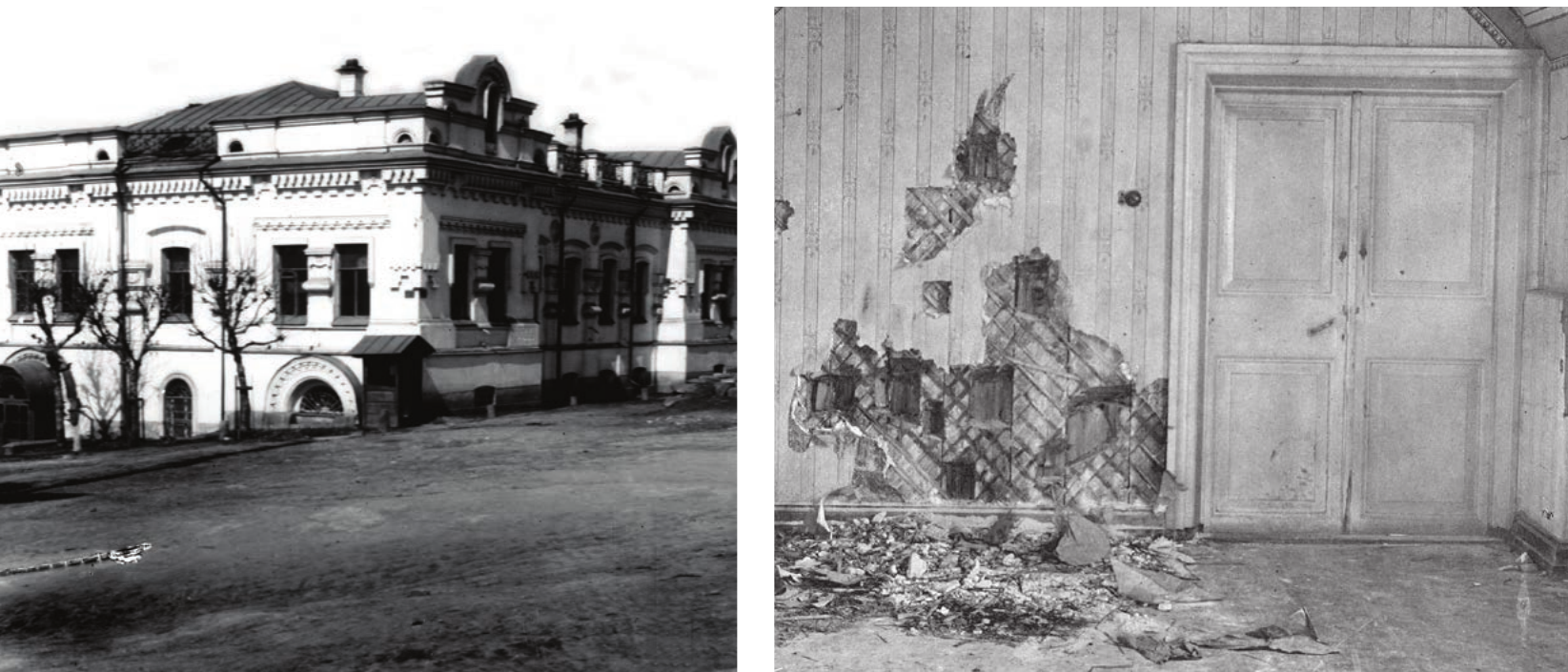
On the way to Moscow by train for Trotsky's planned show trial, the Romanovs were intercepted by a local Bolshevik group and imprisoned in Ipatiev House in Ekaterinburg, near the Ural Mountains.
The execution
On 4 July 1918, the Tsar and his family were woken at 10:30 pm, instructed to dress and taken down to the narrow basement of the house. There they were met by a detachment of armed Bolsheviks led by Yakov Yurovsky, the head of the local Cheka (the state security organisation under Bolshevik rule).
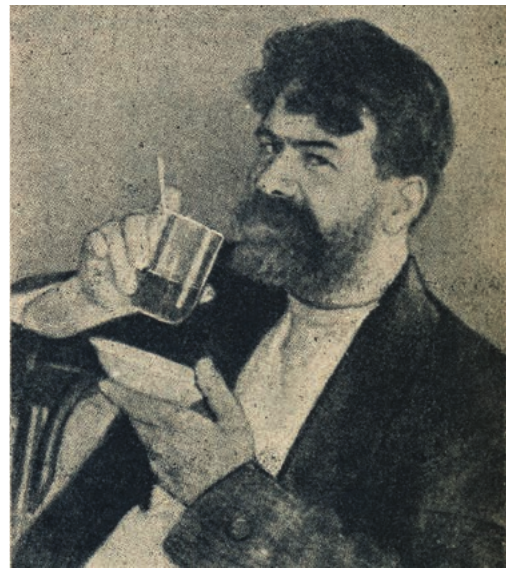
According to Yurovsky's later account, Nicholas had placed Alexei on a chair and stood positioned to shield him. Yurovsky told Nicholas that his royal relatives inside and outside the country had tried to save him, but the Soviet of Workers' Deputies had resolved to shoot them. When Nicholas asked 'What?' and turned toward Alexei, Yurovsky shot him, killing him instantly. Nicholas didn't have time to face them or receive an answer.
At that moment, disorganised, chaotic firing began. Because the room was small with brick walls, bullets began to ricochet. The firing intensified when the victims' shouts arose. Yurovsky managed to stop the firing but with great difficulty.
After the Tsar was executed, came the shooting and bayoneting of the Tsarina, Alexei and his four sisters, plus their cook, maid, doctor, valet and dog Jimmy. Before dawn, their bodies were taken by truck to a deserted mine shaft where they were cut into pieces, soaked in petrol and burnt, with the faces dissolved in sulphuric acid to hide their identities. The graves were not discovered until the collapse of Soviet Russia in the early 1990s.
Note
The Bolsheviks murdered another six Romanov family members the following night. The news of the killings sent a shock wave of horror through Europe's ruling classes, as the murder of the Romanovs was a definitive statement of the permanent rejection of tsarism.
According to historians Greg King and Penny Wilson, Yurovsky later admitted feeling 'great regret' over his part in the murders.
Public reaction and legacy
Historian Orlando Figes claims that public reaction in Russia to the news of the executions was 'remarkably subdued', even though initially the Bolsheviks only announced the death of the ex-Tsar, not his innocent family members, fearing public anger. By initially announcing just Nicholas's death, the Bolsheviks accidentally promoted a long-held myth that some young Romanov family members (such as Anastasia) escaped their fate.
The Romanov royal family continues to fascinate Russians today:
- In 1998, remains of the royal family were buried in the traditional Cathedral of Saints Peter and Paul in a controversial ceremony commemorating the 80th anniversary of their deaths.
- In 2000, the Tsar and his family were granted the official title of 'martyrs' by the Russian Orthodox Church because of the honourable way they went to their deaths. Given the location of the 17 bullet holes in the lower wall and floor, it is likely the family members were shot while kneeling and praying.
- In 2006, Russian President Vladimir Putin allowed Nicholas's mother to be reburied with the rest of the family.
- In 2008, at Ekaterinburg, 44 bone fragments, seven teeth, three bullets and one piece of cloth were found in a second burial grave. Hours before the ceremony marking the 90th anniversary of their deaths, Russian police confirmed that DNA testing had proven these were remains of Alexei and either Anastasia or Maria. The mystery of the 'disappearance' of the royal family was finally closed.
Remember!
Summary
Key Points to Remember:
-
The February 1917 Revolution began with strikes and protests over bread shortages on International Women's Day, escalating when soldiers refused to fire on demonstrators and joined them instead.
-
Nicholas II abdicated on 2 March 1917, but power was not transferred to any new authority, creating a power vacuum that lasted throughout 1917.
-
The Provisional Government implemented impressive democratic reforms but failed due to four key reasons: refusing to end the war, refusing to sanction peasant land seizures, inability to improve the economy, and the Bolshevik challenge.
-
The system of dual power meant the Provisional Government had authority without power, whilst the Soviets had power without authority - a fundamentally unstable arrangement.
-
The October Revolution saw the Bolsheviks, led by Lenin and Trotsky, successfully seize power on 25 October 1917, establishing the world's first socialist state.
-
The Romanov family was executed on 4 July 1918 in Ekaterinburg during the Russian Civil War. The execution marked the definitive end of tsarism in Russia, and their remains were not discovered until the 1990s.