The Development of Opposition to the Romanovs (HSC SSCE Modern History): Revision Notes
📚Revision Notes
The Development of Opposition to the Romanovs
Introduction
During the late 19th and early 20th centuries, opposition to Russia's traditional autocracy grew steadily. This opposition took the form of revolutionary political movements, with many drawing inspiration from the political ideas of Marxism. These ideas became increasingly popular among both the working class and educated Russians.
Marxism and its influence on Russian opposition
Understanding Marxism
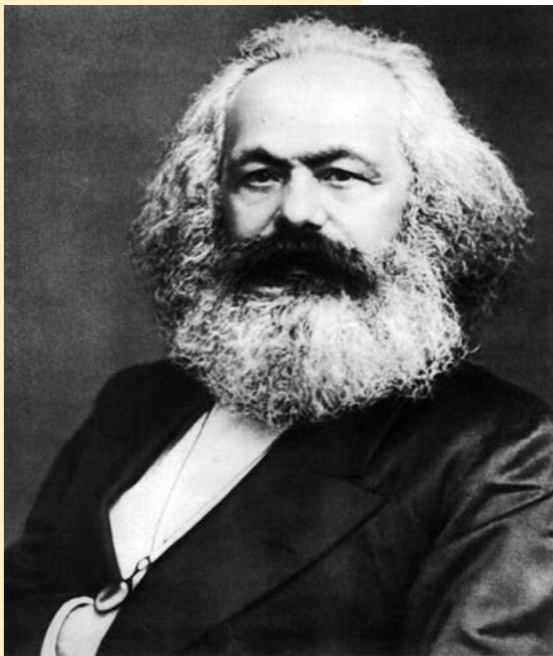
Marxism is a social, political and economic theory developed by German philosopher Karl Marx and Friedrich Engels. In 1848, they published the influential book The Communist Manifesto, which predicted violent revolutions in capitalist societies.
Key concepts in Marxist theory:
- Capitalism: An economic and political system where trade and industry are controlled by private owners for profit, rather than by the state
- Proletariat: Marx's term for industrial workers
- Bourgeoisie: Marx's term for employers and owners of large companies who possess most of the wealth and exploit ordinary workers
- Socialism: A belief system stating that all people are equal and should share equally in a country's wealth
- Communism: The belief in a society without different social classes, where production methods are owned and controlled by all members, everyone works according to their abilities, and receives according to their needs
- Revolution: A fundamental change in how a country is governed, usually involving a shift to a different political system and often using violence
Note
Marx's theory provided a framework for understanding class conflict and social change that resonated with many Russians experiencing rapid industrialization and urbanization. These ideas would profoundly shape the political opposition movements that emerged in the late 19th and early 20th centuries.
Marx's stages of history
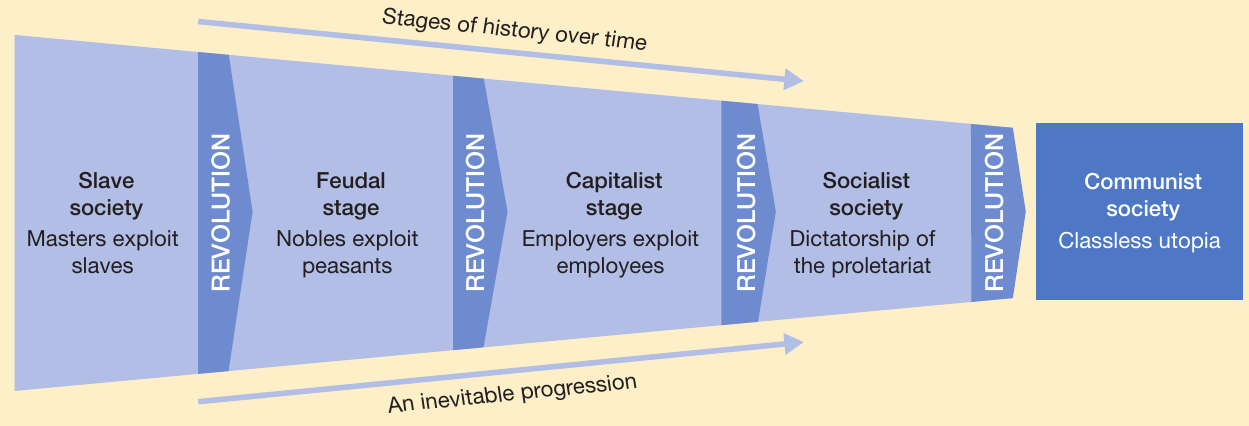
Marx and Engels envisioned society progressing through distinct stages via revolution:
Important
Marx's Five Stages of Historical Development:
- Slave society - masters exploit slaves
- Feudal stage - nobles exploit peasants
- Capitalist stage - employers exploit employees
- Socialist society - dictatorship of the proletariat
- Communist society - a classless utopia
Each stage represents a fundamental transformation in the relationship between those who control resources and those who work. According to Marx, revolution drives the transition from one stage to the next.
According to this theory, in capitalist societies (which had rapidly developed due to industrialisation), the working class would eventually overthrow the minority capitalists who owned the country's wealth. Workers would then seize factories, mines, machinery and raw materials from the capitalists and share them equally. This sharing of wealth was called socialism.
Marx and Engels believed that in a socialist society, people would learn to work together for the common good rather than for themselves. They would become less selfish and take only what they needed as payment for their work. Eventually, this would evolve into communism - a society where people work according to their abilities and are paid according to their needs.
| Marxist definition of capitalism | Marxist definition of communism |
|---|---|
| An economic system in which investment in and ownership of the means of production, distribution and exchange of wealth is in the hands of private individuals and corporations | A system of economic and social organisation in which industry, capital, land and other means of production are owned and controlled by the community as a whole |
Important
Exam tip: Be clear about the differences between capitalism, socialism and communism. These terms are often confused but represent distinct stages in Marx's theory of historical development.
Revolutionary political movements
Marxist revolutionary parties
The Social Democratic Workers' Party
In the 1890s, Marxist principles spread throughout Russia. In 1898, George Plekhanov, considered the father of Russian Marxism, founded the Social Democratic Workers' Party based on socialist principles. Political parties were illegal in Russia at this time, so in 1903, the Party held its second congress outside Russia in Western Europe.
This congress aimed to unite all Russian Marxists. However, a seemingly minor question about party membership caused a major split into two factions:
Note
The Bolsheviks (meaning 'majority')
- Led by Vladimir Lenin
- Believed Russia could bypass the capitalist stage and move directly to socialism
- Restricted membership to dedicated workers only
- Made decisions through leaders alone
- Believed the party needed to plan a revolution and seize power as the 'vanguard of the proletariat'
The Mensheviks (meaning 'minority')
- Led by Julius Martov
- Believed the capitalist stage was necessary before evolving into socialism
- Opened membership to all workers
- Made decisions after open debate and majority vote
- Believed the party should educate workers to develop class consciousness that would unleash a spontaneous struggle for equality
Both factions shared Marx's writings as their key influence, but differed significantly in their approach to achieving revolution.
Note
Key term: Class consciousness refers to a clear understanding of the differences between various social classes or of belonging to a particular social class.
Before 1914, the Bolsheviks had limited political influence, with membership perhaps only reaching 10,000. Lenin was also in exile, leaving the party without direct leadership. Ironically, it was the Mensheviks, not the Bolsheviks, who were more closely monitored by the Okhrana (secret police) as the major revolutionary threat to tsarist authority.
The Socialist Revolutionary Party
The Socialist Revolutionary Party (SR) had the longest political tradition of any party. The Party had two contrasting approaches to political action:
The moderate face:
- Believed deeply in education and organisation
- Fought for a democratic and free society where capitalism existed but was restricted by social reform laws
- Wanted a socialist society with complete state control over the economy
- Advocated for local institutions run by workers and peasants
The radical face:
- Used terrorism to lay groundwork for popular revolution
- Believed violence would inspire people to prepare to attack the state
- Weakened the government through political assassinations
- Between 1901 and 1917, the Social Revolutionaries killed 139 officials, many of them high-ranking
Important
This dual approach effectively terrorised the tsarist government whilst also working within the political system. The Socialist Revolutionaries represented a unique blend of legitimate political action and violent revolutionary tactics, making them particularly dangerous to the regime.
Liberal political parties
Liberal ideas had a long history in Russia, dating back to the late 18th century. Despite differences among individuals in the liberal movement, most agreed on a common programme:
- Extension of basic civil rights to all Russians
- Freedom of conscience, religion, speech and assembly
- Rule of law over absolute power
- A society based on a constitution and democratically elected government
- Stronger zemstvos (local councils made up of elected representatives of peasants and landowners) to control local affairs
- Active state engagement in social reforms
Note
Key term: A constitutional monarchy is a system where the monarch's power is severely limited, as they act only on the advice of politicians who form the government.
Two main liberal political parties emerged during 1905:
The Kadets (Constitutional Democratic Party):
- The largest of the liberal parties
- Main policy was promoting a constitutional monarchy
- Played an important role in the First Duma in 1906 and in the Provisional Government in 1917
The Octobrists:
- Named after their readiness to accept the October Manifesto of 1905
- More conservative than the Kadets
- Their loyalty to the Tsar made them embrace the Dumas as significant constitutional reform
The Russo-Japanese War (1904-1905)
Background and causes
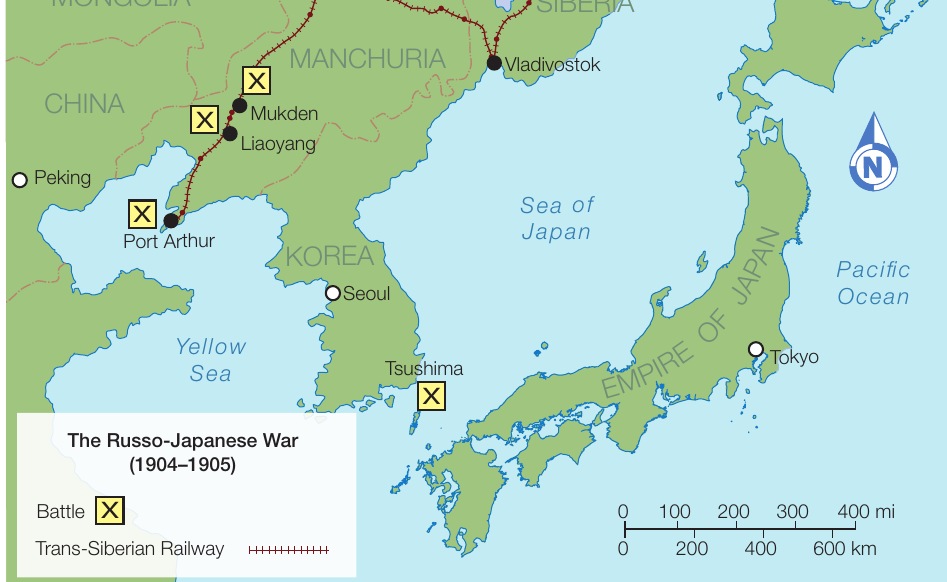
The war with Japan began in early 1904, formally started by Japan but provoked by aggressive Russian policy competing for property, land and influence in Korea and Manchuria (Northern China). The Japanese launched a surprise torpedo attack against Russian ships anchored at Port Arthur.
Key battles and defeats
Between April and September 1904, Japan launched a massive invasion:
- Ferried hundreds of thousands of troops to Manchuria
- Defeated Russian armies at the battles of the Yalu River and Nanshan
- Captured the port of Dalny
- Surrounded and captured Port Arthur in January 1905
- Defeated a Russian army of 320,000 at Mukden in March 1905
The Battle of Tsushima
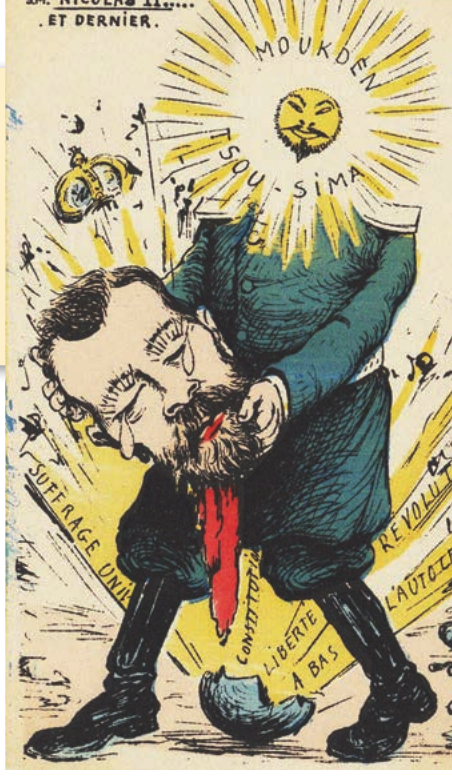
The most devastating defeat came on 27 May 1905 in the Tsushima Strait (the narrow gap of water between Japan and Korea). A thoroughly modern Japanese fleet annihilated a much larger Russian fleet, announcing Japan's entrance onto the global stage as a major power.
Outcomes and significance
The war had profound effects on Russia:
Important
Critical Consequences of the Russo-Japanese War:
- It was the first time a European power had been beaten by an Asian nation
- Although Russia had a much larger fleet than Japan, many vessels were outdated and crews were generally ill-trained
- The Battle of Tsushima directly contributed to damaging the image of Tsar Nicholas II's leadership
- Russian soldiers appeared unprofessional and poorly led compared to the highly disciplined and dedicated Japanese forces
- The disaster contributed significantly to the uprising of 1905
Important
Exam tip: The Russo-Japanese War demonstrated the weakness of the tsarist regime and directly contributed to the 1905 Revolution. Be prepared to explain this connection.
The 1905 Russian Revolution
By 1905, the tsarist autocracy faced its greatest political challenge: a massive social and political revolution that dramatically demonstrated the growing opposition to traditional autocracy.
Bloody Sunday
Background
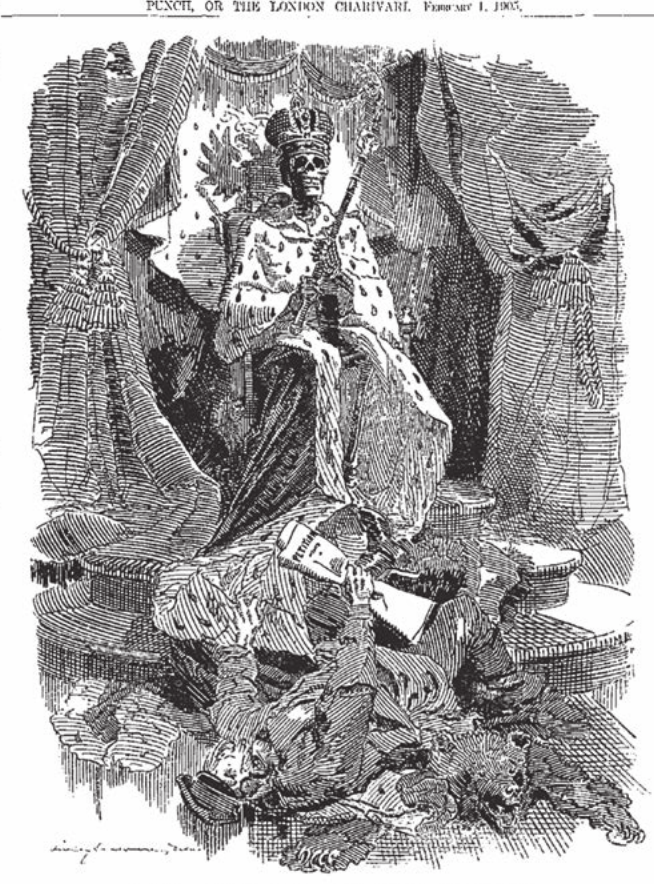
The events of Bloody Sunday had a crippling effect on the tsarist government, demonstrating for the first time widespread contempt for the regime. The autocracy soon stood on the verge of collapse as domestic and external events continued to punish an already fragile state.
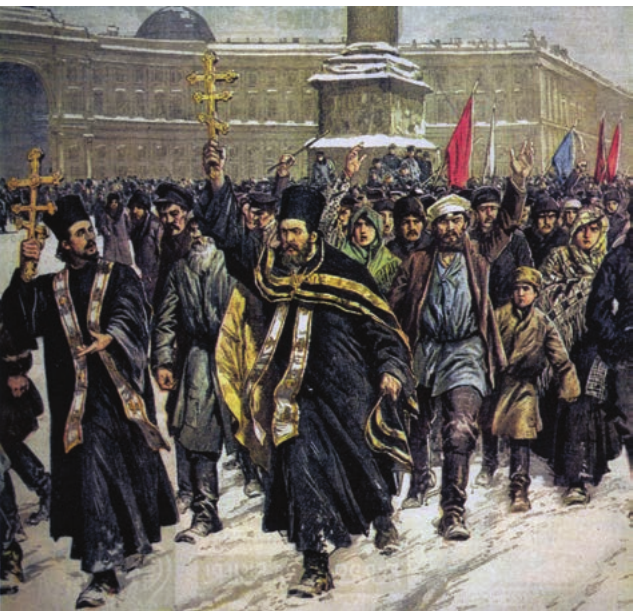
The march had a bizarre context. In 1901, hoping to lead workers away from radicals, the government established special legal labour organisations under the control of the secret police (Okhrana). One such body, established in St Petersburg in 1904, was the Assembly of Russian Factory Workers, headed by a priest named Georgii Gapon who also worked for the secret police. It became phenomenally successful.
In December 1904, amid growing strikes among workers, Father Gapon's organisation decided to arrange a massive march to convey workers' grievances to the Tsar himself.
The petition and march
On the freezing Sunday morning of 9 January 1905, Gapon led tens of thousands of workers to the Winter Palace carrying a petition. About 135,000 workers signed this petition. The march was a traditional act, as the petitioners appealed to Tsar Nicholas II as the symbolic father of the people. They carried:
- A picture of the Tsar
- Religious icons (paintings of Jesus Christ or holy figures)
- Banners borrowed from churches
However, the content of their demands was less traditional. They demanded:
- State intervention to improve working and living conditions
- Civil liberties: freedom of press, speech, assembly, belief, unions and strikes
- Election of a 'pre-parliament' - a constituent assembly to create a constitution
- Universal, secret, direct and equal suffrage (the right to vote)
Example
Extract from the Bloody Sunday Petition:
The petition began: "Sire, We working men of St Petersburg, our wives and children, and our parents, helpless, aged men and women, have come to you, O Tsar, in quest of justice and protection. We have been beggared, oppressed, over-burdened with excessive toil, treated with contempt..."
This language reveals the traditional relationship between the Tsar and his subjects - workers still viewed Nicholas II as their protector and father figure, despite their desperate conditions.
The massacre
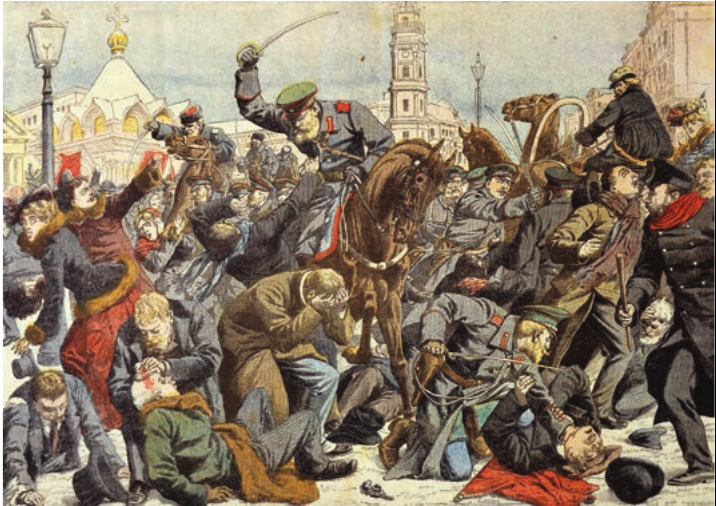
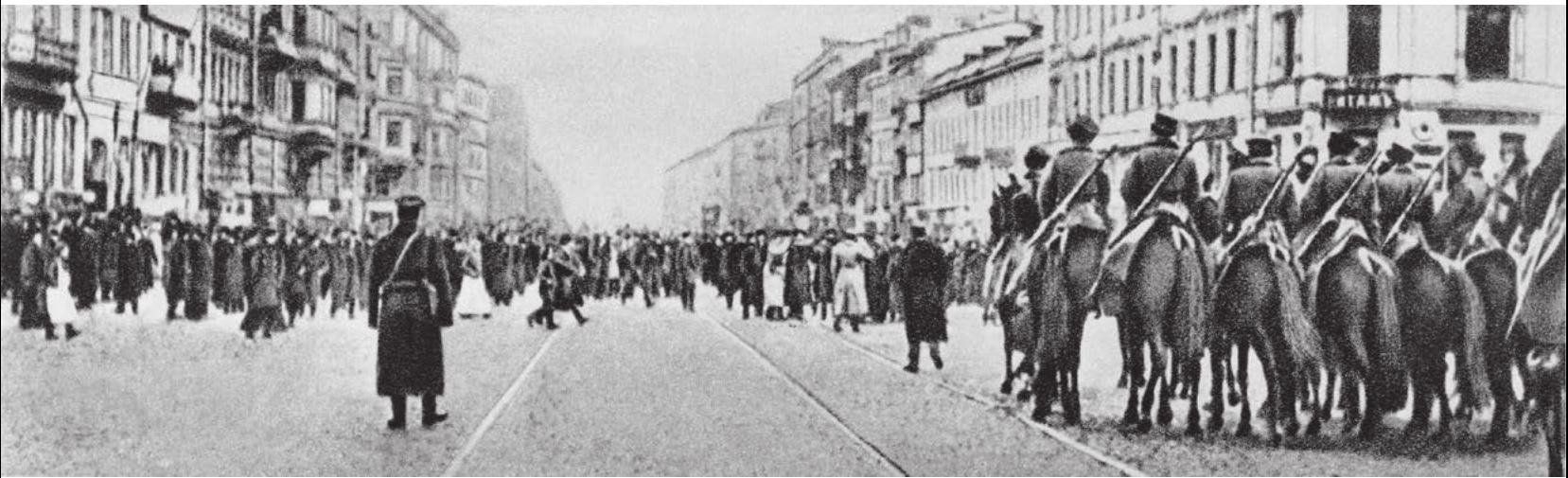
The marchers were not met by the Tsar, who had left town, but by troops with orders to fire on the crowds approaching the palace. The violence was severe:
- Hundreds were injured and killed
- Historians estimate 200 were killed and 800 wounded
- The event became known as 'Bloody Sunday'
Note
Nicholas II's diary entry on that day simply stated: "A painful day. There have been serious disorders in St. Petersburg because workmen wanted to come up to the Winter Palace. Troops had to open fire in several places in the city; there were many killed and wounded. God, how painful and sad."
This detached tone reveals the disconnect between the Tsar and the reality of what had occurred, showing little understanding of the magnitude of the tragedy.
Consequences of Bloody Sunday
In the weeks following Bloody Sunday, everything the government had feared came to pass:
Labour movement developments:
- The number of strikes and strikers in 1905 exceeded all previous years of Russian history combined
- The labour movement became more organised than ever before
- Trade unions began to appear, ignoring the fact they were illegal
- New types of worker organisations called soviets (councils with elected members) appeared for the first time
Political demands:
- Workers' demands became more political
- Workers felt betrayed by the 'Tsar father'
- They demanded a constitutional republic and full civil liberties
- Worker unions began publishing their own newspapers, completely ignoring censorship laws
- The streets filled throughout the year with endless demonstrations
Important
Government response: The government tried to respond with mild concessions. In February, Nicholas II offered a consultative assembly. Years earlier, this would have been regarded as a major achievement, but now it was too little, too late. Most people no longer had enough confidence in the government; they wanted a real legislature (a group of people with the power to make and change laws).
The October general strike
The high point of protests came in early October with a massive general strike:
- For two weeks, millions of workers stayed off their jobs
- Factories all over the country shut down
- Railways, government offices and commercial firms stopped operating
- Every school and university was closed by its students
Important
The demands everywhere were the same (Russian society had never been so united):
- Complete civil liberties
- A constituent assembly to establish a constitutional order based on a legislature
- For many, this meant nothing less than a democratic republic with no Tsar at all
The October Manifesto
Witte's role
Sergei Witte was a key player in 1905. He held the position of Chairman of the Council of Ministers, equivalent to Prime Minister. Witte was born into a family of mixed Dutch and Russian ancestry in government service. He studied mathematics, then entered railway administration, rising to responsible positions. In 1892, he was named Minister of Finance, where he developed far-reaching plans for Russia's economic development, particularly railway building.
His relationship with Tsar Nicholas II was strained. In August 1903, Witte was removed from the Ministry of Finance. In July 1905, he was appointed head of the Russian delegation to conduct peace negotiations with Japan.
The Manifesto
In the face of the general political strike, Nicholas called on Witte to implement reforms. On 17 October 1905, he signed the October Manifesto. For the first time in Russian history:
- Basic civil liberties were granted to all Russians
- A Duma with legislative powers was created
- Russia was about to become a constitutional monarchy
Reactions to the Manifesto
The October Manifesto produced mixed reactions:
Continued opposition:
- Many workers and socialists condemned the Manifesto as inadequate
- Protests continued
- Students refused to attend classes
- Soldiers and sailors rebelled to transform conditions in the army
- Peasants seized land, believing the Tsar had approved this
Note
Liberal split:
- Many liberals found the popular movement frightening
- This split the united social front for democracy
- The Kadets complained reforms didn't go far enough and continued campaigning
- More moderate liberals felt the October Manifesto had done enough
- They feared further disorder would only encourage greater social unrest
The Fundamental Laws of 1906 and the politics of the Duma
The Fundamental Laws
In 1906, within a few months, the details of the promised reforms were announced in the Fundamental Laws. In many respects, these represented a real effort to include people in policy formulation for the first time:
Positive aspects:
- Political parties were legalised
- Elections to the Duma (parliament) were to be held
- All Russian men from all classes could participate
- The Duma was given real legislative authority to pass laws
Important
Limitations and restrictions:
Despite the positive aspects, the Fundamental Laws contained severe restrictions that undermined genuine democratic reform:
-
Voting laws were skewed:
- Initially favoured landowners and peasants
- In 1907, after dealing with two troublesome Dumas, laws changed to favour just landowners
- Not based on equal or universal terms
-
Legislative power was restricted:
- The Tsar kept the power to veto any legislation
- An upper house (State Council) was created with veto power
- Half the State Council members were personally appointed by the Tsar
- The rest were well-established notables there by right of their elite position
- The State Council became known as 'the gravedigger' of democratic legislation
-
Limited competence:
- A large part of the budget was out of Duma control
- No real influence over military or foreign policy
- Day-to-day political power remained with ministers personally appointed by the Tsar
-
Article 87:
- The government could declare a state of emergency at any time
- Could pass any law it wished while the Duma was out of session
- This notorious article severely limited the Duma's legislative authority
Assessment of the Constitutional Experiment (1906-1914)
The Constitutional Experiment was not a complete failure. The Duma offered people a public voice and measure of public power that had never existed before in Russia. However:
Shortcomings:
- Most of the nation was unrepresented
- Half the Duma seats were held by the gentry (people of high social class), who represented only one per cent of the population
- Members of the Octobrist party dominated the Duma
- Even Octobrists were dissatisfied by the government's refusal to grant them real influence
- Social reforms left peasants and workers dissatisfied
- Workers who were allowed to strike and form unions were harassed and under state surveillance
Important
Historical perspective: Many historians argue that these half-hearted reforms only increased people's appetite for more substantial change, rather than satisfying their demands for democracy.
The reforms of Stolypin
Stolypin's appointment and approach
In July 1906, Peter Stolypin was appointed Prime Minister of Russia in the wake of the traumatic events of 1905. He was a traditional statesman who supported tsarism but was also a political realist.
Stolypin's primary motivation during the reforms was to strengthen the Tsar's position. He stated: "As the revolution is so strong ... I must carry through effective measures of reform, and at the same time I must face revolution, resist it, and stop it."
Important
Repression: The period under Stolypin saw severe repression of revolutionary parties, ideologies (sets of beliefs or principles on which political systems are based) and movements. The hangman's noose became informally known as 'Stolypin's necktie' because he had so many political revolutionaries executed during his six years in power. This repression, combined with the growing economy, made revolutionary action less likely each year.
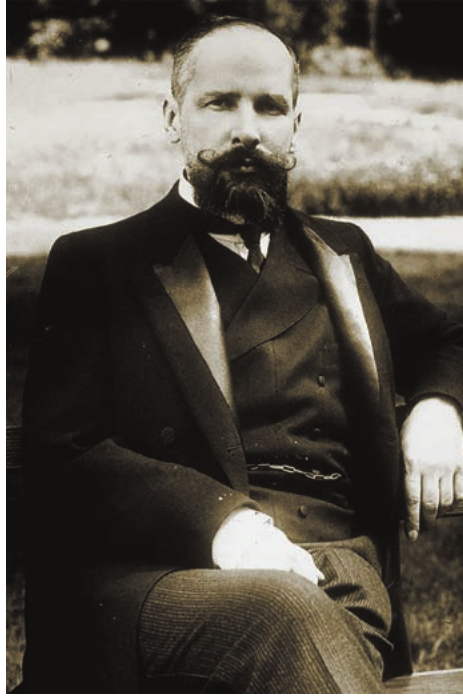
Stolypin's reforms
Stolypin implemented three main categories of reforms:
Land reforms
- All royal and government land was made available to the Peasants' Land Bank for purchase by enterprising peasants
- Land was sold at prices consistent with its value and the buying power of farmers
- A large-scale credit system was initiated so peasants had money to buy more land and equipment and improve cultivation techniques
- Peasants were permitted to leave the previously compulsory village commune (mir) to farm independently
Example
Results of Land Reforms:
- By 1913, almost two million peasant families had left their village communes to farm independently
- Another three million accepted government offers of land and financial aid to relocate to Siberia
- However, most peasants preferred the security of the mir
Social reforms
- Aid was offered to insure peasants against sickness, mutilation, disablement or old age
- Proportional taxation was introduced that exempted most landless peasants from new taxes
- Religious tolerance and freedom of conscience were granted
- Compulsory primary education was introduced
Example
Results of Social Reforms:
- The number of primary schools doubled between 1906 and 1912
- Local councils' expenditure on health, poor relief and agriculture advice also doubled
Industrial reforms
- Night and underground labour was banned for children, teenagers and women
- The maximum working day was shortened for adult workers
Note
Results: The reforms began to slowly meet the demands from the workers' petition presented on Bloody Sunday in 1905
Stolypin's downfall
Despite his success in consolidating the regime and his reform efforts, Stolypin was not a popular figure:
Important
Factors Leading to Stolypin's Downfall:
- His relationship with the Tsar had deteriorated
- Some historians suggest this was due to the malign influence of Rasputin
- Stolypin presented a report to Nicholas outlining the drunken and sexual activities of Rasputin
- This earned him the undying hatred of the Tsarina
- In 1911, Stolypin was assassinated by a young revolutionary at an opera performance in Kiev
- The royal family did not attend his funeral because of his negative comments about Rasputin
Remember!
Summary
Key Points to Remember:
-
Opposition to the Romanovs grew through revolutionary movements inspired by Marxism, which predicted workers would overthrow capitalists and create a socialist, then communist society.
-
Revolutionary parties split over strategy: the Bolsheviks (Lenin) wanted immediate revolution led by dedicated revolutionaries, whilst the Mensheviks (Martov) favoured gradual change through worker education. The Socialist Revolutionaries combined political organisation with terrorism.
-
The disastrous Russo-Japanese War (1904-1905) exposed the weakness of the tsarist regime, with Russia's defeat by an Asian power for the first time undermining Nicholas II's authority and contributing to the 1905 Revolution.
-
Bloody Sunday (9 January 1905) marked a turning point, when troops fired on peaceful workers petitioning the Tsar, killing hundreds. This event triggered strikes, the formation of soviets, and demands for a constitutional government.
-
The October Manifesto promised reforms but the Fundamental Laws of 1906 severely limited them. Whilst creating a Duma and granting civil liberties, the Tsar retained veto power, an unelected upper house blocked legislation, and voting laws favoured landowners.
-
Stolypin's reforms (1906-1911) combined repression with social, land and industrial reforms aimed at stabilising the regime. Whilst some reforms were successful, they failed to satisfy peasants and workers, and Stolypin's assassination in 1911 ended this reform period.