The Consequences of Modernisation for Japan (HSC SSCE Modern History): Revision Notes
📚Revision Notes
The Consequences of Modernisation for Japan
The Meiji Restoration brought sweeping changes to Japan. This note explores the political, economic, educational and military transformations that modernised Japan and established it as a significant world power by the early 20th century.
Political changes
The road to representative government
During the first decade of Meiji rule, representative government was not politically feasible. The Emperor and his officials focused their energies on modernisation and westernisation. However, by 1881, mounting pressure from government leaders and dissatisfied shizoku (former samurai class) made calls for genuine representation impossible to ignore.
Note
The shizoku were members of the former samurai class who had lost their traditional privileges under the new Meiji system. Their dissatisfaction with the government's policies created significant political pressure for reform.
Several factors forced the government's hand:
- Government monopolies had emerged from rapid infrastructure development
- A scandal erupted when officials conspired to buy government property in Hokkaido at reduced prices
- Both government leaders and the shizoku demanded political representation
In response to these pressures, the Meiji government committed to establishing a new national assembly by 1890. This assembly would allow different groups and factions to have their voices heard.
Political parties emerge
Several political parties quickly organised themselves in anticipation of the new assembly:
- Liberal Party (Jiyuto) - led by Itagaki
- Progressive Party (Rikken Kaishinto) - led by Okuma
- Constitutional Imperial Rule Party (Rikken Teiseito) - formed to moderate the influence of the two main parties
Drafting the Meiji Constitution
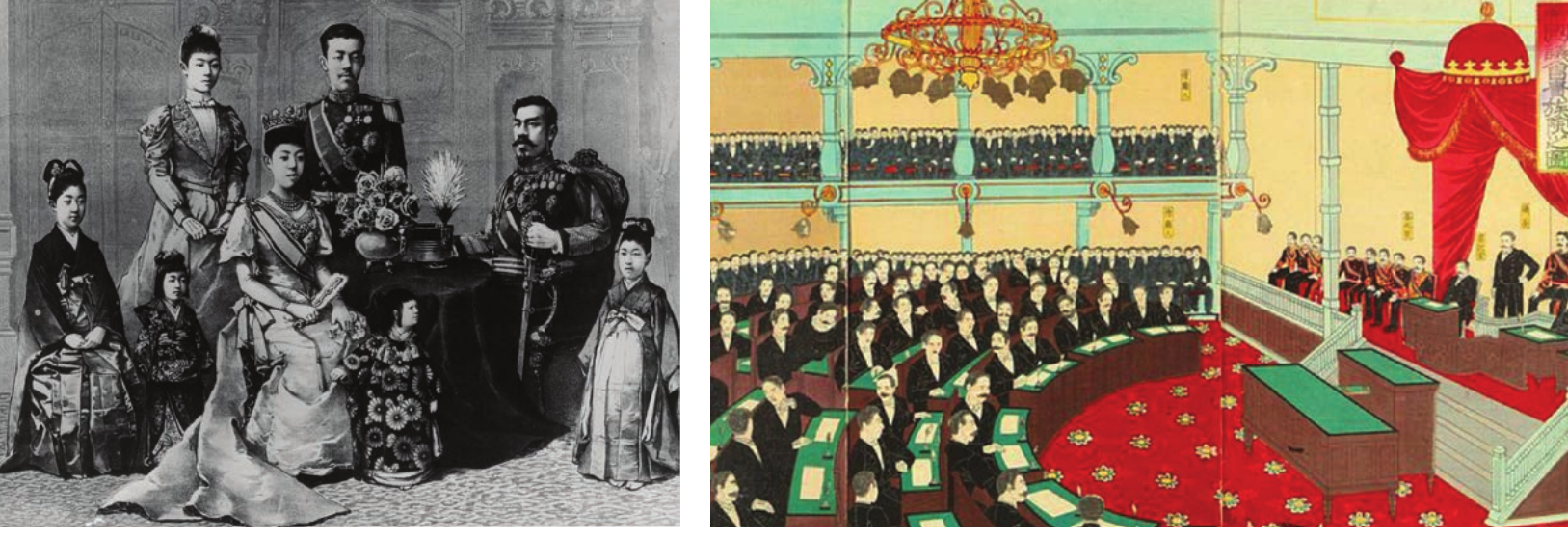
A constitution was needed to incorporate these representative bodies into government. Ito Hirobumi, a highly respected government official, received this critical task. He studied various Western governmental systems abroad to determine how Japan could create a constitution that was both representative and loyal to the Emperor.
Ito adopted the Prussian model, which placed parliament under the Emperor's control while allowing some representation from the nobility. Drafting began in 1884 to carefully blend these two approaches.
Note
Prussia was a former European empire that included modern-day Germany and Poland. Its governmental system was particularly attractive to Japanese leaders because it maintained strong centralized authority while incorporating limited representative elements.
The Constitution of 1889
On 11 February 1889 - chosen to coincide with the traditional founding date of Japan in 600 BCE - the new constitution was finally proclaimed. This date was symbolically significant, linking the modern government to Japan's ancient heritage.
The constitution established three separate bodies working together:
The Emperor held supreme executive power with these key attributes:
- Absolute and divine authority
- Hereditary title and reign
- Commander-in-chief of the armed forces
- Power to negotiate treaties with foreign nations
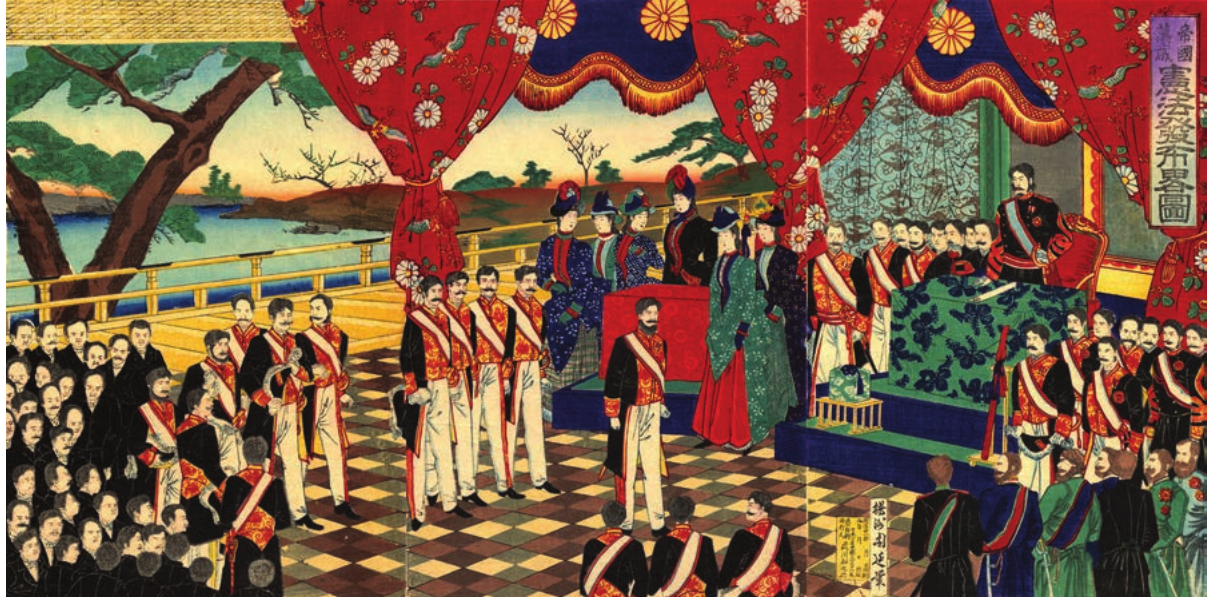
The Imperial Diet (Japan's parliament) comprised two houses:
- House of Peers - made up of royal family members and nobles nominated by the Emperor
- House of Representatives - 300 elected members chosen through a restricted voting system
Note
The Imperial Diet was Japan's equivalent of a parliament. The term "Diet" refers to a formal deliberative assembly, and it represented a significant step toward representative government in Japan.
Legislative power refers to the ability to make laws - a crucial aspect of governmental authority.
Limited powers of the Diet
The Diet had severely restricted legislative powers. Several constitutional provisions ensured the Emperor retained supreme control:
- All Cabinet members were appointed by the Emperor
- If the Diet blocked funding, the government could simply continue using the previous year's budget - this effectively prevented parliament from exerting any real pressure on the Emperor
- The Emperor could dissolve the Diet at will
- The Emperor could use his Privy Council (a group of close advisers) to make decisions without parliamentary input
Important
The most significant limitation on the Diet's power was the budget continuation clause. By allowing the government to use the previous year's budget if new funding was blocked, this provision effectively eliminated parliament's traditional power of the purse - one of the most important checks on executive authority in democratic systems.
Note
Prorogue means to temporarily halt the processes of a parliament. This power gave the Emperor significant control over when and how the Diet could function.
The power of the genro
The Privy Council quickly became dominated by the genro - members of the new Japanese military elite. These influential figures held powerful positions in government and military circles, with many of their followers appointed to the House of Peers.
The genro's influence can be seen in early struggles within the House of Representatives. However, these conflicts typically didn't affect Japan's modernisation agenda because:
- The budget couldn't be frozen by parliament
- Cabinet ministers often allied themselves with particular political parties
- Over time, as ministers gained experience, the genro's role diminished to mainly advisory functions
By 1920, the genro's influence had significantly weakened.
Note
An oligarchy is government by a small group of powerful people. The genro effectively created an oligarchic system where real power was concentrated in the hands of a military elite rather than distributed among elected representatives.
Rights granted to citizens
The new Constitution made some concessions to the people, in keeping with the Charter Oath. Citizens were granted important freedoms that hadn't existed under the previous Shogunate system:
- Right to free speech
- Freedom to worship
However, these freedoms existed only at the Emperor's discretion and could be withdrawn arbitrarily. In practice, the Meiji Constitution created a quasi-oligarchic system where real power remained concentrated in the hands of the genro and the Emperor.
Judicial system reform
One major reason for introducing the Constitution was to reform Japan's judicial system. The justice system under the Tokugawa Shogunate was seen as unjust and arbitrary by Western powers. This perception had forced Japan into extra-territoriality agreements - treaties that allowed foreign nationals to be tried under their own country's laws rather than Japanese law.
Western powers refused to revise these humiliating treaties until Japan's legal system matched their standards of justice and rule of law.
Important
Extra-territoriality agreements were deeply humiliating for Japan because they implied that Western nations did not trust Japanese law to provide fair justice. These treaties symbolized Japan's inferior status in the international community and became a major motivator for legal reform.
Key reform measures:
- 1890: New penal code based on the French model
- Commercial and civil code introduced based on French and German models
- The civil code still prioritised the state's collective rights over individual rights, but it established regulated and principled approaches
Note
A penal code is the system of legal punishment in a country. Japan's adoption of a French-style penal code represented a shift toward systematic, predictable legal procedures.
A commercial and civil code is a systematic collection of laws designed to comprehensively deal with core areas of private law, including contracts, property rights, and commercial transactions.
These reforms satisfied British and other Western nations. By 1894, Britain agreed to abandon its extra-territoriality clause, and by 1899 many other Western nations followed.
Summary of political transformation
The Meiji period witnessed:
- Rebuilding of Japan's legal, social and political systems
- Abolition of feudalism
- Replacement of the old feudal system with a new authoritarian government
- Emergence of nationalist spirit deeply connected to reverence for the Emperor
- Creation of a right-wing authoritarian society
- Achievement of diplomatic equality with Western powers
- Reversal of unfair treaty obligations
- Dismantling of the class system
- Introduction of civil and penal codes providing political stability (though not necessarily greater individual liberty)
Financial and industrial reform
Taxation reforms
The massive modernisation programme required substantial funding. Initially, the Meiji government relied on land tax as its primary revenue source.
With feudalism abolished, the government allowed land to be sold and assessed for taxation. In 1873, a new tax system was introduced with an important change:
- Old system: Tax based on crop yields (varied year by year)
- New system: Tax based on assessed land value (consistent annual revenue)
Note
This reform ensured the government received regular, predictable tax income that wasn't affected by agricultural productivity. The shift from crop-based to value-based taxation was crucial for funding long-term modernisation projects that required stable, reliable revenue streams.
Dealing with samurai stipends
Despite these improvements, the government faced a significant financial burden: ongoing payments to the samurai class. Under the Tokugawa feudal system, daimyo had been obligated to provide stipends to samurai. The Meiji government had assumed these financial commitments, but the payments were crippling the new treasury.
To manage these obligations, from 1876 onwards the government paid samurai in government bonds rather than cash. This strategy:
- Relieved immediate pressure on the treasury
- Freed up funds for urgent modernisation programmes
- Spread the financial burden over time
Currency reform
Japan's currency system required complete overhaul. Under the old system, both rice and various forms of coinage circulated as currency. Additionally, different foreign currencies had entered circulation through trade with Western nations.
In 1871, the Meiji government instituted a decimal currency system:
- The yen became the standard unit of currency
- The yen was backed by gold held in the treasury
- This followed the gold standard system used internationally at the time
Financial independence
These financial reforms were critical to the success of the Meiji Restoration. The effective taxation and currency systems enabled Japan to:
- Become self-sufficient
- Avoid reliance on Western capital or trade
- Fund large-scale industrialisation and modernisation projects primarily through land tax revenue
- Support projects with a stable, consistent currency
Important
Remarkably, Japan sought external funding from Britain for only two projects:
- Railway construction
- Paying interest on government bonds issued to the samurai classes
This demonstrates the extraordinary financial independence Japan achieved through its taxation and currency reforms - a rare accomplishment for a rapidly modernising nation in the 19th century.
Industrialisation
The drive to industrialise
Western technological superiority had triggered the Tokugawa Shogunate's rapid decline. Japan's leaders believed that developing industry and commerce would:
- Restore financial and social stability during the Meiji period
- Provide necessary labour and capital in the post-feudal economy
- Enable Japan to compete with advanced Western economies
The heimin (common people) flocked to new urban centres seeking work, driving Japan's industrialisation forward.
Adopting Western technology
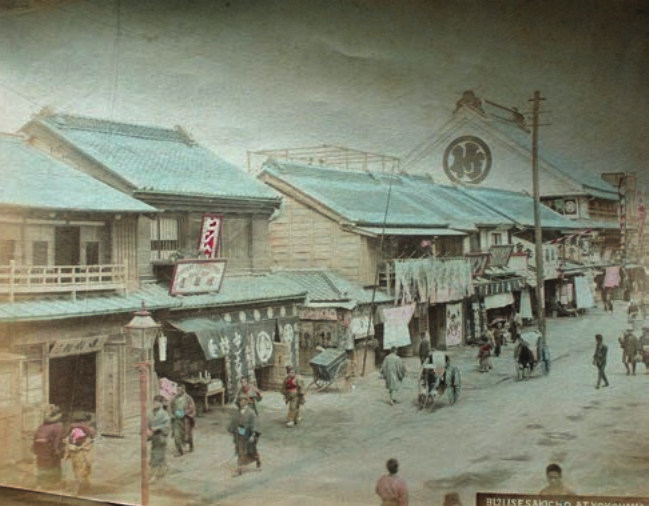
Japan adopted Western technologies and processes to compete with more advanced economies:
- Foreign experts with technical expertise were encouraged to share their knowledge
- Japanese workers were sent overseas to gain skills
- New industries aimed to improve efficiency and match Western production methods
Government-sponsored industries
To avoid dependence on overseas capital, the Meiji government directly sponsored new industries. Using land tax revenue, the government:
- Created productive employment for various classes dissolved by feudalism's abolition
- Provided ideal leadership roles for the disaffected samurai, who possessed both technical skills and high literacy levels
- Gave collective purpose to the Meiji Restoration
- Catapulted Japan toward becoming a modern economic nation
Note
The government's strategy of directly sponsoring industries was unusual for the time. Most Western nations relied on private capital and entrepreneurship for industrialisation, but Japan's approach allowed for rapid, coordinated development while maintaining national control over key industries.
Mechanisation and development
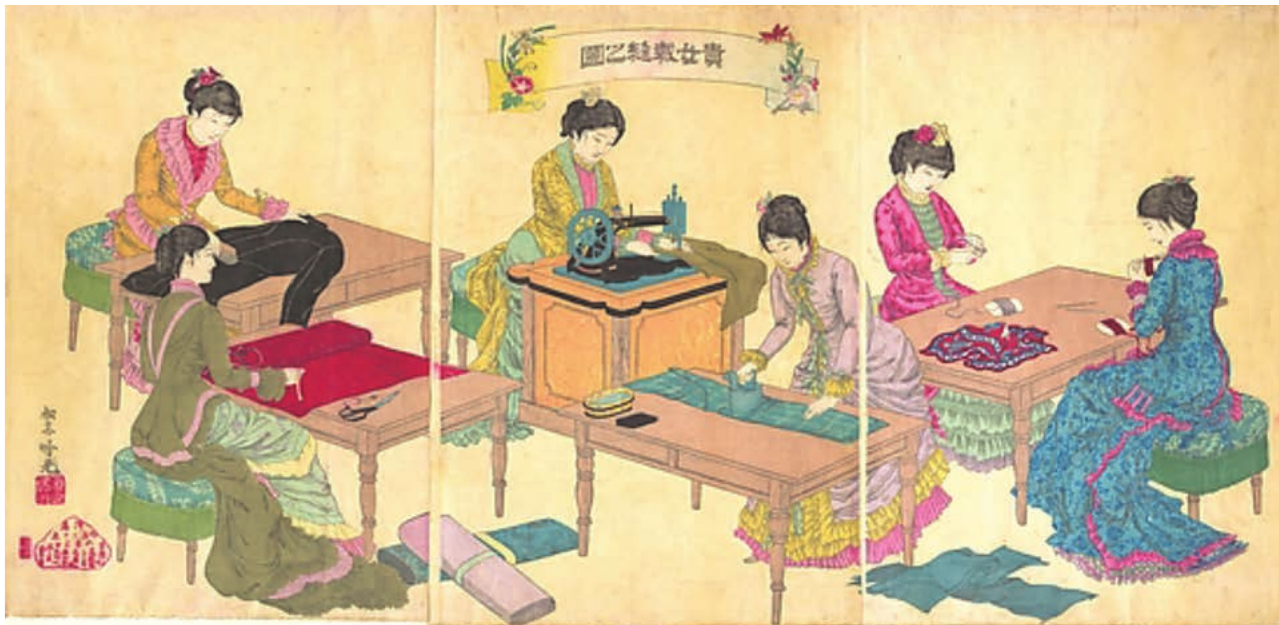
Rapid mechanisation occurred across several sectors:
- Textiles: Cotton and wool production with spinning and mill equipment
- Mining: Copper, silver and gold mines established
- Shipbuilding: New shipyards opened
- Munitions: Factories built for military production
Government support strategy:
- Often paid for heavy machinery in full
- Sold equipment to private companies through instalments
- This approach meant industrialisation occurred quickly
- Private investors became committed to both their own profits and state economic goals
In the 1880s, the government provided subsidies to commercial enterprises for technical innovations and expertise. Once enterprises became self-sufficient with well-established technical processes, the government would sell its interest to wealthy industrialist families at reasonable prices.
The zaibatsu
The government's privatization strategy led to the rise of the zaibatsu - groups of industrial and financial companies that controlled a large part of Japan's economy until World War II.
Note
Zaibatsu were powerful family-controlled business conglomerates that dominated Japanese industry. Unlike Western corporations, zaibatsu were tightly integrated across multiple industries and maintained close relationships with government officials.
These influential groups were powerful families including:
- Mitsubishi
- Yasuda
- Sumitomo
- Mitsui
The zaibatsu were responsible for:
- Manufacturing different products
- Large-scale infrastructure projects
- Building railways, factories, shipyards and transport systems
Creation of capital and expansion
Industrial growth created capital that could be invested or loaned for future projects. The establishment of internal, private capital within Japan allowed:
- Foreign and domestic trade to expand rapidly into China and other parts of Asia
- Reduced reliance on land taxation as the sole revenue source
- Internal funding of Japanese industry
Towns and cities expanded to provide labour for these industries. The creation of a working class transformed Japan from a feudal, class-based society to a modern capitalist economy.
Trade and infrastructure developments
Trade expansion was supported by:
- Development of merchant shipping
- Modern banking processes
- Advanced transport and communication systems
Key infrastructure achievements:
- 1869: Telegraph line established from Tokyo to Yokohama
- 1870: First railway line construction began between Hyogo and Tokyo
- 1871: Postal services commenced
Note
These infrastructure developments were all significant advances for Japanese society. The speed of their implementation - all within just three years - demonstrates the urgency and commitment behind Japan's modernisation efforts.
Trade dependencies
Despite improvements in farming machinery and techniques:
- Growing urban population and factory establishment created food supply challenges
- Fishing industry grew exponentially in response
- By 1890, Japan needed to rely on foreign trade for food and essential goods
- This pattern of foreign trade dependency continued into the 20th century
Important
Japan's increasing reliance on foreign trade for food and resources became a crucial factor in its later imperial expansion. The need for reliable access to raw materials and markets would significantly influence Japan's foreign policy in the early 20th century.
Education
Education as a national priority
Compulsory education was critical to the Meiji Restoration. The Charter Oath mandated Western education and modernisation, resulting in:
- Many overseas scholarships
- Adoption of Western ideas
- Secularisation of education
- Education becoming a national priority
Under the Shogun, education had been:
- Typically conducted in Chinese
- Reserved for daimyo and samurai classes
National Ministry of Education
With the Restoration, a new National Ministry of Education was established in 1871. Its aims were to:
- Enlighten the Japanese population
- Eliminate illiteracy
- Promote Western knowledge
The 1872 Education Act
This landmark legislation established:
- Compulsory, nationally funded primary education
- Development of each area into districts with schools
- Technical and middle years education
- Focus on scientific and technical knowledge to foster modernisation
Important
The growth of schooling and the importance of education significantly broke down traditional feudal class barriers. For the first time in Japanese history, children from all social classes had access to education, creating unprecedented opportunities for social mobility.
Funding and structure
The education system was:
- Funded by taxation
- Allowed some local council input (designed to gain grassroots support)
- Highly functional, centred on Western knowledge
- Emphasised literacy and practical skills
Imperial Rescript on Education (1890)
Some opposition emerged to the adoption of Western ideas and methods. In response, the 1890 Imperial Rescript on Education reinforced:
- Importance of Japanese tradition
- Reverence for the Emperor
- Loyalty to the state and family
Note
Liberalism is a political ideology that promotes equality, liberty, protection from injustice and economic opportunity for all people. The Imperial Rescript was designed to counter liberal Western political ideologies while still embracing Western technical knowledge.
Students were asked to:
- Adopt Western scientific and technical knowledge
- Disregard liberalism and Western political ideologies
Important
This dual approach - embracing Western technology while rejecting Western political ideology - became a defining characteristic of Japanese modernisation. Students were encouraged to learn Western science and methods but maintain traditional Japanese values of loyalty and hierarchy.
Results of mass education
The mass education campaign produced:
- Increased reverence for the Meiji Emperor
- Loyalty to the new modern state
- A skilled and literate workforce to drive the Restoration forward
Example
Impact of Educational Reform: A Generation of Change
Consider the transformation within a single generation:
- 1870: Literacy rates estimated at 15-20% among common people
- 1890: Literacy rates exceeded 50% nationally
- 1910: Japan achieved near-universal literacy
This rapid educational expansion created the skilled workforce necessary for industrialisation and established Japan's competitive advantage in technical fields.
The growth of Japanese militarism and imperialism following the Restoration
Formation of a national military
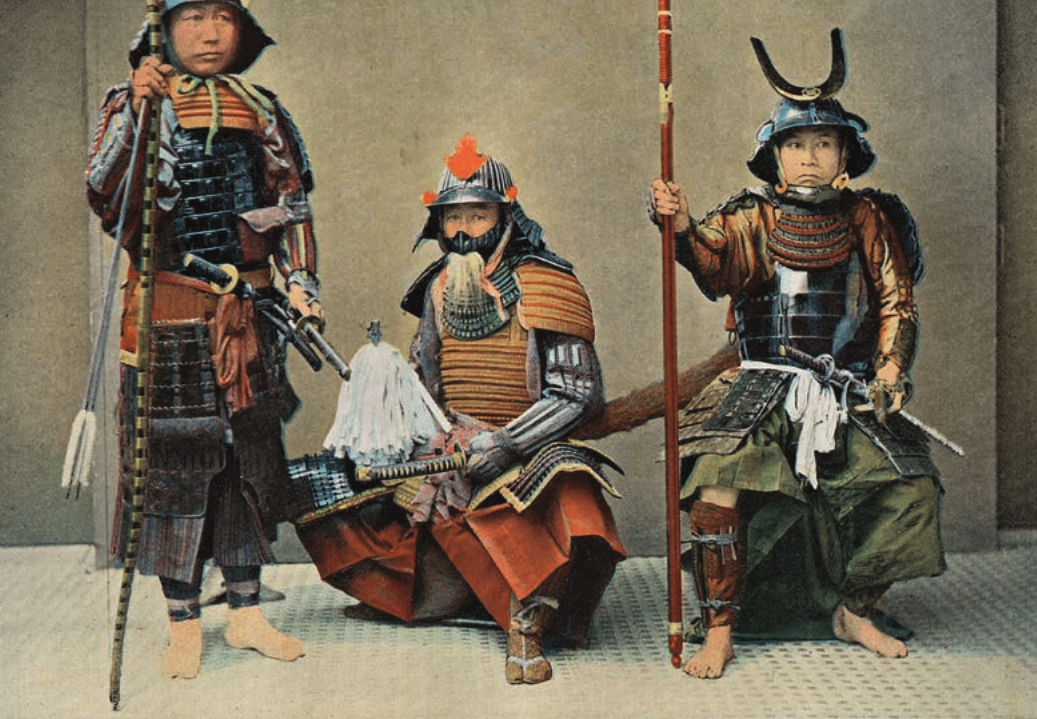
The abolition of feudalism and the samurai's traditional role created momentum for establishing a national military to defend the new Meiji state.
1873 Conscription introduced:
- Made military service universal and compulsory for all classes
- Elevated the status of former peasants
- Disappointed samurai, who lost their privileged warrior status
The Satsuma Rebellion
The samurai's disappointment was clear during the Satsuma Rebellion. Despite their superior training, the traditional samurai were defeated by newly formed peasant armies due to:
- Greater numbers of peasant conscripts
- Advanced weaponry
- Modern military organisation
Important
The defeat of the traditional samurai by conscript armies demonstrated that modern military technology and organization could overcome traditional martial skills. This marked the definitive end of the samurai's military relevance and validated the government's modernisation strategy.
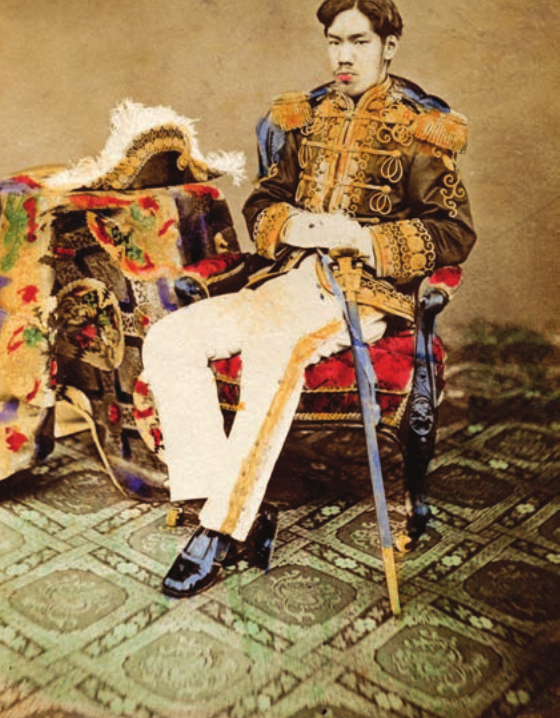
The emergence of the military became a powerful embodiment of nationalist ideology promoted during the Meiji Restoration.
Military models and expansion
Army development:
- Followed Western models, notably Prussian militarism
- Conscription extended in 1890
- By the turn of the 20th century, the Japanese Imperial Army was second only to the German military in size and training
Navy development:
- Followed British naval system organisation
- Acquired modern ships
- Became a significant maritime force
Constitutional military power
The nationalisation of an Imperial Army and Navy was a defining feature of this new militaristic society. Due to the oligarchic 1889 Constitution:
- The military had a powerful political voice
- Could prosecute war without Cabinet approval with the Emperor's endorsement
- Cabinet ministers for War and Navy had to be active generals, ensuring military interests were always represented
Important
The constitutional requirement that War and Navy ministers be active military officers gave the military extraordinary political power. The military could effectively veto any government by withdrawing its ministers, making Cabinet formation impossible.
Motivations for militarism
Japanese militarism emerged from both political necessity and nationalist interest:
Economic factors:
- Shift from agrarian to industrial economy meant Japan increasingly relied on imported food and materials
- Foreign expansion could alleviate resource shortages
- Colonies could provide vital trading partnerships and resources (rubber, metals)
Nationalist factors:
- Common desire to restore the Japanese Empire to greatness
- Determination to reverse the legacy of unequal treaty impositions
- Drive to restore national prestige and wealth
Note
These motivations shaped Japan's virulent militarism and its entry into the 20th century. The combination of economic necessity and nationalist ambition created a powerful drive toward imperial expansion that would dominate Japanese foreign policy for decades.
Military successes and expansion
Japan's military strength was demonstrated through:
- Boxer Rebellion (1900): Intervention in China
- Sino-Japanese War (1894-1895): Victory over China
- Russo-Japanese War (1904-1905): Naval victory against Tsar Nicholas II of Russia
- Anglo-Japanese Alliance (1908): Alliance with Britain
By the beginning of the 20th century, Japan was a modern military nation capable of expansion and strong defence.
Flashpoint: The Russo-Japanese War (1904-1905)
The Russo-Japanese War placed Japan on the world stage. It culminated in a humiliating defeat for the Russian navy at the Tsushima Straits in May 1905.
Causes of the conflict
The war was sparked by:
- Japanese interests in Manchuria and Korea
- Russia's desire to extend influence into these regions
- Russia's plan to build the Trans-Siberian Railway through Manchuria
Note
The conflict over Manchuria and Korea reflected both nations' imperial ambitions. These resource-rich territories were strategically important for controlling trade routes and accessing raw materials.
Casualties
The war was costly for both sides:
- Over 71,000 Japanese casualties
- Over 80,000 Russian casualties
The Portsmouth Treaty
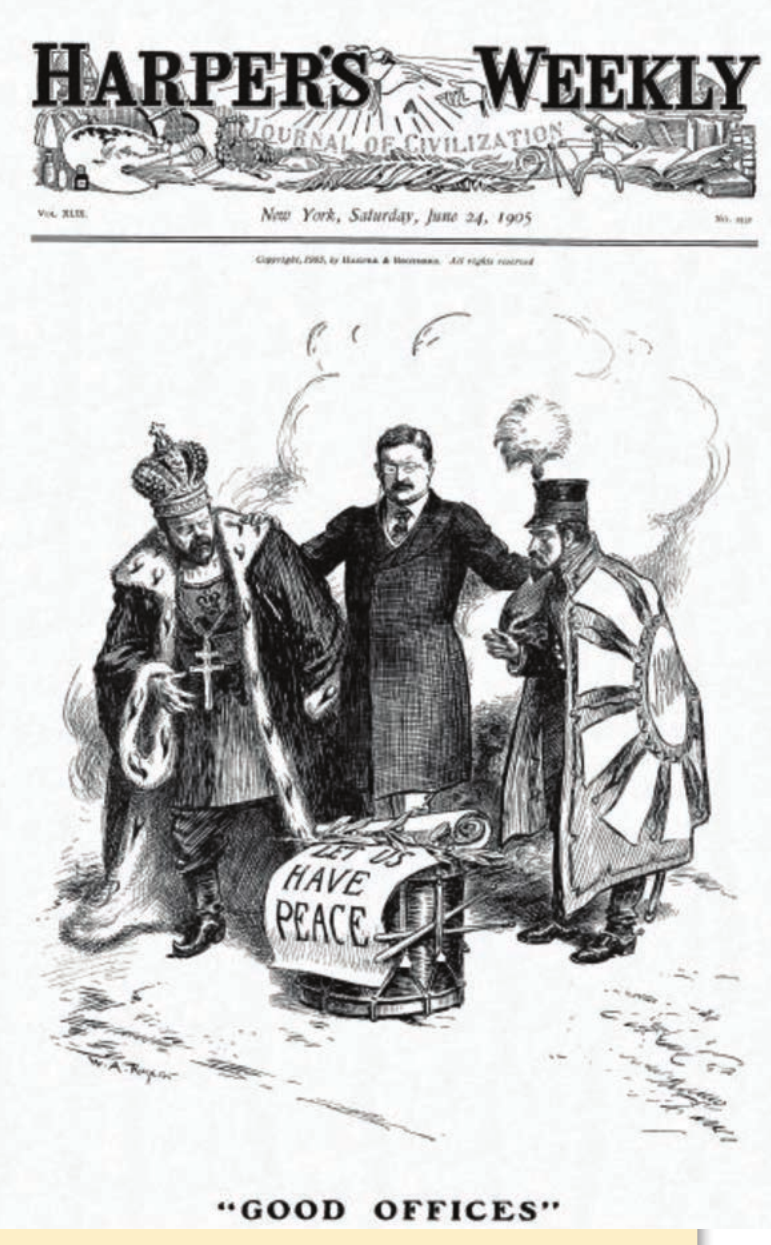
American President Theodore Roosevelt mediated the peace negotiations:
- Met with both the Japanese Emperor and Tsar Nicholas II in Portsmouth
- The Portsmouth Treaty denied Japan considerable territorial concessions
- Roosevelt was awarded the Nobel Peace Prize in 1906 for his mediation efforts
Important
The Portsmouth Treaty was controversial in Japan. While it confirmed Japan's victory, many Japanese felt the treaty failed to adequately compensate Japan for its military success and the lives lost. This disappointment contributed to growing nationalist sentiment and militaristic attitudes in Japanese society.
Remember!
Summary
Key Points to Remember:
Political transformation: The Meiji Constitution of 1889 created a system where the Emperor held supreme power, supported by a two-house Diet with limited legislative authority. Real power remained with the genro (military elite) who influenced the Emperor through the Privy Council.
Economic modernisation: Japan achieved financial independence through land tax reform (1873), introduction of the yen currency (1871), and government-sponsored industrialisation. The zaibatsu (powerful industrial families) drove economic expansion and reduced reliance on Western capital.
Social revolution: The 1872 Education Act established compulsory education, breaking down feudal class barriers and creating a skilled, literate workforce. Education balanced Western technical knowledge with traditional Japanese values of loyalty to the Emperor and state.
Military expansion: Universal conscription (1873) created a powerful army modelled on Prussia and a navy modelled on Britain. By 1905, Japan had defeated both China and Russia, establishing itself as a major military power and reversing the humiliation of earlier unequal treaties.
Modernisation with tradition: Japan successfully adopted Western technology, legal systems, and industrial processes while maintaining reverence for the Emperor and traditional Japanese values. This unique blend of modernisation and tradition transformed Japan from a feudal society into a modern nation-state within a single generation.