Constructing a History of Trump (HSC SSCE Modern History): Revision Notes
📚Revision Notes
Constructing a History of Trump
Introduction
Constructing a historical account of Donald Trump presents unique challenges for historians. As a contemporary figure who has been in the public eye for over 40 years, Trump has generated an enormous amount of material. Since becoming the 45th President of the United States in 2017, the scrutiny and commentary about him has been intense and global in reach. This section examines the specific difficulties historians face when attempting to write about Trump and explores how different types of sources shape our understanding of this controversial figure.

The challenge of contemporary history
Writing history about recent events and living people involves different problems compared to studying more distant historical periods. With Trump, historians must navigate an unprecedented volume of sources while dealing with issues of bias, incomplete evidence, and rapidly changing perspectives.
Note
As Professor Kyle Volk noted, what historians say about Trump in 20 years will likely differ from what they say in 50 or 100 years. The history of Trump, like virtually all others, will be rewritten many times as new evidence emerges and historical perspectives shift.
Problems with sources in the contemporary world
Information overload
The sheer volume of information available about Trump is overwhelming. Throughout his entire business career, Trump appeared in print and other media almost daily. Many books have been written both about him and by him. Since becoming President, Trump has been a constant presence in global news, with countless articles, interviews, and documentaries analysing his every move.
This abundance of material creates several problems for historians:
- Deciding which sources are most important becomes extremely difficult
- Cross-referencing and fact-checking takes enormous time
- Important information can be buried beneath trivial details
- The constant flow of new material makes it hard to establish a definitive account
Important
For anyone constructing a history of Trump, the challenge is not finding sources but rather selecting which ones to use from the vast amount available.
Social media and internet media outlets
The rise of social media has profoundly changed how news is reported and consumed. Facebook and Twitter have become primary news sources for many people, creating new challenges for historians:
Echo chambers: Facebook tailors its newsfeed to individual preferences, meaning people often only see information that already aligns with their worldview. This makes it difficult to assess how different groups perceived Trump and his actions.
Fake news: Fabricated information spreads quickly on the internet and social media. Fake news refers to a concerted effort to fabricate information to influence political opinion or gain financial advantage. The term itself has also become a weapon, used to dismiss legitimate reporting. Historians must carefully verify information from internet sources.
Speed over accuracy: Online media often prioritises being first over being accurate. This can result in errors being widely circulated before corrections are made.
Financial pressure on traditional media: Established news organisations that pride themselves on factual reporting struggle to compete financially because news is available free from so many online sources.
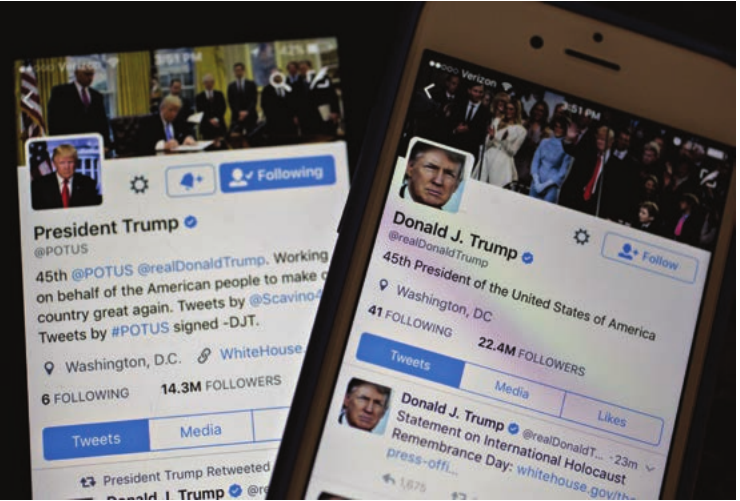
Trump himself has been a master of social media, particularly Twitter. His personal account had over 22 million followers, and as President he also controlled the official @POTUS account with over 14 million followers. His supporters argue that Twitter allows him to communicate directly with the public without his message being filtered by traditional media. For historians, Trump's tweets represent a valuable primary source showing his unfiltered thoughts, but they also raise questions about authenticity, context, and intent.
Political bias
Traditional news sources in the United States are not politically neutral. Understanding this bias is essential when using these sources to construct historical accounts.
Note
Understanding US Media Bias
Left-leaning sources: CNN, ABC, MSNBC, and The New York Times generally lean left politically. These outlets tend to be more critical of Trump and his policies.
Right-leaning sources: Fox News and The Wall Street Journal lean right politically. These outlets are generally more supportive of Trump and conservative positions.
Centrist sources: Some publications attempt to maintain a more balanced position, though complete neutrality is nearly impossible.
This political polarisation means that accounts of the same events can differ dramatically depending on the source. A historian writing about Trump must acknowledge these biases and seek to balance different perspectives. This becomes particularly challenging because journalists within these organisations tend to hold similar political views, creating institutional bias rather than just individual opinion.
Selectivity, emphasis and omission
All historians must select which evidence to include in their accounts. This selection process is inherently political because it shapes how historical figures and events are understood.
Important
Three Key Historiographical Choices
Selectivity: Historians choose which sources to consult and which quotations to include. For example, someone writing a positive account of Trump might rely heavily on conservative sources like Breitbart News (founded by Steve Bannon, who became Trump's chief strategist). Someone writing a critical account might focus on liberal sources like The New York Times.
Emphasis: By dedicating more space to certain aspects of Trump's career or character, historians signal what they consider most important. A biographer might emphasise Trump's business successes or his bankruptcies, depending on their interpretation.
Omission: Historians also choose what to leave out. Information that doesn't support their argument or interpretation may be excluded entirely. This doesn't necessarily involve dishonesty - with limited space, choices must be made - but it does shape the final historical account.
The challenge for historians is to remain as objective as possible whilst acknowledging that complete objectivity is impossible. Many professional writers and commentators write passionately about Trump because they believe his words and actions carry great significance. Historians must strive to balance different perspectives and make their own selection criteria transparent.
Trump biographies and memoirs
Published biographies
Numerous biographies have been written about Donald Trump, particularly around the time of his 2016 presidential campaign. These works vary significantly in their approach and perspective:
Trump Revealed: An American Journey of Ambition, Ego and Power by Michael Kranish and Marc Fisher was written over three months by a team of twenty reporters from the Washington Post, supported by two fact-checkers and three editors. The team wrote more than thirty articles covering all aspects of Trump's life. Trump himself participated in twenty hours of interviews with the reporters. This represents a comprehensive journalistic approach, drawing on the resources of a major newspaper.
The Truth About Trump by Michael D'Antonio involved over three years of research, indicating a more in-depth biographical study.
The Making of Donald Trump by David Cay Johnston drew on the author's thirty years of following Trump "intensely." Johnston described his work as:
a presentation of the facts as I have witnessed them and as the public record shows. They are facts reported with the same flint-eyed diligence as everything else I have written about in the past half century.
Johnston acknowledged in his biography that whilst we can never truly know Trump's character, we can assess it based on his actions and words. This highlights a key challenge in biographical writing - understanding the inner motivations of the subject whilst relying primarily on external evidence.
Note
Each of these biographies brings different perspectives and emphases based on their authors' political leanings, research methods, and interpretations of evidence. There is no single "authoritative" biography of Trump; instead, historians must consider multiple accounts to develop a rounded understanding.
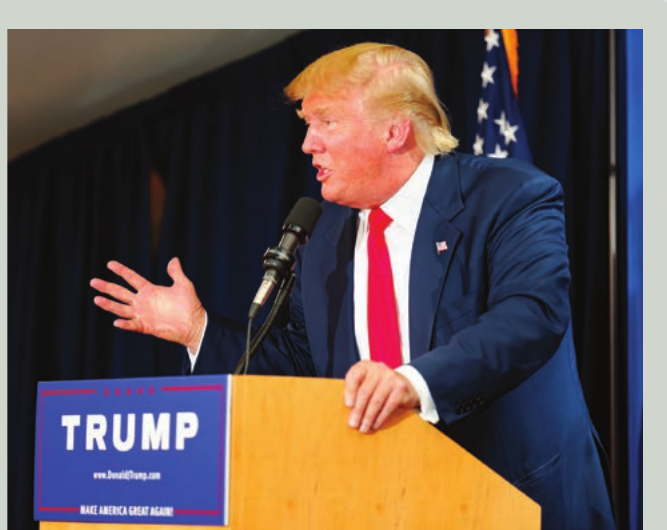
Trump's own writings
Trump has written numerous books about himself, including memoirs, business advice books, and political works. These provide valuable insight into how Trump wants to be perceived, though they must be used critically as historical sources.
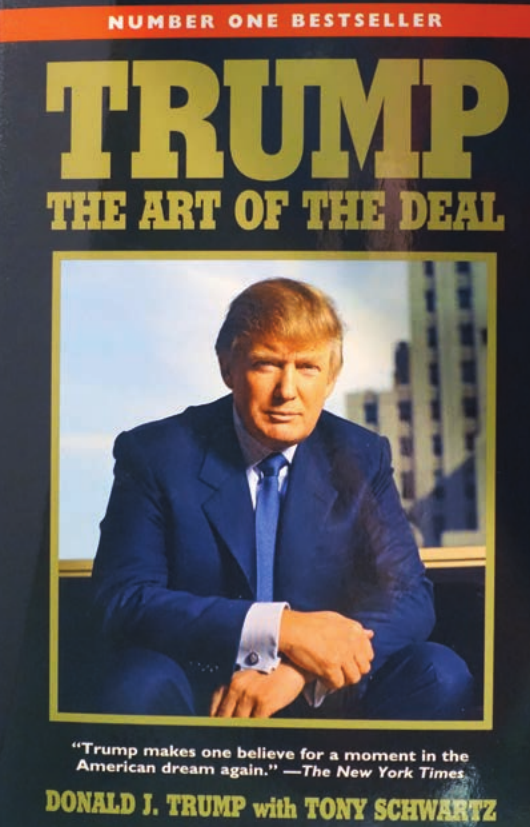
The Art of the Deal (1987) became a bestseller and established Trump's public persona as a successful businessman. In this book, Trump was remarkably candid about his business practices and his approach to media relations.
Crippled America: How to Make America Great Again (2015) was released during the presidential campaign, combining memoir with political manifesto.
Trump's books were written with the assistance of ghost writers but clearly reflect his voice and perspective. According to journalist Carlos Lozada, who read all 2,212 pages of Trump's books in 2015, consistent themes emerged:
Example
Consistent Themes in Trump's Writings
Carlos Lozada identified these recurring patterns across Trump's books:
- Constantly mentioning his achievements
- Use of exaggeration and "truthful hyperbole"
- Frequent insults, as if making sure readers stay engaged
- Describing his buildings as if they were living beings, friends or lovers
- Reluctance to admit mistakes
- Confrontations with news media
- Demanding absolute loyalty from associates
- Vengefulness: "If someone screws you, screw them back"
Key Finding: Lozada concluded that Trump's world is binary, divided into "class acts and losers". The discipline of book writing did not moderate Trump's personality but rather presented it in concentrated form.
Trump's relationship with publicity
Throughout his career, Trump prioritised attracting publicity above almost everything else. According to the biography Trump Revealed, his daily routine included reading everything written about him the previous day. He was quick to contact journalists if he disapproved of their coverage.
Crucially, Trump viewed even negative publicity as beneficial because it kept him in the news. As he explained in The Art of the Deal:
One thing I've learned is that the press is always hungry for a good story, and the more sensational the better... Sometimes they write positively and sometimes they write negatively. But from a pure business point of view, the benefits of being written about have far outweighed the drawbacks.
This approach to media manipulation became central to Trump's business success and later his political career. Understanding this relationship with publicity is essential for historians attempting to separate Trump's carefully crafted image from underlying realities.
The concept of "truthful hyperbole"
One of Trump's most revealing self-descriptions comes from his explanation of how he promotes his properties and himself. In The Art of the Deal, he introduced the concept of "truthful hyperbole":
Important
Defining "Truthful Hyperbole"
The final key to the way I promote is bravado. I play to people's fantasies. People may not always think big themselves, but they can still get very excited by those that do. That's why a little hyperbole never hurts. People want to believe that something is the biggest and the greatest and the most spectacular. I call it truthful hyperbole. It's an innocent form of exaggeration – and a very effective form of promotion.
Hyperbole means language used deliberately to exaggerate, to emphasise something, to add humour, or to gain attention. When people use hyperbole, they often make statements that are obviously untrue.
Trump's embrace of "truthful hyperbole" as a business strategy creates particular challenges for historians. When Trump makes a claim, historians must determine:
- Is this statement literally true?
- Is it exaggerated for effect?
- Is it completely false?
- What was Trump's intent in making this statement?
This ambiguity runs throughout Trump's public statements and writings, making it difficult to establish factual accounts of events he describes.
Trump's worldview in his writings
Analysis of Trump's books reveals a consistent worldview that influenced his approach to both business and politics. Journalist Dylan Matthews summarised Trump's philosophy as fundamentally "zero-sum" - meaning Trump viewed life as a series of competitions where one person's gain is another's loss.
According to Matthews' analysis:
[Trump's] always believed in the fundamental zero-sum nature of the world. Whether he's discussing real estate in New York, or his '00s reality TV career, or his views on immigration and trade, he consistently views life as a succession of deals. Those deals are best thought of as fights over who gets what share of a fixed pot of resources. The idea of collaborating for mutual benefit rarely arises. Life is dealmaking, and dealmaking is about crushing your enemies.
Note
This worldview helps explain many of Trump's actions and statements. Rather than seeking win-win solutions or compromises, Trump approaches situations as contests with clear winners and losers. For historians, understanding this philosophy provides context for interpreting Trump's decisions and rhetoric.
However, historians must be careful not to reduce Trump's complex personality and motivations to a single explanatory framework. Multiple factors influence any historical figure's actions, and oversimplification can lead to misleading conclusions.
The challenge of objectivity
Constructing a balanced historical account of Trump is particularly challenging because he inspires such strong reactions. Perspectives on Trump range from viewing him as a defender of traditional American values to seeing him as a threat to democracy itself.
Professional historians and commentators often write passionately about Trump because they believe his actions carry great historical significance. Some see him as a transformative figure who challenged political establishments, whilst others view him as dangerous to democratic institutions.
Important
The Historian's Challenge
For historians, the challenge is to:
- Acknowledge their own perspectives and potential biases
- Consult sources representing different viewpoints
- Focus on verifiable facts rather than opinions
- Distinguish between Trump's self-presentation and documented actions
- Consider multiple interpretations of the same events
- Recognise that historical understanding will evolve over time
The study of Trump demonstrates that historical writing is not simply recording "what happened" but involves interpretation, selection, and perspective. Different historians, writing at different times and from different political positions, will construct different histories of Trump.
Summary
Key Points to Remember:
-
Constructing a history of Donald Trump presents unique challenges due to information overload - the sheer volume of sources about him is unprecedented.
-
Social media, particularly Twitter, has fundamentally changed how historical sources are created and distributed, whilst also spreading fake news rapidly and creating echo chambers where people only encounter information confirming their existing views.
-
Political bias in US media sources (with outlets leaning left or right) means historians must carefully balance different perspectives when constructing accounts of Trump.
-
All historical writing involves selectivity, emphasis, and omission - historians choose which sources to use, what to highlight, and what to leave out, and these choices shape the final historical account.
-
Trump's own writings reveal his approach of "truthful hyperbole" - deliberate exaggeration for promotional effect - which creates challenges for historians trying to establish factual accounts of his career and actions.
-
Understanding Trump's zero-sum worldview and his relationship with publicity provides essential context for interpreting his actions and statements throughout his career.