President Trump (HSC SSCE Modern History): Revision Notes
📚Revision Notes
President Trump
Trump's first weeks in power
Before taking office, many people wondered whether Donald Trump would moderate his behaviour as President, choose a broad team for his executive, and rethink his most controversial policies, such as building a wall with Mexico or banning Muslims from entering the United States. However, this did not happen, and Trump's presidency was marked with controversy from the very first day.
Inauguration day: 20 January 2017
On 20 January 2017, Donald Trump was sworn in as the 45th President of the United States. The inauguration is a ceremony that marks the formal beginning of a President's term.
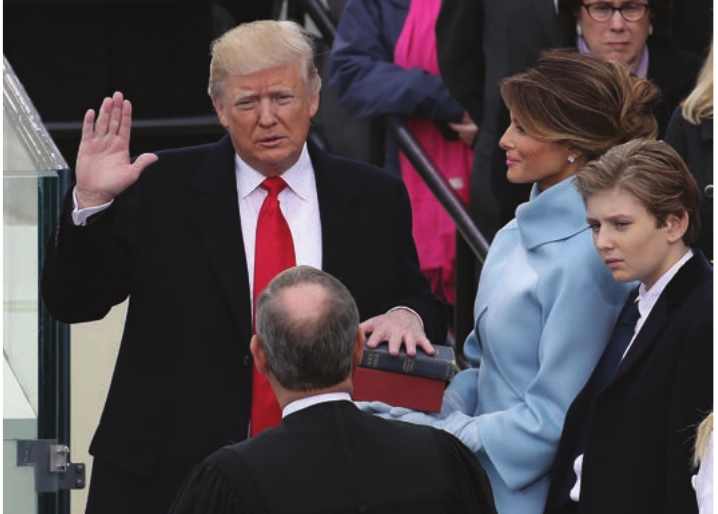
In his inauguration speech, Trump declared that he would put America first and that America would start winning again, winning like never before.
The crowd size controversy
Right after the ceremony, controversy erupted. Commentators estimated that the crowd numbers on the streets for the inauguration were low and much smaller than they had been for Obama's inauguration in 2008.
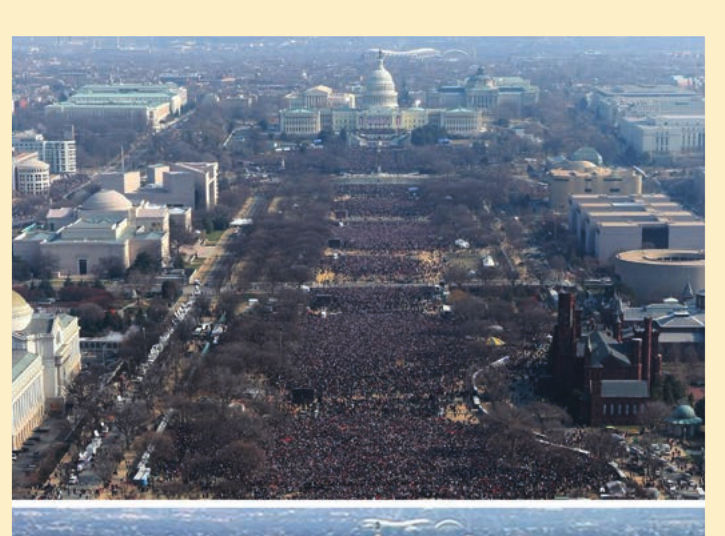
Sean Spicer, President Trump's new press secretary, claimed that this was the largest audience ever to witness an inauguration and expressed outrage, condemning the press for giving deliberately false reports. Kellyanne Conway, the White House counsellor, defended Spicer's comments, calling them alternative facts.
Important
Alternative Facts: A New Concept in Political Discourse
Alternative facts are politically created 'facts' that do not match reality. This term became widely discussed as an example of how the Trump administration handled information that contradicted their claims. The concept of "alternative facts" emerged on the very first day of Trump's presidency and became a defining characteristic of his administration's relationship with truth and the media.
The Women's March: 21 January 2017
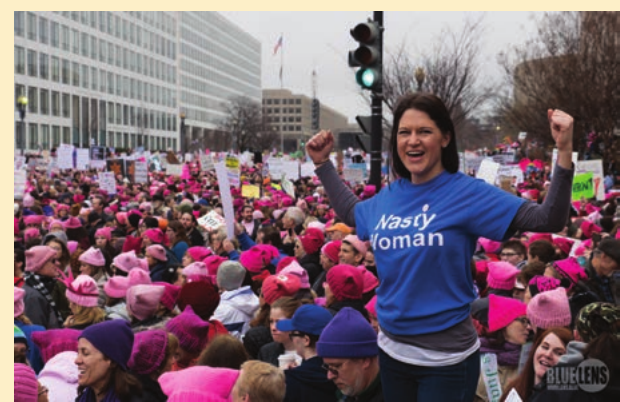
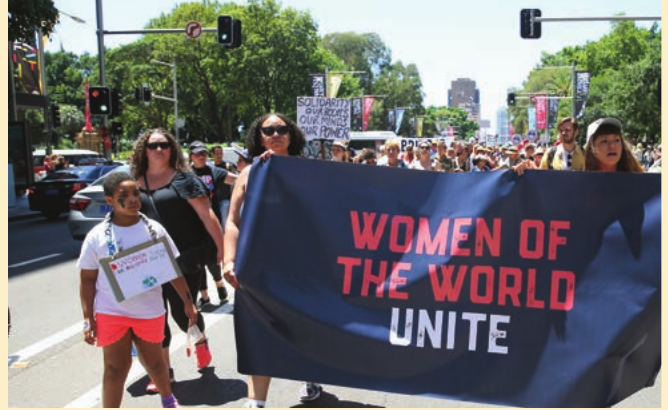
On 21 January 2017, the day after President Trump's inauguration, mass women's protest marches took place across the United States and around the world. Over half a million protesters took to the streets in Washington DC, in the same location where the inauguration had taken place the day before.
Note
The Women's March Message
According to the Women's March website, the aim of the march was to send a bold message to the new government on their first day in office, and to the world, that women's rights are human rights. The organisers stated they stood together, recognising that defending the most marginalised among us is defending all of us.
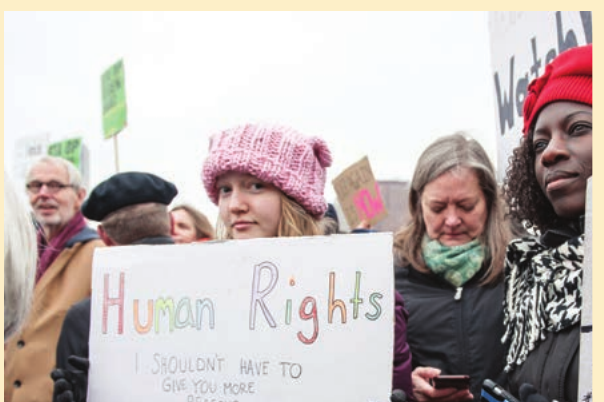
Marches were also held in the capital cities of Australia and elsewhere in the world. One commentator described it as a human rights demonstration of historic proportions.
Supreme Court nomination
One key election issue was that the winning President would get to choose a new Supreme Court judge. The US Constitution requires the President to nominate justices to the Supreme Court, subject to the advice and consent of the Senate. In the US justice system, these judges hold significant power and serve for life.
Justice Antonin Scalia died in early 2016 and needed to be replaced. Therefore, the choice of a Supreme Court judge became an important election issue for voters. Supporters knew that Democrat Hillary Clinton would choose a liberal judge and Republican Donald Trump would choose a conservative one.
Donald Trump scored political points with conservatives when he appointed Neil Gorsuch to the Supreme Court on 31 January 2017. According to reports, Gorsuch was known for his strong conservative stance on key issues such as:
- Abortion
- Gun control
- The death penalty
- Religious rights
Note
Why the Gorsuch Nomination Mattered
The Gorsuch nomination was significant for Trump because it fulfilled a key campaign promise and secured the support of conservative voters who had prioritised this issue during the election. Supreme Court justices serve for life, meaning this appointment would influence American law for decades to come.
Timeline: The first month of Trump's presidency
The following timeline documents the key events and actions during Trump's first 30 days in office:
Week 1: Days 1-7
Day 1 (Friday 20 January): Inauguration. Controversy erupted over low turnout for Trump compared to Obama's inauguration in 2008, and the use of alternative facts by Trump's team.
Day 2 (Saturday 21 January): Women's marches against Trump took place across the United States and other countries around the world.
Day 3 (Sunday 22 January): Trump phoned Prime Minister Benjamin Netanyahu of Israel.
Day 4 (Monday 23 January): Trump's first Executive Order saw the United States pull out of the Trans-Pacific Partnership. Controversy arose when Trump claimed that votes from 3-5 million illegal immigrants cost him the popular vote in the election.
Day 5 (Tuesday 24 January): Trump signed five Executive Orders.
Day 6 (Wednesday 25 January): Executive Order to begin construction of the wall with Mexico.
Day 7 (Thursday 26 January): Mexican President Enrique Peña Nieto cancelled his meeting with President Trump.
Week 2: Days 8-14
Day 8 (Friday 27 January): Executive Order issued. Trump banned entry to the United States of any citizen from Iraq, Iran, Libya, Somalia, Sudan, Syria or Yemen for 90 days. Known as the Muslim travel ban, this sparked mass protests in the United States and around the world.
Important
The Muslim Travel Ban Controversy
The travel ban was one of Trump's most controversial early actions. It immediately sparked mass protests across the United States and internationally, with concerns raised about religious discrimination and the treatment of refugees and immigrants. Courts would later challenge this executive order multiple times.
Day 9 (Saturday 28 January): Trump spoke with a number of foreign leaders by phone, including Vladimir Putin (Russia), Angela Merkel (Germany) and Shinzo Abe (Japan).
Day 10 (Sunday 29 January): Trump sacked Sally Yates from the position of acting Attorney-General for defying his immigration order.
Day 11 (Monday 30 January): No major recorded events.
Day 12 (Tuesday 31 January): Trump nominated Neil Gorsuch to fill the Supreme Court vacancy.
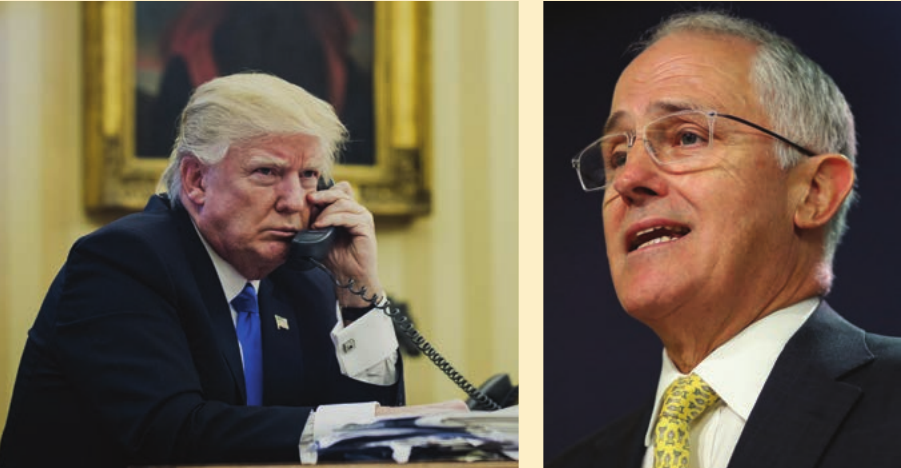
Day 13 (Wednesday 1 February): Controversy erupted after Trump spoke on the phone with Australian Prime Minister Malcolm Turnbull about a refugee deal. Trump later tweeted that it was the worst phone call and a dumb deal.
Day 14 (Thursday 2 February): No major recorded events.
Week 3: Days 15-21
Day 15 (Friday 3 February): Trump re-imposed sanctions on Iran.
Day 16 (Saturday 4 February): No major recorded events.
Day 17 (Sunday 5 February): Appeals Court denied request for the immigration ban to be reinstated.
Day 18 (Monday 6 February): Appeals Court of the Ninth Circuit refused to restore the immigration ban.
Day 19 (Tuesday 7 February): Betsy DeVos was appointed Secretary of Education with a 51-50 vote in the Senate, with the Vice-President using his deciding vote.
Day 20 (Wednesday 8 February): Jeff Sessions was appointed Attorney-General despite allegations he had expressed racist views in the past.
Day 21 (Thursday 9 February): Ninth Circuit again refused to block a lower court ruling that blocked the President's immigration order. President Trump agreed to follow the One China policy in discussion with China's President Xi Jinping.
Note
Understanding the One China Policy
The One China policy is a policy that originated in 1979 from an agreement that involved the United States shifting its embassy from Taiwan to China and officially acknowledging that Taiwan was a part of China. The United States continues unofficial relations with Taiwan. This was a significant diplomatic commitment that Trump initially questioned but ultimately upheld.
Week 4: Days 22-28
Day 22 (Friday 10 February): President Trump met with Prime Minister Shinzo Abe from Japan.
Day 23 (Saturday 11 February): North Korean missile test occurred.
Day 24 (Sunday 12 February): No major recorded events.
Day 25 (Monday 13 February): President Trump met with Canadian Prime Minister Justin Trudeau. Michael Flynn resigned as National Security Adviser over secret Russian meetings.
Day 26 (Tuesday 14 February): No major recorded events.
Day 27 (Wednesday 15 February): President Trump met Prime Minister Benjamin Netanyahu of Israel. Both abandoned the two-state solution.
Note
The Two-State Solution
The two-state solution is the goal to establish an independent State of Palestine alongside the State of Israel. This has been the agreed basis of peace negotiations, from all stakeholders, for decades. Trump and Netanyahu's abandonment of this long-standing policy framework marked a significant shift in Middle East diplomacy.
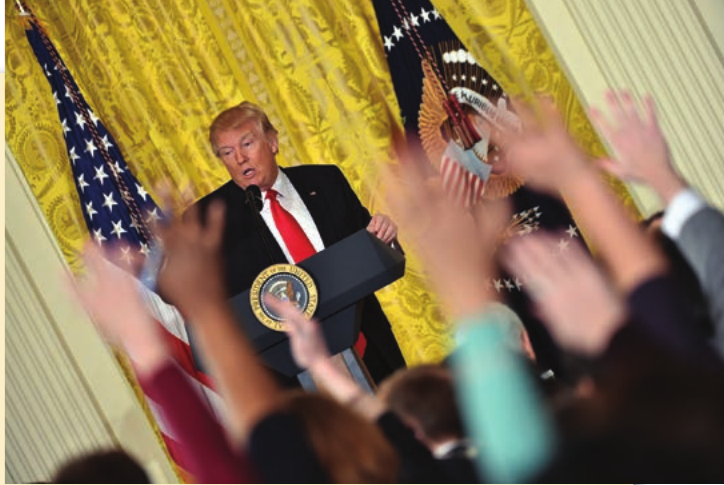
Day 28 (Thursday 16 February): Press conference. President Trump defended his administration's work, made statements many deemed to be false and attacked the press for being dishonest.
The Day 28 press conference
On his 28th day as President, Donald Trump held a 77-minute press conference in the White House. Most of the press conference consisted of a monologue by the President during which he made a number of assertions.
Trump's claims
Trump stated that:
- He had inherited a mess when he took power
- There had been no other president who had done so much in so short a time
- His cabinet would be one of the greatest ever assembled in history and his government was making incredible progress and running like a fine-tuned machine
- He had a bigger Electoral College vote than the last few presidents
- There had been a very smooth roll-out of the travel ban
- The press was out of control and the media was the real enemy
- The story of his administration's links with Russia was fake news
- A nuclear holocaust would be like no other
Important
Questionable Claims and Fact-Checking
Many of Trump's claims during the press conference were disputed by fact-checkers. For example, his claim about having a bigger Electoral College vote than recent presidents was demonstrably false - both Obama and Clinton had larger Electoral College victories. His characterization of the travel ban rollout as "smooth" contradicted widespread reports of chaos at airports and legal challenges.
Trump's behaviour during questions
During the question period, President Trump:
- Scolded an Orthodox Jewish reporter for asking about rising anti-Semitism in America
- Asked a black reporter whether members of the Congressional Black Caucus were friends of hers
- Refused to answer any questions from media outlets he did not like
- Refused to answer questions about his links with Russia
Media reactions
The media had a variety of views about the press conference. USA Today, known for their lack of political bias, called it one of the wildest presidential press conferences on record. One journalist commented that in many ways, the performance summed up Trump's first four weeks in office - a 180-degree reversal from the no drama days of the Obama administration, led by a cautious, diplomatic President who tried to steer clear of controversy.
Conservative commentators had a different view. According to The Wall Street Journal, President Trump defended his administration and his campaign from questions about their association with Russian officials. Conservative analyst Rush Limbaugh argued on a radio show that this was one of the most effective press conferences he had ever seen, noting that the press would hate Trump even more after this, but it would rally people who voted for him to stay with him.
Many left-wing media outlets strongly criticised Trump. The Guardian called it an anti-press conference and a freak show. Other press outlets had headlines describing it as fiery, combative, surreal, free-wheeling, unhinged, a spectacle for the ages and an amazing moment in history.
Week 5: Days 29-30
Day 29 (Friday 17 February): No major recorded events.
Day 30 (Saturday 18 February): Florida rally with 9000 supporters. President Trump defended his actions and attacked the fake media.
The Florida rally
Two days after his controversial press conference and on Day 30 of his term as President, Donald Trump spoke confidently to a gathering of 9000 people in Florida in an event that was more like a campaign rally.
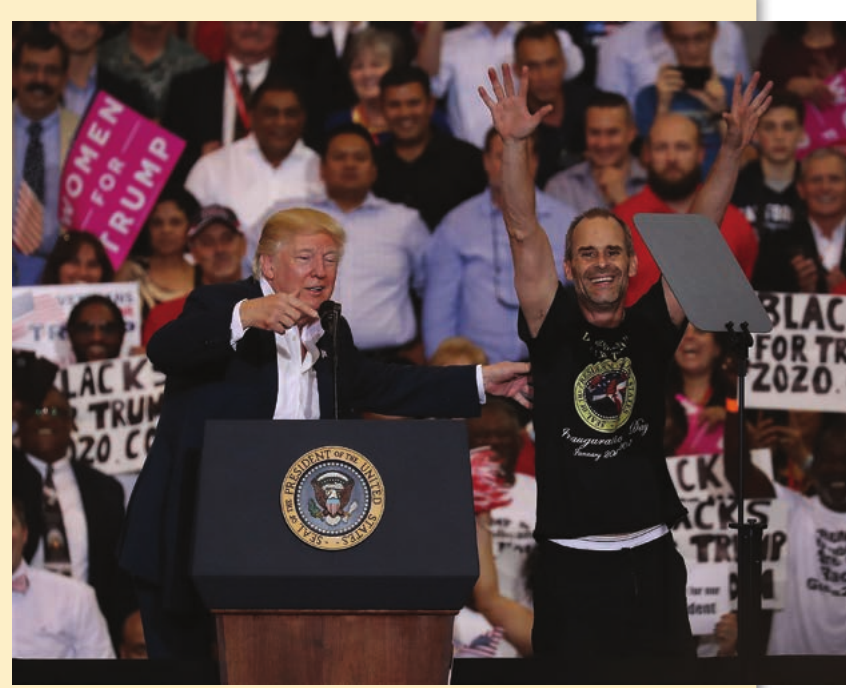
Among other things, Trump promised to:
- Create more jobs in the United States
- Repeal Obamacare (a name given to the Affordable Care Act, a law introduced by President Obama in 2010 to make it easier for people in the United States to get insurance for medical treatment)
- Rebuild the military
- Totally destroy the Islamic State (an Islamist terrorist organisation, formed in the early twenty-first century)
Note
Key Policy Targets
Two of Trump's main policy targets were Obamacare (the Affordable Care Act) and the Islamic State. Repealing Obamacare was a central Republican campaign promise, while destroying the Islamic State represented Trump's approach to counter-terrorism and foreign policy.
He also highlighted a terrorist attack that occurred last night in Sweden, though this was later reported as false. Trump then criticised the dishonest media and said that reporters were part of a corrupt system reporting fake news.
The Florida rally showed that there was a large number of Americans who supported Donald Trump and who saw him as an inspirational leader. The day after the Florida rally, a commentator wrote that most people who voted for Trump were responding to him with cheers, not boos. He concluded that absent any major debacle - another disastrous war or economic crash - Trump's supporters would continue to believe that he represented the only solution to a broken political process and rigged economic system. The media's criticism would only harden that belief.
Key themes of Trump's first month
The first 30 days of Trump's presidency revealed several defining characteristics that would shape his time in office.
Executive action and policy
Trump's first month was characterised by rapid executive action. He signed numerous Executive Orders, including:
- Withdrawing from the Trans-Pacific Partnership
- Beginning construction of a wall with Mexico
- Implementing the travel ban on citizens from seven predominantly Muslim countries
Note
Executive Orders as Presidential Power
Executive Orders are official directives from the President that manage operations of the federal government. Trump's use of Executive Orders in his first month demonstrated his preference for quick, unilateral action rather than working through Congress. This approach allowed him to immediately pursue campaign promises but also led to legal challenges.
Controversial appointments
Several cabinet and judicial appointments proved controversial:
- Neil Gorsuch to the Supreme Court (conservative stance)
- Betsy DeVos as Secretary of Education (narrow Senate vote)
- Jeff Sessions as Attorney-General (allegations of past racist comments)
- Firing of Sally Yates for defying the immigration order
International relations
Trump's first month involved significant international engagement:
- Phone calls with leaders from Russia, Germany, Japan, Israel, Canada and Australia
- Some calls were controversial, particularly with Australian Prime Minister Turnbull
- Agreement to follow the One China policy
- Abandoning the two-state solution with Netanyahu
Important
Diplomatic Disruption
Trump's approach to international relations marked a departure from traditional diplomatic norms. His phone call with Australian Prime Minister Turnbull, which he described as the "worst" call and a "dumb deal," created tension with a long-standing ally. His initial questioning of the One China policy raised concerns about stability in US-China relations.
Relationship with the media
A defining feature of Trump's first month was his contentious relationship with the media:
- Disputes over crowd sizes and alternative facts
- Claims of fake news
- Attacking the press as the real enemy
- Refusing questions from certain media outlets
Remember!
Summary
Key Points to Remember:
-
Donald Trump was inaugurated as the 45th President of the United States on 20 January 2017, with immediate controversy over crowd size and the concept of alternative facts.
-
The day after inauguration, over 500,000 people participated in the Women's March in Washington DC, with global protests focusing on women's rights as human rights.
-
Trump's appointment of Neil Gorsuch to the Supreme Court on 31 January 2017 was significant for securing conservative support on key issues like abortion, gun control and religious rights.
-
Trump's first 30 days involved numerous executive orders, including withdrawal from the Trans-Pacific Partnership, beginning construction of the Mexico wall, and the controversial Muslim travel ban affecting seven countries.
-
The relationship between the Trump administration and the media was contentious from Day 1, with disputes over facts, accusations of fake news, and the Day 28 press conference showcasing this tension.