Trump’s First 100 Days in Office (HSC SSCE Modern History): Revision Notes
📚Revision Notes
Trump's first 100 days in office
Introduction: A candid reflection
By the 100-day mark of his presidency, Donald Trump offered a surprisingly honest assessment of his new role. In an interview with Reuters News Agency on 28 April 2017, Trump admitted a revealing truth about the presidency:
Note
Trump's Honest Assessment:
"I loved my previous life. I had so many things going. This is more work than in my previous life. I thought it would be easier."
— Donald Trump, Reuters interview, 28 April 2017
This reflection captured the essence of Trump's first 100 days: a rocky beginning marked by controversies and setbacks, but also some successes that pleased his supporter base. Trump's administration began navigating the complex realities of governing, often finding it more challenging than anticipated.
Trump's battle with the media
The unprecedented press ban (Day 36)
On 24 February 2017, President Trump took an unprecedented step in his ongoing conflict with mainstream media. He barred several major news organisations from a White House press briefing, escalating tensions between the administration and the press to a new level.
The banned outlets included prominent organisations that had been critical of the Trump administration:
- The New York Times
- The Los Angeles Times
- CNN
- Politico
White House Press Secretary Sean Spicer defended the decision, stating: "I think we're going to aggressively push back ... We're just not going to sit back and let false narratives, false stories, inaccurate facts get out there."
Press freedom concerns
This action sparked widespread criticism and raised serious concerns about press freedom. Left-wing commentators, including The Guardian's Lawrence Douglas, argued that Trump viewed the media as his primary opposition and sought to silence critical voices. This interpretation suggested an attack on free speech, considered a fundamental pillar of democracy.
Important
Even conservative Fox News, which was allowed to attend the briefing, joined other news outlets in condemning the move. This rare unity across the political spectrum highlighted the seriousness of concerns about press freedom.
Ben Smith, editor-in-chief of BuzzFeed News, stated: "While we strongly object to the White House's apparent attempt to punish news outlets whose coverage it does not like, we won't let these latest antics distract us from continuing to cover this administration fairly and aggressively."
Trump's "fake news" narrative
Trump continued his aggressive stance against the media. Speaking at the Conservative Political Action Conference (CPAC) on 24 February 2017, he declared: "I want you all to know that we are fighting the fake news. It's fake, phony, fake. A few days ago, I called the fake news 'the enemy of the people', and they are. They are the enemy of the people. Because they have no sources. They just make them up when there are none."
This rhetoric of "fake news" became a defining feature of Trump's relationship with the media throughout his presidency. It represented his strategy of discrediting unfavourable coverage and maintaining direct communication with his supporter base.
Foreign policy flashpoint: The Syria missile attack
Background and policy reversal
On 31 March 2017, key Trump administration officials made a significant foreign policy statement. Nikki Haley, US Ambassador to the UN, and Rex Tillerson, Secretary of State, announced a reversal of Obama-era US foreign policy. They stated that the US would no longer focus on removing Syria's President Bashar al-Assad from power.
The chemical weapons attack
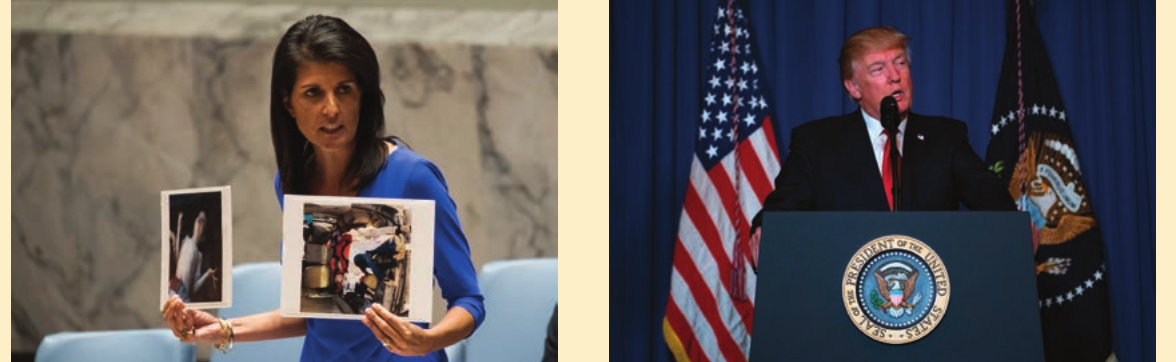
This position changed dramatically just days later. On 4 April 2017, the Syrian air force launched a devastating chemical weapons attack on the town of Khan Shaykhun in the Idlib region of Syria. President Trump swiftly condemned the attack. Ambassador Nikki Haley returned to the UN Security Council to present evidence of the attack and condemn the Syrian government's actions.
US military response (Day 28)
On 6 April 2017, President Trump authorised a surprise retaliatory missile strike against Syria. The operation involved:
Note
Operation Details:
- 59 precision-guided missiles launched
- Target: Shayrat Airfield in Syria
- Objective: To destroy the base from which Washington believed the chemical attack was launched
International reaction
Trump's decision to launch the missile attack received widespread international support. Many world leaders praised the swift action against the use of chemical weapons. However, the strike complicated US relations with Russia, a key ally of the Syrian government. This incident demonstrated the complex balancing act required in international diplomacy.
Important
The Syria response raised questions about Trump's "America First" foreign policy. While he had campaigned on reducing American involvement in foreign conflicts, this action showed the US continuing its traditional role as what some called the "global policeman" - intervening in international affairs when deemed necessary.
Judging presidential performance after 100 days
The 100-day tradition
New US presidents are traditionally assessed after their first 100 days in office. According to historian Dale S. Kuehne, "this exercise is based on the assumption that by this time we can evaluate the effectiveness of a President and predict his future promise."
Trump himself had mixed feelings about this tradition. He called the 100-day assessment a "ridiculous standard" on Twitter. Yet he also claimed to have brought "profound change" as President, asserting that "the first 100 days of my administration has been just about the most successful in our country's history."
Marking the milestone
Trump chose to mark his 100 days with an election-style rally in Pennsylvania, maintaining his connection with his voter base. Simultaneously, across America and in solidarity rallies worldwide, tens of thousands of Trump opponents marched against his policies. These protests focused particularly on:
- His stance on climate change
- His crackdown on illegal immigration
- Various other policy positions
These parallel events - the Trump rally and the protest marches - symbolised the deep division in America over Trump's presidency.
Achievements versus failures
Media organisations worldwide attempted to balance Trump's successes and setbacks. The UK newspaper The Telegraph published an analysis on 29 April 2017 titled "What are Donald Trump's achievements and failures in his first 100 days as president?" Their assessment provided a comprehensive overview:
Achievements:
- Supreme Court nomination - Successfully nominated Neil Gorsuch to the Supreme Court, securing a conservative majority
- Withdrawal from the Trans-Pacific Partnership - Fulfilled campaign promise to exit this trade agreement
- Illegal border crossings - Reduction in illegal border crossings, partly due to enhanced enforcement
- National security - Increased focus on military readiness and defence spending
Failures:
- Travel ban - Multiple legal challenges blocked his executive order restricting travel from certain Muslim-majority countries
- Drain the swamp - Failed to reduce Washington insider influence as promised
- Healthcare - Unable to repeal and replace Obamacare despite Republican control of Congress
- Mike Flynn's resignation - National Security Advisor resigned after just 24 days due to Russia controversy
- Build the wall - No significant progress on constructing border wall with Mexico
- $1 trillion infrastructure program - Campaign promise remained unfulfilled
- White House infighting - Numerous reports of internal conflicts and disorganisation
- The presidential voice - Controversial tweets and statements causing diplomatic incidents
- Executive branch job vacancies - Slow pace of appointments left many key positions unfilled
Note
The Telegraph's summary was typical of media analysis at that point. While Trump achieved some notable wins, the failures list was significantly longer, suggesting a challenging start to his presidency.
Approval ratings: Record lows
Historical comparison
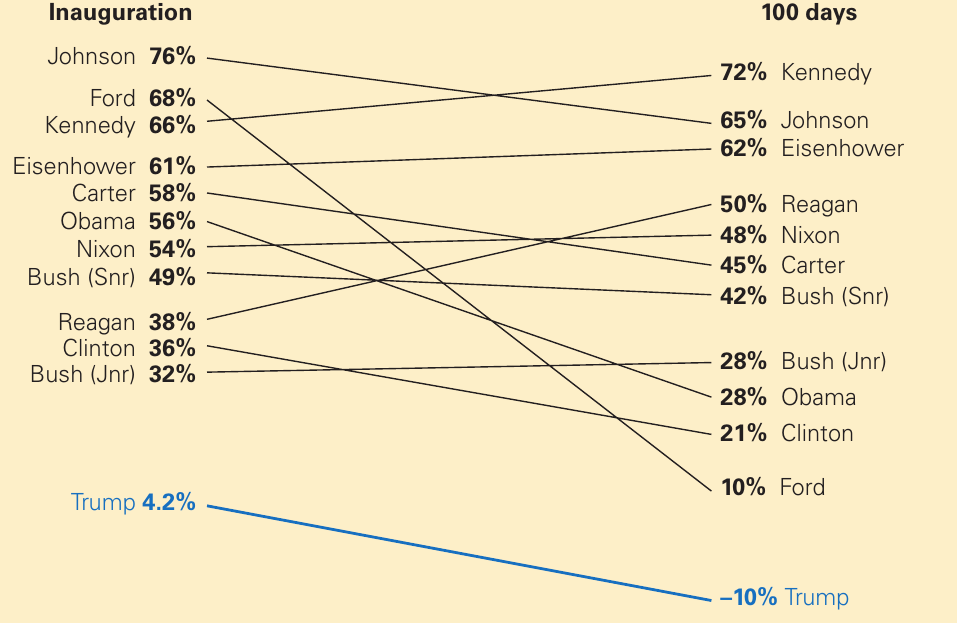
According to opinion polls, Trump had the lowest approval ratings of any US president after 100 days in office. The data revealed a stark contrast with his predecessors.
Note
Understanding approval ratings: These are calculated by subtracting the percentage of Americans who disapprove from the percentage who approve.
Trump's trajectory was unique:
- At inauguration: 4.2% approval rating (already historically low)
- After 100 days: -10% approval rating (unprecedented negative rating)
By comparison, most recent presidents had much higher ratings:
- Kennedy: Started at 66%, reached 72% after 100 days
- Johnson: Started at 76%, maintained 65% after 100 days
- Obama: Started at 56%, ended at 28% after 100 days
- Even Ford, who had the previous lowest rating, started at 68% and dropped to only 10%
The partisan divide
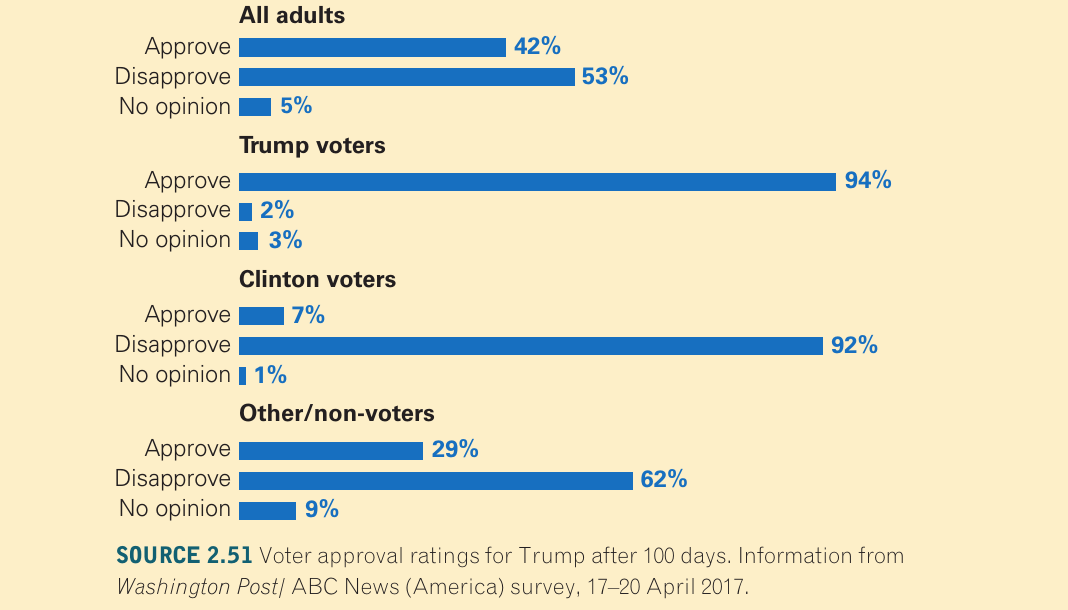
Despite these overall low approval ratings, Trump's support remained remarkably strong among his own voters. A Washington Post/ABC News survey from 17-20 April 2017 revealed the deep partisan divide:
All adults:
- Approve: 42%
- Disapprove: 53%
- No opinion: 5%
Trump voters:
- Approve: 94% (extraordinarily high loyalty)
- Disapprove: 2%
- No opinion: 3%
Clinton voters:
- Approve: 7%
- Disapprove: 92%
- No opinion: 1%
Other/non-voters:
- Approve: 29%
- Disapprove: 62%
- No opinion: 9%
What the numbers reveal
These statistics demonstrated several important points:
Important
Extreme polarisation: Trump's presidency created one of the most divided political landscapes in modern American history. The 94% approval among his own voters contrasted sharply with just 7% approval among Clinton voters.
- Loyal base: Despite controversies and setbacks, Trump's core supporters remained remarkably loyal. This 94% approval rating among his voters was extraordinarily high and showed their continued faith in his presidency.
- Overall unpopularity: While his base was loyal, Trump failed to appeal to the broader American population, resulting in historically low overall approval ratings.
- Limited crossover appeal: The data showed Trump had almost no support among opposition voters, unlike some previous presidents who managed to win over voters from the other party.
A nation divided
The underlying reality
Trump's 100 days ended as they had begun - with America profoundly divided in opinion over the man and what he represented. The opinion polls revealed a nation split along political lines more sharply than perhaps any time in recent history.
Understanding the division
Several factors contributed to this division:
- Political outsider status: Trump's unconventional approach to politics and governance appealed strongly to some Americans while alienating others. His supporters valued his directness and rejection of political norms; his critics saw it as unpresidential and dangerous.
- Media coverage: The intense and often negative media coverage reinforced existing opinions rather than changing minds. Trump supporters dismissed critical coverage as "fake news," while his opponents saw it as necessary accountability.
- Policy positions: Trump's stances on immigration, trade, and foreign policy resonated strongly with his base but were deeply opposed by liberals and moderates.
- Communication style: His use of Twitter and aggressive rhetoric excited supporters but concerned those who valued traditional presidential decorum.
The historical significance
Any historical account of the rise of Donald Trump must acknowledge a crucial fact: despite the controversies, setbacks, and record-low approval ratings, Trump's brand of politics appealed to at least 62 million American voters. His supporter base remained remarkably loyal throughout these tumultuous first 100 days.
Note
This loyalty suggested that Trump had successfully tapped into genuine concerns and frustrations among a significant portion of the American electorate. Whether viewed as a positive or negative development, this represented a major shift in American political culture that would have lasting implications.
Summary
Key Points to Remember:
-
Trump's first 100 days were marked by significant controversies, including an unprecedented ban on certain media outlets and ongoing battles with the press over "fake news."
-
The Syria missile strike on Day 28 showed Trump's willingness to use military force and represented a reversal of his stated "America First" non-interventionist policy.
-
Trump achieved some successes (Supreme Court nomination, TPP withdrawal) but faced more failures (travel ban, healthcare reform, border wall), according to media assessments like The Telegraph's analysis.
-
Trump had the lowest approval ratings of any president at the 100-day mark (-10%), but maintained extraordinarily high support (94%) among his own voters, demonstrating extreme political polarisation.
-
The first 100 days revealed a deeply divided America, with Trump's presidency creating one of the most polarised political environments in modern US history, yet also demonstrating the strength and loyalty of his core supporter base.