Triumph of the CCP (HSC SSCE Modern History): Revision Notes
📚Revision Notes
Triumph of the CCP
The Chinese Civil War ended in 1949 with Mao Zedong's Communist Party claiming victory and establishing the People's Republic of China. This section examines how the CCP defeated Jiang Jieshi's Nationalist forces despite facing superior numbers and US support.
US support - Chongqing or Yan'an?
After Hitler invaded the Soviet Union in 1941, Stalin could no longer provide significant support to China. The United States became China's main hope for assistance during the Second World War.
Important
The shift from Soviet to American support marked a critical turning point in China's wartime alliances. Understanding US involvement is essential to comprehending why the civil war unfolded as it did.
General Stilwell's mission to Chongqing (1942)
President Roosevelt sent General Joseph Stilwell to advise and organise Chinese forces at Jiang's headquarters in Chongqing. What Stilwell discovered deeply troubled him:
- GMD forces suffered from widespread corruption
- Troops lacked proper training and equipment
- When Stilwell attempted to take military command, Jiang blocked him
- Both Stilwell and Jiang complained to Roosevelt about each other
- Roosevelt chose to replace Stilwell rather than confront Jiang
Note
Roosevelt's decision to replace Stilwell rather than challenge Jiang revealed the political constraints on US policy. Washington prioritised maintaining the alliance with China's recognised government over addressing military inefficiency.
The Dixie Mission to Yan'an (1944)
In contrast to the disappointing situation in Chongqing, American officials found a very different atmosphere at the communist base in Yan'an.
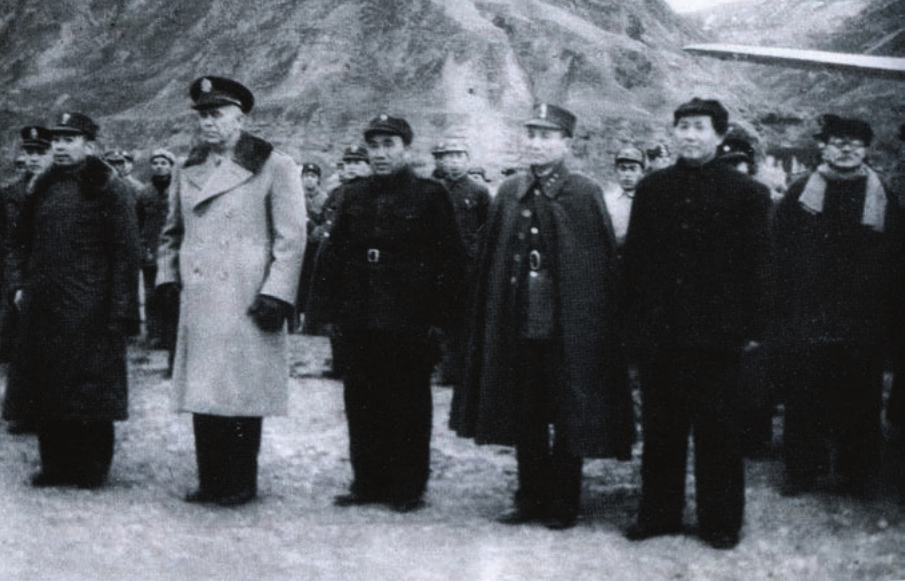
Colonel David Barrett led the Dixie Mission to Yan'an in 1944. The mission received this nickname possibly because Americans saw the communists as comparable to the Confederate rebels in the American Civil War. The Americans who visited were impressed by what they witnessed, although Mao had carefully staged the best communist propaganda presentations for them.
Roosevelt's special representative, Patrick Hurley, also praised the soviet's policies after visiting Yan'an. However, despite these positive impressions, US officials could not convince Jiang to cooperate fully with the communist forces or change his military strategy.
Note
Key term: Soviet refers to a communist-controlled region, not to the Soviet Union.
Timeline: from Japan's surrender to communist victory
The period from 1945 to 1949 saw rapid changes in China's political and military landscape:
- 14 August 1945: Japan surrenders after atomic bombs dropped on Hiroshima and Nagasaki
- 12 July 1946: Full-scale civil war begins between GMD and CCP
- 19 March 1947: GMD captures Yan'an, the communist capital
- 13 May 1947: Major PLA offensive begins in Manchuria, turning the tide
- September 1948: Jiang's new gold yuan currency collapses, devastating the economy
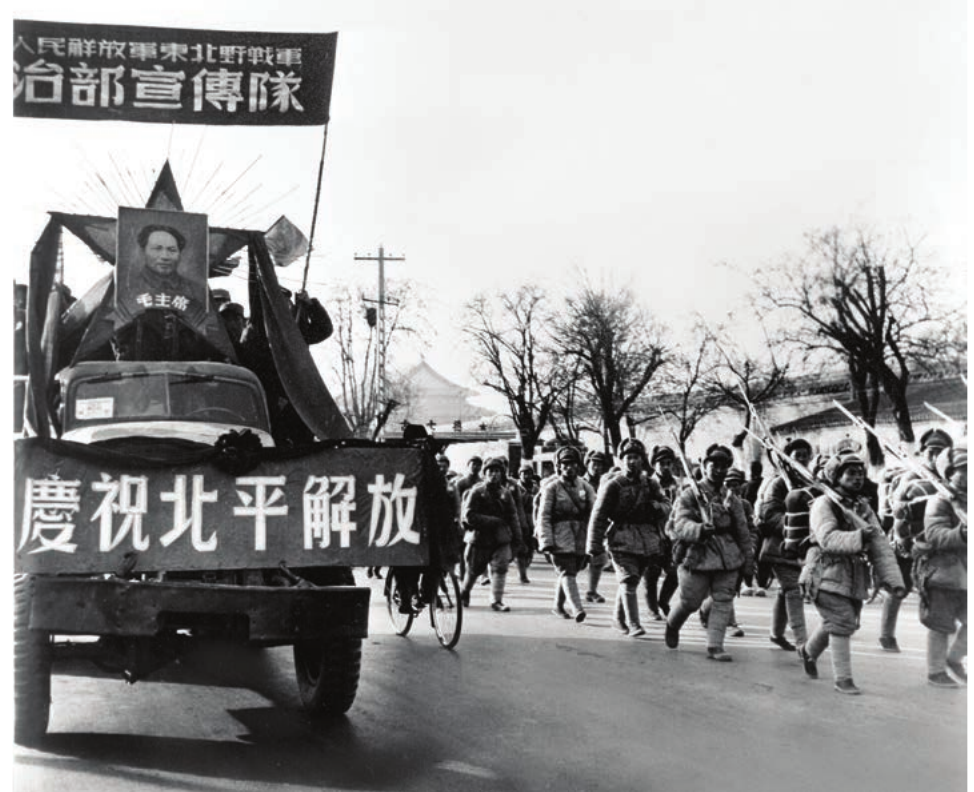
- 13 January 1949: CCP armies occupy Beijing without resistance
- 1 October 1949: Mao declares the People's Republic of China from Tiananmen
- 10 December 1949: Jiang and GMD forces retreat to Taiwan
Important
Notice how quickly the situation reversed: the GMD captured Yan'an in March 1947, but within just two months, the CCP launched the offensive in Manchuria that would ultimately win them the war. The momentum shifted dramatically in a very short period.
Who really fought the Japanese?
A significant propaganda battle centred on which side truly confronted Japanese forces during the Second World War. This debate shaped public opinion about both parties.
The communist narrative
Mao successfully promoted the idea that the communists alone took on the Japanese invaders. This narrative gained traction because:
- Jiang had retreated to Chongqing, far from the main fighting
- Reports of Japanese atrocities made Jiang's withdrawal seem cowardly to young patriotic Chinese
- Corruption meant that millions of dollars in US war aid never reached the front lines
- Communist guerrilla forces remained visible behind Japanese lines
The reality of GMD military efforts
However, the GMD forces actually bore the main burden of fighting the Japanese:
- GMD armies defended coastal cities and major communication routes
- In the battle for the Yangzi River area, Japanese forces lost 62,000 soldiers
- GMD casualties in this campaign were even higher
- Nationalist forces fought the conventional military engagements
Note
Why did the CCP appear more effective?
The Japanese focused on conquering cities, railways and coastal areas where GMD forces were concentrated. They lacked the resources to control rural regions where the communists operated. Communist forces:
- Operated mainly in countryside areas that Japan rarely attacked
- Used guerrilla tactics against occasional Japanese raids
- Faced less sustained combat than GMD troops
- Were more successful in the propaganda war despite fighting fewer major battles
The Japanese sought to take over the coastal cities and the main communication routes, especially the railways. To do this they had to defeat mainly Nationalist, not Communist forces. On the other hand, the Japanese had neither the means nor the desire to establish power throughout the rural areas where the Communists were established; these areas were subject to only occasional attacks. Thus although the Nationalist armies bore almost the whole brunt of the attacks, it was the Communist armies which impressed the Chinese public.
This historical interpretation by Jack Gray explains why the CCP gained more credit despite the GMD fighting more intensively against Japan.
Attempts to avoid civil war
When Japan surrendered in August 1945, both the GMD and CCP scrambled to secure advantages before peace negotiations could begin.
The post-surrender power grab
GMD actions:
- General Douglas MacArthur flew Jiang and his representatives to major coastal centres
- GMD officials formally accepted Japanese surrender at key locations
- This gave the GMD control of important urban areas
CCP actions:
- Communist forces infiltrated north-east China as Japanese withdrew
- They confiscated weapons and vehicles from defeated Japanese troops
- Recruited soldiers from the puppet state of Manchukuo
- Even recruited some GMD soldiers
Important
Stalin's unexpected move:
Surprisingly, Stalin offered support to Jiang rather than Mao. The Soviet leader agreed to hold Manchuria until GMD forces could take control, completely snubbing the Chinese communists. This decision reflected Stalin's preference for dealing with recognised governments and his concern about appearing too interventionist in Chinese affairs.
General Marshall's peace mission (1945-1946)
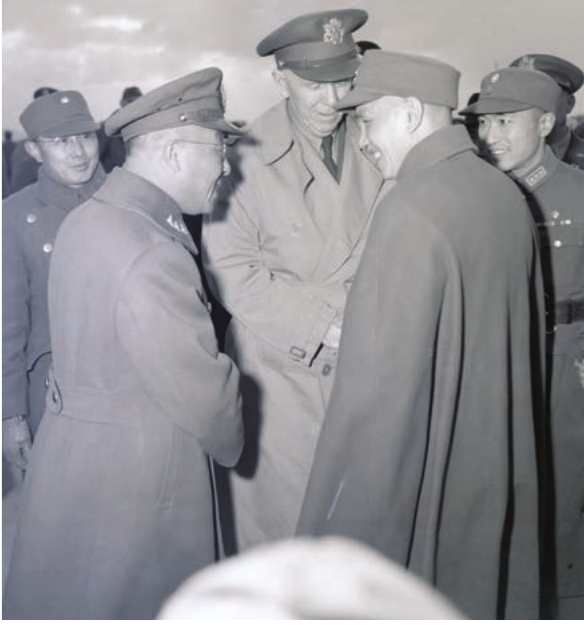
In 1945, President Roosevelt sent General George C Marshall to negotiate a peaceful power-sharing arrangement in post-war China.
Marshall's achievements:
- Arranged a ceasefire in January 1946
- Brought Mao to Chongqing to meet with Jiang
- The two leaders posed together for photographs, suggesting cooperation
- Zhou Enlai stayed in Chongqing as chief communist representative
Why peace failed:
Despite Marshall's efforts, full-scale civil war erupted in June 1946. Marshall blamed both sides equally for the breakdown in negotiations. Neither party was genuinely committed to sharing power.
Note
Marshall's mission represented the last real chance for peaceful resolution. His failure demonstrated that both the GMD and CCP saw total victory as the only acceptable outcome. Compromise was never truly on the table for either side.
The Civil War: initial GMD advantages
When civil war broke out in mid-1946, the GMD appeared to hold all the advantages:
GMD strengths
- Superior numbers: 4,000,000 regular troops compared to CCP's 1,200,000
- Better equipment: Thanks to extensive US military aid
- Control of major cities: GMD held most urban centres and industrial areas
- International recognition: The GMD was China's recognised government
GMD weaknesses
- Conscription problems: Many soldiers were forcibly recruited
- High desertion rate: Low morale led to soldiers abandoning their units
- Poor military strategy: Despite numbers, troops were poorly deployed
Important
Despite their numerical superiority of more than 3-to-1, the GMD's advantages proved hollow. Numbers alone cannot win wars when soldiers lack motivation, supplies never reach the front lines due to corruption, and the population sees the government as illegitimate.
The first phase: GMD advances (1946-1947)
From 1946 to early 1947, GMD armies made substantial territorial gains:
- Captured major centres in northern China
- Even took Yan'an, the communist capital, in March 1947
- Appeared to be winning the civil war
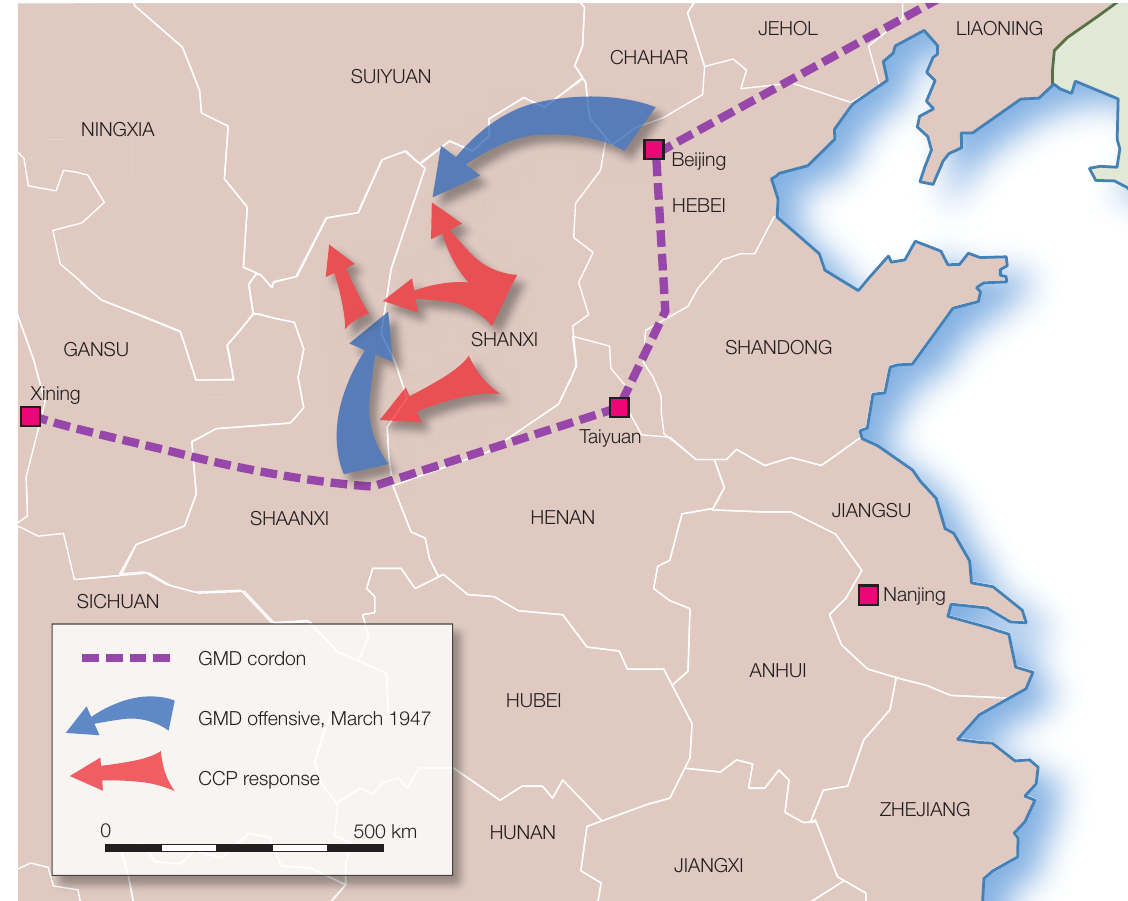
CCP strategy during retreat:
The communists deliberately adopted a flexible defensive approach:
- Willingly gave up cities without major resistance
- Maintained influence in the countryside
- Relied on peasant support in rural areas
- Used guerrilla tactics where they were most effective
Example
Strategic Retreat: The Loss of Yan'an
When GMD forces approached Yan'an in March 1947, Mao made the controversial decision to abandon the communist capital without a major fight. Many party members questioned this decision, but Mao explained:
"We can give up Yan'an, but we cannot give up China. As long as we preserve our forces and maintain support among the peasants, we can retake cities later. Cities are temporary; the people's support is permanent."
This decision proved strategically brilliant. The GMD exhausted resources occupying empty cities while communist forces regrouped in the countryside where they had strong peasant support.
Offence is the best defence
This Chinese proverb reflected CCP military thinking - they saw tactical retreat as setting up better offensive opportunities.
The Red Tide: CCP counteroffensive and victory
By 1947, the momentum of the civil war shifted dramatically in favour of the communists.
The turning point (1947-1948)
CCP offensive operations:
- Captured much of Manchuria, China's industrial heartland
- Made successful raids south of the Yellow River (Huang He)
- Key cities began falling to communist forces in 1948
Major victories in 1948:
- Changchun fell to the armies of Lin Biao
- Mukden fell in October - hundreds of thousands of GMD soldiers died or surrendered
- GMD generals began switching sides and joining the communists
Note
The defection of GMD generals represented a critical turning point. These weren't just individual soldiers deserting—entire units, complete with equipment and command structures, switched to the communist side. This phenomenon accelerated the GMD's collapse exponentially.
The final collapse (1949)
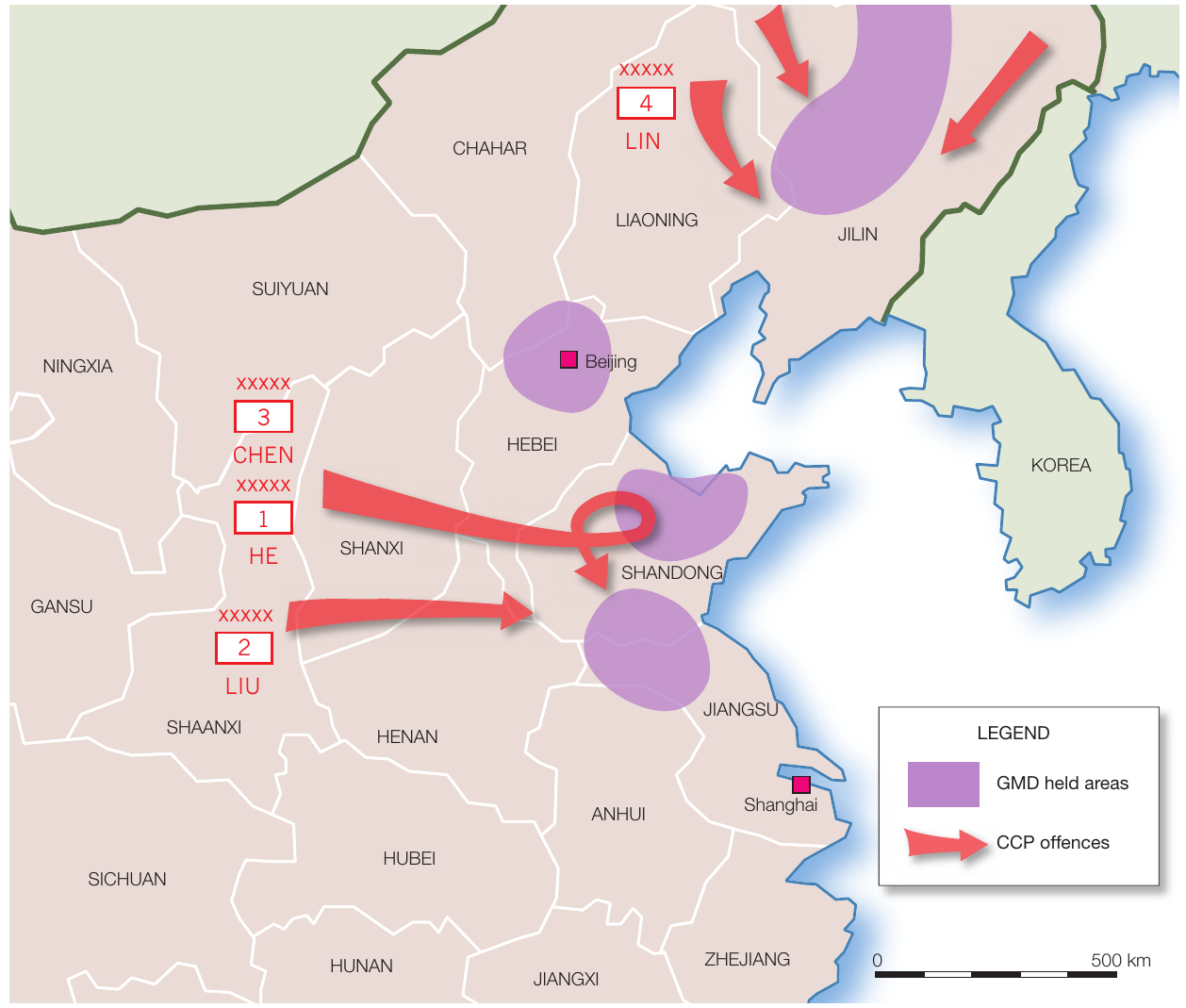
The map shows four major CCP offensives that overwhelmed GMD positions:
- He's offensive from the west
- Liu's offensive from Shaanxi towards the centre
- Chen's offensive from the north-west towards Shandong
- Lin's offensive from Manchuria pushing south
The fall of major cities:
- January 1949: Suzhou fell, only 180 kilometres from Nanjing (the GMD capital)
- 31 January 1949: Beijing surrendered without resistance
- April 1949: The Red Army, now renamed the People's Liberation Army (PLA), captured Nanjing
- Subsequently, Wuhan, Xi'an and Shanghai quickly fell
- The GMD military campaign was collapsing
Note
People's Liberation Army (PLA): The new official name for the communist Red Army, adopted as they moved from guerrilla force to national army. This name change reflected the CCP's transformation from revolutionary insurgents to the legitimate army of China's new government.
Jiang's retreat to Taiwan
On 10 December 1949, Jiang Jieshi and his family boarded a plane and fled to Taiwan, an island off Fujian Province.
What Jiang took with him:
- Hundreds of thousands of GMD soldiers
- National treasures from Beijing's museums
- Gold bullion from China's reserves
- His navy, supported by the US Seventh Fleet
Taiwan's situation:
- Taiwan had been under Japanese control since 1898
- Local Taiwanese people were not happy with the GMD takeover
- Any resistance to GMD rule was met with deadly force
- The US Seventh Fleet patrolled the Taiwan Strait, preventing a CCP invasion
- Jiang intended to use Taiwan as a base to eventually retake mainland China
Note
Jiang died in Taiwan in 1975. His body was not buried for another 20 years because he had requested burial on the mainland, which never became possible. This detail poignantly symbolises the permanence of the division that Jiang never accepted.
Declaration of the People's Republic of China
On 1 October 1949, Mao Zedong and leading Communist Party members stood on the rostrum above Tiananmen (Heavenly Peace Gate) in Beijing. From this symbolic location at the entrance to the Forbidden City, Mao announced the establishment of the People's Republic of China (Zhonghua Renmin Gongheguo).
Beijing, which had been China's capital during imperial times, was once again designated as the national capital.
Important
The choice of Tiananmen as the location for this announcement was deeply symbolic. Standing at the entrance to the Forbidden City, where Chinese emperors once ruled, Mao was declaring not just a new government but a fundamental break with China's imperial and republican past.
Why did the CCP win? Understanding the GMD collapse
The speed and completeness of the CCP victory surprised many observers. Despite having fewer troops, less equipment and no major foreign backing, the communists decisively defeated the better-resourced Nationalists.
GMD failures and weaknesses
Political problems:
- Jiang ruled as a dictator with no genuine attempt at democratic governance
- Used Sun Yixian's concept of a period of tutelage as an excuse for authoritarian rule
- Made no real effort to involve ordinary people in government
- Failed to implement Sun Yixian's principle of People's Livelihood
Economic disasters:
- Initial economic growth was destroyed by two costly wars (against Japan and the CCP)
- Food supplies dwindled, causing widespread starvation
- Uncontrolled inflation devastated people's savings
- The gold yuan currency introduced in 1948 quickly collapsed
Example
The Hyperinflation Crisis of 1948-1949
The collapse of the gold yuan currency demonstrated the GMD's economic incompetence:
Stage 1: August 1948 - Government introduces gold yuan to replace the old currency at a rate of 3 million old yuan to 1 gold yuan
Stage 2: September-October 1948 - Price controls fail; black markets flourish
Stage 3: November 1948 - Gold yuan begins rapid devaluation
Stage 4: Early 1949 - Complete currency collapse; people's life savings become worthless overnight
A worker's monthly salary that could buy a bag of rice in August could barely buy a bowl of rice by January. This economic catastrophe destroyed what remained of urban middle-class support for the GMD.
Corruption:
- Although Jiang himself lived simply, his government and generals were extremely corrupt
- Much US aid money ended up in private hands
- For example, Jiang's brother-in-law, HH Kung, embezzled war funds
- Little foreign aid actually reached the troops who needed it
Military problems:
- Low troop morale due to poor conditions
- High desertion rates
- Many soldiers were unwilling conscripts
- Commanders often incompetent or corrupt
CCP advantages and strengths
Peasant support:
- The CCP actively appealed to China's hundreds of millions of peasants
- Promised land redistribution
- Pledged to reduce the heavy taxation burden
- Actually delivered on promises in areas they controlled
Important
The CCP's land reform programme was revolutionary in practice, not just theory. In areas under communist control, peasants received land confiscated from landlords, witnessed reductions in taxation, and participated in local governance through peasant associations. This tangible improvement in their lives created genuine loyalty to the communist cause.
Effective propaganda:
- Won the propaganda war both domestically and internationally
- Successfully convinced people and media that communists had fought the Japanese alone
- Portrayed the GMD as corrupt and ineffective
- Used Jiang's retreat to Chongqing as evidence of cowardice
Military effectiveness:
- Better morale among troops who believed in their cause
- Effective guerrilla tactics
- Promised captured GMD soldiers they would not be killed
- Many GMD officers surrendered their entire units to the CCP
- Called surrendering soldiers little Jiangs rather than treating them as enemies
Note
The CCP's treatment of captured GMD soldiers was strategically brilliant. By calling surrenders "little Jiangs" (suggesting they were joining the winning side, not betraying their cause) and promising lenient treatment, the communists encouraged mass defections. Many captured soldiers were re-educated and integrated into PLA units, swelling communist ranks while depleting GMD forces.
Foreign perceptions:
- Edgar Snow's book Red Star Over China presented a very positive image of Yan'an
- American officials who visited Yan'an were impressed (though Mao carefully staged what they saw)
- The Dixie Mission reported favourably on communist organisation
Historical perspectives on the defeat
Historians have debated whether Jiang lost the war or whether the CCP stole China from him.
Jiang's own explanation (1957):
When the war ended, the Communists resorted to armed insurrection. They did everything to nullify all reconstruction projects, to hinder the Government's programme of demilitarisation, to disrupt the nation's economic life and to upset its social order. They spread national defeatism at a time when the people were weary after the long war. Finally, the general public became so confused and bewildered that all they had asked was peace at any cost, however transient it might turn out to be. This was the basic reason for the tragic reverses which China suffered in her war against Communism.
Jiang blamed communist disruption and public war-weariness for his defeat.
Alternative historical view:
Professor A Doak Barnett offered a different perspective:
The relative ease of the final Communist takeover was a result in part, of course, of the strength of the Chinese Communist revolutionary movement forged during the previous two decades of armed struggle, but the speed of the takeover was also the result of the completeness of the demoralisation, disintegration, and collapse of the Nationalist regime on the mainland.
Barnett emphasised both CCP strength and GMD collapse as causes of communist victory.
Most historians conclude:
Despite superior resources, US aid and initial military successes, the GMD lost because:
- They failed to win support from the peasant majority
- Corruption undermined government effectiveness
- Military morale was extremely low
- The CCP offered tangible benefits to ordinary people
- Communist propaganda was more effective
- GMD forces were demoralised and willing to surrender
Historical significance
The communist victory created two separate Chinese governments:
- The People's Republic of China on the mainland under Mao
- The Republic of China on Taiwan under Jiang
This division continues to affect international relations today. Taiwan's political debates still revolve around whether to seek reunification with the mainland or maintain independence.
Note
The legacy of 1949 remains politically sensitive. The "Two Chinas" problem affects everything from Olympic participation to international diplomacy. Both governments originally claimed to represent all of China, though Taiwan's position has evolved considerably since the 1990s.
Remember!
Summary
Key Points to Remember:
-
The CCP defeated the GMD in 1949 despite having fewer troops and less equipment because they won peasant support and the propaganda war
-
US attempts at mediation through General Marshall failed, and full-scale civil war broke out in July 1946
-
Although the GMD initially advanced and even captured Yan'an, the tide turned by 1947
-
Key CCP victories in Manchuria and major cities in 1948-1949 led to the GMD's rapid collapse
-
Jiang retreated to Taiwan with troops, treasures and gold in December 1949
-
Mao declared the People's Republic of China on 1 October 1949 from Tiananmen in Beijing
-
The GMD lost primarily due to corruption, failed economic policies, low military morale and inability to appeal to the peasant masses