Racism and the Ku Klux Klan (HSC SSCE Modern History): Revision Notes
📚Revision Notes
Racism and the Ku Klux Klan
Introduction to racism in 1920s America
Despite America's promise of liberty and happiness for all citizens, Black Americans faced severe discrimination and exclusion. While women gained voting rights in 1921, Black Americans remained segregated and oppressed under discriminatory laws that had existed since the 1890s.
Note
The contradiction between America's founding ideals of equality and the reality of systematic discrimination against Black Americans reveals the deep-seated racial prejudice that persisted into the twentieth century, even as the nation celebrated democratic progress in other areas.
The 1920s saw the rise of the Ku Klux Klan, an ultra-right white supremacist group that became highly influential during this decade. This organisation terrorised minority groups, particularly Black Americans, throughout the South and rural parts of America.
Jim Crow Laws and segregation
Jim Crow Laws were laws that enforced racial segregation under the principle of "separate but equal" treatment. These laws, in place since the 1890s, were fundamentally unjust and enabled widespread discrimination against Black Americans after the Civil War.
The Jim Crow Laws segregated:
- Employment opportunities
- Housing
- Education and schooling
- Public facilities and services
Despite the Emancipation Act declared by Abraham Lincoln in 1862, these laws ensured that Black Americans remained excluded and oppressed in American society.
Important
The Jim Crow Laws created a system of legal apartheid in America that would persist for decades, denying Black Americans basic civil rights and human dignity despite constitutional amendments that theoretically guaranteed their freedom and equality.
Origins and revival of the Ku Klux Klan
Ku Klux Klan was a white extremist group founded after the US Civil War in 1866 that promoted violent racist and intolerant attitudes towards minority groups.
Early history
The Klan first emerged towards the end of the Civil War in 1865 as a secret society that initiated many people into hate crimes. The organisation was officially outlawed in 1869 during the Reconstruction period. However, the Klan experienced a dramatic revival in the early twentieth century.
The revival of the 1920s
Several factors contributed to the Klan's resurgence in the 1920s:
Cultural influences: The 1915 silent film Birth of a Nation, directed by DW Griffith (originally titled The Clansmen), portrayed the Klan as heroic, virtuous and all-American. The film depicted the Klan as critical to America's salvation, legitimising their ideology in popular culture.
Note
Birth of a Nation was one of the first major Hollywood blockbusters and reached massive audiences across America. Its glorification of the Klan as defenders of white civilisation had a profound cultural impact, helping to reshape public perception of the organisation and contributing directly to its revival.
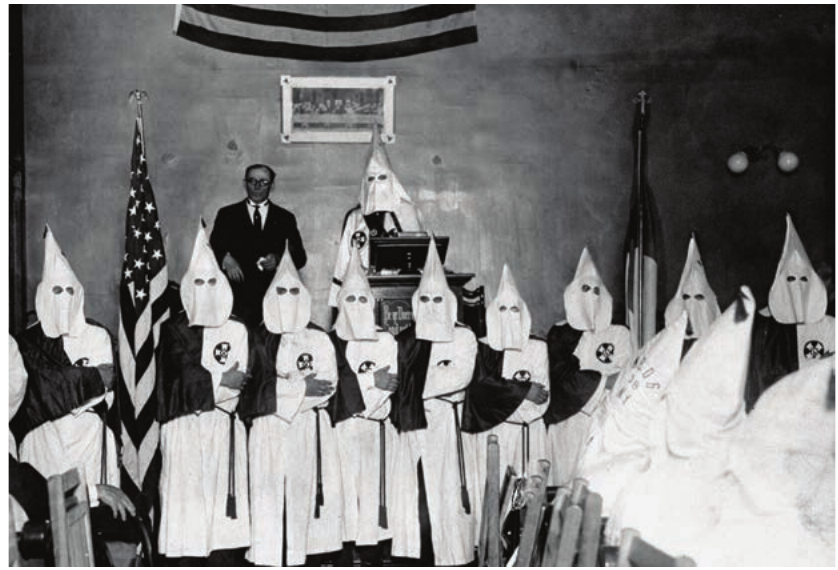
William Simmons, from Georgia in the southern states, capitalised on the cultural values promoted by the film. He became the first Imperial Wizard (the head of the Ku Klux Klan) of what he called the "Invisible Empire of the Ku Klux Klan".
Economic and social factors: The revival resulted from:
- American prosperity and increased consumerism
- Rapid urbanisation and industrialisation
- Massive increase in immigration to the United States
- Demographic changes as workers moved to industrial centres
Xenophobia and fear: During and after World War I, foreigners were treated with suspicion in the xenophobic national consciousness. Americans resented and feared the accents, beliefs and cultural practices of immigrants.
Important
The combination of rapid social change, economic transformation, and demographic shifts created widespread anxiety among white Americans who felt their traditional way of life was threatened. The Klan exploited these fears, positioning itself as the defender of "true" American values.
Migration patterns: Black Americans moved from low-paid agricultural labour in the South to highly industrialised factory jobs in northern cities like Chicago and Detroit. These demographic changes and traditional racial antagonisms resulted in escalating race riots in the North.
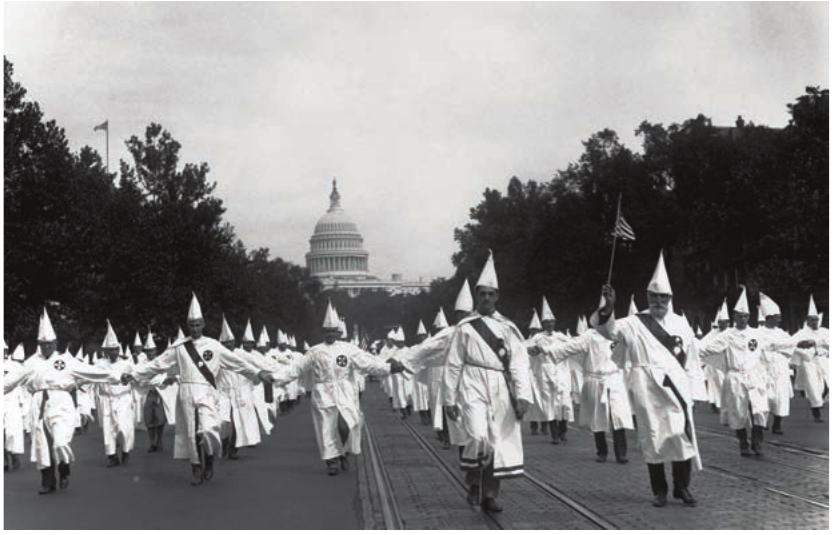
The rise of the Klan in the 1920s
Membership and influence
By 1925, the Klan had over 4 million members nationwide. In some states, such as Indiana, the Klan had over 350,000 members. The organisation's influence was so extensive that rumours circulated that President Warren Harding had been secretly sworn in as a Klansman in the White House during the 1920s.
The Klan was a popular and polarising organisation that conflated racial prejudices and ignorance with American traditional values. The tactics and rhetoric were:
- Virulently anti-Semitic
- Anti-Catholic
- Homophobic
- Yet disturbingly patriotic
Public acceptance
The Klan infiltrated many agencies and levels of American society. Membership drives and regular activities were listed in community notices alongside everyday events like sewing classes, baseball games, weddings and death notices. The organisation had:
- Basketball teams
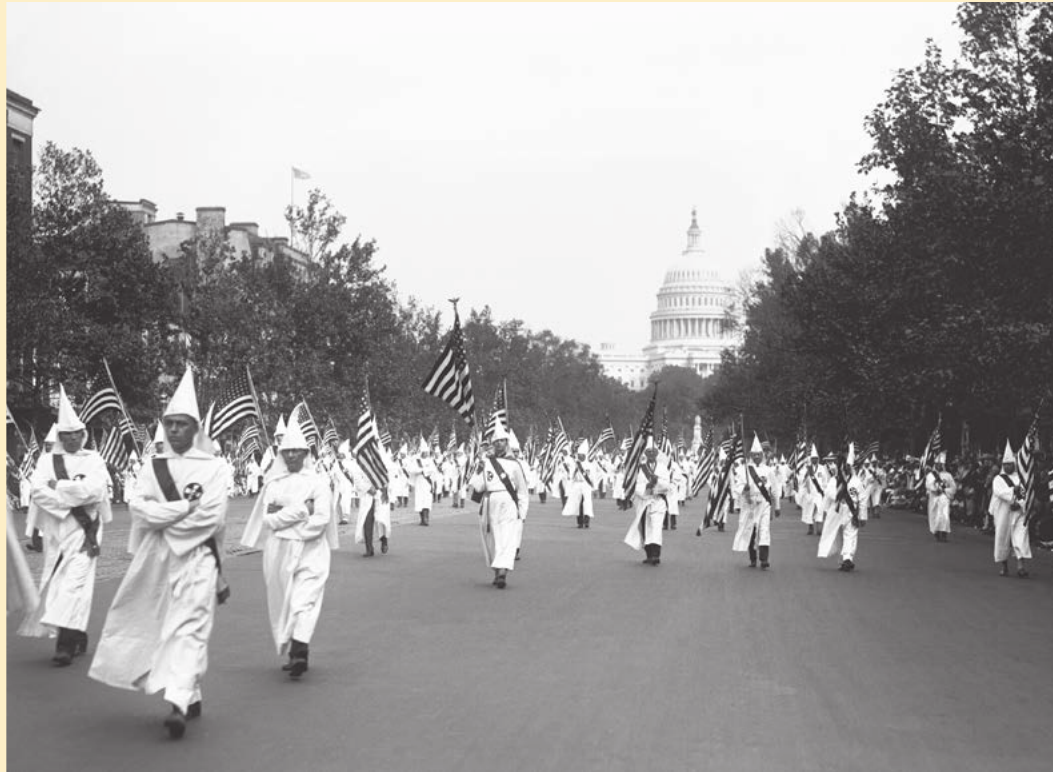
- Public marches
- Sponsored social events (corn-roasts, fireworks, parades, picnics)
- Public gatherings of people in white robes and hoods
Important
This white supremacist group became normalised as part of American community life, making their fascist message more acceptable to the public. The integration of Klan activities into everyday social life demonstrates how extremist ideology can become mainstream when presented alongside familiar, wholesome community events.
Key leaders
Hiram Evans succeeded William Simmons as Imperial Wizard in 1922. Evans promoted more extreme white supremacist ideology against Blacks, Jews and immigrants. He pushed government officials to restrict immigration, while local Klans (called Klaverns) persecuted minority groups with violence and intimidation.
David Stephenson was another influential Klansman who led the organisation in Indiana and Texas, where the Klan reached massive popularity.
Immigration restrictions and the 1924 Act
The Klan's political influence contributed to increasingly restrictive immigration policies.
Timeline of restrictions
1917: Following America's entry into World War I, President Coolidge endorsed migration restrictions that:
- Excluded people from the "Asiatic Barred Zone" (except migrants from the Philippines and Japan)
- Introduced a literacy test for those over 16 years old
- Increased taxation for newly arrived immigrants
1922: President Harding endorsed further restrictive quotas limiting immigrant numbers to 3% of nationalities represented in the 1910 national census, with a maximum of 350,000 people.
1924 Immigration Act (Johnson-Reed Act): This was a restrictive and racist US immigration policy that:
- Limited the number of immigrants to 2% of the overall number of people of each nationality as per the 1890 national census
- Completely excluded Asian immigration
- Further restricted citizenship to those from Asiatic ancestry
- Prevented people with Japanese heritage from claiming citizenship, despite large numbers of Japanese migrants living in the United States
Note
The choice of the 1890 census as the baseline was deliberate and racist. By using an earlier census, the Act favoured immigration from Northern and Western European countries while severely limiting immigration from Southern and Eastern Europe, Asia, and other regions where newer immigrant populations came from.
The 1924 Immigration Act was the product of increasing fear and xenophobia, fuelled by the Klan's political influence. These policies antagonised foreign nations and demonstrated the extent of the Klan's power over American politics.
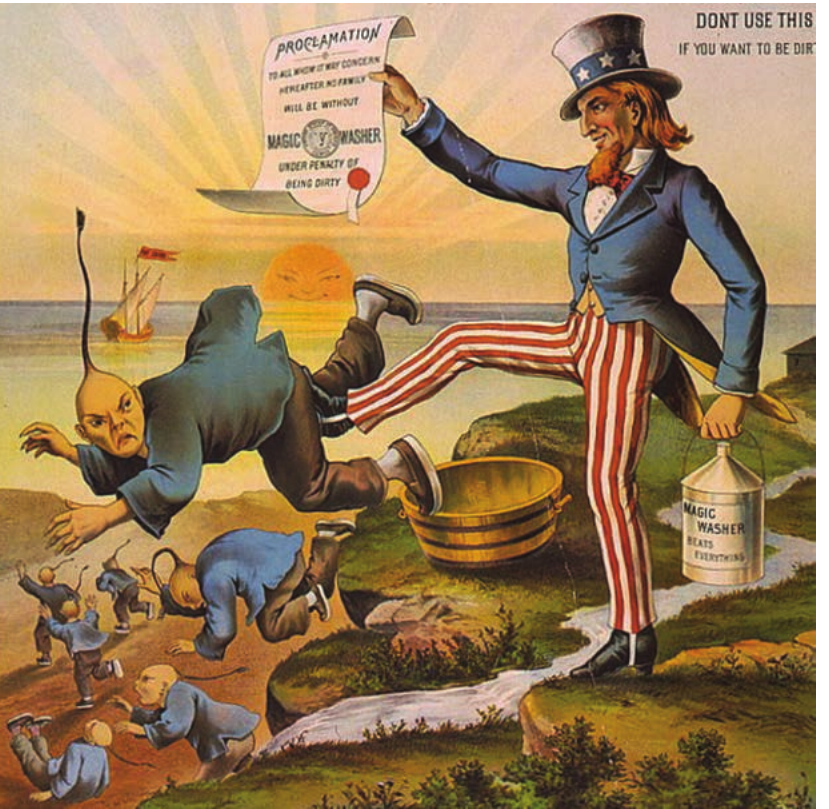
Propaganda, tactics and ideology of the Klan
Ideology and beliefs
The Klan's propaganda was pseudo-intellectual, thoroughly capitalistic and appealing to Americans who clung to dreams of Manifest Destiny (the belief that America was destined to expand and dominate).
The organisation promoted an ideal of Southern White "Americanism" reminiscent of the Reconstruction Era following the American Civil War. They argued that:
- Pioneers who built America bequeathed to their children a priority right to control America's future
- America's mission was to perpetuate the kind of civilisation created by the forefathers
- Races of men are as distinct as breeds of animals
- Any mixture between races is evil
- The American stock should not be "mongrelised"
- Foreigners should become part of American society and adopt American ideals, never forcing Americans to change
Important
The Klan's ideology was rooted in the false belief of racial superiority and the fear of demographic change. By wrapping racist beliefs in patriotic language and appeals to tradition, the Klan made white supremacy appear respectable and even virtuous to millions of Americans.
Recruitment and organisation
Kleagles were paid lecturers who actively recruited new members through public lectures and speeches. These recruiters were paid US$10 for every new member they signed up. This capitalistic approach made recruitment a profitable business.
Masked Klansmen (also called "Knights") were sent to:
- Funeral homes
- Hospitals
- Churches
These visits inspired both fear and compliance among communities.
Geographic spread
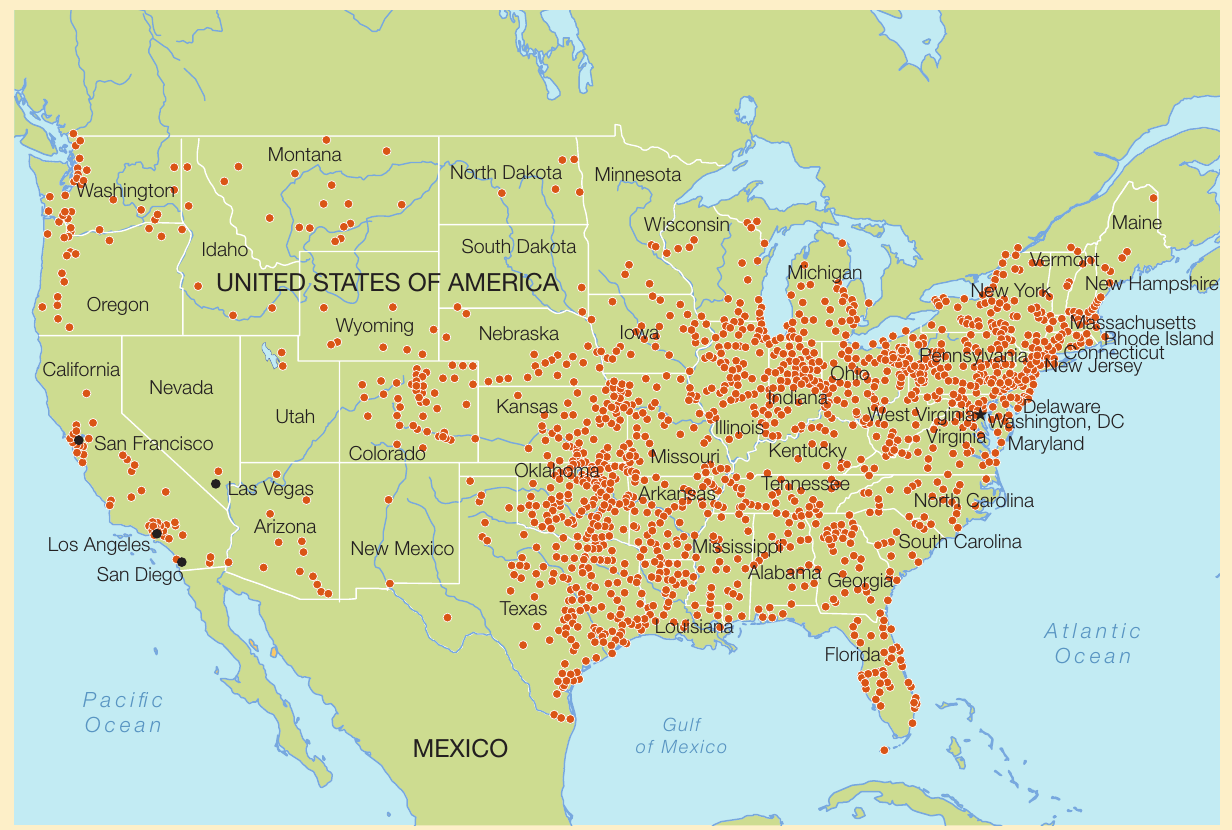
The Klan appealed predominantly to mid-western and southern states, but its political activity and violence stretched into northern industrial states and towns. The map shows that Klan activity was concentrated in:
- The Southeast (Tennessee, Mississippi, Alabama, Georgia, Carolinas)
- The Midwest (Indiana, Ohio, Illinois, Kansas, Oklahoma)
- Texas
- Parts of the Northeast
Tactics and violence
The Klan used various tactics to terrorise minority groups:
Public character assassination: Used against local officials to ensure the Klan's continuation and viability
Political manipulation: The Klan:
- Maintained expensive lobbies
- Acted secretly in both political parties
- Constantly tried to gain secret control of elections, legislatures and government
- Pushed specific agendas depending on the region (anti-Asian racism in California, anti-Catholic sentiment in Texas, temperance movements in "Dry" states)
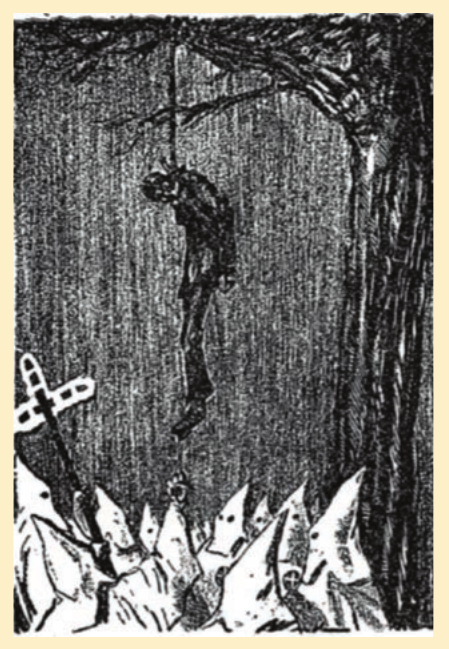
Violence and intimidation: Klaverns became unauthorised vigilantes who morally policed the lives of minority groups. Catholics, Jews, immigrants and Black Americans frequently suffered:
- Tar-and-feather attacks
- Violent abuse
- Public lynchings (hangings or executions)
Important
The Klan's tactics combined psychological terror with physical violence. By operating openly in some contexts (parades, social events) while conducting violence secretly or with impunity, the organisation created an atmosphere of fear that extended far beyond its direct victims. The chameleon nature of the Klan, adapting its message to local concerns, made it highly successful throughout the 1920s.
The Creed of the Klanswomen
The Klan extended its reach to women through the Women of the Ku Klux Klan. Their creed, published in 1924, reveals how the organisation wrapped racist ideology in patriotic and religious language:
Key beliefs stated in the Creed:
Religious beliefs: Belief in God, Jesus Christ and Protestant Christianity (specifically excluding Catholics)
Separation of church and state: While keeping institutions separate, uniting in mission and purpose
American home values: The home as the foundation of the American Republic and its liberties
Women's emancipation: Celebration of women freed from "old-world traditions" and standing in equality and enlightenment
Gender equality: Equality of men and women in political, religious, fraternal, civic and social affairs
Public education: Support for free public schools training children in American ideals
Patriotic symbols: The Stars and Stripes flag symbolising "purity of race, blood of martyrs and fidelity of patriots"
Constitutional supremacy: Dedication to preserving the Constitution against all enemies
Racial purity: The belief that "pure American blood must be kept uncontaminated by mongrel strains and protected from racial pollution"
White Protestant nationalism: The belief that America's perpetuity rests upon "native-born, white, Gentile, Protestant men and women"
Militant purpose: A commitment to maintaining these principles, preserving racial purity, protecting homes and children, and guaranteeing prosperity against "usurpation, disloyalty and selfish exploitation"
Note
This creed demonstrates how the Klan presented discriminatory and racist ideology as if it were patriotic duty and Christian values. The organisation successfully recruited women by framing white supremacy as protection of family, tradition and American values. By appealing to women's roles as mothers and guardians of the home, the Klan extended its influence into the domestic sphere.
Opposition and criticism of the Klan
Despite the Klan's popularity, many Americans opposed the organisation. Political cartoons were an important form of criticism.
Anti-Klan perspectives
Critics argued that the Klan's ideology was fundamentally un-American because:
Against founding principles: The Klan idea of Americanism contradicted the teachings of Washington, Jefferson, Lincoln, Roosevelt and Wilson. True Americanism is an ideal and spirit based on freedom, tolerance and humanity, not discrimination based on colour, birthplace or creed.
Against Christianity: The Klan's ideology opposed the whole spirit of true Christianity and represented a reversion to old, cruel religious hatreds.
Secret political influence: The Klan attempted secret and threatening influence on government, seeking secret control of legislators, judges and other officials. This abandoned the American principle of rule by and for all.
Breeding hatred: The Klan deliberately bred and exploited hatred and prejudice as a means to sway public opinion and win political power.
Note
Opposition to the Klan came from diverse sources including religious leaders, political figures, journalists, and ordinary citizens who recognised the fundamental contradiction between the Klan's message and American democratic values. These critics understood that the Klan's wrapped its bigotry in patriotic language, but its actions revealed its true anti-American nature.
Political cartoons as criticism
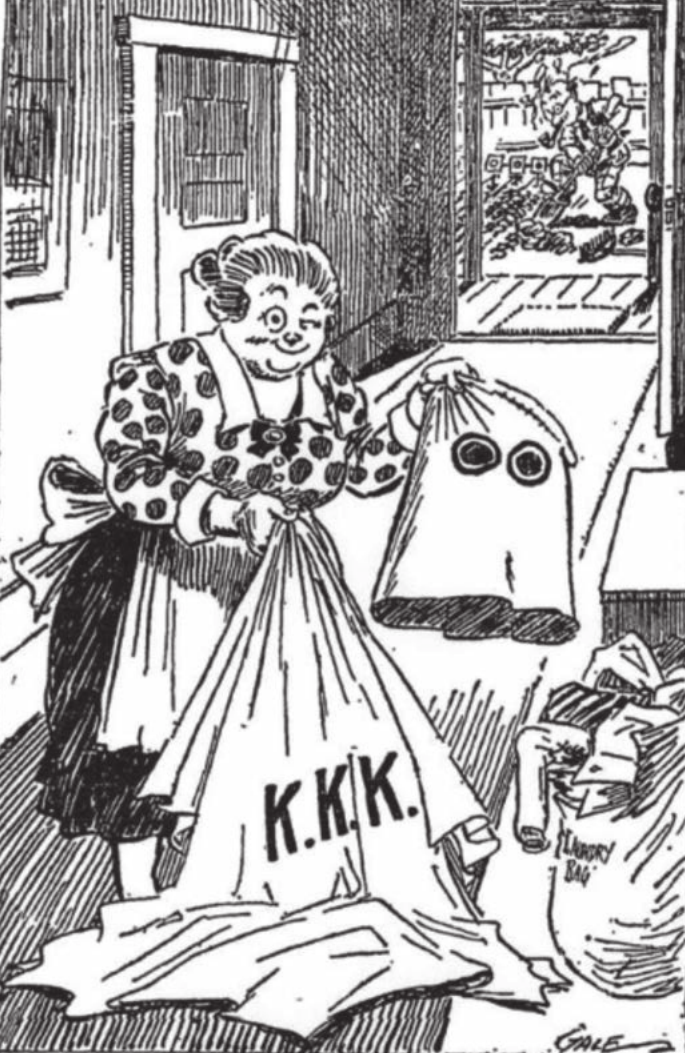
Political cartoons published in newspapers satirised and spoke out publicly against the Klan. These cartoons:
- Depicted the Klan as cowardly (hiding behind sheets)
- Showed the contradiction between the Klan and American values
- Highlighted the threat the Klan posed to liberty and democracy
- Were published in mainstream newspapers, showing that opposition existed
Resistance from Black Americans
Black leaders and communities resisted the Klan's intimidation. WEB Du Bois, writing in The Crisis in March 1919, noted that the Klan faced a different Black community than existed after the Civil War:
- Many Black men had served in World War I, training at camps and fighting in French forests
- They had battled a "magnificently trained and relentless foe"
- This was a "new Negro" and "new Negro youth" who would not be cowed by superstition or fear
- Black Americans who followed the exploits of their soldiers at the front would not be easily intimidated
Important
This resistance challenged the Klan's tactics of psychological intimidation. The experience of military service and combat in World War I had transformed many Black Americans' sense of self-worth and willingness to accept subjugation. Veterans returned home with new confidence, skills, and determination to fight for their rights at home as they had fought for freedom abroad.
Demise of the Klan
The Stephenson scandal
The Klan's popularity in the mid-1920s was unprecedented, but the organisation was ultimately brought down by scandal and corruption.
Grand Wizard David Curtis Stephenson led an organisation with over 350,000 members in Indiana and 4 million members nationally. He preached Americanism and a war on anti-Prohibition vices such as drinking, prostitution and gambling.
The Madge Oberholtzer case
Example
The Fall of Grand Wizard Stephenson
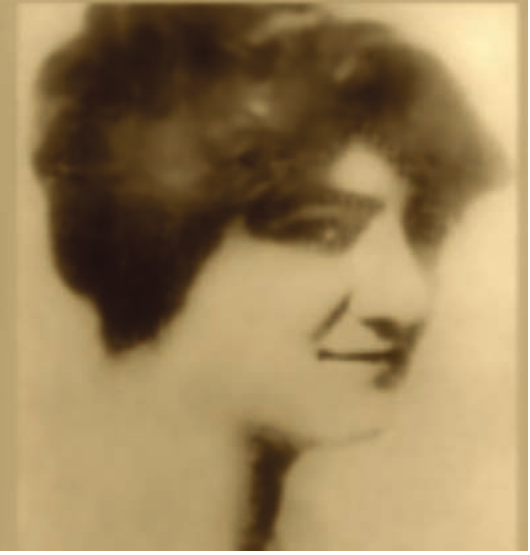
In 1925, Stephenson was brought down by his own misuse of power. He led a violent and prolonged attack on 28-year-old Madge Oberholtzer:
The Crime:
- Klansmen kidnapped the young woman from Indianapolis
- They raped and viciously beat her in the nearby town of Hammond
- She was released the next morning
- In desperation, she obtained mercury tablets from a pharmacist
- She consumed six mercury tablets and died an agonising death, allegedly from infection caused by vicious bite wounds combined with mercury poisoning
The Trial: Stephenson and his Klansmen were indicted on charges of second-degree murder. They were unremorseful and convinced their political allies would save them from a guilty verdict. Stephenson's political alliances included the Governor of Indiana, Ed Jackson.
Despite Stephenson's protestations of innocence, he was convicted. His political friend, Governor Ed Jackson, refused to pardon him.
The Prosecution's Argument:
- Madge Oberholtzer would be alive if not for the unlawful acts of the defendants
- They destroyed her body and tried to destroy her soul
- They attempted to assassinate her character
- Stephenson had claimed to be "the law in Indiana"
- Her statement, made while facing death, stood as truth
Impact on the Klan
The conviction resulted in a dramatic exposé of Indiana's corruption and political intrigue with the Klan, leading to its demise in popularity and influence:
Immediate decline: In Indiana, membership declined by 300,000 immediately following the trial
National collapse: Nationally, the decline was exponential, with the loss of over 3 million members during the period 1925-30
Failed revival attempts: Marches and parades did little to attract former members back to the organisation
1930s resurgence fails: A brief Klan resurgence in the 1930s was short-lived when the organisation's support for presidential candidate Franklin D Roosevelt dissipated due to Roosevelt's sympathy and progressive attitude towards Catholics and Jews
Important
The Stephenson scandal revealed the hypocrisy of the Klan's moral crusade and exposed the corruption at the heart of the organisation. The dramatic trial showed that even powerful Klan leaders could be held accountable for their crimes. The conviction shattered the image of the Klan as defenders of morality and law, revealing them instead as criminals hiding behind white robes and patriotic rhetoric.
Remember!
Summary
Key Points to Remember:
-
Jim Crow Laws enforced racial segregation in employment, housing, education and public facilities from the 1890s onwards, despite the Emancipation Act of 1862.
-
The Ku Klux Klan experienced a dramatic revival in the 1920s, reaching over 4 million members by 1925, fuelled by xenophobia, economic prosperity, rapid urbanisation and the influence of the film Birth of a Nation.
-
The Klan successfully infiltrated American society and politics, contributing to the restrictive Immigration Act of 1924 which limited immigration and excluded Asians from citizenship.
-
The organisation used propaganda, violence and intimidation against minority groups, including Catholics, Jews, immigrants and especially Black Americans, through tactics such as lynching, tar-and-feather attacks and public character assassination.
-
The Klan's demise began with the Stephenson scandal in 1925, when Grand Wizard David Stephenson was convicted of murdering Madge Oberholtzer. This exposed corruption and hypocrisy, leading to the loss of over 3 million members between 1925-30.