The US in the Aftermath of World War I and 1920s Politics (HSC SSCE Modern History): Revision Notes
📚Revision Notes
The US in the Aftermath of World War I and 1920s Politics
Introduction
Between 1919 and 1941, the United States underwent a dramatic transformation. The nation emerged from World War I as an emerging superpower, yet it chose to retreat from international engagement. This period saw profound changes in American society, politics, and economy that would shape the nation's future role in the world.
Note
This transformative period is crucial for understanding how the United States developed its modern identity and foreign policy approach. The tensions between international leadership and domestic focus that emerged during these years continue to influence American politics today.
Key factors shaping the United States during this period included:
- Massive migration from rural to urban areas
- Rapid industrialization and technological advancement
- The rise of consumerism and mass production
- Deep social divisions based on race, religion, and wealth
- A deliberate shift toward isolationist foreign policy
- Economic boom followed by the devastating Great Depression
The United States' rise as a superpower
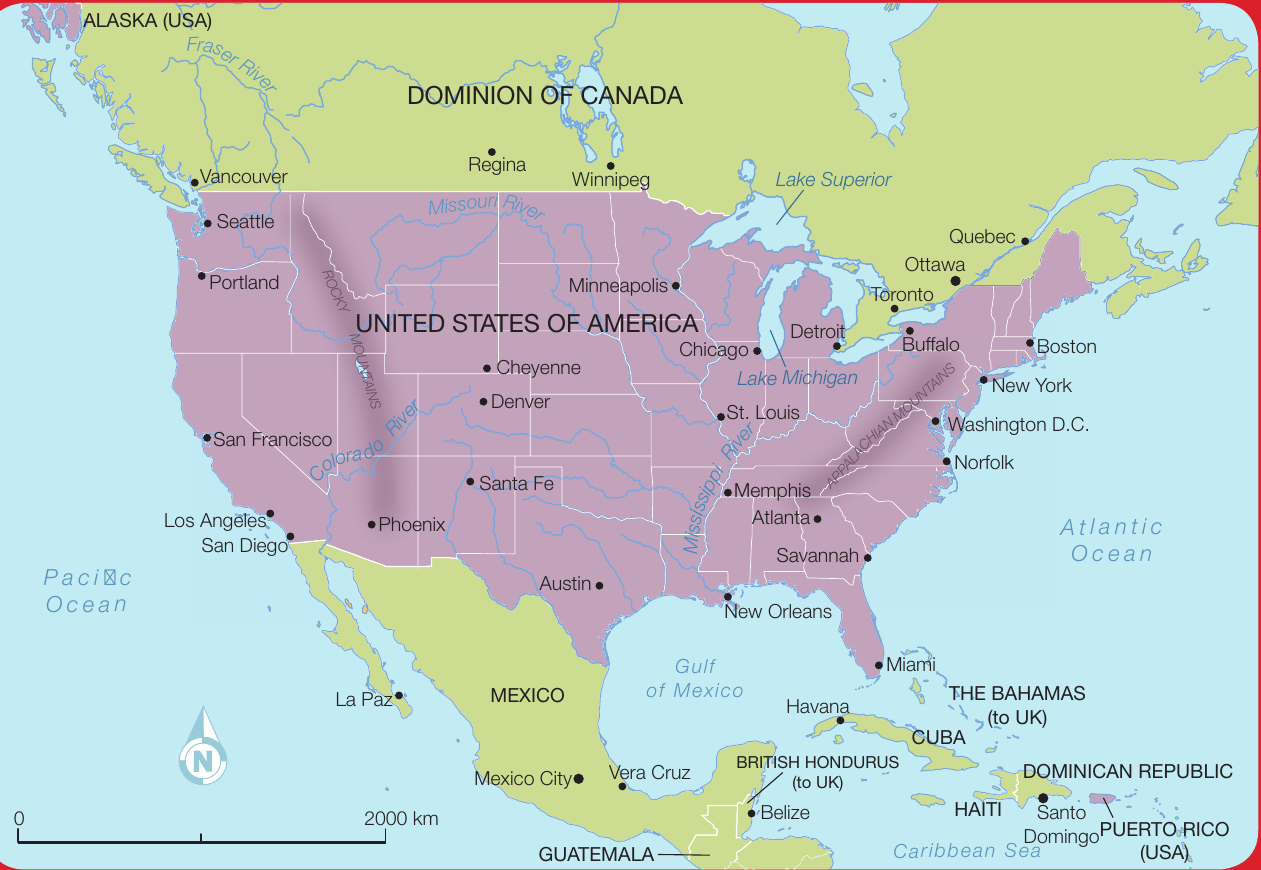
American geography and position in 1917
By 1917, the United States occupied a vast territory stretching from the Atlantic to the Pacific Ocean. The nation included the continental United States, Alaska, and territories in the Caribbean (such as Puerto Rico). This geographic position gave America significant strategic advantages, particularly its relative isolation from European conflicts by the Atlantic Ocean.
The country's major industrial centers were located in the northeast and around the Great Lakes, with cities like New York, Chicago, and Detroit becoming powerhouses of manufacturing. The nation's extensive river systems, particularly the Mississippi and Missouri rivers, facilitated trade and transportation across the continent.
American ideology and national identity
Manifest Destiny was a nineteenth-century belief that shaped American thinking well into the twentieth century. This idea held that the United States was destined for greatness and offered unlimited opportunities for wealth and liberty to its citizens. According to this belief, Americans were justified in expanding westward across North America toward the Pacific Ocean.
Key elements of American ideology included:
- The Puritan work ethic: Groups that fled England and settled in America espoused hard work and morality as the path to enrichment. This belief emphasized individual effort and determination as keys to success.
- Self-determination: Americans believed in the power of individuals to shape their own destiny through hard work and perseverance. This was closely linked to capitalist values and free enterprise.
- Patriotism and nationalism: American identity was strongly tied to the nation's founding principles of liberty and independence, symbolized by the Declaration of Independence (1776) and the American Revolution.
Important
There was a significant contradiction at the heart of American ideology. While the nation proclaimed equality and liberty for all, these ideals often excluded:
- Black Americans and formerly enslaved peoples
- Native American populations
- The working class and impoverished communities
- Women (until 1920, women could not vote)
- Recent immigrants, particularly from non-Western European countries
Note
Exam tip: When discussing American ideology, always acknowledge the gap between the stated ideals and the reality for marginalized groups. This contradiction is central to understanding American history in this period.
The cult of success and industrial heroes
American society in the early twentieth century celebrated entrepreneurs and industrialists who achieved great wealth. Figures like Henry Ford, who revolutionized automobile production through the assembly line, and William Randolph Hearst, who built a media empire, were admired as symbols of American success.
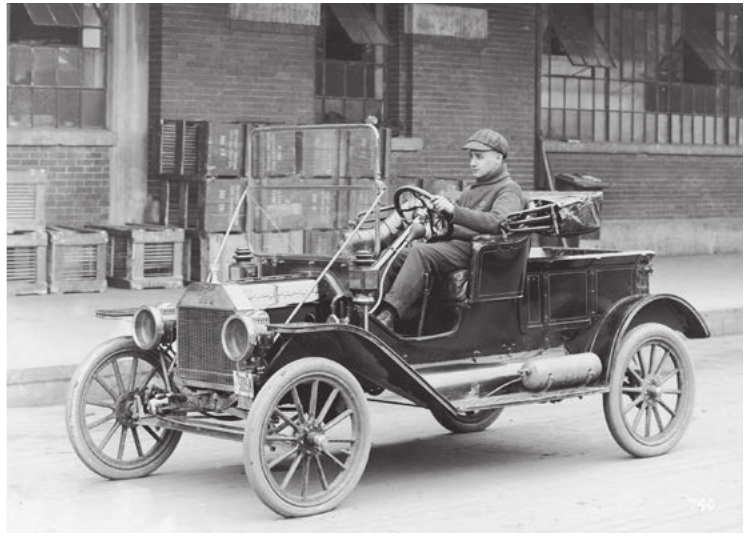
The automobile became a powerful symbol of American industrial might and consumerism. Ford's Model T, introduced in 1908 and mass-produced through the 1920s, made car ownership accessible to middle-class Americans for the first time. Ford's assembly line techniques represented the cutting edge of manufacturing technology, dramatically reducing production costs and time.
Note
This celebration of wealth and industrial success reinforced the belief that anyone could achieve prosperity through hard work, even though social and economic barriers prevented many Americans from accessing such opportunities.
The Progressive Age (1902-19)
Origins of progressivism
Progressivism developed as a response to the social problems created by rapid industrialization in the late nineteenth and early twentieth centuries. As factories expanded and cities grew, serious issues emerged:
- Widespread poverty in urban areas
- Dangerous working conditions in factories and mines
- Child labor exploitation
- Inadequate housing and sanitation
- Growing inequality between industrial owners and workers
- Lack of protection for workers injured on the job
Progressive ideology recognized that these collective problems required government intervention and social policy, not just individual effort. Progressives believed education and regulation could improve conditions for all classes and peoples, contrasting with the prevailing emphasis on individual self-determination.
President Woodrow Wilson and progressive reforms
President Woodrow Wilson, elected in 1912 as a Democrat, championed progressive reform at the federal level. His presidency marked a significant period of modernization and social change.
Wilson's key progressive achievements included:
- Banking reform: Modernizing the American banking system to make it more stable and accessible
- Trade reform: Lowering tariffs to promote more open and fair trade
- Labor protections: Introducing regulations to protect child workers from exploitation
- Workers' compensation: Creating a system to compensate workers injured during industrial work
- Improved working conditions: Implementing safer labor laws and regulations for factories
These reforms represented a shift toward greater federal government involvement in economic and social matters. Wilson believed the government had a responsibility to protect citizens from the excesses of unregulated capitalism.
Important
Wilson's progressive reforms faced significant opposition from conservative politicians and business interests who believed the government should not interfere with free enterprise.
World War I and its aftermath
American entry into World War I
The United States initially remained neutral when World War I began in Europe in 1914. However, several factors eventually drew America into the conflict:
- German submarine warfare threatening American ships
- The Zimmermann Telegram (1917), in which Germany proposed a military alliance with Mexico against the United States
- Economic ties to Britain and France
- Wilson's belief that America could shape a just peace
In 1917, the United States entered World War I on the side of the Allies (Britain, France, and Russia). American entry proved decisive in breaking the stalemate on the Western Front.
Wilson's Fourteen Points
As the war neared its end, President Wilson developed a vision for lasting peace. His Fourteen Points plan offered war-weary nations a framework for ending the conflict and preventing future wars.
Key elements of the Fourteen Points included:
- Open diplomacy (no secret treaties)
- Freedom of the seas
- Removal of economic barriers between nations
- Reduction of armaments
- Fair adjustment of colonial claims
- Self-determination for peoples of Europe
- Creation of a League of Nations to prevent future conflicts
Germany agreed to end the war based on these principles, believing they would receive a fair peace settlement.
Note
Wilson's Fourteen Points represented an idealistic vision of international relations based on cooperation, transparency, and collective security rather than military alliances and balance-of-power politics.
The Treaty of Versailles
The Treaty of Versailles was the peace treaty that officially ended World War I in 1919. However, the final treaty departed significantly from Wilson's vision.
The Treaty of Versailles imposed harsh terms on Germany, including:
- Massive financial reparations to be paid to the Allies
- Acceptance of full responsibility for causing the war (the 'war guilt' clause)
- Severe restrictions on German military forces
- Loss of German territory and colonial possessions
Important
While Wilson had promised a fair peace based on his Fourteen Points, the final treaty was much more punitive toward Germany. This contributed to German resentment and economic hardship, creating conditions that would later enable Hitler's rise to power.
The League of Nations
The League of Nations was an international organization proposed by Wilson to prevent future wars through collective security and diplomacy. It was the forerunner to the modern United Nations.
The League's intended functions included:
- Providing a forum for nations to resolve disputes peacefully
- Coordinating international efforts to prevent aggression
- Promoting disarmament and cooperation
- Protecting smaller nations from more powerful aggressors
Note
Wilson's vision: He believed the League of Nations would usher in a new era of international cooperation and make another devastating war impossible.
America's failure to join the League of Nations
Despite Wilson's passionate advocacy, the United States Congress voted against joining the League of Nations in 1920. This was a devastating blow to Wilson's vision of world peace and American leadership.
Reasons for Congressional opposition included:
- Isolationist sentiment: Many Americans wanted to avoid future involvement in European conflicts
- Constitutional concerns: Senators worried that League membership would require the US to go to war without Congressional approval
- Political opposition: Wilson's Republican opponents in Congress sought to defeat his signature achievement
- Public war-weariness: After the sacrifices of World War I, many Americans wanted to focus on domestic issues
Note
Wilson's personal tragedy: While campaigning across the country to build support for the League, Wilson suffered a severe stroke in 1919. He was left paralyzed on one side and unable to effectively continue his fight for American membership. His wife, Edith Wilson, acted as an unofficial steward, advising on matters of state and controlling access to the president.
Wilson died in 1924, his dream of American leadership in a peaceful world order unrealized.
Important
Historical significance: America's refusal to join the League of Nations seriously weakened the organization. Without American economic, military, and political support, the League proved unable to prevent aggressive expansion by Germany, Italy, and Japan in the 1930s. This failure contributed directly to the outbreak of World War II.
American isolationism
Definition and origins
Isolationism was a period of US foreign policy in which governments chose to remove or distance themselves from international conflicts or affairs to concentrate on domestic developments.
After the disappointment of World War I and the League of Nations debate, America turned decisively inward. The election of President Warren G. Harding in 1920 marked the beginning of this isolationist era.
Harding campaigned on a platform of:
- "Return to normalcy" after the upheaval of war
- Focus on American prosperity and domestic issues
- Avoiding foreign entanglements and conflicts
- Promoting American business interests
Characteristics of American isolationism
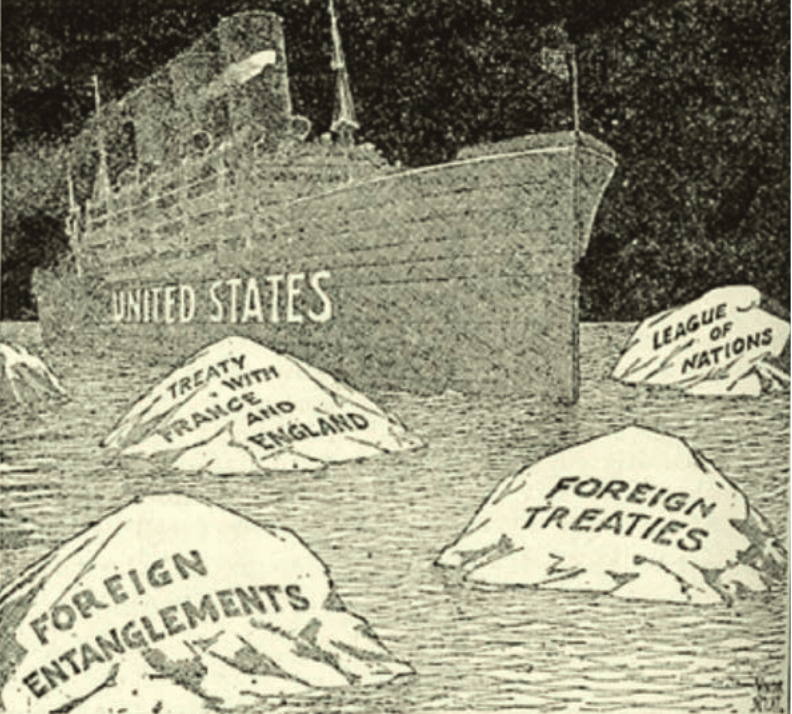
Note
The political cartoon above illustrates the American isolationist mindset. The ship "United States" carefully navigates through dangerous waters filled with obstacles labeled "League of Nations," "Foreign Treaties," and "Foreign Entanglements." This visual metaphor captured the widespread American belief that international commitments threatened national independence and prosperity.
Key features of isolationist policy:
- Refusal to join international organizations: America remained outside the League of Nations throughout its existence
- High tariffs: Protective tariffs were raised to shield American businesses from foreign competition
- Immigration restrictions: The Immigration Act of 1924 established quotas severely limiting immigration, particularly from Southern and Eastern Europe and Asia
- Neutrality legislation: In the 1930s, Congress passed laws prohibiting arms sales to warring nations
- Non-intervention: America refused to intervene in international conflicts, even as Hitler expanded German territory in Europe
Impact of isolationism
Domestic impact:
- Allowed focus on economic growth and industrial development in the 1920s
- Contributed to nativist sentiment and discrimination against immigrants
- Reinforced American nationalism and sense of exceptionalism
International impact:
- Weakened collective security efforts in Europe
- Emboldened aggressive nations (Germany, Italy, Japan) in the 1930s
- Left democratic nations like Britain and France to face fascist expansion largely alone
- Made the United States unprepared for the challenges of World War II
Important
Critical assessment: While isolationism reflected legitimate American concerns about avoiding future wars, it ultimately proved short-sighted. By refusing to engage with international problems in the 1920s and 1930s, America allowed conditions to develop that made World War II more likely and more devastating.
The end of isolationism
American isolationism ended abruptly on 7 December 1941 when Japan attacked the US naval base at Pearl Harbor in Hawaii. This devastating surprise attack killed over 2,400 Americans and destroyed much of the Pacific Fleet.
Note
Significance of Pearl Harbor:
- Demonstrated the impossibility of complete isolation in an interconnected world
- United American public opinion behind entry into World War II
- Marked the beginning of America's transformation into a global superpower with worldwide military commitments
- Represented the failure of isolationist policy to protect American security
The attack on Pearl Harbor proved that geographic isolation was no longer sufficient protection in the age of modern warfare and global power politics.
Timeline of key events (1919-1941)
| Year | Event | Significance |
|---|---|---|
| 1919 | United States negotiates peace treaties using Wilson's Fourteen Points but fails to fully support the League of Nations | America plays major role in ending WWI but begins retreat from international engagement |
| 1920 | US Congress vetoes joining the League of Nations | Marks decisive turn toward isolationism |
| 1920 | President Harding elected and endorses American isolationism | Confirms shift in American foreign policy |
| 1920 | Prohibition introduced with the Volstead Act | Beginning of the Prohibition era |
| 1920 | Nineteenth Amendment grants American women the right to vote | Major expansion of democratic participation |
| 1921 | Henry Ford creates new production methods for Model T automobiles | Symbolizes American industrial innovation and consumerism |
| 1924 | Immigration restriction quotas introduced under Harding's presidency | Reflects nativist sentiment and isolationist ideology |
| 1928-29 | Herbert Hoover promotes "American Individualism" doctrine; elected president in 1929 | Emphasizes capitalist and consumer policy |
| 1929 | Wall Street stock market crashes on 29 October | Triggers the Great Depression |
| 1931 | Al Capone indicted for tax evasion | Symbolizes government efforts to combat organized crime |
| 1932 | Franklin D. Roosevelt elected president | Marks shift toward government intervention in economy |
| 1933 | Prohibition repealed | End of the Prohibition experiment |
| 1933 | Roosevelt's New Deal introduced | Beginning of major federal programs to address Depression |
| 1941 | Bombing of Pearl Harbor; United States enters World War II | End of American isolationism |
Note
Exam tip: Understand the connections between events on this timeline. For example, the failure to join the League of Nations (1920) relates directly to the rise of isolationism, which in turn affected America's response to international crises in the 1930s, culminating in the surprise attack at Pearl Harbor (1941).
Remember!
Summary
Key takeaways about the US in the aftermath of WWI and 1920s politics:
-
American ideology was contradictory: While the nation proclaimed values of liberty, equality, and opportunity for all (Manifest Destiny), these ideals were often denied to Black Americans, indigenous peoples, women, immigrants, and the working class.
-
Progressivism marked a shift in government's role: The Progressive movement (1902-19) and President Wilson's reforms represented a new belief that government should actively intervene to address social problems, protect workers, and regulate business - a departure from the purely individualistic approach.
-
Wilson's vision failed at home: Despite playing a crucial role in ending World War I and proposing the League of Nations, President Wilson could not convince the American Congress to join the international organization he championed. His stroke and death in 1924 symbolized the failure of his internationalist vision.
-
Isolationism dominated the 1920s and 1930s: After the disappointment of World War I, America deliberately withdrew from international affairs, refusing to join the League of Nations and focusing on domestic prosperity. This policy persisted even as fascist aggression threatened global stability.
-
Pearl Harbor shattered isolationism: The Japanese attack on Pearl Harbor in December 1941 demonstrated that geographic isolation could no longer protect America from global conflicts. This event marked a permanent shift in American foreign policy from isolationism to international engagement.