El Alamein and the Significance of North Africa (HSC SSCE Modern History): Revision Notes
📚Revision Notes
El Alamein and the Significance of North Africa
Hitler's Mediterranean strategy
After the fall of France in 1940, Hitler developed a strategy to pressure Britain from multiple directions. He hoped to create a firm alliance with Spain under Franco, Vichy France, and Italy. This coalition would then be able to apply pressure on British interests in the Mediterranean region.
However, Hitler's attempts to build this Mediterranean alliance failed. Franco proved extremely frustrating to deal with. Whilst Franco would agree to Hitler's proposals in principle, he would then raise numerous practical objections that prevented any real cooperation. Hitler later complained that negotiating with Franco was like "chewing rocks". Mussolini also proved surprisingly uncooperative, frequently springing surprises on his German partner.
Important
The reality was that the Mussolini-Hitler partnership functioned more as a public relations exercise than as a genuine, well-coordinated military alliance. This fundamental weakness would have significant consequences for Axis strategy in North Africa.
Mussolini's Egyptian campaign and Italian failures
Despite the weak nature of the Axis alliance, Mussolini ultimately drew Hitler into the Mediterranean theatre. However, this was not to achieve German strategic objectives, but rather to rescue Mussolini's own failed ambitions in the region.
In 1940, Mussolini decided to take advantage of what he perceived as British weakness following the fall of France. Believing Britain was finished, he launched campaigns to conquer both Egypt and Greece. Mussolini showed great enthusiasm for the Egyptian campaign and tried to drum up domestic support for it. However, his military high command had serious reservations about going to war with Great Britain in 1940.
Important
The Italian Disaster in North Africa
The results were catastrophic for Italy. The British caught the Italians by surprise in December 1940, and disaster followed disaster:
- December 1940: British forces captured 45,000 Italian prisoners in one operation
- January 1941: Another 45,000 Italian prisoners taken in a second operation
- Later in January: British forces encircled Tobruk (an important port city), leading to the surrender of 30,000 Italians
- February 1941: A further 20,000 Italian prisoners were taken
In total, over 130,000 Italian soldiers surrendered whilst Britain suffered fewer than 2,000 casualties during operations in 1940 and early 1941.
By the end of May 1941, Britain controlled virtually all of Italian East Africa and had reconquered French and British Somaliland.
Rommel and the Afrika Korps
The scale of the Italian disaster forced Hitler to intervene. In February 1941, he dispatched Erwin Rommel to save the situation. Hitler remained reluctant to commit significant resources to North Africa, as he saw the Mediterranean as a sideshow compared to his main focus on preparing for the invasion of the Soviet Union. Nevertheless, the Italian collapse had to be brought under control.

Note
The Afrika Korps
The Afrika Korps was the German expeditionary force in Africa during the North African Campaign. Rommel was sent to Libya in command of this small armoured force in February 1941. His arrival would dramatically change the nature of the North African campaign.
Even before his troops were fully in place, Rommel launched an aggressive attack against the British. He forced them all the way back into Egypt and even captured the British General O'Connor. However, he was unable to dislodge British forces from Tobruk, whose port facilities he desperately needed for supplies. By late May 1941, the offensive had stalled, and a deadlock developed along the Egyptian frontier. There followed a pause in hostilities.
Strategic dilemma for Germany
The Mediterranean theatre presented a fundamental dilemma for German strategy. For Hitler, this region had always been intended as a sideshow. His main military preparations focused on the planned invasion of the Soviet Union. Hitler was simply not interested in North Africa or the Mediterranean, which reveals his limitations as a strategist. He never fully appreciated the strategic importance of the Middle East and remained very reluctant to seize the opportunities that presented themselves.
Note
Could Germany Have Prevailed?
After the war, German generals frequently debated whether Germany could have prevailed if Hitler had been willing to commit the necessary forces to North Africa. Success in the region could have brought enormous benefits:
- Seizure of the Suez Canal would cut Britain off from links to its empire
- Capture of Middle Eastern oil fields would solve Germany's desperate fuel shortages
- Success would make British links between the war in Asia and Europe extremely tenuous
These were genuine strategic opportunities. However, the question remains whether German success was actually feasible given the severe logistical problems.
Logistical challenges
The logistical difficulties in North Africa were immense. Tripoli served as the only major Axis port in North Africa, yet it was located 1,300 miles from Alexandria in Egypt. This distance was more than twice that from the pre-war Polish border to Moscow. Moreover, Tripoli had limited capacity as a port and could not have supported a major military effort.
The fighting across North Africa took place in a very narrow coastal band rather than involving huge flanking movements. Supply problems so severely hampered both the Axis and Allied armies in 1940-41 that they essentially operated as expeditionary forces rather than as fully supported military campaigns.
Important
These logistical constraints make it doubtful whether any German strategy in the Middle East could have succeeded, regardless of Hitler's commitment of resources. The supply situation would prove to be the decisive factor throughout the North African campaign.
The North African campaign 1941-1942
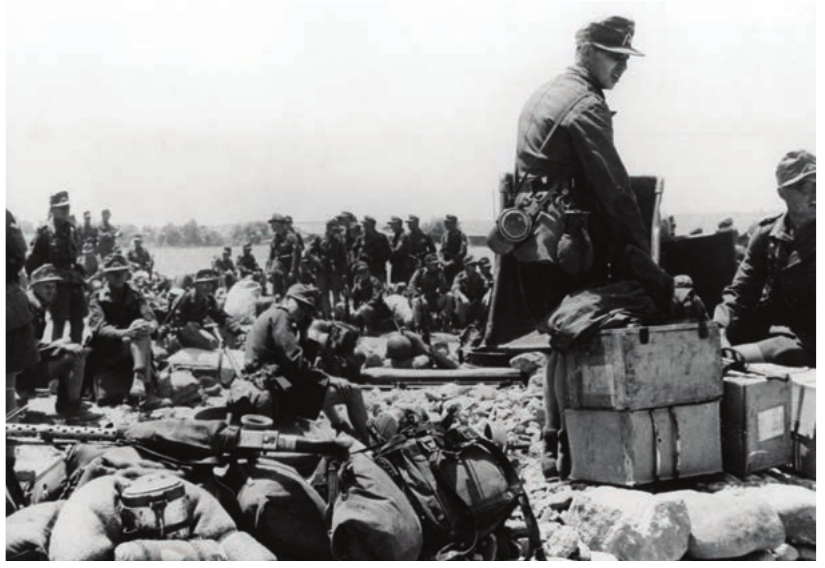
During 1941-42, the campaign in North Africa swung back and forth. The turning point would come through the British ability to resupply their forces in Egypt, which ultimately shifted the balance of power during 1942.
In May 1942, Rommel initiated a fresh offensive. Following the usual pattern of advance and retreat, German troops achieved a tremendous victory in late May when they captured Tobruk. This success inflicted terrible casualties on the British and resulted in:
- Capture of 35,000 British prisoners
- Seizure of vast quantities of fuel, food, and drinking water
- A major boost to German morale
Note
Hitler rewarded Rommel for this achievement by promoting him to the rank of field marshal. Rommel renewed his offensive, and by late June, the Afrika Korps had thrust deep into Egypt. On 30 June, German troops reached El Alamein, positioned only 60 miles west of Alexandria. Victory appeared within Rommel's grasp.
The battles of El Alamein
El Alamein served as the gateway to Alexandria and therefore held crucial strategic importance. The battles fought here would prove to be turning points in the North African campaign.
First Battle of El Alamein (July 1942)
The First Battle of El Alamein took place in July 1942. The battle ended with British forces holding their ground but unable to push the Germans back. The familiar pattern returned, with supplies proving to be the decisive factor. The Germans simply could not sustain their offensive and lacked the resources to continue pushing forward.
At this critical point, supplies began pouring into Egypt to support British forces. American Sherman tanks arrived in large numbers, significantly strengthening British armoured capabilities.
British leadership changes
Following the embarrassments of the previous month, Churchill decided to shake up the military leadership in North Africa. In mid-August 1942, he made two crucial appointments:
Note
New British Leadership in North Africa
General Harold Alexander was appointed to command the entire North African theatre. He would become a major figure in the British military for the remainder of the war.
General Bernard Montgomery was chosen to lead the British Eighth Army. Montgomery would prove to be an exceptionally important commander. He mastered what military professionals call the "set piece" approach, never wanting to move until he had all his preparations perfectly in place ("all his ducks in a row"). He proved tremendously popular with his troops and built strong morale among the forces under his command.
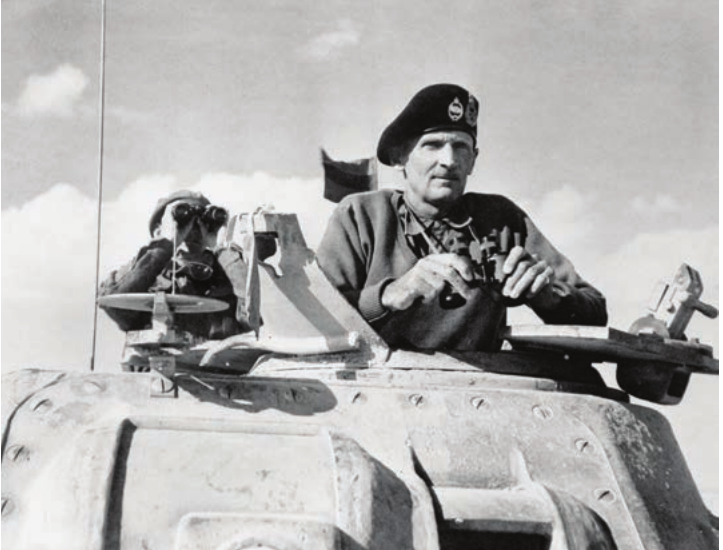
Second Battle of El Alamein (October 1942)
Montgomery launched his attack with overwhelming force on 23 October 1942 in what became the Second Battle of El Alamein. This battle would mark a crucial turning point in the North African campaign and, more broadly, in the entire war.
Example
The Balance of Forces at Second El Alamein
The force comparison heavily favoured the British:
| Forces | British | German |
|---|---|---|
| Personnel | 230,000 | 80,000 |
| Tanks | 1,500 (many American Sherman tanks) | 500 |
In addition to numerical superiority, the British enjoyed:
- Complete air superiority over the battlefield
- Intelligence advantages through Ultra intercepts, allowing them to determine when supplies were crossing from Italy
Despite these advantages, the British suffered terrible casualties during the battle. They lost four times as many tanks as the Germans. However, Rommel could not afford to take even the losses he sustained. The difference in resources and capacity to replace losses proved decisive.
Important
Hitler refused to send significant reinforcements to Rommel. The German commander constantly pressed for help, but very little support came from Germany. This was partly because of Germany's deep involvement in the Soviet Union, which absorbed the bulk of German military resources.
By November 1942, Rommel was in retreat. That retreat proved to be a masterpiece of military skill. Combined with Montgomery's characteristic caution, Rommel's tactical brilliance allowed German forces to escape back into Libya. The question now became whether the British would seize the initiative and drive the Germans completely out of North Africa.
Operation Torch
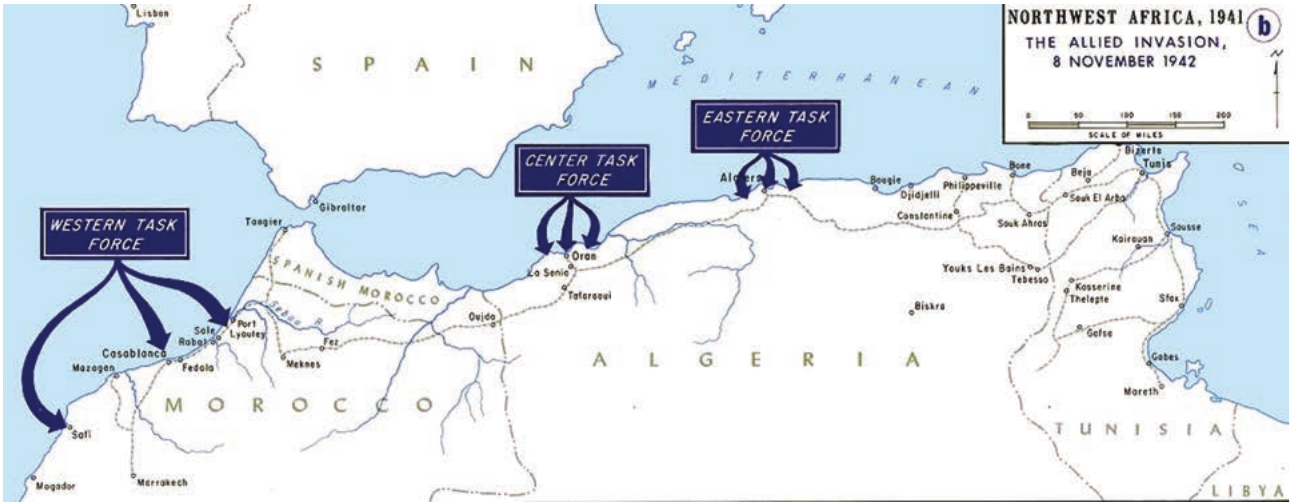
Rommel's position deteriorated further when Operation Torch was launched. This marked the first major Allied joint operation, bringing American forces into the North African theatre alongside the British.
Note
Operation Torch: Allied Landings in North Africa
General Dwight Eisenhower was chosen to lead Operation Torch. The plan called for Allied landings at three locations:
- Casablanca in Morocco
- Oran in Algeria
- Algiers in Algeria
After establishing these beachheads, Allied forces would sweep eastward toward Tunisia, catching Rommel's forces between Montgomery's advance from the east and the new American and British forces advancing from the west.
The German response to Operation Torch was to pour troops into Tunisia in an attempt to hold the territory. The Allies, having successfully landed in November 1942, found themselves bogged down in Tunisia as German resistance stiffened.
By March 1943, Great Britain and the United States had assembled overwhelming strength and began the final push toward victory in North Africa. Rommel remained unable to secure adequate supplies. Hitler, who had refused to see the potential of the Afrika Korps throughout the campaign, attempted to reinforce it too late. Only after the Allies had already established a dominant position did Hitler try to reverse the situation, but by then it was futile.
Strategic significance of North Africa
The North African campaign held enormous strategic significance for the European war. Historian David Thomson explained that the victory in North Africa:
Important
The Strategic Impact of Victory in North Africa
made possible the next steps – an attack upon the Balkans and upon Italy, and immediately it exposed those areas to bombing attack. Above all, it was complete testing and vindication in action of the Atlantic Alliance.
The campaign demonstrated that British and American forces could work together effectively in combined operations. It also opened up new strategic options for the Allies, particularly the possibility of attacking what Churchill called the "soft underbelly of Europe" through Italy and the Balkans.
Churchill captured the significance of the El Alamein victory in his famous speech at the Mansion House on 10 November 1942. For the British people, who had endured years of defeats and setbacks, El Alamein represented their first permanent victory. Churchill declared:
Note
Churchill's Famous Quote
Now this is not the end, it is not even the beginning of the end. But it is perhaps the end of the beginning.
This quote perfectly encapsulated the importance of the North African victory. Whilst the war was far from over, the tide had finally turned in favour of the Allies.
The combination of the British victory at El Alamein and the success of Operation Torch meant that from late 1942 onwards, Germany would be on the defensive rather than advancing.
From the American perspective, the success of Operation Torch had one significant drawback. It meant there would not be a cross-channel invasion of Europe in 1942, and American commanders feared it would also prevent such an invasion in 1943. Resources committed to the Mediterranean theatre would not be available for the direct assault on German-occupied France that American strategists preferred.
Summary
Key Points to Remember
-
Hitler failed to build effective Mediterranean alliances with Spain, Vichy France, and Italy, which weakened Axis strategy in the region.
-
Mussolini's disastrous Egyptian campaign of 1940 resulted in over 130,000 Italian prisoners taken by the British with minimal British casualties.
-
Rommel's Afrika Korps arrived in February 1941 and dramatically changed the North African campaign, but always struggled with severe supply and logistics problems.
-
The Second Battle of El Alamein (October 1942) marked a crucial turning point, with Montgomery's forces (230,000 troops, 1,500 tanks) overwhelming Rommel's smaller army (80,000 troops, 500 tanks).
-
Operation Torch (November 1942) brought American forces into North Africa and marked the first major Allied joint operation, demonstrating the effectiveness of the Atlantic Alliance.
-
The North African victory had strategic significance beyond the theatre itself, enabling attacks on Italy and the Balkans, and representing, in Churchill's words, "the end of the beginning" of Allied victories in World War II.