German Foreign Policy (HSC SSCE Modern History): Revision Notes
📚Revision Notes
German Foreign Policy
Introduction to Nazi foreign policy
When the Nazis came to power in 1933, they promised to restore Germany's lost grandeur and overturn the hated Treaty of Versailles. The party pledged to rebuild Germany's military strength and return the nation to its rightful place among the world's great powers.
Nazi foreign policy is often viewed as Hitler pursuing his ideological goals with single-minded determination, inevitably driving Germany towards war. However, this wasn't the image Hitler presented to the German public. Instead, he emphasised equality, Germany's right to defend itself, and the pursuit of peace. Hitler's actual foreign policy strategy was based on his own understanding of international relations and was essentially outlined in the NSDAP Twenty-five-point Program of 1920.
Note
The contrast between Hitler's public messaging (peace, equality, self-defence) and his actual ideological objectives (racial empire, Lebensraum, confrontation with the Soviet Union) was a deliberate strategy that proved highly effective in gaining both domestic and international acceptance for his early foreign policy moves.
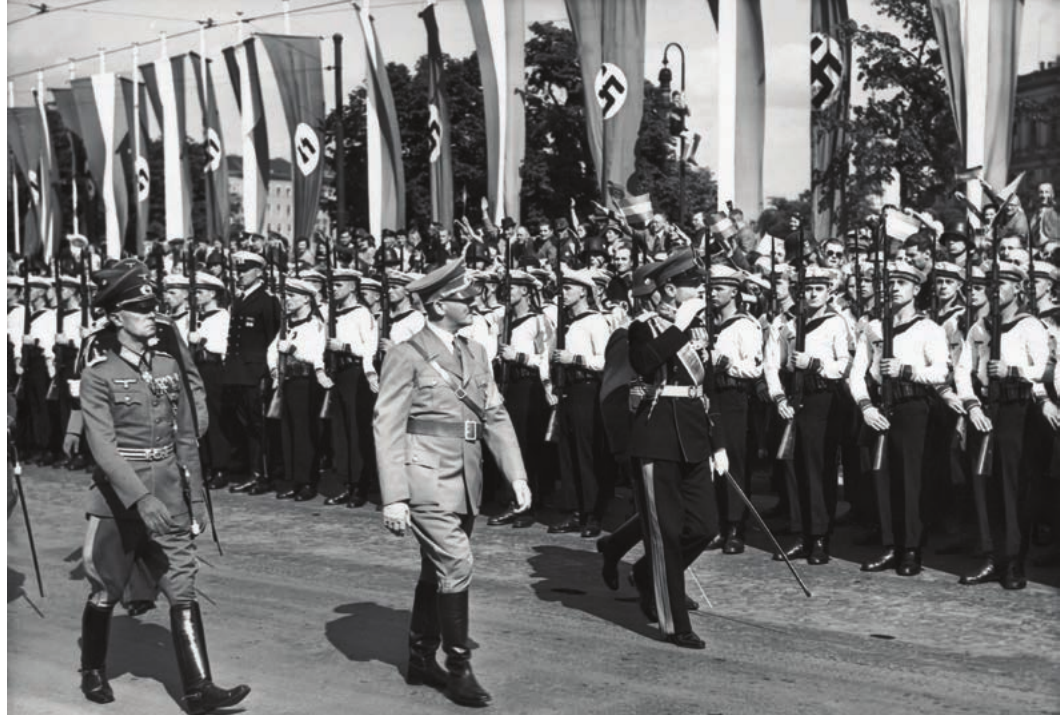
Key term: Mein Kampf - Hitler's 1925 autobiographical book, written whilst imprisoned after the Beer Hall Putsch. It outlined his anti-Semitic views, political ideology and future plans for Germany.
Main objectives of German foreign policy
Hitler's foreign policy had two primary objectives, supported by four key principles.
Objective 1: Achievement of Lebensraum
The primary aim of Nazi foreign policy was to secure Lebensraum (living space) in the east. This concept meant Germany needed to expand eastward to claim land for its growing population.
Historically, Germans had looked eastward for expansion, similar to how Americans expanded westward. After World War I, new states like Poland, Czechoslovakia and Yugoslavia were created in Eastern Europe. The Nazis viewed these states as illegitimate and saw them as opportunities for German expansion.
Beyond these new states lay the real prize: the Soviet Union. Hitler sought control of:
- The vast agricultural lands of Russia and Ukraine
- The raw materials of the Urals
- The forests of Siberia
Note
As Hitler stated in 1936:
If we had at our disposal the Urals, with their incalculable wealth of raw materials, and the forests of Siberia, and if the unending wheatfields of the Ukraine lay within Germany, our country would swim in plenty.
This statement reveals Hitler's economic and strategic thinking behind Lebensraum - it wasn't merely about territorial expansion, but about securing the resources necessary for Germany to become a truly independent great power.
Key term: Lebensraum - 'Living space', Hitler's term for Germany's need to expand eastward to claim land for the Reich's growing population.
Objective 2: Racial aims
Important
Nazi foreign policy was deeply rooted in racial ideology. Hitler's plans for Eastern Europe were inseparable from his racist worldview. These racial aims were not secondary considerations - they were fundamental to understanding Nazi foreign policy objectives.
Hitler's plans for Eastern Europe included:
- Reducing 'inferior' Eastern Europeans to a slave labour force
- Eliminating Jews to ensure Germany's racial purity
- Creating a racially pure German empire
These racial aims were inseparable from the pursuit of Lebensraum. As historian Christopher Browning noted, by September 1939, Hitler had approved a massive program of demographic engineering based on racial principles. These policies aligned with Hitler's core ideological assumptions: the need for Lebensraum in the east, contempt for Slavic populations, and determination to eliminate Jews from the expanding German Reich.
Key term: Judeo-Bolshevism - A propaganda term conflating Jews and Bolsheviks. The Nazis promoted the myth that the Russian Revolution was a Jewish conspiracy, making the Soviet Union both a racial and ideological enemy.
Supporting principles of German foreign policy
Revisionism
Hitler was determined to destroy the Treaty of Versailles, not merely revise it. This involved:
- Ending reparation payments
- Introducing conscription and rearmament
- Recovering territory lost after World War I
- Restoring Germany's 'rightful place in Europe'
Note
The Treaty of Versailles was widely hated in Germany and considered unjust. Hitler exploited this sentiment masterfully by publicly emphasising his determination to revise the treaty whilst privately planning its complete destruction. This dual approach allowed him to garner both domestic support and international sympathy for his early foreign policy moves.
Creation of Gross Deutschland
Hitler aimed to create a Greater Germany (Gross Deutschland) by:
- Bringing all ethnic Germans into the Reich
- Reuniting Germans separated by the post-World War I settlement
- Creating a unified German empire
Self-sufficiency (Autarky)
Hitler wanted to create an autarchic German Reich - an economically independent state that could withstand blockades like those Britain imposed during World War I (which caused mass starvation).
This self-sufficiency would be achieved through:
- Seizing territory in the east for its resources
- Making Germany independent of international trade
- Ensuring Germany could survive economic warfare
Key term: Autarchic - The quality of being self-sufficient and economically independent.
A reckoning with France
Hitler believed a confrontation with France was inevitable after World War I. His strategy was to:
- Defeat France first
- Remove France as a threat on Germany's western border
- Then focus German expansion eastward
Note
This strategic thinking reveals Hitler's understanding that Germany could not successfully pursue Lebensraum in the east whilst facing a potential threat from France in the west. The defeat of France was thus a prerequisite for eastern expansion, not an end in itself.
Hitler's public strategy versus private goals
Important
The Public-Private Contradiction
Understanding the gap between Hitler's public statements and his actual objectives is crucial to comprehending Nazi foreign policy. This deliberate deception allowed Hitler to achieve his ideological goals whilst presenting himself as a reasonable statesman seeking only justice for Germany.
Hitler's public statements consistently emphasised three themes:
- Equality - Germany deserved the same rights as other nations
- Defence - Germany needed to defend itself (other countries had armies, why not Germany?)
- Peace - Germany wanted peaceful revision of the Treaty of Versailles
From becoming Chancellor in 1933 until war began in 1939, Hitler always spoke publicly about equality and Germany's rightful position. He argued that Germany had been unfairly denied its place by the Treaty of Versailles and simply wanted to restore what was rightfully theirs.
This public message deliberately contrasted with Hitler's actual ideological goals of racial empire, Lebensraum and the eventual showdown with the Soviet Union.
Implementation of foreign policy, 1933-1938
Between 1933 and 1938, Hitler achieved a series of impressive foreign policy victories that overcame many Germans' reservations about Nazi domestic policy.
1935: The Saar plebiscite
In 1935, the Saar region (southwest Germany) held a plebiscite after being under League of Nations control since World War I. The vote was overwhelmingly in favour of returning to Germany. The Nazis celebrated this as a great success.
Key term: Saar - A German region occupied and governed by Britain and France from 1920 to 1935 under a League of Nations mandate.
1935: Creation of the Luftwaffe (1 March)
Hitler announced his determination to build an air force, the Luftwaffe, specifically banned by the Treaty of Versailles. He justified this by arguing that since Britain was modernising its air force, Germany needed to defend itself. France protested, but no concerted action was taken against Germany.
Note
This event demonstrates Hitler's public strategy in action. By framing German rearmament as a defensive response to British modernisation, Hitler made it difficult for other powers to object without appearing hypocritical. The lack of effective response from the League of Nations encouraged Hitler to pursue more aggressive policies.
Key term: Luftwaffe - The aerial warfare branch of the German Wehrmacht military forces during World War II.
1935: Introduction of conscription (15 March)
Two weeks after announcing the Luftwaffe, Hitler introduced conscription and announced plans to build up the Wehrmacht (armed forces) to half a million men within a year. He explicitly renounced the Versailles clauses on rearmament. The League of Nations protested, but took no action.
Key term: Wehrmacht - The unified armed forces of Nazi Germany from 1935 to 1946, consisting of the Heer (Army), the Kriegsmarine (Navy) and the Luftwaffe (Air Force).
1935: Anglo-German Navy Agreement (June)
Britain made a separate deal with Germany, allowing Germany to rebuild its fleet to 35 per cent of Britain's size, with equal numbers of submarines. This agreement:
- Violated the Treaty of Versailles
- Demonstrated Britain's willingness to negotiate separately with Hitler
- Made France feel betrayed by Britain
- Damaged French trust in British commitment to enforcing Versailles
Important
Critical Turning Point
The Anglo-German Navy Agreement represented a major diplomatic victory for Hitler. By securing British agreement to German rearmament, Hitler effectively undermined the entire Treaty of Versailles framework. More importantly, it created a rift between Britain and France that Hitler would exploit repeatedly in subsequent years.
Key term: Anglo-German Navy Agreement - In June 1935, Germany and Britain signed an agreement permitting Germany to have a navy of 35 per cent the size of Britain's and an equal number of submarines.
1936: Remilitarisation of the Rhineland (7 March)
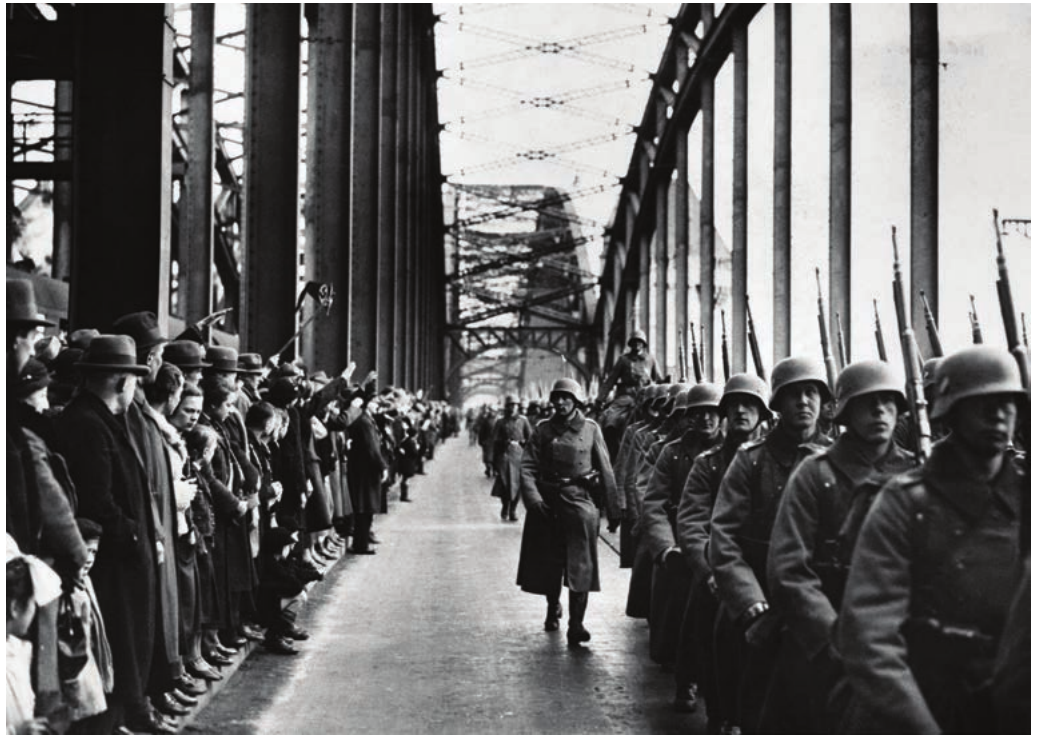
On 7 March 1936, Hitler moved German troops into the Rhineland. The Rhineland's west bank was still German territory, but the Treaty of Versailles required it to be demilitarised.
This was strategically crucial because:
- Previously, if Germany threatened the region, French troops could easily march across the Franco-German border
- France had done this in 1923 during the Occupation of the Ruhr
- Remilitarisation removed France's military leverage over Germany
Note
Hitler's generals strongly opposed this move, fearing French military intervention. Hitler overruled them, gambling that France and Britain would not respond with force. His gamble paid off - once again, the League of Nations protested but took no real action. Britain didn't even formally protest. This success emboldened Hitler and convinced him that the Western powers would not effectively resist German expansion.
Key terms:
- Occupation of the Ruhr - In 1923, French troops occupied the Ruhr Valley in the Rhineland after the Weimar Republic defaulted on reparation payments.
- Remilitarisation of the Rhineland - In March 1936, Hitler ordered German military into the Rhineland in western Germany, the first time since World War I German troops had been there, enabling Germany to pursue aggressive policies in Eastern Europe.
1936: Spanish Civil War involvement
Hitler sent troops and equipment to support Franco's forces against the Spanish Republic. This achieved several objectives:
- Positioned Hitler to develop closer ties with Mussolini (who also sent Italian troops)
- Drove a wedge between Mussolini and Britain/France
- Allowed Germany to test military equipment and tactics
Note
The Spanish Civil War provided Germany with a valuable testing ground for its new military technology and doctrines, particularly the Luftwaffe's capabilities. The experience gained in Spain would prove valuable in the coming war. Additionally, supporting Franco aligned Germany with another authoritarian regime and further isolated the Soviet Union, which supported the Republican side.
1937: The Hossbach Memorandum (5 November)
In 1937, Hitler held a famous and controversial meeting with his foreign policy advisers and top military leaders. Although no official notes were to be taken, Colonel Hossbach made personal notes that became known as the Hossbach Memorandum.
The memorandum recorded Hitler's foreign policy and military goals:
- Germany needed and would achieve Lebensraum between 1943 and 1945
- This would probably require annexing both Austria and Czechoslovakia
- Poland and the Soviet Union weren't mentioned specifically
Note
Historians debate whether this was a concrete blueprint for war or typical Hitler rhetoric where he spoke in general terms. Some view it as evidence of Hitler's planned aggression from an early date, whilst others argue it reflected Hitler's general thinking rather than a specific timetable. Regardless of interpretation, the memorandum clearly shows that by 1937, Hitler was openly discussing expansion and potential war with his military leadership.
Key term: Hossbach Memorandum - Personal notes recording a meeting held on 5 November 1937 between Hitler and his military and foreign policy leadership, where he outlined his future expansionist policies.
1938: Anschluss with Austria (12 March)
In early 1938, Austria grew nervous about German foreign policy. Although the Austrian Nazi Party had been officially banned in 1934, it still existed four years later.
Hitler invited Austrian Chancellor Kurt Schuschnigg to the Eagles Nest to resolve tensions. Schuschnigg was deeply opposed to Austria becoming part of Germany. He left the meeting a broken man and returned to arrange a plebiscite on Austrian incorporation into Germany.
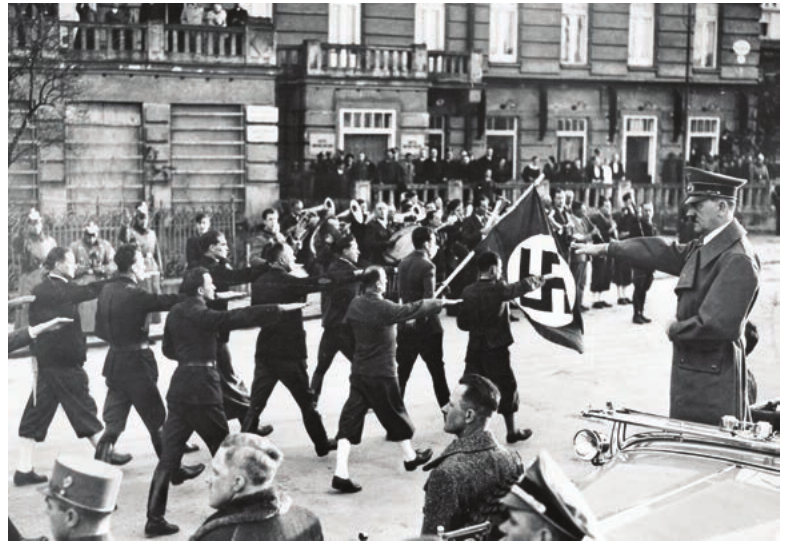
Hitler wasn't prepared to risk a vote deciding Austria's fate. On the morning of 12 March, German troops moved into Austria to cheering crowds. Hitler announced that Austria had become part of Germany.
Important
The Anschluss: A Template for Future Expansion
The Anschluss demonstrated Hitler's evolving strategy: combine diplomatic pressure, internal subversion (through local Nazi parties), military intimidation, and appeals to ethnic German unity. This pattern would be repeated with Czechoslovakia. Following the Anschluss, Czechoslovakia moved to the forefront of German foreign policy, and Europe began sliding towards war.
Exam tips
When answering questions about German foreign policy, consider:
Hitler's basic goals:
- Achievement of Lebensraum in the east
- Racial aims (enslaving Eastern Europeans, eliminating Jews)
- Creating an autarchic Greater Germany
- Destroying the Treaty of Versailles
- Eventual confrontation with the Soviet Union
Why France struggled to respond aggressively:
- Britain's separate deal with Germany (Anglo-German Navy Agreement) undermined French trust
- France lost its military leverage when Germany remilitarised the Rhineland
- The League of Nations proved ineffective at enforcing the Treaty of Versailles
- France felt isolated without reliable British support
The role of ideology in Hitler's foreign policy:
- Hitler's public statements emphasised equality and peace, not ideology
- His actual goals were deeply ideological (Lebensraum, racial purity, anti-Bolshevism)
- Successfully implemented his ideological program step-by-step 1933-1938
- Each foreign policy move had both pragmatic and ideological dimensions
Example
Worked Example: Analysing a Foreign Policy Event
Let's examine the Remilitarisation of the Rhineland (1936) to see how it demonstrates Hitler's objectives and principles:
Step 1: Identify the objectives served
- Revisionism: Directly violated Treaty of Versailles demilitarisation clauses
- Preparing for reckoning with France: Removed France's military advantage on western border
- Necessary precondition for Lebensraum: Secured western frontier before eastern expansion
Step 2: Analyse the public strategy
- Hitler presented it as Germany reclaiming its own territory
- Emphasised defensive nature: protecting German soil
- Framed as equality: other nations had troops on their territory, why not Germany?
Step 3: Consider the consequences
- No effective opposition from League of Nations or Western powers
- Emboldened Hitler to pursue more aggressive policies
- Demonstrated the gap between verbal protests and actual enforcement
- Convinced Hitler that Britain and France would not risk war to stop German expansion
This example shows how a single event can illuminate broader patterns in Nazi foreign policy.
Summary
Key Points to Remember:
-
Two main objectives: Lebensraum (living space in the east, ultimately the Soviet Union) and racial aims (enslaving Slavs, eliminating Jews)
-
Four supporting principles: Revisionism (destroying Treaty of Versailles), Gross Deutschland (uniting all Germans), self-sufficiency (autarky), and defeating France before eastern expansion
-
Public versus private strategy: Hitler publicly emphasised equality, defence and peace whilst privately pursuing ideological goals of racial empire and Lebensraum
-
Series of victories 1933-1938: Each success (Saar, Luftwaffe, conscription, Anglo-German Navy Agreement, Rhineland, Austria) built on the previous one, with the League of Nations and Western powers failing to take effective action
-
Ideology drove policy: Nazi racial ideology and pursuit of Lebensraum shaped all foreign policy decisions, even when Hitler presented them as reasonable responses to Germany's legitimate grievances about the Treaty of Versailles