Communist Victory and the Fall of Saigon (HSC SSCE Modern History): Revision Notes
📚Revision Notes
Communist Victory and the Fall of Saigon
The Paris Peace Accords 1973
In January 1973, a peace agreement was reached between the United States, North Vietnam, and South Vietnam. The negotiations had been difficult, starting and stopping repeatedly since 1968. Under the terms of the treaty, President Nixon announced that American military forces would withdraw from Indochina within 60 days. A small number of troops would remain to protect the embassy in Saigon. Significantly, the US Congress had already voted to cut all funding to the conflict.
In exchange for the American withdrawal, North Vietnam agreed to release all American prisoners of war. Among those who returned home was John McCain, who would later become a US Senator and presidential candidate in 2008. The United States ended its military involvement in Vietnam in 1973, leaving South Vietnam to face the communist forces alone.
Important
The Paris Peace Accords effectively abandoned South Vietnam to fight alone against North Vietnamese forces. Without American military support or funding, the South Vietnamese government and army (ARVN) were left isolated and vulnerable to the coming offensive.
Background to the fall
The Watergate Scandal and leadership change
By 1974, the Watergate Scandal had engulfed President Nixon, forcing him to resign from office. His replacement was President Gerald Ford. This political crisis in Washington further weakened American commitment to supporting South Vietnam, leaving the country increasingly isolated and vulnerable to North Vietnamese attack.
Note
The political turmoil in the United States during 1974 meant that even if the South Vietnamese government had requested further American assistance, the new Ford administration was politically unable and unwilling to provide it. This marked a decisive turning point in the war.
The fall of Saigon 1975
The final North Vietnamese offensive
In 1974, North Vietnamese forces launched their decisive military campaign against the isolated Army of the Republic of Vietnam (ARVN). The South Vietnamese military hoped that American air strikes might keep the advancing North Vietnamese forces at bay, and they prepared for what they knew would be a desperate fight for survival. However, the air strikes never came.
The defence of South Vietnam proved catastrophic. The chaos within the South Vietnamese Government, which had experienced one corrupt administration after another since the fall of President Diem, meant they were completely unable to coordinate an effective defence. As the communist forces advanced, hundreds of thousands of civilians and soldiers fled in panic.
The final assault
On 31 March 1975, the North Vietnamese Army (NVA) launched the final assault on Saigon. In the surrounding areas, they initiated the Ho Chi Minh Campaign, designed to eliminate the remaining pockets of ARVN resistance and complete the conquest of South Vietnam.
The last days of Saigon
In the final days before the city fell, Saigon's population had swelled far beyond capacity as refugees poured in from across the country. Those who had collaborated with US forces or served in the South Vietnamese Government, particularly members of the ARVN, feared for their lives under communist rule. Many South Vietnamese people tried desperately to escape alongside the evacuating American forces.
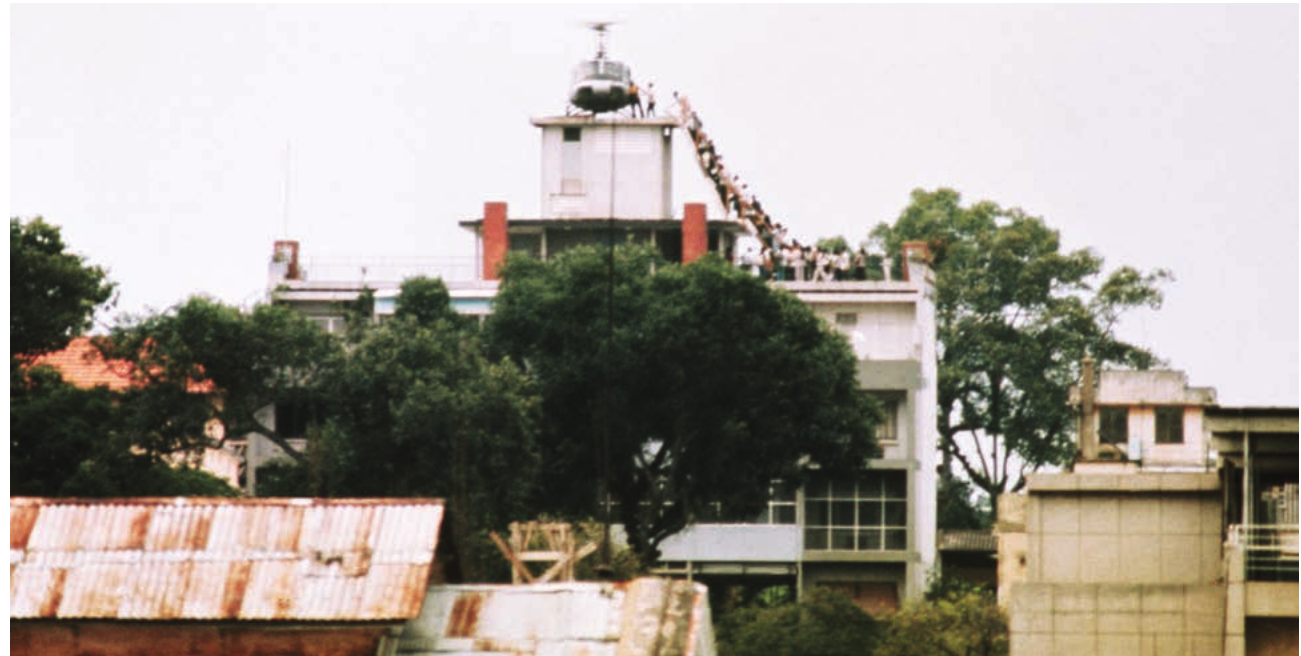
Tens of thousands of these people were ultimately left behind to face an uncertain fate. As the first major 'television war' came to its conclusion, news cameras captured dramatic footage showing US helicopters evacuating the last American personnel from the roof of the US Embassy. The helicopters flew out to aircraft carriers stationed off the coast of Vietnam, while desperate Vietnamese people who had fought against the communists reached upward, hoping for salvation.
Note
Inside the embassy, American personnel were frantically destroying sensitive materials. According to eyewitness Michael Caulfield, they were burning four million dollars in cash and shredding vast quantities of documents, including lists of names, secret files, and records of spies, collaborators, and assassins, all while North Vietnamese tanks drew closer to the city centre.
The capture of Saigon: 30 April 1975
On 30 April 1975, a Soviet-made North Vietnamese tank burst through the gates of the Independence Palace and drove across the lawn. The offensive had taken just 55 days from its launch to the complete capture of Saigon. This moment marked the end of the war and the formation of a united Vietnam under communist control. However, the suffering was far from over for many South Vietnamese people.
Vo Dang Toan, the tank commander who led this symbolic breakthrough, later reflected on that moment:
The first thing I thought of was my family, my home village, my wife and children. Then I thought of how, from now on, my people and fellow soldiers wouldn't have to spill their blood any more.
Aftermath: re-education camps
The fate of South Vietnamese collaborators
Van Nhung Tran, a former ARVN officer who surrendered to the NVA, experienced firsthand what awaited those who did not escape.
Example
Personal Testimony: Van Nhung Tran's Experience
Van Nhung Tran described the conditions he and approximately 200 other captains faced in the re-education camps:
There were about 200 of us, all captains. We were given a little rice, a few vegetables and a very small piece of fish ... They said 'Tomorrow, we will give you your first lesson'. And the lecturer came in. His first lesson was, 'The Imperialist Americans invaded our country. They are the number one enemy!'
After three years of captivity in harsh conditions, Tran was finally released. He described his return:
I walked out in just my clothes, back to the city, back to my parents' home. They cried. They did not know where I was for three years.
Tran was sent to a re-education camp, where he and other former South Vietnamese military personnel were forced to confess their 'crimes' during the war. These camps were harsh detention facilities where the communist government subjected former enemies to political indoctrination and forced labour.
Important
The psychological toll of the re-education camps was severe. Many internees lost their battle with depression and despair. Those who attempted to escape were shot without hesitation. The camps were designed not just to punish, but to break the spirit of those who had opposed communist rule.
Key terms
- ARVN (Army of the Republic of Vietnam): The military forces of South Vietnam that fought alongside American troops against communist forces. After US withdrawal, they were left isolated and unable to defend against the North Vietnamese offensive.
- NVA (North Vietnamese Army): The regular military force of North Vietnam, equipped with Soviet-made weapons and vehicles. They launched the final offensive that captured Saigon in 1975.
- Re-education camps: Detention facilities established by the victorious communist government where former South Vietnamese soldiers, government officials, and those who had collaborated with the Americans were imprisoned. Inmates were subjected to political indoctrination, forced to confess their 'crimes', and required to undergo ideological transformation. Conditions were harsh, with minimal food, and escape attempts were met with lethal force.
- Ho Chi Minh Campaign: The final military operation launched by North Vietnamese forces to eliminate remaining ARVN resistance in the areas surrounding Saigon during the fall of the city in 1975.
Exam tips
Note
Preparing for Exam Questions on the Fall of Saigon
- Be able to explain the significance of the Paris Peace Accords: they marked the end of US military involvement but left South Vietnam vulnerable.
- Remember the key date: 30 April 1975 - the Fall of Saigon when a North Vietnamese tank broke through the Independence Palace gates.
- Understand the role of the Watergate Scandal: it weakened US political will to provide further support to South Vietnam.
- Be prepared to discuss the humanitarian crisis: the desperate evacuation attempts and the fate of those who collaborated with the Americans.
- Use specific examples like Van Nhung Tran's testimony to illustrate the human cost of the communist victory.
Remember!
Summary
Key Points to Remember:
-
January 1973: The Paris Peace Accords marked US withdrawal from Vietnam, leaving South Vietnam isolated without American military support or funding.
-
1974-75: The Watergate Scandal forced Nixon to resign, weakening US commitment further. North Vietnam launched its final offensive against the isolated ARVN, who hoped for air support that never came.
-
30 April 1975: After a 55-day offensive, North Vietnamese forces captured Saigon when a Soviet tank broke through the Independence Palace gates, ending the war and unifying Vietnam under communist control.
-
Humanitarian crisis: Tens of thousands of South Vietnamese who had collaborated with the US were left behind during chaotic evacuations. Iconic footage showed desperate people trying to board helicopters leaving the US Embassy roof.
-
Re-education camps: Former South Vietnamese soldiers and officials faced years of imprisonment in harsh re-education camps, where they were subjected to political indoctrination, forced confessions, minimal food, and brutal treatment. Those who tried to escape were shot.