Alliances and the Balance of Power (HSC SSCE Modern History): Revision Notes
📚Revision Notes
Alliances and the Balance of Power
Introduction: foreign policy and the Great Powers
Despite the sweeping social and economic changes transforming Europe in the late 19th and early 20th centuries, foreign policy remained firmly in the hands of aristocratic elites. Small groups of privileged men dominated international relations, with little or no parliamentary oversight.
Note
The control of foreign policy by aristocratic elites meant that crucial diplomatic decisions were made by a small, privileged group without democratic oversight or public accountability. This concentration of power would have significant consequences for the events leading to World War I.
By 1900, European and global affairs were controlled by six Great Powers: Great Britain, France, Germany, Austria-Hungary, Italy and Russia.
After the Napoleonic Wars, these Great Powers initially cooperated through the Concert of Europe. This system prioritised order, stability and the suppression of revolutionary movements over equality and justice. The Great Powers worked together to crush uprisings, such as the revolutions of 1848. Until the mid-19th century, the Great Powers remained largely united on most international issues.
The breakdown of the Concert of Europe
From the mid-19th century onwards, three major wars disrupted the Concert of Europe and set the stage for the rival alliance systems that would emerge:
- Crimean War (1853-1856): Russia attacked Turkey, prompting Britain and France to intervene due to concerns about Russian expansion into the Middle East
- Franco-Prussian War (1870-1871): Prussia inflicted a devastating and humiliating defeat on France
- Balkan Wars (1912-1913): Balkan countries fought for independence from the Ottoman Empire, then turned on each other for regional supremacy
These conflicts revealed deep divisions among the Great Powers and demonstrated that their earlier cooperation had broken down.
The formation of rival alliance systems
Between the Franco-Prussian War and the Balkan Wars, the Great Powers gradually formed two rival alliance systems: the Triple Alliance and the Triple Entente.
Important
This development made balance of power diplomacy increasingly precarious. A war between just one member of the Triple Entente and one member of the Triple Alliance could potentially drag in four additional Great Powers, transforming a regional conflict into a global war. The conflict would become global because of the vast colonial empires controlled by these powers, which would inevitably be drawn into any general European war.
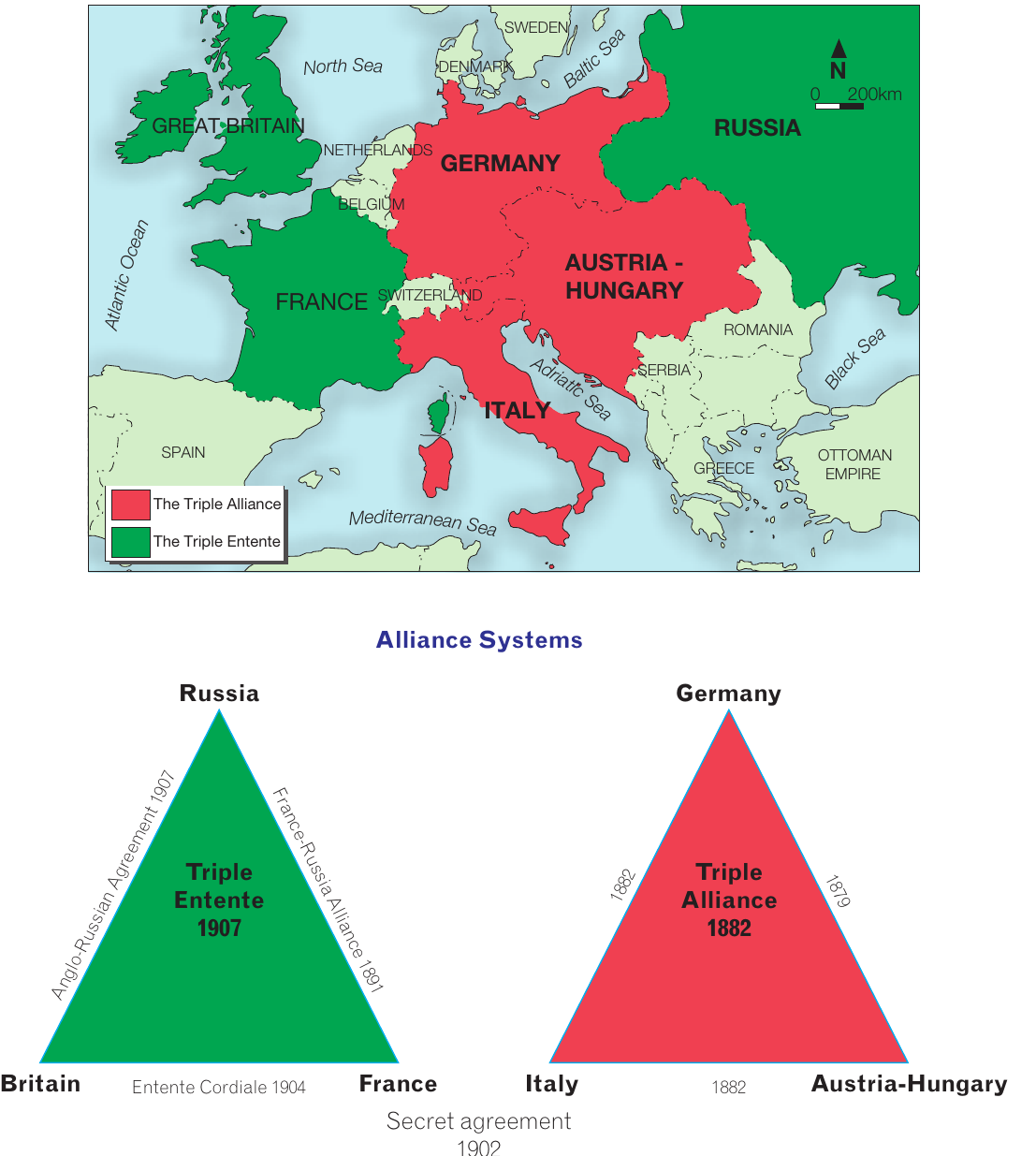
The Triple Alliance: Germany, Austria-Hungary and Italy
The Dual Alliance (1879)
Within eight years of German unification in 1871, security concerns led German Chancellor von Bismarck to pursue an alliance with Austria-Hungary. Both nations shared a common concern: Russia and its growing interest in the Balkans. This alliance, formed in 1879, became known as the Dual Alliance.
Italy joins (1882)
Italy was prompted to join the Dual Alliance in 1881, transforming it into the Triple Alliance of 1882. Italy's motivation stemmed from its rivalry with France, particularly after France seized Tunisia, which Italy had colonial ambitions towards. Since France was also Germany's main concern, it made strategic sense for Italy to align with Germany and Austria-Hungary.
Note
Mnemonic: Remember the Triple Alliance members as GAI - Germany, Austria-Hungary, Italy
The Triple Entente: France, Russia and Britain
The Franco-Russian Alliance (1891/1894)
France's desire for revanche (revenge) motivated it to seek an alliance with Russia. After its humiliating defeat in the Franco-Prussian War, France was forced to pay a massive indemnity and cede the provinces of Alsace-Lorraine to Germany. Seeking to counter German power, France pursued an alliance with Russia, resulting in the Franco-Russian Alliance of 1891.
Initially, Russia was a reluctant ally. However, the Franco-Russian Military Convention of 1894 established concrete terms:
- Russia promised to aid France with all its forces if attacked by Germany
- France offered all its resources if attacked by either Germany or Austria-Hungary
This arrangement aligned well with Russia's long-term strategic agenda. Russia had keen interests in the Balkans, where its major rival was Austria-Hungary. Germany was also establishing closer relations with the Turkish rulers of the Ottoman Empire. Additionally, Russia had traditional concerns about maintaining free trade and commerce through the Dardanelles Straits, which could be threatened by a hostile Turkish government.
Note
Historian Justin D Murphy commented on the significance of this agreement:
The Franco-Russian Military Convention marked the first step in what some historians have termed the 'diplomatic revolution'. Although Germany remained the dominant military power in Europe, it was losing the diplomatic hegemony it had enjoyed under Bismarck.
Britain's shifting position
At the turn of the century, Britain's geopolitical concerns centred on imperial rivalry with France and Russia, as well as the growing threat posed by an increasingly active Germany. Russia was seen as a threat to British interests in the Middle East, India and the Pacific.
Anglo-Japanese Alliance (1902)
In 1902, Britain concluded an alliance with Japan, in which each promised to support the other if attacked by a third party. This treaty was originally aimed at countering Russia, but it would later provide the legal basis for Japan's immediate entry into World War I.
Entente Cordiale (1904)
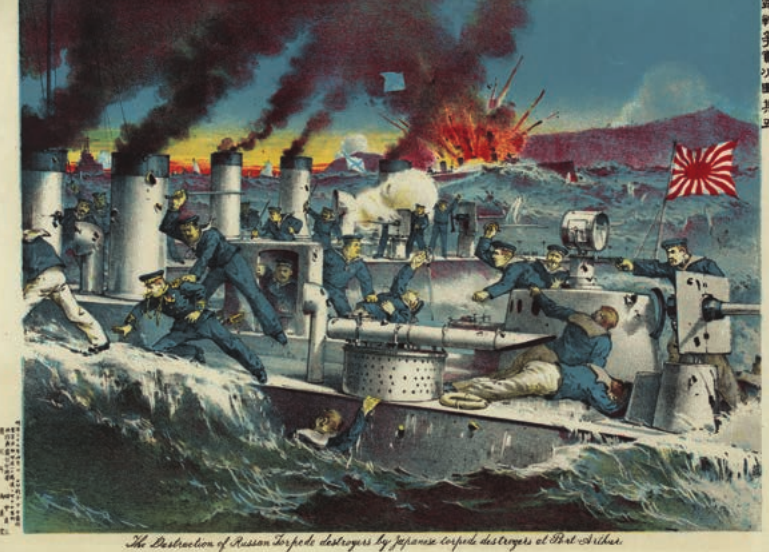
The outbreak of war between Russia and Japan accelerated negotiations between Britain and France. The Entente Cordiale, signed in 1904, was primarily concerned with resolving their imperial rivalries and ending geopolitical tensions over colonial interests. However, it also reflected Britain's growing anxiety about the naval arms race with Germany.
Note
Whilst this agreement was not a firm commitment for Britain to intervene militarily in Europe to protect France, it marked an important shift in British foreign policy.
Anglo-French Naval Convention (1912)
In 1912, Britain and France signed the Anglo-French Naval Convention, which contained secret provisions to apply if France and Germany went to war:
- France would concentrate its naval forces in the Mediterranean
- Britain would concentrate its forces in the North Sea and Atlantic Ocean (including protecting the French coast) to defend against German naval attacks on France
Important
Although Winston Churchill, Lord of the Admiralty, assured the British Cabinet in 1914 that this provision was not a formal military alliance, it became a contributing factor that helped tip the deeply divided Cabinet towards a decision for war in August 1914.
Anglo-Russian Agreement (1907)
After Russia's defeat in the Russo-Japanese War in 1905, Russia no longer posed a significant threat to British interests in the Pacific and Asia. British Foreign Secretary Lord Grey therefore pursued an alliance with Russia, which was concluded on 31 August 1907.
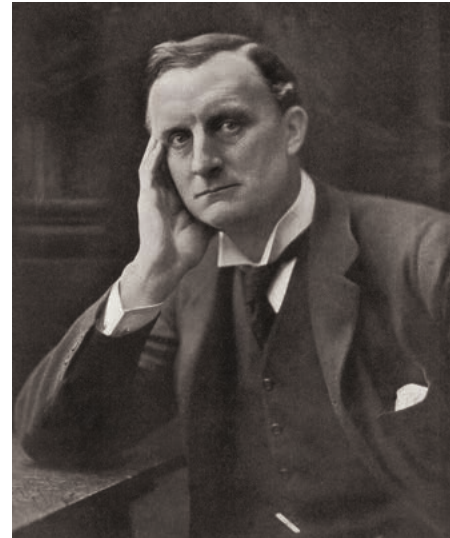
Although Britain had now settled its colonial differences with Russia, it did not have a formal military agreement with Russia. The only binding military agreement within the Triple Entente, in its final form in 1907, was between France and Russia in the Franco-Russian Military Convention. There was no binding agreement between Britain and Russia. According to Foreign Secretary Grey, Britain had no binding military commitments regarding European conflicts.
Despite the agreement with Russia, Britain made several attempts to reach an understanding with Germany and end the naval arms race. These efforts culminated in the Haldane mission to Germany in February 1912, but Germany's passing of a new naval law ended these discussions.
Note
Mnemonic: Remember the Triple Entente members as FRB - France, Russia, Britain
Italy's secret agreement and the undermining of the Triple Alliance
Important
There was one more complicating element in the web of alliance systems: Italy's diminishing support for the Triple Alliance. In 1902, Italy made a secret agreement with France stipulating that if Germany or Austria-Hungary attacked either country, Italy would remain neutral. This agreement thoroughly undermined the Triple Alliance.
However, Italy kept its 1902 secret and continued to renew the Triple Alliance agreement in 1907, 1912 and 1914. When war broke out in 1914, Italy remained neutral and ultimately joined the Allies in 1915, fighting against its former Triple Alliance partners.
Balance of power diplomacy: success and failure
The rival alliances, including their secret provisions, were complete by 1912. These systems developed as a result of longer-term factors contributing to geopolitical instability, including nationalism, imperialism and the arms race.
At the time, many believed that balance of power diplomacy would ensure peace. The theory was that if power was evenly distributed between rival alliance systems, neither side would risk war. However, for this system to work effectively, it required wise statesmanship combined with straightforward and honest diplomacy, neither of which could be guaranteed.
Balance of power diplomacy succeeded in resolving several geopolitical crises up until 1912. However, as Canadian historian Margaret MacMillan concluded:
Important
Europe's very success in surviving those earlier crises paradoxically led to a dangerous complacency in the summer of 1914 that, yet again, solutions would be found at the last moment and the peace would be maintained.
This complacency would prove fatal. The alliance systems, intended to maintain peace through balanced power, instead created a mechanism that could transform a regional conflict into a global catastrophe.
Remember!
Summary
Key Points to Remember:
-
Six Great Powers dominated European affairs by 1900: Great Britain, France, Germany, Austria-Hungary, Italy and Russia
-
The Concert of Europe broke down after three wars: Crimean (1853-56), Franco-Prussian (1870-71), and Balkan Wars (1912-13)
-
The Triple Alliance (1882) consisted of Germany, Austria-Hungary and Italy, formed primarily due to concerns about Russia and France
- Mnemonic: GAI (Germany, Austria-Hungary, Italy)
-
The Triple Entente (1907) brought together France, Russia and Britain through a series of agreements: Franco-Russian Alliance (1891/1894), Entente Cordiale (1904), and Anglo-Russian Agreement (1907)
- Mnemonic: FRB (France, Russia, Britain)
-
Italy's secret 1902 agreement with France undermined the Triple Alliance, and Italy ultimately fought with the Allies in World War I
-
Balance of power diplomacy aimed to preserve peace, but the alliance systems created a dangerous situation where a regional conflict could escalate into a global war
-
Secret provisions in various agreements, particularly the Anglo-French Naval Convention (1912), created hidden commitments that influenced the decision for war in 1914