The July Crisis and the Decision for War (HSC SSCE Modern History): Revision Notes
📚Revision Notes
The July Crisis and the Decision for War
Introduction: Understanding the July Crisis
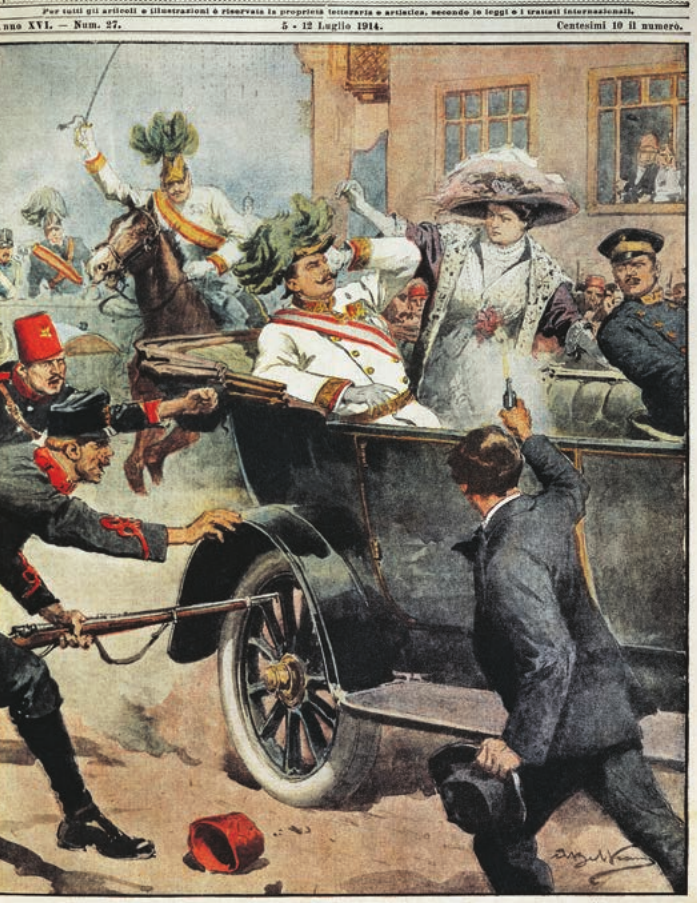
Historians call the period from 28 June to 4 August 1914 the July Crisis. This 37-day period began with the assassination of Archduke Franz Ferdinand and ended with Britain's declaration of war on Germany, marking the outbreak of World War I.
According to historian Christopher Clark, the July Crisis is the most complex event in modern times. This complexity explains why historians continue to debate the origins of World War I more than a century later. The central questions remain contentious: why did the war happen, and who was to blame?
Note
Understanding Historical Complexity
The July Crisis involves multiple nations, competing alliances, rigid military plans, and dozens of key decision-makers. This multipolar nature means that no single cause or simple explanation can fully account for why war broke out. Students should appreciate that historical events of this magnitude rarely have straightforward answers.
The debate about responsibility
Most modern historians agree that no single person or nation was completely responsible for World War I. However, they still debate the degree of blame that should be assigned to each participant. What historians do agree on is that a small group of older male monarchs, politicians and diplomats shared responsibility for the decisions that led to war.
Important
Popular Mandate and Democratic Accountability
None of the leaders who chose war had a popular mandate to launch their nations into years of devastating conflict. While crowds cheered the declaration of war in many capitals, equally large antiwar protests took place in the same cities. This raises important questions about leadership accountability and democratic control over foreign policy decisions.
The context: Europe before the crisis
Long-term causes of World War I
Traditionally, historians have identified several long-term causes that created the conditions for war:
- Imperial rivalry: Competition between Great Powers for colonies and influence
- Militarism: The glorification of military power and arms buildup
- Nationalism: Intense patriotic feeling and desire for national greatness
- Arms race: Competitive military expansion among European powers
These long-term causes shaped the alliance systems that existed in 1914, creating two rival power blocs.
The alliance systems
By 1914, Europe was divided into two main alliance groups:
Triple Entente:
- Britain
- France
- Russia
Triple Alliance:
- Germany
- Austria-Hungary
- Italy (though Italy later declared neutrality)
This division meant that a dispute between one member of each alliance could potentially drag all six Great Powers into war.
Note
The Alliance Trap
Think of the alliance system as a chain reaction waiting to happen. If Austria-Hungary fought Serbia, Russia would defend Serbia. If Russia mobilized, Germany would respond. If Germany mobilized, France would be threatened. This interconnected system meant that a local Balkan dispute could escalate into a continental war involving all the Great Powers.
Balance of power diplomacy
The alliance system was based on the principle of balance of power - the idea that no single Great Power could dominate Europe or the world. Supporters of this system believed it would prevent war because leaders would understand the terrible consequences of their decisions and act with restraint.
However, critics argued that this system was dangerous because political leaders were not immune to making poor decisions. They warned that a few bad choices by key individuals could trigger a war involving all six Great Powers.
As it turned out, the critics were right. According to historian Margaret MacMillan:
Europe's very success in surviving those earlier crises paradoxically led to a dangerous complacency in the summer of 1914 that, yet again, solutions would be found at the last moment and the peace would be maintained.
Important
The Paradox of Success
Previous international crises (such as the Moroccan Crises of 1905 and 1911, and the Balkan Wars of 1912-1913) had been resolved through diplomacy. This track record created dangerous complacency among European leaders. They assumed that, as before, a diplomatic solution would emerge at the last moment. This false confidence contributed to the risk-taking behavior that made war more likely.
Exam tip: When discussing the causes of WWI, distinguish between long-term structural causes (like alliance systems) and short-term triggers (like the assassination). Both were necessary for war to occur.
The assassination: 28 June 1914
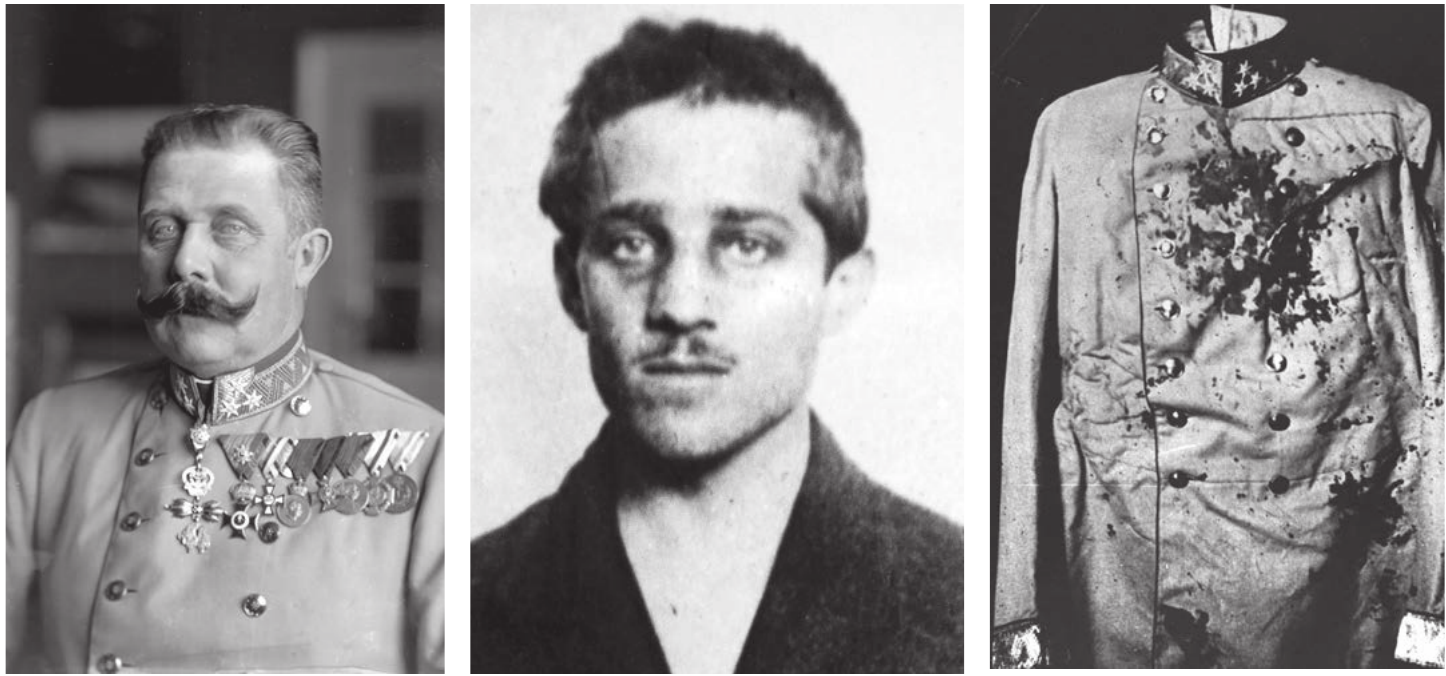
On 28 June 1914, a 19-year-old Bosnian terrorist named Gavrilo Princip assassinated Archduke Franz Ferdinand in Sarajevo, the capital of Bosnia. Franz Ferdinand was the heir to the Austrian throne, making his death a shocking event across Europe.
Gavrilo Princip was a member of the Black Hand, a terrorist organisation with connections to the Serbian government. The Black Hand supported Serbian nationalist ambitions to unite all southern Slav peoples in the Balkans into a greater Serbia.
Austria-Hungary's response
The assassination shocked European public opinion, and there was initially much sympathy for Austria-Hungary. However, the Austro-Hungarian government decided to use this tragedy to gain a strategic advantage. Their goal was to invade Serbia and permanently end Serbian ambitions to unite the southern Slavs - which would have threatened Austria-Hungary's control over its own Slavic territories.
Germany's "blank cheque"
Germany's Kaiser Wilhelm issued what historians call a blank cheque to Austria-Hungary - essentially unconditional support for whatever action Austria-Hungary chose to take against Serbia. This was a calculated risk. The Kaiser believed that the conflict could be kept localised between Austria-Hungary and Serbia. Germany hoped that Russia's allies in the Triple Entente would restrain Russia from intervening to protect Serbia.
Important
The Fatal Miscalculation
Germany's "blank cheque" was based on a fundamental miscalculation: that the war could remain localized to the Balkans. Kaiser Wilhelm assumed that Britain and France would restrain Russia from intervening. This assumption proved catastrophically wrong. The blank cheque encouraged Austria-Hungary to act aggressively, setting in motion the chain of events that would lead to general war.
The thirteen critical days: 23 July to 4 August 1914
While the July Crisis technically lasted 37 days, the final 13 days were when events spiralled out of control. The following timeline shows how a regional dispute transformed into a global war:
Timeline of events
| Date | Event | Details |
|---|---|---|
| 23 July | Austria-Hungary issues ultimatum to Serbia | Austria-Hungary had taken several weeks to prepare its ultimatum. By this time, European sympathy had faded, and the move appeared calculated rather than a measured response. Russia gave strong support to Serbia, with France backing its ally. |
| 25 July | Austria-Hungary severs diplomatic ties with Serbia and begins mobilisation | Serbia's reply to the ultimatum was surprisingly reasonable, accepting most demands but rejecting the requirement to allow Austrian troops on Serbian soil. Many Europeans found Serbia's response acceptable. |
| 25 July | Serbia mobilises against Austria | The European public remained largely unaware that war was imminent. To many, this seemed like another distant Balkans dispute. |
| 28 July | Austria-Hungary declares war on Serbia and invades the next day | After seeing Serbia's reply, Kaiser Wilhelm believed there was no cause for war and urged Austria-Hungary to act with restraint. However, Austria-Hungary rejected this advice, confident of retaining German support. After the invasion, the crisis spiralled out of control. |
| 29 July | British Fleet sails into the North Sea on high alert | First Lord of the Admiralty Winston Churchill ordered this show of force on his own initiative, alarming fellow Liberal Cabinet members. Britain also called for international mediation. Austrian warships shelled Serbia's capital, Belgrade. |
| 30 July | Russia begins partial mobilisation | Russia mobilised its forces in response to the Austrian attack on Serbia. |
| 31 July | Austria mobilises forces on the Russian frontier; Germany demands Russia stop | Russia switched to full mobilisation along both the German and Austro-Hungarian frontiers. |
| 1 August | Germany mobilises | Germany enacted full mobilisation according to its Schlieffen Plan, committing to a war on two fronts. Belgium began mobilisation anticipating a German attack. |
| 1 August | Germany declares war on Russia | Germany warned France against supporting Russia. |
| 1 August | France mobilises | France prepared its forces in response to German mobilisation. |
| 2 August | Germany invades Luxembourg | Germany sent an ultimatum to Belgium demanding safe passage through its territory. Luxembourg was occupied to secure railway connections into Belgium. |
| 3 August | Germany declares war on France | Germany activated plans for the invasion of Belgium. Italy declared its intention to remain neutral. |
| 3 August | Britain warns Germany not to violate Belgian neutrality | The British government made its position clear regarding Belgium. |
| 4 August | German troops march into Belgium | The invasion of Belgium had a powerful effect in Britain, strengthening support for intervention. |
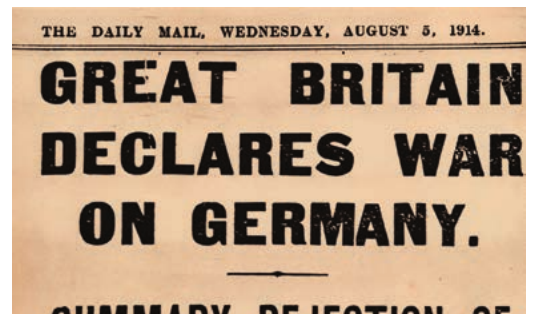
| 4 August | Britain declares war on Germany | Britain's declaration automatically bound all colonies in the British Empire. The Dominions (Canada, Australia, New Zealand, and South Africa) had already committed to sending expeditionary forces. The United States declared neutrality and offered to mediate. |
The cascade effect
The timeline reveals how the alliance systems and mobilisation plans created a cascade effect. Once Russia mobilised to protect Serbia, Germany felt compelled to mobilise according to its war plans. German mobilisation threatened France, which then mobilised. Germany's invasion of Belgium brought Britain into the war.
Note
War by Timetable
Historian AJP Taylor argued that leaders became prisoners of their own complex mobilisation and war plans. These plans were designed as deterrents but lacked flexibility. Once enacted, they could not be stopped or altered, and events spiralled out of control.
The rigid nature of these plans meant that mobilisation effectively meant war. There was no way to mobilize forces as a show of strength without committing to actual military operations. This inflexibility removed diplomatic options once the mobilization process began.
Example
Worked Example: Tracing the Cascade of Mobilizations
To understand how the war escalated, trace the chain reaction:
Step 1: Austria-Hungary attacks Serbia (28 July)
- This threatens Russia's ally and interests in the Balkans
Step 2: Russia mobilizes (30-31 July)
- This activates Germany's alliance commitment to Austria-Hungary
- Germany's war plans require attacking France through Belgium
Step 3: Germany mobilizes and declares war on Russia (1 August)
- This threatens France, Russia's ally
Step 4: Germany declares war on France and invades Belgium (3 August)
- This violates Belgian neutrality, which Britain guaranteed by treaty
Step 5: Britain declares war on Germany (4 August)
- The Balkans crisis has become a world war
Each mobilization triggered the next, demonstrating how alliance commitments transformed a regional conflict into a continental war.
Historiographical perspectives: Why did war come?
Historians continue to debate why the July Crisis led to war. Here are key perspectives from major historians:
Margaret MacMillan: The importance of choice
MacMillan emphasises that war was not inevitable. In 1914, there were strong forces for both war and peace - it could have gone either way. She argues that the actions of individuals were crucial:
Perhaps the most we can hope for is to understand as best we can those individuals, who had to make the choices between War and Peace, and their strengths and weaknesses, their lives, hatreds and biases.
Note
MacMillan's Key Argument: Two Critical Failures
MacMillan identifies two key failures by 1914 leaders:
-
Failure of imagination: Not understanding how destructive the war would be
- Leaders thought in terms of short, decisive wars like the Franco-Prussian War (1870-71)
- They could not conceive of four years of industrial-scale slaughter
-
Lack of courage: Failing to stand up to those who claimed there was no choice but war
- Civilian leaders deferred too much to military advisors
- Few were willing to challenge the prevailing assumptions about honor and national prestige
MacMillan insists: "There are always choices." Even in the final days of the crisis, leaders could have chosen differently.
Christopher Clark: The "sleepwalkers"
Clark describes the leaders of 1914 as sleepwalkers - "watchful but unseeing, haunted by dreams, yet blind to the reality of the horror they were about to bring on the world."
He argues that the crisis was:
- The fruit of a shared political culture
- Multipolar and genuinely interactive
- The most complex event of modern times
Clark emphasises that while leaders spoke of war as "Armageddon," they did not truly comprehend what they were about to unleash. His metaphor suggests that leaders were making fateful decisions without fully grasping the consequences.
Important
Clark's "Tragedy, Not a Crime"
Clark makes a crucial distinction: "There is no smoking gun in this story or rather, there is one in the hands of every major character. Viewed in this light the outbreak of war was a tragedy, not a crime."
This perspective challenges the idea of assigning primary blame to one nation. Instead, Clark sees the war as resulting from shared responsibility across all the Great Powers. Each nation made decisions that contributed to the outbreak of war, and no single actor was solely responsible.
Niall Ferguson: Germany's sense of weakness
Ferguson challenges the idea that Germany sought war to achieve world domination. Instead, he argues Germany's leaders acted from a sense of weakness:
- Germany was losing both the naval arms race (British to German warship ratio: 2.1:1) and the land arms race (Allied to Central Powers manpower ratio: 2.5:1)
- This weakness was not due to lack of economic resources but to political and fiscal constraints
- Germany's federal system and democratic parliament made it difficult to match the defence spending of more centralised neighbours
- Germany spent only 3.5% of GNP on defence compared to France's 3.9% and Russia's 4.6%
Note
Ferguson's Paradox
Ferguson concludes: "Paradoxically, if Germany had been as militarist in practice as France and Russia, she would have had less reason to feel insecure and to gamble on a pre-emptive strike."
This argument suggests that Germany's democratic constraints actually made war more likely, not less. Because Germany could not match its rivals' military spending through normal political processes, its leaders felt increasingly desperate and willing to take risks. This challenges simplistic views about democracy always promoting peace.
Kent Forster: The role of individuals
Forster emphasises that the question of why war continued cannot be explained by abstract forces alone. Instead, "the actions and influences of these few human beings are encountered" at every turn.
The nationalistic attitudes of the small group of men who controlled diplomacy led them to prioritise other concerns over peace.
Exam tip: When writing about the causes of WWI, show awareness of different historiographical interpretations. Demonstrate understanding that historians continue to debate the relative importance of structural causes versus individual decisions.
Historical context: The war guilt clause
After World War I ended, the Treaty of Versailles (signed 28 June 1919) included Article 231, which placed sole responsibility for the war on Germany and its allies:
The Allied and Associated Governments affirm and Germany accepts the responsibility of Germany and her allies for causing all the loss and damage to which the Allied and Associated Governments and their nationals have been subjected as a consequence of the war imposed upon them by the aggression of Germany and her allies.
This controversial war guilt clause shaped post-war politics and contributed to German resentment that would have significant consequences. Modern historians generally reject the idea of sole German responsibility, instead viewing the outbreak of war as resulting from decisions by leaders in all the Great Powers.
Important
The Legacy of Article 231
The war guilt clause had profound consequences:
- It provided the legal justification for demanding reparations from Germany
- It generated intense resentment in Germany, which politicians exploited
- It oversimplified the complex causes of the war
- It contributed to the political instability in Germany during the 1920s and 1930s
Modern historians view Article 231 as both historically inaccurate and politically counterproductive. It assigned blame rather than promoting understanding of the complex causes of the war.
Summary
Summary
Key Points to Remember
-
The July Crisis lasted 37 days (28 June to 4 August 1914), but the critical 13 days were from 23 July onwards
-
No single nation or person was solely responsible for World War I; historians emphasise shared responsibility among the Great Powers
-
The alliance systems (Triple Entente vs. Triple Alliance) meant a regional dispute could escalate into a global war
-
Germany's blank cheque to Austria-Hungary encouraged aggressive action against Serbia and was based on the fatal miscalculation that the war could remain localized
-
The cascade of mobilisations demonstrates how rigid military plans and alliance commitments transformed a Balkan crisis into world war
-
Modern historians emphasise both structural causes (alliance systems, arms races) and the crucial role of individual decisions by leaders who had choices but failed to choose peace
-
MacMillan argues war was not inevitable and identifies two key failures: failure of imagination about the war's destructiveness and lack of courage to stand up to war advocates
-
Clark's "sleepwalkers" metaphor suggests leaders made fateful decisions without fully grasping the consequences - viewing the war as a tragedy rather than a crime
-
Ferguson argues Germany acted from a sense of weakness rather than strength, with democratic constraints paradoxically making war more likely
-
Article 231 (the war guilt clause) oversimplified the causes of WWI and had lasting negative consequences for European politics