The Flawed Treaty of Versailles (HSC SSCE Modern History): Revision Notes
📚Revision Notes
The Flawed Treaty of Versailles
Wilson's vision and the Fourteen Points
In January 1918, US President Woodrow Wilson delivered his famous Fourteen Points speech to Congress. This speech outlined his vision for reconstructing Europe and reforming international relations after the war. The most significant element was the fourteenth and final point, which called for the creation of a League of Nations. This organisation would provide mutual guarantees of political independence and territorial integrity to all nations, both great and small.
The fourteenth point stated:
A general association of nations must be formed under specific covenants for the purpose of affording mutual guarantees of political independence and territorial integrity to great and small states alike.
Initially, the other Allied leaders showed little enthusiasm for Wilson's Fourteen Points or his proposed League of Nations. The British Prime Minister Lloyd George, French Premier Clemenceau, and Italian leader Orlando were more focused on defeating Germany than on Wilson's idealistic peace plans. However, everything changed in October 1918 when the German Government requested an armistice based on Wilson's Fourteen Points. This development placed the Allied leaders under significant pressure to accept Wilson's framework. After lengthy negotiations, they agreed to a peace settlement based on the Fourteen Points, though they expressed important reservations. The war ended one week later.
Note
The German request for an armistice based on Wilson's Fourteen Points was a strategic move that forced the Allied leaders to engage with Wilson's vision, even though they had previously shown little interest in his idealistic peace proposals.
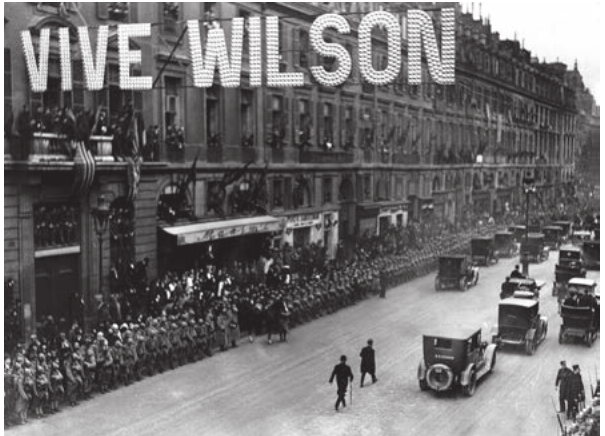
The Versailles Peace Conference 1919
When the leaders of the Allied and Associated Powers gathered at the Versailles Peace Conference in 1919, they were far from united in their aims. Wilson remained single-mindedly focused on establishing his League of Nations, viewing it as essential for preventing future wars. In contrast, Lloyd George (Britain), Clemenceau (France), and Orlando (Italy) prioritised securing territorial gains, economic reparations, and strategic advantages for their nations. They saw the League as secondary to obtaining what they considered the rightful spoils of war.
Key term: Versailles Peace Conference - The 1919 gathering of Allied leaders in France to negotiate the terms of peace following World War I. It resulted in several treaties, including the Treaty of Versailles with Germany.
Wilson recognised that securing agreement for the League would require significant compromises. He adopted a strategic approach by insisting that the League be debated and agreed upon first, before any other peace settlement issues were discussed. This ensured that the twenty-six articles establishing the League of Nations would form the entire first section of the Treaty of Versailles. Wilson calculated that once the other leaders agreed to the League, they would be committed to it regardless of what came afterwards.
The price of this strategy was steep. Wilson found himself forced to compromise on virtually every other principle he had outlined in the Fourteen Points. The only point he refused to abandon was the last one - the creation of the League. From Wilson's perspective, the League was worth any sacrifice because it represented humanity's best hope for preventing future conflicts through collective security and international cooperation.
Note
Understanding the leaders' different priorities:
- Wilson (USA): Wanted an idealistic peace based on international cooperation and collective security
- Lloyd George (Britain): Sought to expand the British Empire and secure naval supremacy
- Clemenceau (France): Demanded harsh terms to weaken Germany and ensure French security
- Orlando (Italy): Aimed to gain promised territories, particularly along the Adriatic coast
These conflicting objectives created intense tensions at Versailles and explain why Wilson had to sacrifice so many of his principles to secure the League.
The treaty's departure from Wilson's ideals
The Treaty of Versailles was finally signed on 28 June 1919, exactly five years after the assassination of Archduke Franz Ferdinand that had triggered the war. However, the final document bore little resemblance to the just and lasting peace that Wilson and other progressive internationalists had advocated throughout the war. Progressive internationalists believed in creating a new world order based on cooperation, democracy, and peaceful resolution of disputes, rather than the old system of secret alliances and power politics.
Key term: Treaty of Versailles - The treaty that officially ended World War I when it was signed by the nations involved on 28 June 1919. Despite being negotiated at the Paris Peace Conference, the actual signing ceremony took place at the Palace of Versailles.
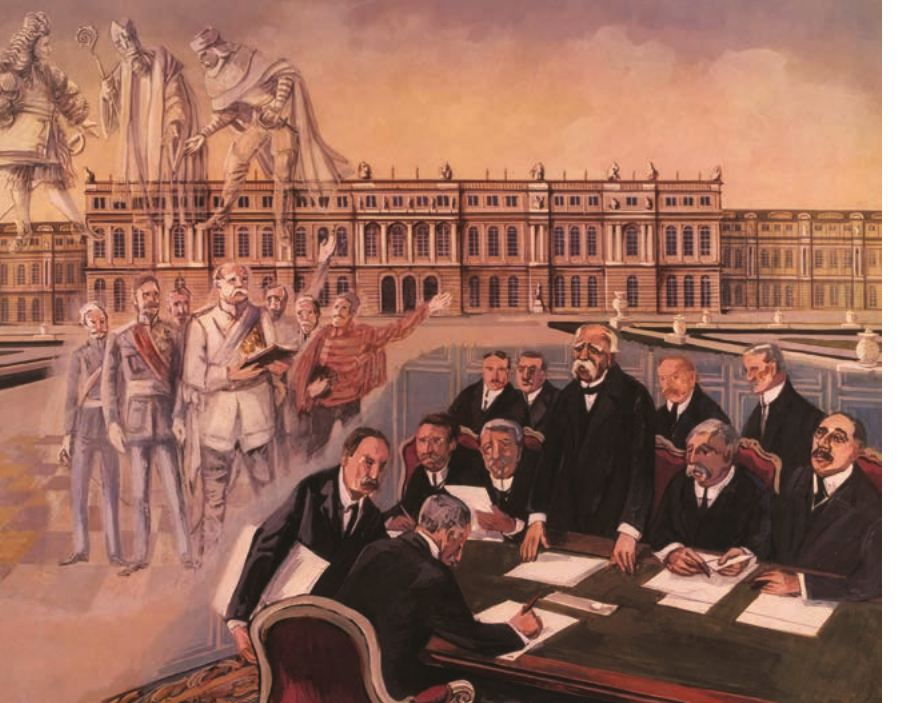
The treaty imposed harsh terms on Germany, including massive reparations payments, significant territorial losses, severe military restrictions, and the controversial "war guilt" clause that blamed Germany entirely for the war. These punitive measures contradicted Wilson's vision of a peace based on fairness and reconciliation. Instead, the treaty reflected the victorious powers' desire for revenge and security, creating conditions that many historians believe contributed to the outbreak of World War II just twenty years later.
Important
Wilson's problems didn't end with compromising his principles to satisfy the other Allied leaders. He also faced opposition at home from the United States Senate. To address Senate concerns and increase the chances of ratification, Wilson agreed to insert special clauses into the Treaty. Despite these concessions, it proved insufficient to secure the two-thirds Senate majority required for the US to ratify the Treaty of Versailles and join the League of Nations.
The battle for ratification in the United States
By late 1919, the entire fate of the League of Nations rested on the shoulders of one man: Woodrow Wilson. The US Senate, particularly the Republican opposition led by Senator Henry Cabot Lodge, strongly opposed American participation in the League. Their main objection centred on Article 10 of the League Covenant, which committed member nations to act collectively against aggression by any nation.
Article 10 of the League Covenant stated:
The members of the League undertake to respect and preserve as against external aggression the territorial integrity and existing political independence of all Members of the League. In any case of any such aggression or in case of any threat or danger of such aggression the Council shall advise upon the means by which this obligation shall be fulfilled.
Note
Understanding Article 10:
Article 10 represented the core principle of collective security - the idea that an attack on one member would be treated as an attack on all. Wilson believed this article was the "heart of the League" because it would deter aggression through the promise of united international response. However, many US Senators feared it would entangle America in foreign conflicts and compromise national sovereignty.
Refusing to accept defeat, Wilson embarked on an exhausting nationwide speaking tour in September 1919. He travelled across America, giving passionate speeches to rally public support for ratifying the Treaty and joining the League. Wilson poured all his energy into this campaign, delivering dozens of speeches and travelling thousands of miles. The gruelling schedule took a devastating toll on his health.
After delivering one of his most moving speeches in support of the League, Wilson collapsed. He had suffered a severe stroke that left him partially paralysed and incapacitated for the remaining year and a half of his presidency. Despite his weakened condition, Wilson refused to compromise with the Republicans on the League, particularly on Article 10. From his sickbed, he maintained that compromising on this article would render the entire League useless, as it would remove the mechanism for collective action against aggression.
Important
The tragic outcome:
Wilson's unwillingness to negotiate, combined with Senate opposition, meant the United States never ratified the Treaty of Versailles. Consequently, America never joined the League of Nations - the international organisation that Wilson himself had fought so hard to create. This absence of the world's most powerful nation significantly weakened the League from the start and contributed to its ultimate inability to prevent World War II.
Exam tip: When discussing the Treaty of Versailles, remember to distinguish between its different aspects: the League of Nations (which Wilson achieved) and the punitive terms imposed on Germany (which contradicted Wilson's ideals). Understanding this distinction helps explain why the treaty is considered "flawed" - it combined an idealistic institution (the League) with harsh, vengeful terms that undermined the just peace Wilson had promised.
Summary
Remember!
-
Wilson's Fourteen Points (January 1918) outlined his vision for peace, with the last point calling for a League of Nations to provide collective security.
-
At Versailles in 1919, Wilson compromised on thirteen of his fourteen points to secure agreement on the League, which became the first section of the Treaty of Versailles signed on 28 June 1919.
-
The "flaw" in the treaty was that it departed from Wilson's vision of a just peace, instead imposing harsh, punitive terms on Germany that satisfied the other Allied leaders' demands for revenge and reparations.
-
Article 10 controversy: This article required League members to act collectively against aggression, but US Senate Republicans feared it would compromise American sovereignty and entangle the nation in foreign conflicts.
-
The ultimate irony: Despite Wilson's personal sacrifice - including the stroke that incapacitated him - the United States never ratified the Treaty of Versailles or joined the League of Nations, significantly weakening both from the start.