Electric Current (HSC SSCE Physics): Revision Notes
📚Revision Notes
Electric Current
What is electric current?
Electric current is the flow of electrically charged particles through a material. Every time you use an electrical device like a light, computer, or phone, electric current is flowing through circuits, transferring and transforming energy.
In a circuit, current usually involves the flow of electrons. However, in other systems like the human body, current can be carried by larger charged particles such as calcium ions () and potassium ions ().
Defining current mathematically
Current, represented by the symbol , is defined as the quantity of charge passing through a point per unit time:
where:
- is the current
- is the quantity of charge (measured in coulombs, C)
- is the time (measured in seconds, s)
The unit of current is amperes (A), named after French mathematician and physicist André-Marie Ampère. One ampere equals one coulomb per second:
Note
While current is defined as a scalar quantity, it has a sign because charges can move in different directions and can be either positive or negative. This is why understanding the direction convention is essential.
Understanding the direction of current
It's often difficult to determine whether moving charges are positive or negative. The same observable effect can result from different scenarios. Consider the following three possibilities:

In all three cases shown above, the right-hand side becomes more positive by the same amount. This can happen through:
- Positive charges moving to the right
- Negative charges moving to the left
- A combination of both
Important
Direction Convention
To avoid confusion, physicists have established a convention: we define the direction of current as the direction that positive charges would move if positive charges were creating the current.
This means:
- In your body, the current direction matches the direction that calcium and sodium ions move
- In an electric circuit, the current direction is opposite to the direction that electrons move
Remember: regardless of the sign of the actual charge carriers, the result is the same, so we always describe current in terms of positive charge flow.
Worked example: Calculating current from ionic movement
Example
Worked Example: Current from Ionic Movement
Problem: A cell membrane has 500 ions move across it in 1.0 s. What is the current flow through this membrane?
Solution:
Given information:
- Time:
- Number of ions: 500
Each ion carries a charge of , where is the electron charge ().
Step 1: Calculate total charge
Step 2: Apply the current formula
Step 3: Calculate the final answer
Conditions required for current flow
For electric current to flow, three conditions must be satisfied:
- A path for the current to flow along
- Charge carriers (charged particles) that are free to move
- An applied force to make the charge carriers start moving
Without all three conditions, no current can flow.
Conductors, insulators, and semiconductors
Materials can be classified based on their ability to allow current flow:
Conductors are materials that allow current to flow through them easily. Metals are excellent conductors because they contain many free electrons that can move throughout the material.
Insulators are materials that do not allow current to flow through them. Insulators lack free electrons, so charge carriers cannot move even when a force is applied.
Semiconductors are materials with a small number of free electrons. These materials allow current to flow, but not as easily as conductors.
Note
Whether a material acts as a conductor, insulator, or semiconductor depends on its atomic structure and how its atoms bond together. The key factor is the availability of free charge carriers.
Atomic structure and free electrons
To understand why metals conduct electricity, we need to examine their atomic structure.
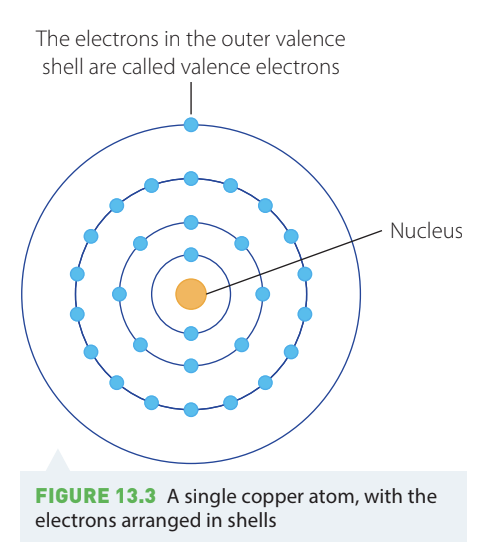
A single copper atom has many electrons arranged in shells around its nucleus. When the atom is isolated, all electrons are bound to the nucleus by electrostatic forces. The electrons in the outermost shell are called valence electrons.
However, when many copper atoms come together to form metallic copper, something remarkable happens. A small number of outer-shell electrons (one in copper, but one, two, or three in other metals) become unbound from their original nuclei. These electrons become free electrons or conduction electrons that can move throughout the metal.
Metallic bonding and the sea of electrons
The free electrons in a metal play a crucial role in holding the material together. They act as a negative "sea" or "glue" surrounding the positive metal ions (which consist of the nuclei and their remaining bound electrons).
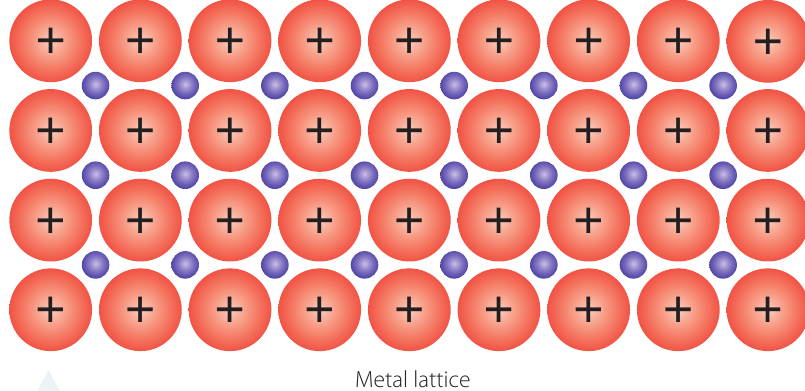
This arrangement is called metallic bonding – a type of bonding between many atoms enabled by these free electrons. The sea of free electrons holds the positive ions together while simultaneously providing mobile charge carriers that can flow when a force is applied.
This explains why metals satisfy two of the three conditions for current flow:
- They have free charge carriers (the free electrons)
- They provide a path for these carriers to move through
Measuring current with an ammeter
Current in a circuit is measured using an ammeter. A multimeter can function as an ammeter when set to the appropriate current setting.
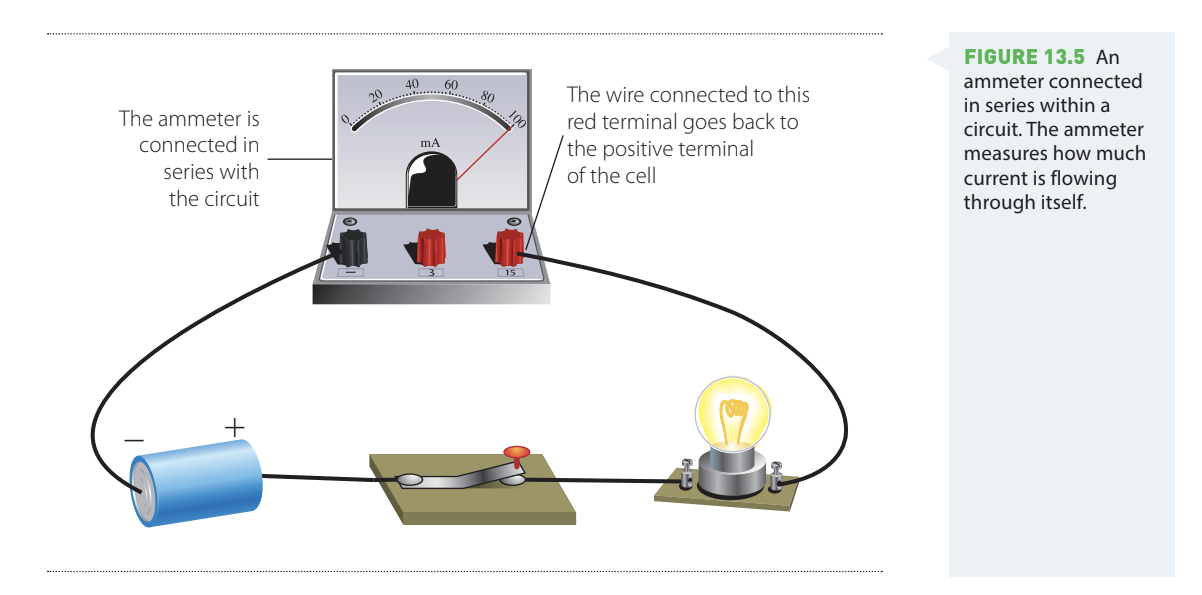
Ammeters have two different settings:
- DC (direct current): Used when current flows in one direction continuously, such as in battery-powered circuits
- AC (alternating current): Used when current oscillates in direction, such as in mains power supply
Because an ammeter measures the current flowing through a specific point, it must be inserted directly into the circuit at that location. We say the ammeter is connected in series with the circuit.
Important
Critical Safety Rule
Never connect an ammeter in parallel (across) components, as this can damage the ammeter or the circuit. Ammeters must always be connected in series.
Investigation 13.1: Current flow in metals
Aim: To investigate the flow of current through metal wire
Note: A resistor is used in this experiment to ensure the current in the circuit does not become too high.
Materials:
- 1.5 V battery in holder
- 10 Ω resistor
- Current meter (ammeter or multimeter on current setting)
- Fine copper wire in various lengths (minimum 20 m total; for example: 20 m, 40 m, 60 m, 80 m, 100 m)
- Micrometer
- Crocodile clips for making connections
Risk assessment:
| What are the risks? | How can you manage these risks? |
|---|---|
| Electricity can cause shocks | Do not touch both terminals of the battery at once |
| A length of wire across the battery can cause a short circuit, damaging the battery | Always keep the resistor in the circuit |
Method:
- Read the instructions for your multimeter or current meter, or ask your teacher for guidance
- Connect the resistor to the positive terminal of the battery
- Connect one probe of your current meter to the resistor
- Connect the other probe of the current meter to one end of the wire
- Connect the other end of the wire to the negative terminal of the battery
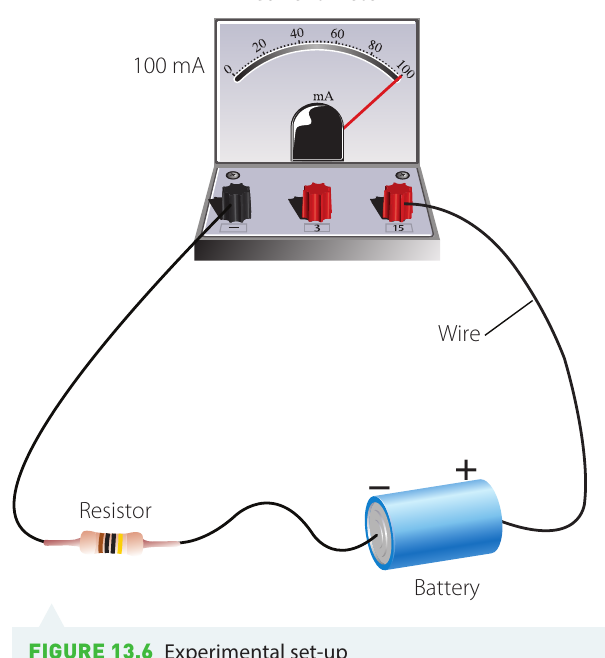
- Record the current flowing through the wire as shown on the current meter (remember to include units)
- Remove the wire from the circuit
- Repeat steps 4-7 for each different length of wire
- Use the micrometer to measure the diameter of the metal conductor within the wire
Note
Tip: If the current doesn't change as you change wire lengths, try using a smaller resistor (e.g., 5 Ω or 1 Ω).
Results:
Record your data in a spreadsheet with columns headed "length" and "current". Include units in the heading cells or in the cell below.
Analysis of results:
- Use the spreadsheet to create a scatter plot with current on the vertical axis and length on the horizontal axis. Observe the shape of your graph
- Add another column headed and calculate this value for each wire length
- Plot a scatter graph of current as a function of . If this graph is linear, add a line of best fit and display the equation
- Write an equation describing the relationship between current and wire length
Discussion:
- Were you able to answer your research question?
- What are the limitations of this experiment?
- Can you suggest better ways of making the measurements or further investigations?
Conclusion:
Write a conclusion based on the aim of this investigation, making reference to your data and its analysis. Answer your research question.
Summary
Key Points to Remember:
- Electric current is the flow of charged particles (charge carriers) through a material
- Current is calculated using the formula , where is charge in coulombs and is time in seconds
- Current is measured in amperes (A), where
- By convention, current direction is defined as the direction positive charges would flow, even if the actual charge carriers are negative electrons
- Three conditions must be met for current to flow: a path, free charge carriers, and an applied force
- Conductors (like metals) allow current flow easily because they have many free electrons; insulators prevent current flow because they lack free electrons; semiconductors have few free electrons and conduct poorly
- In metals, outer valence electrons become free and form a "sea of electrons" that holds the material together through metallic bonding while also serving as charge carriers
- Ammeters measure current and must always be connected in series in a circuit