Energy and Power in Electric Circuits (HSC SSCE Physics): Revision Notes
📚Revision Notes
Energy and Power in Electric Circuits
Introduction to energy in electric circuits
Electric circuits involve the continuous transformation of energy from one form to another. Understanding how energy moves through a circuit and how it changes form is fundamental to understanding how electrical devices work.
In any electrical circuit, you'll find two main types of components: sources of potential energy (like batteries) and components that convert that energy into useful forms (like light globes, motors, and resistors). The principle of energy conservation applies to all circuits, meaning that energy cannot be created or destroyed, only transformed from one form to another.
Note
The Law of Conservation of Energy
This fundamental principle states that the total energy in an isolated system remains constant. In electrical circuits, this means all the energy supplied by the battery must be accounted for - it's transformed into other forms (light, heat, motion, sound) but never disappears.
Energy transformations in circuits
How batteries provide energy
A battery acts as a source of potential energy in a circuit. When charged particles (electrons) move through a battery, their potential energy increases. This increase in energy comes from the chemical energy stored within the battery itself. As the battery supplies energy to the charged particles, its own store of chemical energy gradually decreases, which is why batteries eventually go 'flat' and need replacing or recharging.
Note
Understanding the Battery Analogy
Think of it like lifting a ball to a higher shelf. The ball gains gravitational potential energy, but you lose chemical energy from your muscles. Similarly, electrons gain electrical potential energy as they pass through a battery, whilst the battery loses its stored chemical energy.
Energy conversions in circuit components
When charged particles flow through circuit components, their potential energy decreases as it gets converted into other useful forms of energy. The specific type of energy produced depends on the component:
Light globes: An incandescent light globe converts electrical potential energy into both light and heat. In fact, much of the energy is wasted as heat, which is why these bulbs feel hot to touch and aren't very efficient.
LEDs (light-emitting diodes): These convert electrical potential energy primarily into light, with very little heat production. This makes them much more energy-efficient than traditional incandescent globes.
Motors: Electric motors convert electrical potential energy into kinetic energy (movement). This rotational motion can then be used to power fans, pumps, drills, and countless other devices.
Resistors: These components convert electrical potential energy into heat. Whilst this might seem wasteful, it's actually useful in applications like electric heaters and toasters. When current flows through a resistor, you can often feel it warming up as the electrical energy transforms into thermal energy that conducts and radiates to the surrounding environment.
Important
Energy Efficiency Matters
Not all energy conversions are equally efficient. Traditional incandescent globes waste about 90% of their energy as heat, whilst LEDs are much more efficient. This is why switching to LED lighting can significantly reduce electricity consumption and costs.
Power in electric circuits
Understanding power
Power measures the rate at which energy is transformed or transferred. In other words, power tells us how quickly energy changes from one form to another. This is expressed mathematically as:
where:
- is the power (measured in watts, W)
- is the energy transformed (measured in joules, J)
- is the time interval (measured in seconds, s)
From this equation, we can rearrange to find the energy transferred over a given time:
Note
This relationship is incredibly useful for calculating electricity bills, as energy companies charge based on the total energy consumed (often measured in kilowatt-hours, kWh).
Deriving the fundamental power equation
We can develop a more practical formula for power by considering what potential difference and current mean in a circuit.
Potential difference (voltage) represents the change in energy per unit charge between two points in a circuit:
Current measures the rate of charge flow, or the amount of charge passing a point per unit time:
If we multiply voltage and current together, something interesting happens:
This gives us the fundamental equation for electrical power:
where:
- is power in watts (W)
- is potential difference in volts (V)
- is current in amperes (A)
Important
Important Unit Relationship
This equation tells us that the power transformed by any component equals the product of the current flowing through it and the potential difference across it.
Combining power and Ohm's law
Three equivalent power formulae
Ohm's law provides us with the relationship:
This can be rearranged in two useful ways:
By substituting these into our power equation , we can derive two alternative expressions for power.
First alternative: Substituting into :
Second alternative: Substituting into :
This gives us three equivalent expressions for calculating power:
Choosing the right formula
Each formula is useful in different situations, depending on which quantities you know:
- Use when you know both voltage and current
- Use when you know current and resistance
- Use when you know voltage and resistance
Important
Strategy for Problem Solving
The choice of formula can simplify your calculations significantly, so always check which values are given in a problem before starting. Using the right formula can save you time and reduce the chance of errors.
Worked examples
Example
Worked Example 1: Calculating Current from Power and Voltage
Question: A light globe is rated at 15 W and is powered by the mains supply, which provides 240 V. What current flows through this globe when it is turned on?
Solution:
| Step | Working |
|---|---|
| Given data | V; W |
| Select formula | |
| Rearrange for current | |
| Substitute values | |
| Calculate | W V |
| Final answer | mA |
The current flowing through the globe is 63 milliamps. Note how we've converted the final answer to milliamps (mA) as this is more convenient than expressing it as 0.063 A.
Extension questions:
- The energy used by this globe in 1 hour would be:
- A 240 V heater with 2 A current running for 1 hour would use: W, so
Example
Worked Example 2: Calculating Power from Voltage and Resistance
Question: The cabin light of a car is powered by the 12 V car battery. When it is turned on, it has a resistance of 25 Ω. Calculate the rate at which it converts electrical potential energy to other forms.
Solution:
| Step | Working |
|---|---|
| Given data | V; Ω |
| Select formula | |
| Substitute values | |
| Calculate | V Ω |
| Final answer | W |
The cabin light converts electrical energy at a rate of 5.8 watts. This power is primarily transformed into light and heat energy.
Extension questions:
- The current through this globe: A
- Energy used per minute: J
Investigation 13.3: Power and energy conversions in a DC circuit
Aim
To observe different energy transformations in an electric circuit and compare the power usage of various circuit elements.
Materials
- 3 V DC power supply (variable supply set to 3 V or two 1.5 V batteries in a holder)
- Connecting wires and clips
- 3 V globe in holder
- 3 V DC buzzer
- Small DC motor
- Ammeter or multimeter (set to measure current)
Risk assessment
| What are the risks? | How to stay safe |
|---|---|
| Electricity can cause shocks | Keep the power supply turned off until your teacher has checked your circuit. Do not touch the terminals when the power supply is on. |
Method
- Familiarise yourself with the ammeter by reading its instructions or asking your teacher for guidance on proper usage.
- Construct a series circuit containing the power supply, ammeter, and globe. The arrangement should match the diagram shown below.
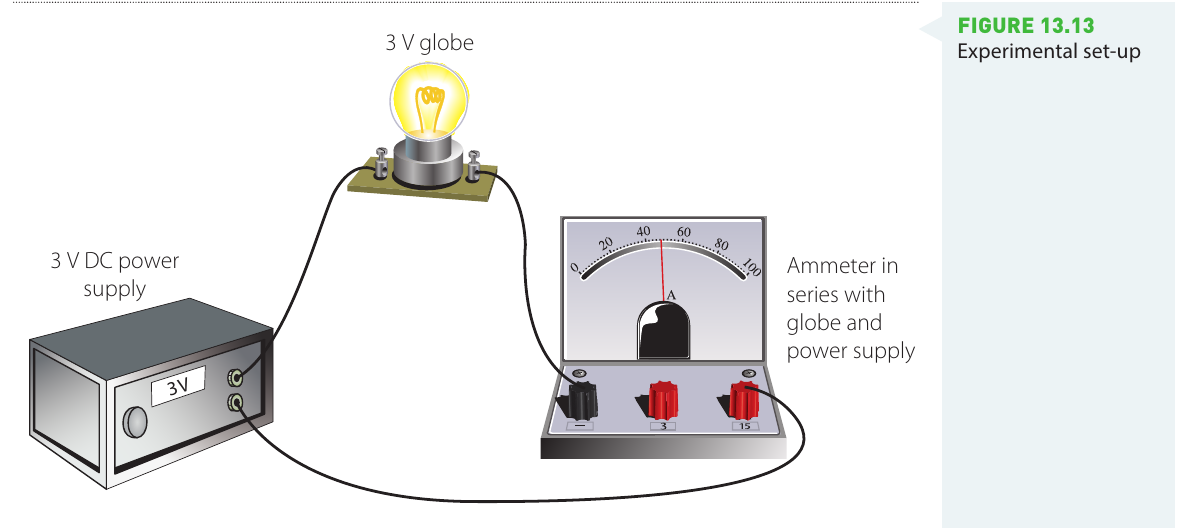
- Once your teacher has approved your circuit setup, switch on the power supply.
- Record the ammeter reading and make note of any other observations (such as the brightness of the globe or any heat produced).
- Switch off the power supply and carefully remove the globe from the circuit.
- Repeat steps 2-5, but this time replace the globe with the buzzer.
- Repeat the process once more, replacing the buzzer with the motor.
Note
Experimental Technique
Make sure to wait a few seconds after turning on each component before taking your ammeter reading, as some components may take a moment to reach steady-state operation.
Results
Record your observations in a table with the following format:
| Component | Electric potential energy transformed to | Current (mA) | Power (W) | Resistance (Ω) |
|---|---|---|---|---|
| Globe | light and heat | |||
| Buzzer | ||||
| Motor |
Analysis of results
- Calculate the power used by each component using the formula , where V and is the current you measured. Remember to convert current from milliamps to amps first (). Record these values in your table.
- Calculate the resistance of each component using Ohm's law: . Enter these values in your table.
- Create a bar graph comparing the power usage of the three components, with component names on the horizontal axis and power in watts on the vertical axis.
Important
Unit Conversion Reminder
When calculating power, ensure your current is in amperes (A), not milliamps (mA). Multiply your mA reading by 0.001 to convert to amperes before using the formula .
Discussion points
- Energy transformations: Describe what form of energy each component produced. The globe converted electrical energy to light and heat. The buzzer transformed electrical energy into sound (and some heat). The motor converted electrical energy into kinetic energy (rotational motion) and some heat.
- Power comparison: Which component used the most power? Which used the least? Explain why different components might have different power requirements even when connected to the same voltage.
- Research question: Based on your data, answer the research question you formulated at the start. For example, if you asked "Which component is most efficient at energy conversion?", discuss which component wasted the least energy as heat.
- Extension ideas: Consider how you might extend this investigation. Could you test components at different voltages? Could you measure the actual light output or sound level to quantify the useful energy produced?
Investigation 13.4: Converting potential energy to heat
Aim
To analyse the energy transformations and transfers taking place as a kettle heats water, and to determine the efficiency of this energy conversion.
Background
This investigation applies the principle of energy conservation to a practical device. Electric potential energy is converted to heat, which then increases the temperature of water. By comparing the theoretical temperature change (assuming perfect efficiency) with the actual measured change, we can calculate how efficiently the kettle transfers energy to the water. You may want to review concepts of heat transfer and specific heat capacity before beginning.
Note
Key Concept: Specific Heat Capacity
The specific heat capacity of water is . This means it takes 4180 joules of energy to raise the temperature of 1 kg of water by 1°C. This relatively high value is why water is excellent for storing thermal energy.
Materials
- 240 V electric kettle
- 500 mL water
- Thermometer
- Stopwatch
- Wooden stirrer
Risk assessment
| What are the risks? | How to stay safe |
|---|---|
| Hot water and steam can cause burns | Avoid spills and do not heat the water to boiling point. Use a wooden stirrer rather than a metal one to prevent heat conduction to your hand. |
Method
- Locate the compliance label on the kettle base. Record the operating voltage (typically 230-240 V in Australia) and the power rating (in watts or kilowatts).
- Pour exactly 500 mL of water into the kettle. This is equivalent to 500 g of water since the density of water is 1 g/mL. Wait several minutes to allow the water and kettle to reach thermal equilibrium with the room.
- Whilst waiting, calculate the theoretical temperature change if the kettle runs for 60 seconds with 100% efficiency. Use the formula to find the energy supplied, then use with the specific heat capacity of water () to find the expected temperature rise.
- Measure the initial temperature of the water using the thermometer. Record this value along with the measurement uncertainty (typically ±0.5°C for a standard thermometer).
- Turn the kettle on for exactly 60 seconds, then immediately switch it off. Note that there will be some uncertainty in the timing.
- Quickly but carefully stir the water with the wooden stirrer to ensure uniform temperature throughout. Measure the final temperature and record it with its uncertainty.
Important
Critical Experimental Technique
Stirring the water before measuring the final temperature is essential. Without stirring, hot water near the heating element won't mix with cooler water at the surface, leading to an inaccurate temperature reading.
Results
You should now have two key pieces of data:
- A theoretical temperature change (calculated assuming 100% efficiency)
- An actual measured temperature change
Analysis of results
- Agreement with theory: Compare your measured temperature change with the theoretical value. Do they agree within the experimental uncertainty? The experimental uncertainty combines the uncertainties in both temperature measurements.
- Actual power to water: Calculate the rate at which energy was actually transferred to the water. Use with your measured temperature change to find the energy gained by the water, then divide by the time (60 s) to get the actual power delivered to the water.
- Uncertainty analysis: Calculate the uncertainty in the power value. The fractional uncertainty in power equals the sum of the fractional uncertainties in temperature difference, time, and mass. If any of these are very small compared to others, they can be neglected.
- Efficiency: Calculate the kettle's efficiency using: This represents the fraction of electrical energy that successfully heated the water.
- Electrical characteristics: Calculate:
- Current through the kettle:
- Resistance of the kettle: or
Summarise all these characteristics in a comprehensive table showing the kettle's specifications and performance.
Note
Understanding Efficiency
An efficiency of 100% would mean all electrical energy became heat in the water. In practice, some energy always escapes to the surroundings or heats the kettle itself. Typical kettles achieve 80-85% efficiency, which is actually quite good compared to many other appliances.
Discussion points
- Theoretical vs experimental: How closely did your measured temperature change match the theoretical prediction? Was it higher or lower? Explain any differences.
- Energy losses: Use energy conservation to explain where the "missing" energy went. Consider that some energy:
- Heats the kettle itself (not just the water)
- Escapes to the surrounding air through convection
- Is lost through conduction to the bench
- Radiates away as infrared radiation
- May be lost through evaporation of water
- Efficiency discussion: Is the efficiency you calculated reasonable for a kettle? Typical kettles are about 80-85% efficient. If your value differs significantly, what factors might explain this?
- Research question: Provide a complete answer to your initial research question, supporting it with your data and analysis.
Important
Energy Conservation in Action
Remember that energy is always conserved - it never disappears. If your kettle is rated at 2000 W but only delivers 1600 W to the water, the remaining 400 W hasn't vanished; it's heating other things like the kettle body, the surrounding air, and the bench surface.
Conclusion
Write a comprehensive conclusion that addresses the investigation's aim. Include specific values from your data (with uncertainties), discuss the energy transformations observed, state the calculated efficiency, and explain what this tells us about energy conversion in electrical appliances. Relate your findings back to the principle of conservation of energy.
Summary
Key Points to Remember:
-
A battery acts as a source of potential energy. As charged particles move through a battery, their potential energy increases, whilst the battery's stored chemical energy decreases.
-
Different circuit components convert electrical potential energy into various useful forms: light globes produce light and heat, LEDs produce mostly light, motors create kinetic energy, and resistors generate heat.
-
Power measures the rate of energy transformation and can be calculated using three equivalent formulae: . Choose the most convenient formula based on which quantities you know.
-
Power is measured in watts (W), where . This means a 1 watt device transfers or transforms 1 joule of energy every second.
-
The principle of energy conservation applies to all circuits. Energy cannot be created or destroyed, only transformed from one form to another, though not all transformations are 100% efficient due to unwanted energy losses (usually as heat).