Electric Charge (HSC SSCE Physics): Revision Notes
📚Revision Notes
Electric Charge
Introduction to electrostatics
Electromagnetism is a fundamental topic in physics that introduces new concepts such as charge and electric fields. However, it also relies on familiar ideas like force and energy that we've studied before. The same core principles of forces, energy, motion, and conservation apply to electromagnetism.
Note
There are only four fundamental forces in nature that govern all physical interactions in the universe. The electrostatic force is part of one of these fundamental forces.
There are only four fundamental forces in nature:
- Electromagnetic force
- Gravity
- Strong force
- Weak force
The electrostatic force is part of the electromagnetic force. It acts on charged particles and is what we'll focus on in this topic.

In nature, we can observe powerful displays of electrostatics, such as lightning storms, which demonstrate the movement and interaction of electric charges on a massive scale.
Atomic structure and charge
The structure of atoms
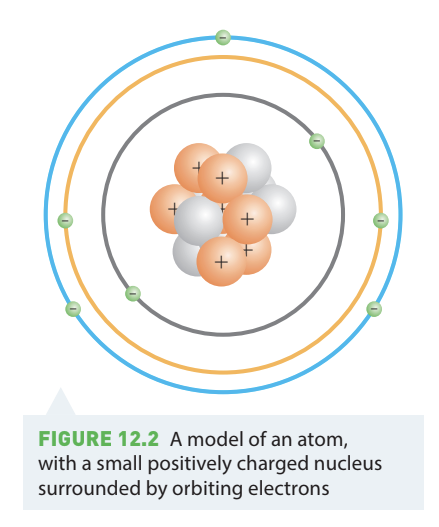
Matter is made of atoms. Although atoms are too small to see directly, experiments have revealed their structure. According to the Rutherford-Bohr model, atoms consist of:
- A tiny nucleus at the centre containing:
- Protons (positively charged)
- Neutrons (uncharged, or neutral)
- Electrons (negatively charged) that orbit the nucleus
What is charge?
Important
Charge is a fundamental property of particles, similar to mass. We know charge exists because of the forces that charged particles exert on one another.
Charge is a fundamental property of particles, similar to mass. We know charge exists because of the forces that charged particles exert on one another. These forces can be either attractive or repulsive, which tells us there must be two types of charge.
The gravitational force, which was described by Newton centuries ago, is always attractive and depends on mass. However, we observe many interactions that include repulsion and are far too strong to be explained by gravity alone. These interactions are explained by the existence of electric charge.
Note
You can think of charge as the answer to the question: "How can we explain observed interactions that are not due to gravity?" The electrostatic model, including the concept of charge, was developed to explain these specific types of interactions.
Neutral atoms
Atoms are generally neutral overall. This means they have equal numbers of positive protons in the nucleus and negative electrons orbiting around it. The attractive force between the positively charged protons and negatively charged electrons is what holds atoms together.
How objects become charged
Ionisation of atoms
Atoms can become ionised by gaining or losing electrons. For example:
- Removing an electron from a sodium atom (Na) creates a positively charged sodium ion (Na⁺)
- Adding an electron to a chlorine atom (Cl) creates a negatively charged chloride ion (Cl⁻)
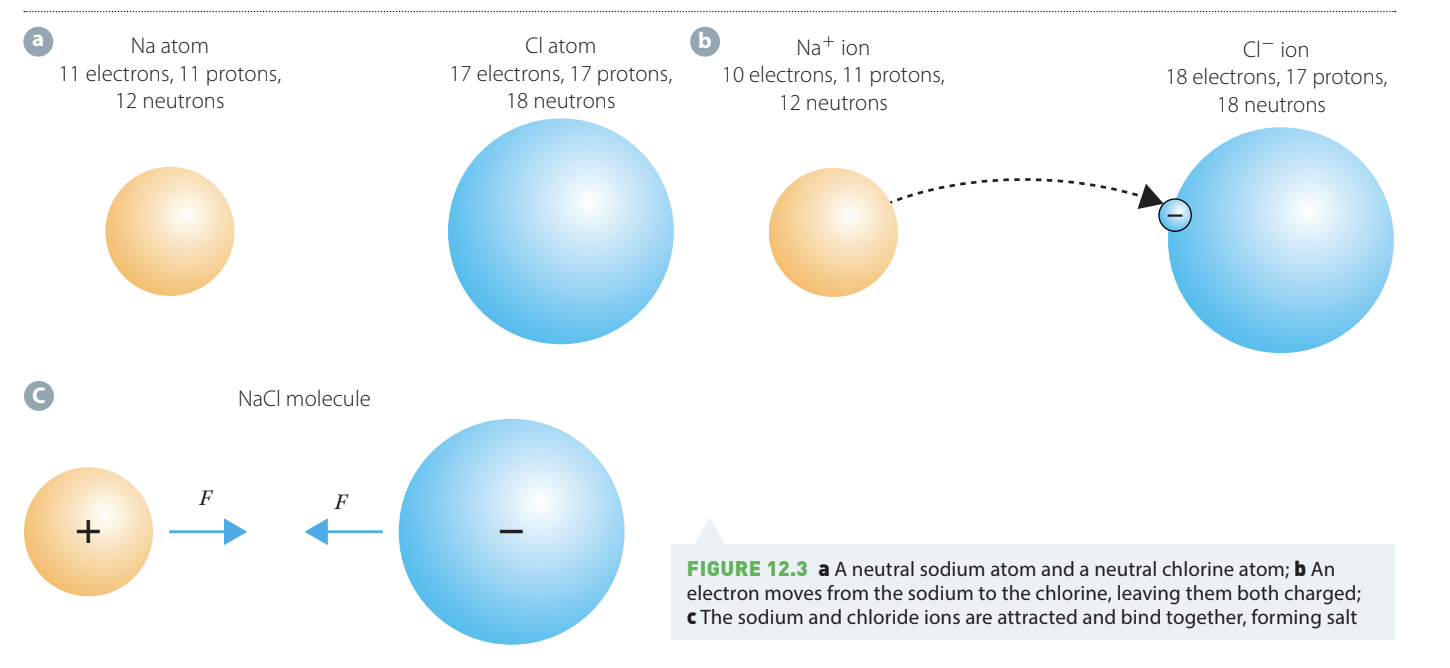
The diagram shows the process of ionic bonding in sodium chloride (salt):
- A neutral sodium atom transfers one electron to a neutral chlorine atom
- This creates a positively charged Na⁺ ion and a negatively charged Cl⁻ ion
- These oppositely charged ions attract each other, forming the chemical bond in NaCl
Charging macroscopic objects
The process of moving electrons can happen on a large scale, leaving everyday objects charged. There are several ways this can occur:
Conductors (such as metals) allow electrons to move freely, so they can be charged by adding or removing electrons directly.
Note
Other materials can be charged by:
- Rubbing one material against another, which transfers electrons between them
- Breaking apart pieces of molecules, leaving behind charged fragments
This is what happens when:
- You slide down a plastic slide and your hair stands up
- You walk across a carpet and get a small shock when touching a door handle
- You rub a balloon on your hair
Charged versus neutral objects
We use specific terminology to describe the charge state of objects:
- Charged objects: objects with a net charge, either positive or negative
- Neutral objects: objects with zero net charge (equal amounts of positive and negative charge)
The electrostatic force
Definition
The electrostatic force is the force that charged objects and charged particles exert on each other. The term 'static' means this force acts when the charged objects are not moving (though it also acts when they are moving). When charges move, they additionally exert a magnetic force, but electrostatics deals with the simpler case where we don't need to consider magnetism.
Van de Graaff generator
A Van de Graaff generator is a device that demonstrates electrostatic principles. It works by removing electrons from a metal dome, leaving it positively charged. This charged dome then exerts forces on other charged objects.
Forces on neutral objects
It's not only charged objects that experience electrostatic forces. A neutral object will experience a force when placed close to a charged object. This happens because neutral objects are made of atoms, and atoms are made of charged particles.
Important
When a neutral object (like a piece of foam) is brought near a charged object (like a charged Van de Graaff dome), something remarkable happens through a process called charge induction:
- The electrons in the atoms of the foam shift slightly towards one side
- This makes that side slightly more negative and the opposite side slightly more positive
- The negative side is closer to the positively charged dome
- The attractive force on the negative side is stronger than the repulsive force on the positive side
- The result is a net attractive force - the foam flies towards the dome
This process is called charge induction - the charged object induces a separation of charges in the neutral object.
Properties of electrostatic interactions
Through experiments, we can observe several fundamental properties of electrostatic interactions:
1. Attraction of neutral objects
Neutral objects are attracted to charged objects, regardless of whether the charged object is positive or negative. Similarly, charged objects are attracted to neutral objects. This is due to the induced charge separation in the neutral object.
Note
According to Newton's third law, forces are interactions between two objects, so both objects experience the force equally.
2. Like and unlike charges
Important
Fundamental Rule of Electrostatics:
- Like charges repel each other (positive repels positive, negative repels negative)
- Unlike charges attract each other (positive attracts negative)
3. Distance dependence
The force that a charged object exerts on another object (charged or neutral) decreases as the distance between them increases. The exact relationship between force and distance will be explored later.
4. Charge magnitude
The larger the charge, the greater the force that is exerted and experienced.
Investigation: Charge and charged objects
Aim
To investigate the interactions between charged and neutral objects.
Research questions
Consider investigating:
- What factors affect the force that a charged object exerts on another object?
- How does the amount of charge affect the force?
- How does distance affect the force?
- How do different materials compare in their ability to transfer charge?
Materials
- Paper torn into tiny pieces (a few millimetres across)
- 2 plastic combs or perspex rods
- Different types of fabric (wool, silk, polyester)
- 2 or more balloons
- Sticky tape (experiment to find which type works best)
- Scissors
Risk assessment
Important
Key safety considerations:
- Keep paper scraps in a bag to prevent them becoming a choking hazard
- Clean up sticky tape properly after use
- Consider any additional risks specific to your setup
Method
Part A: Charging using different materials
- Place a few tiny pieces of paper on the desk
- Rub the plastic comb/rod up and down with a piece of fabric
- Hold the comb/rod approximately 2 cm from the paper and observe what happens
- Remove any paper stuck to the comb/rod and discard it
- Repeat with different types of fabric, noting the results each time
- Identify which material most effectively charges the comb/rod
Part B: Charge and force
- Rub the second comb/rod once with the most effective fabric from Part A
- Hold it approximately 2 cm from the paper
- Observe and count the number of paper pieces that stick to the comb/rod
- Remove stuck paper and discard
- Repeat after rubbing the comb/rod 3, 5, 10, and 20 times
- Record the number of paper pieces attracted each time
Part C: Charge, force and distance
- Rub the comb/rod vigorously many times
- Hold it 20 cm above the paper pieces
- Slowly move the comb/rod down towards the paper
- Note the distance at which paper starts to lift
- Observe whether the number of pieces lifted changes with distance
Part D: Forces between like and unlike charges
- Stick a 15 cm piece of tape to the desk, with 5 cm hanging off the edge
- Place a second similar piece nearby but not overlapping
- Peel off both pieces carefully, one in each hand (or with two people)
- Do not allow them to touch or get close together yet
- Hold the pieces so they hang vertically, then slowly bring them close together
- Record your observations, then discard the tape
- Repeat, but this time place the second piece of tape on top of the first
- Peel off the top piece first (holding the bottom piece down)
- Then peel off the bottom piece
- Bring the two pieces close together and observe
Part E: Forces between charged objects and neutral objects
- Rub an inflated balloon vigorously on your hair until it becomes charged (you'll know it's charged when it crackles and lifts your hair)
- Gently place the charged balloon against a wall
- Observe the behaviour of the balloon
- Try different wall surfaces (windows, plaster, wood, metal)
- Record your observations
Expected results
- Part A: Identify which fabrics are most effective at transferring charge
- Part B: Collect quantitative data showing the relationship between the amount of rubbing (and therefore charge) and the number of paper pieces attracted
- Part C: Collect quantitative data showing the relationship between distance and the number of paper pieces attracted
- Parts D and E: Collect qualitative observations about attraction and repulsion
Analysis
Key questions to consider:
- Which fabric most effectively transferred charge to the comb/rod?
- How does the force vary with the amount of charge? (Plot a graph of pieces attracted versus number of rubs)
- How does the force vary with distance? (Plot a graph of pieces attracted versus distance)
- When tape pieces had the same charge, did they attract or repel?
- When tape pieces had opposite charges, did they attract or repel?
- Was the balloon attracted to, repelled from, or unaffected by the wall?
- Did the wall surface material make a difference?
Key findings
Note
From experiments like these, we can establish that:
- Neutral objects are attracted to charged objects (whether positive or negative)
- Like charges repel each other
- Unlike charges attract each other
- Force decreases with increasing distance
- Force increases with increasing charge
Worked example: Determining charge from interactions
Example
Worked Example: Determining charge from interactions
Problem: Four polystyrene beads (A, B, C and D) sit on a desk after an electrostatics experiment. When beads A and B are brought close together, they repel and move apart. When B and C are brought close together, they attract and move closer. When C and D are brought close together, they do not move. If A has positive charge, what are the signs of the charge on B, C and D?
Solution: We can solve this using logical deduction:
| Answer | Logic |
|---|---|
| A has positive charge | Given in the question |
| B is repelled by A | Given in the question |
| B has positive charge | Like charges repel each other, so B must be positive like A |
| C is attracted to B | Given in the question |
| C has either negative charge or is neutral | Unlike charges attract; charged objects also attract neutral objects |
| D experiences no force from C | Given in the question |
| C and D are neutral | Neutral objects exert no electrostatic force on other neutral objects |
| Final answer: A and B are positive; C and D are neutral | Summary of conclusions |
Key strategy: The key to solving these problems is to:
- Identify what you know from the question
- Apply the rules of electrostatic interactions systematically
- Work through the logic step by step
- Eliminate possibilities that contradict the observations
Remember!
Summary
Key Points to Remember:
- Charge is a fundamental property of particles, existing in two types: positive (protons) and negative (electrons)
- Objects become charged when electrons are transferred, either by rubbing materials together or by direct addition/removal of electrons
- Like charges repel, unlike charges attract - this is a fundamental rule of electrostatics
- Neutral objects are attracted to both positively and negatively charged objects due to induced charge separation
- The electrostatic force increases with the amount of charge and decreases with distance between objects