Magnetisation: Making Magnets (HSC SSCE Physics): Revision Notes
📚Revision Notes
Magnetisation: Making Magnets
Introduction to magnetisation
Magnetisation is the process of making a material magnetic. When you repeatedly draw a permanent magnet along a ferromagnetic material like a steel pin in one direction, something interesting happens. The tiny magnetic fields within the iron atoms in the steel begin to align in the same direction. Once this alignment occurs, the pin becomes magnetised. It can now act as a compass needle and can even pick up other small steel objects like pins or paper clips.
Note
This simple process demonstrates a fundamental principle: ferromagnetic materials can become magnets when exposed to a magnetic field.
Investigation 14.6: Making magnets
Example
Practical Investigation: Making Magnets
This practical investigation allows you to observe magnetisation in action by creating your own magnet.
Aim
To magnetise a nail by exposing it to the magnetic field of a strong magnet.
After reading the method, you should write a hypothesis predicting what will happen when you repeatedly stroke the nail with a magnet.
Materials
- Strong permanent magnet
- Steel nail
- Small steel paper clips (or steel pins with a pincushion)
- Container for paper clips or pins
Important note: Not all metal nails or paper clips are ferromagnetic. You may need to test several different types. Steel pins are generally ferromagnetic and lighter than paper clips, but handle them carefully as they are sharp and easily lost.
Risk assessment
| What are the risks in doing this investigation? | How can you manage these risks to stay safe? |
|---|---|
| Pins are sharp and easily lost. | Use a pincushion to store pins, and always put them back immediately. |
Consider what other risks might be associated with your investigation and how you can manage them.
Method
Important: Do not put your pins close to the magnet initially. You need to control their exposure to the magnetic field.
-
Before you begin magnetising your nail, check that the pins are not attracted to it.
-
Stroke the nail with the permanent magnet once. Make careful note of which way the magnet was held and which direction you moved it relative to the nail.
-
Hold the magnetised nail just above the container of un-magnetised pins. Count how many pins the magnetised nail picks up. Note whether all the pins picked up are directly touching the magnetised nail.
-
Remove the pins from your magnetised nail and set them aside.
-
Repeat steps 2–4, always stroking the nail in the same direction.
Results
Create a table recording how many pins were picked up each time you stroked the nail. Draw diagrams showing any interesting results, such as pins forming a chain attached to the nail.
Analysis of results
Examine your data carefully. Can you identify a relationship between the number of times the nail was stroked and the number of pins picked up? Does the magnetisation strength increase with more strokes?
Discussion
Consider the following questions:
-
State whether your results agreed with your hypothesis.
-
Explain how it is possible for a chain of pins to form from the nail. Describe what is happening to the pins as they form this chain. (Hint: Think about whether the pins themselves might be becoming magnetised.)
Conclusion
With reference to the data obtained and its analysis, write a conclusion based on the aim of this investigation. Did you successfully magnetise the nail? What evidence supports this?
Permanent magnets
Important
Definition: A permanent magnet is a magnetic material that maintains its magnetic field after being magnetised. Unlike temporary magnets that lose their magnetism when removed from an external field, permanent magnets retain their magnetic properties over time.
Manufacturing permanent magnets
Permanent magnets are manufactured from ferromagnetic materials. These may include:
- Metal alloys such as aluminium-nickel-cobalt (Alnico) or neodymium-iron-boron
- Ceramics such as barium ferrite or strontium ferrite
The manufacturing process typically involves:
- The material is powdered and compressed into the desired shape
- The shaped material is placed inside a solenoid
- The solenoid creates a large magnetic field
- This strong field magnetises the material, creating a permanent magnet
Understanding ferromagnets and domains
Un-magnetised ferromagnets
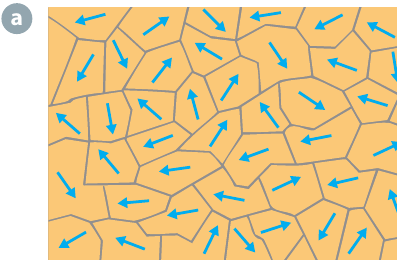
A ferromagnetic material that has not been magnetised and is not in a magnetic field does not produce a magnetic field of its own. However, this doesn't mean there are no magnetic fields present at all.
Note
Inside the material, tiny magnetic fields exist due to individual electrons. These electron magnetic fields line up in very small regions called domains. Within each domain, the fields are aligned. However, the fields due to different domains point in random directions. When you add up all these randomly oriented domain fields, they cancel each other out, giving zero net magnetic field overall.
Magnetisation through domain alignment
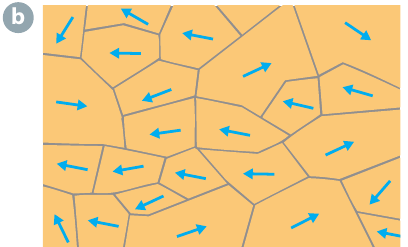
When you place a ferromagnetic material in an external magnetic field (called the applied field), the material responds in a specific way. The applied field causes some of the electron fields to line up with it through two mechanisms:
- Domains where the internal field is already aligned with the applied field grow larger, expanding at the expense of neighbouring domains
- Domains where the internal field is not aligned shrink as the electron fields within them rotate to line up with the external field
Note
The larger the external field, the more domains align with it and the bigger these aligned domains become. Therefore, the bigger the external field, the stronger the magnetic field produced by the material itself.
Saturation magnetisation
Important
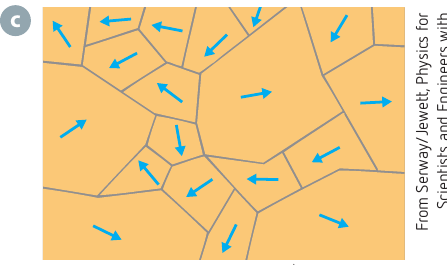
If the applied field is strong enough, eventually every unpaired electron will have its magnetic field aligned with the external field. This state is called saturation magnetisation. At this point, the ferromagnet is producing its largest possible magnetic field. No matter how much stronger you make the external field, the material cannot become more magnetised because all the electron fields are already aligned.
Magnetisation retention and temperature effects
What happens when the external field is removed?
When a ferromagnet is removed from the applied field, its magnetisation typically decreases somewhat. Some domains become un-aligned again. This occurs because of internal energy within the material.
Note
All particles in a material are constantly vibrating and moving about due to thermal energy. The higher the temperature, the more internal energy the particles have, and the more they vibrate and move around. This increased motion causes the arrangement of magnetic fields to become more random. The more random the arrangement becomes, the lower the total magnetic field, and therefore the lower the magnetisation.
Residual magnetisation
However, at low temperatures, the arrangement does not become completely random after the external field is removed. The magnetisation does not return to its initial zero state. Instead, there is a residual magnetisation. This means the ferromagnet continues to produce its own magnetic field even after being removed from the magnetising field. It has become a magnet.
Important
How well a material remains magnetised depends on:
- What the material is made of
- How strong the magnetising field was
- The temperature of the material
The lower the temperature, the less magnetisation is lost when the external field is removed.
Example: Fridge magnets
Thin, flat fridge magnets, such as those often used for advertising, provide an interesting example of domain patterns. These magnets have domains running in strips along the length or width of the magnet.
Note
If you take two fridge magnets and place them with their magnetic sides together, then slide them against each other, you'll feel an interesting sensation. It will feel as though their surfaces are rippled or bumpy. However, when you touch the surfaces with your fingers, they feel perfectly smooth.
This sensation of rippling comes from the alternating north and south pole domains on the two magnets:
- When north pole domains on one magnet line up with south pole domains on the other, they attract
- As you slide them, north pole domains line up with north pole domains, and they repel
- This alternating attraction and repulsion creates the rippled feeling
Remember!
Summary
Key Points to Remember:
-
Ferromagnetic materials can be magnetised by exposing them to a strong magnetic field, such as by stroking them repeatedly with a permanent magnet in one direction.
-
Domains are tiny regions within ferromagnetic materials where electron magnetic fields are aligned. In an un-magnetised material, different domains point in random directions.
-
Magnetisation occurs when an external magnetic field causes domains to align with it. Aligned domains grow larger while un-aligned domains shrink.
-
Saturation magnetisation is reached when all unpaired electrons have their magnetic fields aligned with the external field. This is the maximum magnetisation possible.
-
Residual magnetisation allows permanent magnets to retain their magnetic field after the external magnetising field is removed. Temperature affects how well magnetisation is retained - lower temperatures mean less magnetisation loss.