Analysing Vectors in One and Two Dimensions (HSC SSCE Physics): Revision Notes
📚Revision Notes
Analysing Vectors in One and Two Dimensions
Introduction to vectors in two dimensions
Building on the study of one-dimensional motion, we now explore how to work with quantities that have both magnitude (size) and direction. These quantities are called vectors.
The mathematical tools for working with vectors were developed in the late 19th century by Oliver Heaviside (1850-1925) and J. Willard Gibbs (1839-1903). While vector mathematics can seem complex at first, it provides a powerful way to describe physical quantities. Today, vectors are essential in physics, engineering, computer science, and many other fields.
Common vector quantities in physics
Many physical quantities are represented as vectors. If is a vector, then represents its magnitude. Examples of vector quantities include:
- Displacement - change in position
- Velocity - rate of change of displacement
- Acceleration - rate of change of velocity
- Force - push or pull on an object
- Momentum - mass times velocity
- Electric field - force per unit charge
- Magnetic field - affects moving charges
Note
Understanding how to manipulate vectors is a fundamental skill in physics. Each of these vector quantities has both a magnitude (how much) and a direction (which way), making them more complete descriptions of physical phenomena than scalar quantities alone.
Motion in two dimensions
When an object doesn't move in a straight line, we need to account for changes in direction as well as distance. Consider a car that travels 100 km north, then 100 km west. The total distance travelled is 200 km (this is what the odometer would show). However, the displacement from the starting point is not 200 km in a straight line.
To find the true displacement "as the crow flies", we must add the two parts of the journey while accounting for their directions. This is done by treating each leg as a vector and using vector addition. This concept of adding vectors while preserving directional information is central to analyzing motion in two dimensions.
Vector operations
Vectors can be combined in several ways:
- Addition - combining vectors to form a new vector
- Subtraction - finding the difference between two vectors
- Resolution - breaking a single vector into perpendicular components
- Scalar multiplication - multiplying or dividing a vector by a number
When a vector is divided by a scalar (a quantity without direction), the result is a new vector pointing in the same direction. For example, dividing displacement by time gives average velocity :
Note
The scalar has units (seconds), so has different units from . However, because is a scalar, the direction remains unchanged - is parallel to . This demonstrates an important property: scalar multiplication changes the magnitude but preserves the direction of a vector.
Resolving a vector into perpendicular components
Any vector lying in a two-dimensional plane can be broken down into two perpendicular (at right angles) vectors. This process is called resolving the vector into components.
Choosing a coordinate system
The choice of coordinate system depends on the physical situation:
- Ground-based motion - use compass directions (north, south, east, west)
- Vertical plane motion - use horizontal and vertical directions
- General purpose - use the x-y plane where the x-axis points right and the y-axis points up
For objects on slopes, it's often helpful to choose one axis parallel to the slope and another perpendicular to it.
Important
Key Requirement: The two axes must be perpendicular to each other. This perpendicularity is essential for the mathematical relationships and calculations to work correctly.
Mathematical relationships for vector components
Consider a vector in the x-y plane, making an angle with the x-axis (measured anticlockwise from the positive x-axis).
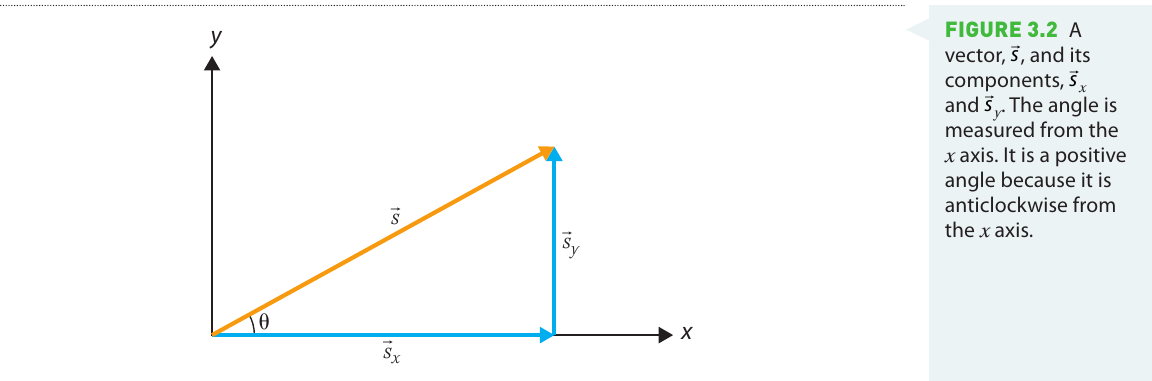
This vector can be expressed as the sum of two perpendicular component vectors:
where is the component along the x-axis and is the component along the y-axis.
The magnitudes of these components are found using trigonometry:
where is the magnitude of , and and are the magnitudes of the component vectors.
Note
The component is sometimes called the projection of onto the x-axis. Similarly, is the projection onto the y-axis. Think of projection as the "shadow" the vector casts on each axis.
Understanding signs and angles
From the diagram, we can see that is opposite the angle , which is why we use sine. The component is adjacent to the angle, which is why we use cosine. However, these relationships depend on how the angle is defined.
Important
Critical Considerations When Working With Angles:
-
Always pay attention to the signs of quantities. A vector of length -12 m in the +x direction is the same as one of +12 m in the -x direction.
-
Angles aren't always measured anticlockwise from the x-axis. In compass-based problems, angles typically increase clockwise.
-
An angle written as N30°W means 30° west of north (or equivalently, 30° from north towards west).
-
N45°E is the same as north-east.
Always draw a diagram to help identify which angles are relevant, which trigonometric functions to use, and which quantities are positive or negative.
Worked example: Finding vector components using compass directions
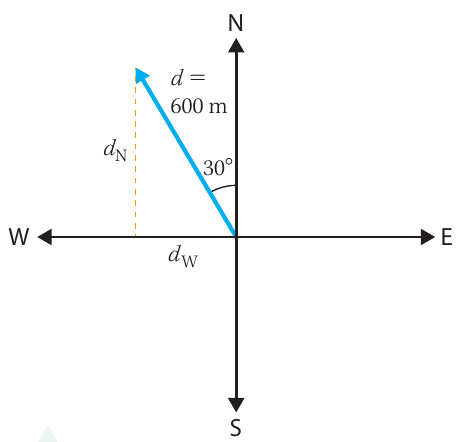
An orienteer is at a position which is 600 m N30°W from the origin. Let's find the northward and westward components, and , of the orienteer's position.
Example
Worked Example: Finding Vector Components with Compass Directions
First, we draw a diagram showing the position as a vector on compass axes. From the diagram, we identify which trigonometric functions to use:
Substituting the known values:
Answer: The orienteer is 520 m north and 300 m west of the origin.
Exam tip: When finding components, always draw a clear diagram first. This helps you identify the correct trigonometric relationships and avoid sign errors.
Adding vector components
The reverse process of resolution is combining perpendicular components to find the resultant vector. If we know the components and , we can find the original vector .
Mathematically:
Since the components are perpendicular (along x and y), we use Pythagoras' theorem to find the magnitude:
where and are the magnitudes of the component vectors.
However, is a vector, so we must also find its direction. We use trigonometry to find the angle that makes with the x-axis:
This gives us both the magnitude and direction of the resultant vector.
Worked example: Finding resultant displacement
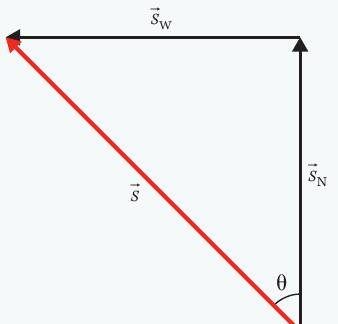
A car drives 125 km north, then 125 km west. Let's find the magnitude and direction of the resultant displacement.
Example
Worked Example: Finding Resultant Displacement
The given information tells us:
- km (northward component)
- km (westward component)
These two paths are perpendicular to each other (north and west are at 90°).
Finding the magnitude:
Using Pythagoras' theorem:
Finding the direction:
To find angle from north toward west:
Answer: The resultant displacement is 177 km at 45° from north toward west, or equivalently, 177 km north-west.
Key insight: When working out the angle, notice that the units (km) cancel out. This is expected because trigonometric functions require dimensionless numbers (numbers without units) as inputs.
The diagram is very useful for understanding what the 45° angle means - it shows the car's final position relative to its starting point.
Investigation 3.1: Displacement vectors
Aim
To investigate how displacement vectors can be decomposed into components, and to practise calculating experimental uncertainties.
Materials
- 20-m tape measure
- Marker pegs
- Coin
- 2 dice
- Set square
- Open space (such as a school oval)
Risk assessment
| Hazard | Risk management |
|---|---|
| Excess sun exposure | Wear a hat and appropriate sun protection |
Consider other risks associated with your investigation and how to manage them.
Method
- Place a marker peg at the starting position.
- Stand at the start and throw the dice. Take as many steps forward in a straight line as the total shown on the dice. Take the dice with you.
- Place a marker peg at your current position.
- Toss the coin. If heads, turn left 90°. If tails, turn right 90°. Use the set square to ensure you turn through exactly 90°.
- Throw the dice again. Take as many steps forward in a straight line as shown on the dice. Place a marker peg at your final position.
- The three pegs should form a right-angled triangle. Carefully measure the distances (side lengths) between the pegs.
- Repeat steps 2-6 several times, either with the same person or different people.
Results
- Record all distances measured and the number of steps taken each time.
- Record the uncertainty in each measurement.
Analysis of results
- Draw a diagram for each set of results showing the right-angled triangle formed.
- Based on the two perpendicular sides, calculate the length of the hypotenuse using Pythagoras' theorem. Compare this calculated length to the measured length.
Note
The uncertainty in the calculated length can be found using the range method:
where:
Here, is the maximum possible value of the first distance (allowing for measurement uncertainty), is the minimum possible value, and similarly for and .
- Investigate whether there was a consistent relationship between number of steps taken and distance travelled. Compare results for individuals and between different people.
Discussion
- Do the calculated and measured values of displacement agree within the uncertainties? If not, explain possible reasons. Were there sources of uncertainty not accounted for?
- Answer your inquiry question or state whether your hypothesis was supported.
- How could you improve or extend this experiment?
Conclusion
Write a conclusion based on the aim, referring to your data and analysis.
Remember!
Summary
Key Points to Remember:
-
A vector is a quantity with both magnitude (size) and direction. Examples include displacement, velocity, acceleration, and force.
-
Any vector in a plane can be resolved into two perpendicular components, typically along chosen axes (x-y coordinates or compass directions).
-
Use trigonometry to find components: and , where is measured from the reference axis.
-
Use Pythagoras' theorem to find magnitude from components:
-
Find the direction using:
-
Always draw a clear diagram when working with vectors - it helps identify angles, choose the right trigonometric functions, and understand the physical meaning of your results.