Significant Practices in the Lives of Adherents (HSC SSCE Studies of Religion): Revision Notes
📚Revision Notes
Significant Practices in the Lives of Adherents
Introduction
Christians mark important life events and celebrate their faith through various significant practices. These practices serve both religious and social functions, expressing core Christian beliefs while strengthening community bonds. Three key practices will be examined:
- Baptism - an initiation rite welcoming individuals into the Christian community
- Marriage - a ceremony establishing a new family unit with legal and religious dimensions
- Saturday/Sunday worship - regular communal worship expressing shared faith through diverse traditions
Each practice functions as a rite of passage (a ritual marking progression through different life stages) and many are considered sacraments (religious ceremonies celebrating an outward sign of inner spiritual grace).
Baptism
Core beliefs about baptism
Baptism derives from the Greek word baptizo, meaning a purifying ritual involving water. Through various methods (anointing, sprinkling, pouring, or full immersion), individuals are cleansed and welcomed into the Christian community.
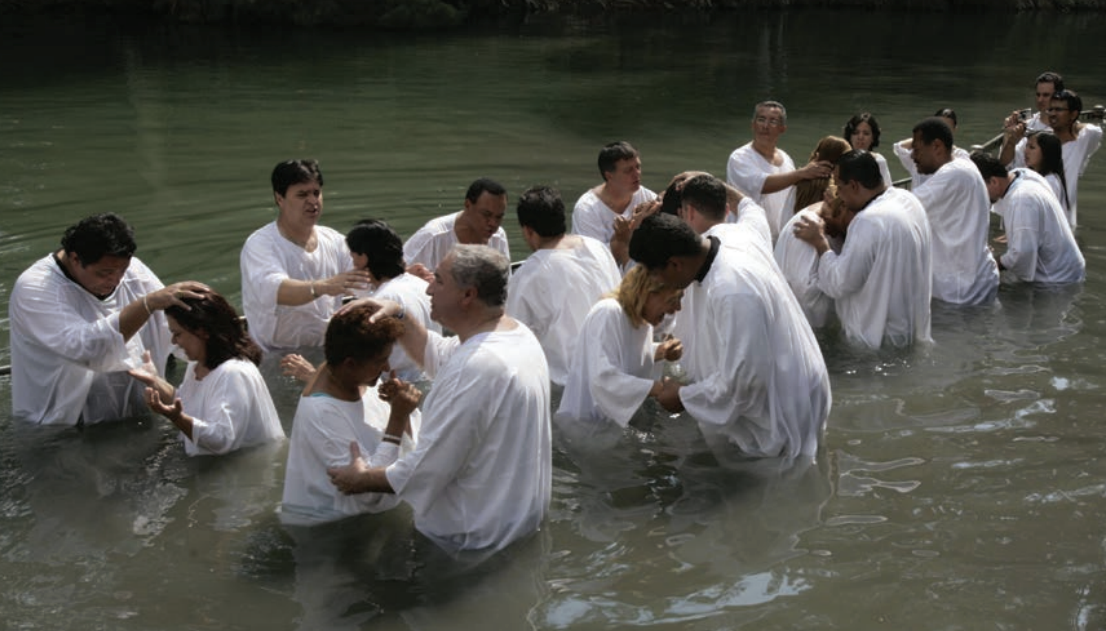
Most Christian groups recognise baptism as necessary for salvation, though denominations differ significantly on its exact meaning and significance. Baptism is considered a sacrament - a religious rite conveying deeper spiritual meaning. Catholic and Orthodox churches recognise seven sacraments, while Protestant churches typically accept only two: baptism and Holy Communion.
Note
Christians commonly believe the sacraments were instituted by Jesus Christ and convey special grace or spiritual blessing. Baptism is generally understood as a sign of new birth or receiving the Holy Spirit.
Different approaches to baptism
Churches practice baptism in varied ways, reflecting different theological interpretations:
Age of baptism:
- Pedobaptism - infant baptism (practised by Catholics, Orthodox, Anglicans, Presbyterians, Uniting Church)
- Credobaptism - adult or "believer's baptism" (practised by Baptists, Seventh Day Adventists, Pentecostals)
- Some churches baptise both infants and adults
Method of baptism:
- Full immersion
- Pouring water
- Sprinkling water
- Different combinations of these methods
Denominational variations in baptism
| Denomination | Beliefs about baptism | Baptise infants? | Initiation into spiritual life? | Method | Biblical basis |
|---|---|---|---|---|---|
| Anglican | Sign affirming forgiveness received through faith | Yes | High Church: Yes; Low Church: No | Immersion or pouring | Matthew 28:19 |
| Baptist | Not necessary for salvation; symbolic ritual showing one has already been saved | No | No | Immersion only | Romans 6:3-4 |
| Eastern Orthodox | Required for forgiveness and regeneration from original sin | Yes (infants also receive Communion and chrismation) | Yes | Immersion three times; sprinkling or air baptism in emergency | Matthew 28:19 |
| Pentecostal | Symbolic acceptance of Christ as personal saviour; also baptise 'in the spirit' | No | Varies | Immersion; spiritual baptism also needed | Various, Romans 6:3-4 |
| Presbyterian | One of two sacraments; seal of adult's faith; sign of covenant between family and God | Yes | No | Sprinkling, pouring or immersion | Linked to Old Testament covenant of circumcision |
| Quaker | Merely an outer symbol, no longer practised | — | — | No water baptism | — |
| Roman Catholic | Required for purifying power starting one on the path of grace; one of seven sacraments | Yes | Yes | Anointing with water or immersion in West; immersion in East | Matthew 28:19 |
| Seventh Day Adventist | Affirmation by believer in death and resurrection of Jesus | No | No | Immersion only | Romans 6:3-4 |
| Uniting Church | Affirms believer's place within community | Yes (shows parents' willingness to guide child into Christian life) | Baptism of children shows parental commitment | Anointing with water | Matthew 28:19 |
Symbolism in baptism
Baptism services incorporate rich Christian symbolism:
- Water - signifies cleansing, washing away sin, presence of the Holy Spirit
- Oil - symbolises healing role of baptism and anointing of the Holy Spirit
- Candles - remind the candidate to be a light to the world
- Sign of the cross - marks membership of the church and belonging to Christ
- White robe - symbolises purity and newness of life
- Sponsors/godparents - represent the gathered Christian community
The profession of faith is central to baptism. Adults make this profession themselves; for infants, family and godparents (spiritual parents who oversee religious growth) make promises on their behalf.
Significance for the individual
Baptism holds multiple meanings for the individual Christian:
Spiritual transformation:
- For Catholics, baptism is the first step on the path of grace towards salvation
- For Anglicans, it provides access to Holy Communion and ultimately salvation
- For Orthodox believers, it cancels the automatic state of sin from birth, providing rebirth for salvation
- For those practising believer's baptism, it demonstrates a profession of personal faith
Obedience and renewal: Many Christians see baptism as obedience to Christ's commands, an act of individual repentance and washing away of sin, representing a new clean start in life.
Note
Personal purification:
The washing ritual is powerful across religious traditions. In Judaism and Islam, washing rituals are important ways of reconnecting with God before worship. Water plays a significant role in most religions.
Different theological perspectives: Some groups, like the Society of Friends (Quakers), note that while Jesus was baptised by John, Jesus himself never baptised anyone. Therefore, they don't believe in the practice, as they don't see themselves as followers of John.
Important
Not all churches see baptism as necessary for salvation; theological positions vary significantly across denominations.
Significance for the community
Baptism serves important communal functions:
Defining membership: Baptism allows the community to define who belongs within the church. It is a welcoming ritual for new members.
Communal participation: When parents present children for baptism, they declare their commitment to guide the child into Christian life. The congregation makes vows, meaning the whole community participates. This marks baptism as a communal event.
Confirmation of adult membership: Adult baptism confirms a new member's adhesion to the Christian group and Christian lifestyle. Baptism is usually conducted during formal worship when the church gathers together.
Symbol of unity: Baptism serves as a symbol of group cohesion and can be used as a standard for assessing who is within the Christian faith and who is outside it.
Note
Rite of passage:
Baptism marks spiritual development for individuals and their relationship to the group. It functions as a purity ritual helping define adherents and their connection to the community.
Biblical and theological sources
Key scriptural references include:
- Luke 3:16-17
- Acts 2:38-39, 8:26-39, 16:29-34
- Romans 6:1-11
- 1 Corinthians 12:13
- Colossians 2:12
- Titus 3:5-7
- Catechism of the Catholic Church, sections 1212-1213
Marriage
Core beliefs about marriage
Marriage is an important rite of passage in Christianity. According to Ephesians 5:25, 29, marriage reflects the relationship between Jesus Christ and the Church. Christians view marriage as a loving, lifelong relationship requiring complete, even sacrificial, commitment between partners.
In religious wedding ceremonies, couples make vows pledging love and faithfulness before God. Witnesses (often the best man and chief bridesmaid) are required. Rings are frequently exchanged - their circular shape symbolises endless love with no beginning or end.
Purposes of marriage according to Christian teaching:
- Proper expression of the sexual relationship
- Mutual companionship
- Good order of society through formation of family units
Christian teaching on marriage permanence
Traditionally, marriages should not be dissolved. Jesus taught that marriage is a permanent state (Mark 10:6-9). Divorce is generally considered a final option after all other attempts to maintain the marriage have failed.
Important
In some churches, notably the Catholic Church, divorce is not recognised. The only option to dissolve a marriage is annulment - a declaration that the marriage never validly took place for various reasons.
Marriage in legal and religious contexts
Marriage functions as both a legal institution and a religious celebration. In Australia, civil celebrations are increasing as religious aspects decrease in influence. However, many people still want religious ceremonies, acknowledging they need spiritual meaning or God's help in their relationship.
Marriage requires witnesses and is a legal contract. It also contains significant symbolism through the use of churches and rings. In some cultures, arranged marriages occur and can be successful.
Biblical foundations
Key biblical passages on marriage include:
"This at last is bone of my bones and flesh of my flesh; this one shall be called woman, for out of man this one was taken. Therefore a man leaves his father and his mother and clings to his wife, and they become one flesh." (Genesis 2:23-24)
"Therefore what God has joined together, let no one separate." (Mark 10:9)
Note
These passages recognise the family as a central unit of society and the exclusiveness of the marriage relationship - views common to all Christians.
Catholic perspectives on marriage and children
Catholic teaching emphasises marriage as a covenantal relationship of love. The Catechism of the Catholic Church states that matrimonial covenant establishes "a partnership of the whole of life, ordered toward the good of the spouses and the procreation and education of offspring."
The Catholic Church sees marriage as the ideal context for having children. However, it also acknowledges that couples without children "can nevertheless have a conjugal life full of meaning, in both human and Christian terms. Their marriage can radiate a fruitfulness of charity, of hospitality, and of sacrifice" (CCC 1654).
Most modern Christians view marriage primarily as the place for expressing love in a sexual relationship, with affection, companionship and love as central features.
Description of the marriage ceremony
Christian marriage services typically include:
Core elements:
- Prayers
- Vows made publicly before God and the gathered community
- Exchange of rings
- Blessings
- Bible readings relating to love or marriage (e.g., 1 Corinthians 13:4-10, Ephesians 5:21-33, Genesis 2:21-24)
- Pronouncement that the couple are husband and wife
- Signing of legal documents (usually witnessed by best man and bridesmaid)
- Opportunity for objections (though good legal reasons should exist)
Denominational variations:
- Orthodox Christians exchange rings before the ceremony; a silver crown is held over the bride and groom's heads
- Roman Catholic weddings often celebrate the Eucharist (the consecrated elements of the Lord's Supper) in a Nuptial Mass
- Marriages are usually accompanied by great celebration
Note
Symbolic meaning:
Marriage in Christianity is rich in symbolism and reflects the relationship between Christ and the Church. Because it is a legal union and essential social institution, it is governed by legal requirements and regulations.
Significance for the individual
Marriage serves several purposes for individuals:
Lifelong commitment: Marriage affirms the commitment of one person to another for life. It functions as a rite of passage marking a new stage in individual development.
Promises before God: Individuals make promises before God in Christian marriage, marking the start of a new family. This acknowledges the purposes of marriage: companionship, appropriate sexual union, and good order of society, affirming individual commitment.
Proper context for sexuality: Marriage is viewed as the institution fit for proper expression of a sexual relationship according to Christian teachings.
Significance for the community
Marriage holds important communal dimensions:
Foundation of society: Marriage affirms the family as a foundation of society. The community witnesses the beginning of a new family and the strengthening of both society and community.
Symbolic of Christ and Church: Marriage symbolises the relationship between the Christian community and Jesus Christ. Christian marriage is recognised as a relationship that should not be undermined.
Saturday/Sunday worship
Core beliefs about communal worship
Christians have met for worship since the beginning of Christianity. Services follow patterns established in the early church years. Many services include the sacrament of Holy Communion. Services generally include:
- Approach to God - gathering and entering worship
- Hearing 'the word' - Bible readings and sermons
- Response to the word - prayer and song
Many churches follow written liturgy (prescribed forms of worship), while others are more informal.
The Sabbath commandment
Christians acknowledge the fourth of the Ten Commandments (enumerated as the third commandment by Catholics and Lutherans):
"Remember the Sabbath day and keep it holy." (Exodus 20:8)
Since Jesus Christ rose from the dead on Sunday, the first day of the week, most Christians celebrate that day - called the Lord's Day - rather than the Sabbath (Saturday) as their holy day.
Important
Notable exception: The Seventh Day Adventist Church keeps Saturday as its Sabbath and day of worship (hence the church's name). Some smaller groups also maintain Saturday worship, believing the change to Sunday was motivated by pagan influences rather than explicit biblical commands.
Early Christian worship patterns
The Book of Acts describes how early Christians devoted themselves to "the apostle's teaching and fellowship, to the breaking of bread and the prayers" (Acts 2:42). They also:
- Practised communalism, sharing possessions (Acts 4:32)
- Spent much time in the temple daily (Acts 2:43-47)
- Experienced many miracles (Acts 5:12-16)
- Instituted significant social welfare components (Acts 6:1-4)
This pattern has essentially remained, with development and formalisation over the centuries.
Note
Early Christians (mainly Jewish) initially met on the Sabbath (Saturday) as expected in Judaism. Over time, Sunday became recognised as the Christian Lord's Day, the day of Jesus' resurrection (Acts 20:1, 1 Corinthians 16:2, Revelation 1:10).
Saturday worship in modern practice
Roman Catholic churches often have Saturday celebration as part of church worship. This is primarily motivated by pragmatic concerns rather than theological issues. In modern society, with shift work, Sunday employment, sport and other time demands, Saturday provides an alternative to Sunday worship or devotional preparation for Sunday services.
Biblical images of the church
Several biblical images explain the church's nature, influencing understanding of Saturday/Sunday worship importance:
- The people of God (1 Peter 2:9, Revelation 21:3)
- The body of Christ (Colossians 1:18, Romans 12:4-8)
- The bride of Christ (Ephesians 5:27, Revelation 19:7)
- The building of God (1 Peter 2:5, 1 Corinthians 3:16)
Purposes of communal worship
Meeting for worship in church fulfils several purposes:
- Communal worship
- Hearing teaching
- Celebrating the Lord's Supper
- Experiencing community
- Individual contemplative experience (though church attendance suggests communal emphasis)
Description of typical worship services
Different denominations emphasise various practices:
Liturgical traditions: Catholic, Orthodox and Anglican churches use formal written liturgy contained in prayer books.
Less formal traditions: Other Protestant churches use more informal or extemporary liturgy.
Common pattern: Most Christian services follow a similar structure, with varied emphasis on Holy Communion celebration:
- Weekly - Catholic, Orthodox, most Anglicans
- Monthly - Uniting Church, Baptist, some Anglicans
- Quarterly - Presbyterian
Example
Typical service format:
-
Approach to God:
- Introduction and call to worship
- Hymns or songs
- Prayers of approach (praise) and confession
-
Word of God:
- Readings from scripture
- Sermon
-
Response to the word of God:
- Prayers for the world (intercession)
- Holy Communion
- Songs or hymns
- Dismissal or sending out into the world
Denominational emphases
Different traditions emphasise various aspects:
- Liturgy-focused - Catholic, Orthodox, Anglican churches
- Word-focused - Reformed churches (Presbyterian)
- Spirit-focused - Pentecostal and Quaker churches
Formality of liturgy tends to decrease in the latter examples. Some churches emphasise sacraments, others emphasise preaching.
Use of lectionary
Some churches follow a lectionary - Bible readings read over a cycle (usually three years) to avoid repetition and ensure most of the Bible is read. Many churches follow the same 'common' lectionary.
Typical weekly readings include:
- Old Testament lesson
- Psalm
- New Testament letter
- Gospel reading
Note
Not all readings are used each week in every church. Catholic, Orthodox and Anglican churches usually use all readings. Pentecostal churches may not have special reading times, but usually reference the Bible in sermons.
Most churches regard the sermon as part of the 'word of God' - a message given with divine authority to explain and apply scriptures to everyday life.
Holy Communion
The institution of Holy Communion
One particular significant feature in Christian worship is 'breaking of bread'. At the Last Supper, Jesus gave particular significance to breaking bread and sharing wine. This became known as Holy Communion (also called the Lord's Supper or Eucharist) - the celebration and remembrance of Jesus' death and resurrection. This has become a formal sacrament of the Church.
Each Synoptic Gospel records the Last Supper, linked to the Jewish Passover celebration but given new meaning with Jesus' imminent death (Matthew 26:17-29, Mark 14:12-25, Luke 22:1-22). While John's Gospel doesn't directly refer to Holy Communion's institution, most view Jesus' discourse on the 'bread of life' as a reference to its significance.
Note
Paul details the institution in 1 Corinthians 11:17-32, a record that almost certainly predates the Gospel writings. Even in New Testament times, passages about Holy Communion's institution take on a formulaic style, suggesting a common set of words handed down as oral tradition.
Central proclamation
In many churches, these words are spoken during celebration:
"Christ has died Christ is risen Christ will come again."
Christians remember Jesus' death and resurrection and anticipate his return through this celebration.
Names for Holy Communion
The practice may be known by several names:
- Eucharist (from Greek eucharistia meaning 'thanksgiving')
- Holy Communion (from Greek koinonia meaning 'fellowship' or 'sharing')
- Lord's Supper
- Mass (which actually includes more than Holy Communion)
Catholic understanding
According to Catholic theology, in the Eucharist celebration, bread and wine become the body and blood of Christ. When adherents receive communion at Mass, they believe they are brought into closer relationship with one another and with Christ.
Receiving the body of Christ at Mass calls adherents to live out what they receive and believe, showing Christ is present in the world through all they do and say.
Typical celebration structure
During Holy Communion celebration:
- The celebrant takes bread and wine
- Makes a prayer of thanksgiving
- The bread is broken and distributed to those present
- Followed by the wine
- Holy Communion is a memorial feast echoing Jesus' last meal with disciples before crucifixion
- At that meal, Jesus gave bread and wine their symbolic representation of his body and blood (Luke 22:14-23)
Denominational variations in Holy Communion
Considerable differences exist across Christian variants in how Holy Communion is conducted, including:
- Nature and role of celebrants
- Significance of sacred writings
- Buildings, elements, clothing and furniture
Catholic and Orthodox practices:
Celebrants:
- Only ordained male priests can celebrate Holy Communion
- Priests believe that when offering the prayer of thanksgiving, bread and wine actually become Christ's body and blood (transubstantiation), while retaining bread and wine's appearance
- Priests are liturgically garbed, wearing vestments with liturgical significance (including alb - white linen robe with wide sleeves - and chasuble - sleeveless outer vestment)
Location and setting:
- Catholic priest stands before people celebrating Mass
- Orthodox priest stands in screened area behind the iconostasis
- Holy Communion celebrated on special table called an altar, echoing Old Testament sacrificial system imagery
Language:
- Catholic services in Australia usually in English (except very traditional services using Latin, or services for migrants with limited English)
- Catholic Mass celebrated worldwide in local vernacular (language)
- Orthodox services generally in the particular church's language, though English increasingly used in Australia
Elements:
- Catholic: wafers and alcoholic wine
- Orthodox: damper bread and alcoholic wine
- Wine usually given on a spoon in Orthodox churches
- Belief in real presence - Jesus really present in elements transformed into body and blood of Christ
- Communion usually given to congregation who come forward to receive individual wafers and wine from common cup
Protestant perspectives:
Important
Most Protestant groups object to transubstantiation theology, believing it impossible or incorrect to sacrifice Christ again on the church altar. However, significant differences exist within Protestant Christianity.
Lutheran view: Consubstantiation - real presence of Christ in bread and wine, but the nature of bread and wine have not changed.
Calvinist/Reformed view: (held by some Anglicans, Presbyterians, Uniting Church members) Christ is present in a spiritual, mystical sense in Holy Communion celebration. Christians are spiritually nourished but it's not easily definable.
Zwinglian view: (held by some Anglicans, Uniting Church members, Baptists, Pentecostals) Holy Communion celebration is merely a memorial feast, a symbolic representation of Christ's presence.
Anglican practices:
Celebrants:
- Priest always celebrates Holy Communion (may be a woman, as women can be ordained as priests in Anglican Church)
- Note: In NSW, not all areas permit women to hold these positions
- Anglicans generally use wafers and alcoholic wine
Theological spectrum:
- Anglo-Catholic (High Church): view closer to Catholic Church
- Evangelical Anglicans (Low Church): probably Zwinglian theology
Other Protestant practices:
Uniting Church:
- Ordained man or woman usually celebrates communion
- Specifically instituted grape juice use in 1984, responding to Aboriginal and Torres Strait Islander members' requests to avoid alcohol
Baptist and Pentecostal churches:
- Pastor or lay congregation member can celebrate communion and conduct service
- Note: Use of term 'priest' can be offensive to some Protestants
Note
Elements used:
- Most Protestants: ordinary bread and grape juice
- Grape juice used more frequently in recent years across all Protestant churches
- Example of contextualisation: Aboriginal Anglican priest Sabo Mabo uses yams or damper and coconut juice instead of bread and wine
Distribution methods:
- Anglican churches often distribute from front using individual wafers and common cup
- Many now use individual cups for wine/grape juice or allow wafer dipping into wine (intinction)
- Other Protestant churches often allow congregation to remain seated while bread is passed around and grape juice served in small individual cups
Central focus:
- Protestant churches place great emphasis on the Bible
- Central service feature is generally biblical accounts of Lord's Supper institution
- Table called holy table or simply 'the table', not altar
- Lectern or pulpit (rather than table) is central furniture piece in Protestant churches
Vestments:
- Anglican priests/ministers usually wear liturgical vestments
- Low Church Anglicans may wear just surplice (loose-fitting broad-sleeved white vestment of linen) and scarf
- Uniting Church ministers may wear alb or ordinary clothes
- Most other Protestant ministers wear ordinary clothes
Churches not celebrating Holy Communion
The sacrament of Holy Communion is considered central to public Christian worship expression. It is celebrated in all Christian denominations except:
- Salvation Army
- Society of Friends (Quakers)
These groups also do not celebrate baptism.
Significance for the individual
Saturday/Sunday worship allows individuals to:
Focus worship on God: Worship in a formal setting with opportunities to build individual faith through:
- Bible readings
- Sermons and teaching
- Organised prayer
- Reflection
Receive spiritual nourishment: Holy Communion celebration is considered a way of receiving spiritual nourishment.
Express commitment: A way to express individual commitment to Christianity.
Significance for the community
Fellowship and community: One key feature of Saturday/Sunday worship is the sense of community and fellowship engendered at services. Meeting as a community is one of the marks of the church - the sense of the gathered body of Christ.
Christ's presence: Jesus' injunction states he is present whenever 'two or three are gathered in my name' (Matthew 18:20).
Appropriate setting for communion: Combined worship is the appropriate setting for Holy Communion celebration.
Communal prayer: The gathered community prays for community and world needs in prayers of intercession.
Note
Essential for growth:
The communal singing, prayer and teaching are considered the meeting not only of the congregation but with Christ (Matthew 18:19-20). Teaching at Saturday/Sunday worship and common fellowship are considered essential for Christian growth.
Summary
Key Points to Remember
Key points about significant practices:
-
Baptism serves as an initiation rite with varying practices across denominations - some baptise infants (pedobaptism), others only adults (credobaptism), reflecting different theological understandings of salvation and grace.
-
Marriage in Christianity reflects the relationship between Christ and the Church, serving purposes of companionship, proper sexual expression, and good social order through family formation.
-
Saturday/Sunday worship provides regular communal gathering for fellowship, teaching, prayer and celebration, with most Christians worshipping on Sunday (the Lord's Day) while Seventh Day Adventists maintain Saturday Sabbath worship.
-
Holy Communion (Eucharist/Lord's Supper) commemorates Jesus' death and resurrection through bread and wine, with significant theological differences between Catholic transubstantiation, Lutheran consubstantiation, and Protestant memorial or symbolic views.
-
Rite of passage - practices like baptism and marriage mark significant life transitions and spiritual development within the Christian community.
-
Sacraments are outward signs of inward grace, with Catholics and Orthodox recognising seven sacraments while most Protestants accept only baptism and Holy Communion.