Significant Practices in the Lives of Adherents (HSC SSCE Studies of Religion): Revision Notes
📚Revision Notes
Significant Practices in the Lives of Adherents
Introduction
Judaism emphasizes three core practices examined in the HSC syllabus: death and mourning, marriage, and synagogue services. Each practice demonstrates respect for tradition, expresses fundamental Jewish beliefs, and reinforces the importance of community in Jewish life. These practices connect individual adherents to their faith, their community, and their relationship with God.
Note
These three practices are not isolated rituals but interconnected expressions of Jewish identity that span from the most personal moments (death) to the most joyous celebrations (marriage) to the regular rhythm of communal life (synagogue services).
Death and mourning
Jewish beliefs about death
Judaism views death as a natural and inevitable part of life. The tradition discourages both prolonging life unnecessarily and hastening death. This understanding stems from the Creation narrative in Genesis, which teaches that human beings are created in God's image (Genesis 1) and formed from the dust of the earth with souls from God's breath (Genesis 2).
When a person dies, Jewish belief teaches that the body returns to dust and the soul returns to God. The first deaths of Adam and Eve resulted from human separation from God, a consequence passed down through generations (Genesis 3:19). Throughout this transition, God remains present as a guide, even during death and suffering (Psalms 23:4 and 48:14).
Key scripture:
"Naked came I out of my mother's womb, And naked shall I return thither; The Lord gave, and the Lord hath taken away; Blessed be the name of the Lord." (Job 1:21)
Judaism affirms belief in an afterlife where the deceased meet God and receive appropriate rewards for lives well lived. However, multiple versions of this belief exist within the tradition. Mourning focuses on showing respect for the deceased (kavod ha-met) and comforting the living (nihum avelim) rather than on extensive grieving. The emphasis remains firmly on life - even the kaddish (mourner's prayer, recited in Aramaic) never mentions the word 'death' but instead praises God.
Important
The kaddish, central to Jewish mourning practices, contains no reference to death itself. Instead, it is entirely focused on praising God, reflecting Judaism's life-affirming approach even in the face of death.
Understanding of sheol and the afterlife
The Torah itself remains silent on the afterlife, but later sections of the Tanakh mention sheol - a shadowy pit beneath the earth where body and soul go after death. Sheol is described as dark, below the earth, and a place of no return. Some passages suggest faint hope of God's redemption from sheol:
"But God will redeem my soul from the power of the nether-world; For He shall receive me." (Psalm 49:16)
The prophets also spoke of resurrection:
"Come, and let us return unto the Lord; For He hath torn, and He will heal us...After two days will He revive us, on the third day He will raise us up." (Hosea 6:1-2)
However, other texts like Ecclesiastes present a more pessimistic view:
"For that which befalleth the sons of men befalleth beasts...all are of the dust, and all return to dust." (Ecclesiastes 3:19-20)
Note
The Tanakh presents diverse perspectives on the afterlife, reflecting the complexity and development of Jewish thought over centuries. This diversity demonstrates that Judaism values questioning and multiple interpretations rather than rigid dogma.
During the Rabbinic period (post 70 CE), possibly influenced by Persian ideas, rabbis developed more detailed concepts about the soul, afterlife, and eventual redemption. They viewed earthly life as a 'waiting room' for eternal life, where good works guaranteed happiness in the hereafter. The Talmud contains numerous stories of great rabbis concerned about their judgment in 'The World to Come'.
Medieval Jewish philosophers, particularly Maimonides, later formulated firm views about the immortality of the soul.
Mourning rituals and practices
Jewish death and mourning rituals reflect reverence for the body as a sacred vessel for the soul. The body is shaped by God; the soul returns to Him after death. These practices are extensive and clearly defined, marking particular stages of mourning.
Immediate actions at death:
When death occurs, mourners close the deceased's eyes, lay out the body, light candles, and assign a shomer (guard or keeper) to remain with the body until burial. The body must never be left alone and should not be touched. Jewish tradition treats a dead body similarly to a damaged Torah scroll - no longer fit for use but deserving reverence and respect.
Aninut (period between death and burial):
During this brief period, the mourning family is exempt from work, prayer, Torah study, and keeping commandments. Their sole focus is preparing for burial while expressing their grief. Family members may perform keriah - tearing their clothes as a sign of grief before the funeral service, symbolizing the torn heart of the mourner. Progressive Judaism often uses a torn ribbon instead of actually tearing clothing.
Note
The practice of keriah (tearing clothing) is a powerful physical expression of the inner emotional tearing that mourners experience. This external action gives form to internal grief, allowing mourners to express their pain in a tangible way.
Preparation by Chevra Kadisha:
Every Jewish community maintains a Chevra Kadisha (Jewish Burial Society, literally 'Holy Fellowship') responsible for preparing and burying the deceased. This organization treats everyone equally in death, making no distinction between people. The body is not embalmed; instead, it is washed, wrapped in clean linen cloth, and sometimes buried in a tallit.
Burial should occur as soon as possible after death, ideally within two days. Autopsies are discouraged. Coffins are simple, often made of pine with holes drilled to allow the body contact with earth. This simplicity emphasizes equality in death. A bag of dirt or sand from Israel is often buried with the body. In Israel itself, bodies are placed directly into the earth without coffins. Cremation is discouraged in Orthodox Judaism due to implications for bodily resurrection and Holocaust associations, though Progressive Judaism permits it.
Important
The Chevra Kadisha's work embodies the principle of equality in death - all bodies are treated with the same respect and dignity, regardless of the person's wealth, status, or achievements in life. This practice reflects the fundamental Jewish belief that all humans are created in God's image.
The funeral service:
Burial services typically occur at funeral homes where prayers and blessings acknowledge God's right to take life. The service includes:
- Psalms (often Psalm 23 and Psalm 91)
- The mourner's kaddish
- El Maleh Rakihamin (memorial prayer)
- A eulogy
Honoured friends carry the coffin, and the procession stops seven times on the journey to the grave. These seven stops recall the word hevel (meaning futility), used seven times in Ecclesiastes, reminding mourners of life's temporary nature.
Coffins are never opened for viewing, as exposing a body is considered disrespectful. Many Jewish people believe the soul is not released until the body is buried. After burial, family shares a ritual meal of consolation prepared by friends or neighbours.
Stages of mourning
Shiva (seven days):
Beginning after burial, shiva lasts seven days. During this period, mourners:
- Avoid wearing leather shoes, shaving, cutting hair, wearing makeup, working, swimming, or having sexual relations
- Sit on low stools wearing torn clothes
- Cover mirrors
- Say prayers, including the daily kaddish
Friends and neighbours often gather to form the minyan (10 people) required for prayers. Many modern Jewish people observe a shortened shiva period, sometimes only three days or finishing with the next Shabbat. Comforting the grieving family is considered an especially important religious duty.
Note
The practice of covering mirrors during shiva has multiple meanings: it prevents mourners from focusing on their own appearance during a time of grief, symbolizes the family's withdrawal from normal social interactions, and reminds mourners that the focus should be on the deceased and their relationship with God, not on vanity.
Shloshim (thirty days):
The next period lasts until the 30th day after burial. During these 30 days, mourners:
- Do not shave or cut hair
- Avoid listening to music or attending celebrations
- Return to work while life resumes some normality
The gravestone is placed either after 30 days or on the first death anniversary.
Avelut (one year):
This period lasts one year after burial. The kaddish is recited daily for the first eleven months. The time of mourning officially ends after the first 12 months, marking a new beginning.
Yahrzeit (annual remembrance):
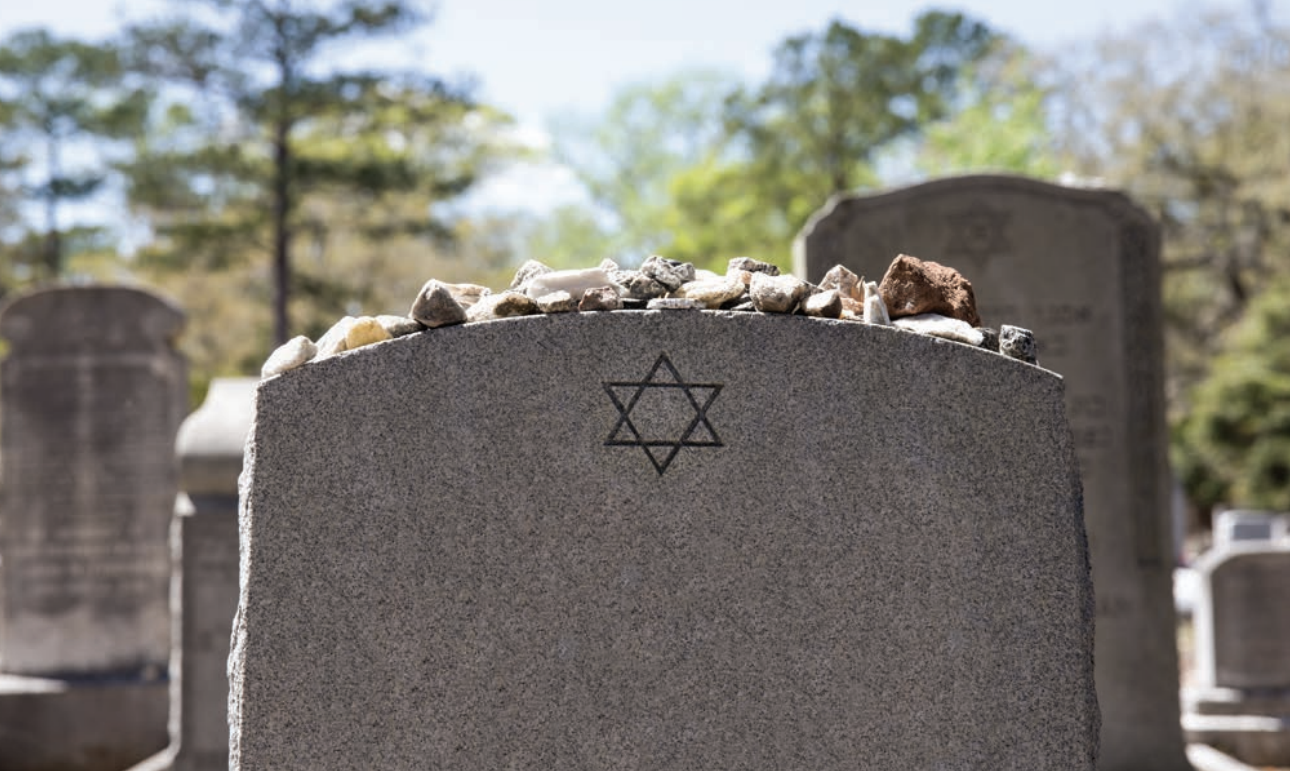
On each death anniversary (according to the Jewish lunar calendar), a day of remembrance is observed, often with a grave visit. When visiting graves, people leave small stones (lasting pieces of earth) and wash their hands when exiting the cemetery, symbolizing purification.
Note
The custom of leaving stones on graves, rather than flowers, has practical and symbolic significance. Stones are permanent, reflecting the eternal memory of the deceased, whereas flowers wither and die. Additionally, in ancient times, stones helped mark and protect graves from animals.
In Israel, burial on the Mount of Olives in Jerusalem is considered advantageous, as the dead buried there can greet the Messiah when he comes.
Summary
Key Stages of Jewish Mourning:
The structured mourning process reflects Judaism's understanding that grief must be acknowledged and processed:
- Aninut - Immediate period between death and burial (focus on preparation)
- Shiva - Seven days of intensive mourning (sitting low, community support)
- Shloshim - Thirty days of continued restrictions (gradual return to normalcy)
- Avelut - One year of remembrance (daily kaddish for eleven months)
- Yahrzeit - Annual commemoration (ongoing connection to the deceased)
Each stage provides a framework for gradually processing grief while maintaining connection to community and faith.
Significance of death and mourning practices
For the individual:
After a death, families carry out associated rituals - torn clothing, body preparation, aninut, shiva, shloshim, avelut, and yahrzeit. These actions recognize and show respect for the deceased. Families hope their deceased loved ones meet God in the afterlife and avoid sheol.
For the community:
The Chevra Kadisha performs crucial functions since touching dead bodies is prohibited. The mourning periods emphasize the Jewish family's importance and reaffirm communal belief and trust in God. Death becomes a communal celebration of life and an opportunity to care for bereaved families. The community supports mourners by providing meals, comfort, and forming the minyan during shiva to recite the kaddish.
Death in Judaism affects not just individuals but entire communities. As a community, it becomes a time to reaffirm faith in God and trust His provision and care. The rituals demonstrate these aspects of Jewish belief.
Marriage
Jewish beliefs about marriage
The Tanakh contains no explicit instruction about Jewish marriage procedures. Marriage is celebrated as essential in Judaism because "a man is incomplete without a wife.". While Genesis 2:24 provides the ideal, most practical instruction comes from the Talmud.
The Tanakh occasionally refers to Israel as God's Bride (Isaiah 62:5, Jeremiah 2:32ff), discussed particularly in the Book of Hosea. This eighth-century BCE prophet's life is seen as an enacted parable of unfaithful Israel - a metaphor suggesting the people of Israel were unfaithful as a bride could be unfaithful to her husband.
Note
The metaphor of Israel as God's bride is deeply significant in Jewish theology. It portrays the covenant relationship between God and Israel as intimate and personal, like a marriage, emphasizing both the commitment and the potential for betrayal when Israel turns to other gods.
Historical context of polygamy:
The Tanakh contains many examples of polygamous marriages (Abraham, Isaac, Jacob), but polygamy was rejected in most of the Jewish world around 1000 CE, largely due to Christian pressure. Some Jewish communities, particularly those from Muslim regions like Yemen, were offended by this Christian influence. While some organizations call for reintroducing polygamy as a valid Jewish option, no reputable rabbinic authority supports these calls.
Concept of bashert:
Many Jewish people believe in an ideal mate destined for each person, called a bashert (meaning 'destiny' or 'fate'). Generally, the marriage partner is accepted as one's bashert by definition. Some seek help in this process by engaging a shadchan (matchmaker). Rabbis sometimes perform this role, though professional shadchanim were historically employed by families to ensure successful matches.
Three ways to indicate marriage
According to the Mishnah (Kiddushin 1:1), couples may indicate marriage three ways:
- By money - Not purchasing a wife as property, but the exchange indicates willingness to give and receive. Historically, a copper coin called a perutah (of insignificant value) was sufficient. Today, this is expressed through giving a wedding ring before two witnesses. The ring must be owned by the husband and freely given as a gift. Usually, the wife knows the ring's value to prevent deception. In modern Judaism, especially Progressive Judaism, wives may give rings to husbands, though this is less common in Orthodox Judaism.
- By contract - The ketubah (marriage contract) is drawn up between the couple. Traditional ketubot spell out the husband's obligations to his wife, including child support and provision in case of death or divorce. Today, women might also obtain prenuptial agreements ensuring husbands will grant divorces if wives request them. Ketubot are often elaborate calligraphy works displayed during wedding ceremonies.
- By sexual intercourse - If two unmarried people sleep together, they may be considered married. This has always been discouraged in Jewish society, though modern contexts see cohabitation between Jewish men and women.
Important
The ketubah is not merely ceremonial - it is a legally binding document that protects women's rights in marriage. It specifies the husband's obligations, including financial support, and outlines the wife's entitlements in case of divorce or widowhood. This demonstrates Judaism's early recognition of the need for legal protections in marriage.
Two stages of Jewish marriage
Kiddushin (betrothal):
This stage is more binding than engagement - essentially an agreement to marry with specified terms and processes. While marriage has not yet occurred, the couple are considered committed and their personal status changed. In modern practice, this refers to drawing up the ketubah. Historically, there could be a long period between kiddushin and actual marriage (nisuin). Today, both stages typically occur together.
Nisuin (formal marriage):
This is the marriage process itself - the legal procedure where couples declare they are married and accept each other as partners. The couple themselves conduct the marriage, with the rabbi as adviser (performing a legal celebrant role), while two guests serve as witnesses. The husband and wife go home to begin their new family unit, completing the nisuin.
Note
Understanding that the couple themselves conduct the marriage ceremony, with the rabbi serving as an adviser rather than the one "marrying" them, reflects Judaism's emphasis on personal agency and responsibility. Marriage is not something done to the couple but something they actively choose and create together.
The wedding ceremony
The wedding ceremony combines cultural, religious, legal, and personal features. Typically, couples avoid seeing each other for some time before the ceremony (up to a week). Bride and groom often fast on the wedding day until the ceremony.
Celebrations may occur in synagogues, homes, or public venues. The marriage service generally includes these components (though order and number may vary):
- Bedecken - The bride is veiled (as Rebecca was before Isaac). The groom lifts the veil to confirm he is marrying the correct woman (unlike Jacob, who married Leah when presented with the wrong sister).
- Chuppah gathering - The groom stands under a chuppah (canopy). The bride approaches and circles him. Both then stand under the chuppah together, symbolizing their living together. The chuppah represents God's covering, and many Orthodox Jewish people prefer outdoor ceremonies under the open sky. Sometimes synagogue roofs can be opened for weddings. The chuppah also symbolizes the couple's new home.
- Initial blessings - Two blessings are recited over wine: one blessing the wine, another regarding marriage commandments.
- Ring ceremony - The groom places the ring on the bride's finger with the declaration: "You are consecrated to me with this ring according to the law of Moses and Israel."
- Ketubah reading - The marriage contract is read aloud.
- Sheva brakhot (seven blessings) - Recited under the chuppah with a minyan (10 adult Jewish people) present. The seven blessings state that God: created everything for His glory, made man, made man in His image, brings Zion joy with children, brings joy to bride and groom, created joy and gladness. A prayer for the wine (seventh blessing) is said, and bride and groom drink it.
- Breaking the glass - The groom smashes a glass underfoot, symbolizing the Temple's destruction in Jerusalem.
- Private time - Bride and groom spend quiet time together in a private room.
- Celebration - A celebratory meal (reception) is held, followed by repeating the sheva brakhot.
Important
The breaking of the glass at a Jewish wedding serves as a sobering reminder even during joyous celebration. It commemorates the destruction of the Temple in Jerusalem, ensuring that even in moments of personal happiness, Jewish people remember the suffering and loss experienced by their community throughout history.
Marriage expectations and divorce
Married couples are expected to enjoy happy lives together in marital harmony. Children are considered blessings. Divorce is permitted, though women cannot initiate divorce proceedings - one of the most contentious issues in Judaism today. A divorce document is called a get. Civil marriages are not allowed in Israel, and strict religious laws applied there have led to calls for greater flexibility.
Important
The inability of women to initiate divorce proceedings in Orthodox Judaism remains one of the most controversial issues in contemporary Jewish life. Women who cannot obtain a get from their husbands become "chained women" (agunot), unable to remarry. This has led to significant reform efforts, particularly in Progressive Judaism.
Marriage is so important that choosing celibacy is rare and discouraged, particularly for men. The Talmud suggests a person without a wife is incomplete and their life lacks vibrancy, joy, and peace.
Purposes of marriage:
- Companionship, love, and intimacy (Genesis 2:18 and 22-25)
- Procreation (considered a wonderful gift)
Marriage regulations:
Marriage is governed by strict purity laws followed closely in Orthodox Judaism. These complex laws relate to:
- Ritual impurity during menstruation
- Regulations for physical contact and ritual cleansing
- Modesty, physical contact, and being alone with strangers
The Torah lists prohibited relationships - people who cannot marry. Any children from such unions are considered illegitimate (manzerim). Orthodox Judaism generally refuses to accept intermarriage between Jewish and non-Jewish people, though Progressive Judaism is more accepting.
Significance of marriage
For the individual:
Marriage reflects commitment to one's partner, to God, and to faith. It fulfils the expectation of finding an ideal mate and bringing children into the world. It marks the beginning of a new family for companionship, love, intimacy, and procreation.
For the community:
Marriage reminds the community of vows made by other couples. It symbolizes the Jewish community's faithfulness to God (a type of marriage). Jewish society regards marriage and family as society's foundation and, through children, the Jewish faith's continuance. Marriage serves as the foundation and future of Jewish society.
Summary
Key Elements of Jewish Marriage:
Marriage in Judaism encompasses multiple dimensions:
- Spiritual significance - Reflects the covenant relationship between God and Israel
- Two-stage process - Kiddushin (betrothal) and Nisuin (formal marriage)
- Symbolic ceremony - Chuppah, ketubah, seven blessings, and breaking of glass
- Legal framework - Ketubah protects women's rights and specifies obligations
- Community importance - Ensures continuity of Jewish faith and traditions
Marriage is viewed as essential for completion and fulfillment in Jewish life, serving both individual and communal purposes.
Synagogue services
Beliefs about synagogues
Synagogue is a Greek word meaning 'meeting place'. Many Jewish people use the Yiddish word shul; the Hebrew term beit k'nesset is less common outside Israel. Synagogues have long been meeting places for Jewish people for prayer, study, and community gathering.
Historical development:
Synagogues probably began as worship places during the Babylonian exile when Jewish people could no longer worship at the Jerusalem Temple. As Jewish people returned from exile, synagogues remained community centres and teaching places even when the Temple was rebuilt. Many Jewish people remained in other countries (the diaspora), and synagogues became their worship centres. Archaeologists have uncovered many Second Temple period synagogues; some in northern Israel have ornate mosaic floors.
Note
The development of synagogues represents a remarkable adaptation in Jewish religious life. When the Temple was destroyed and Jewish people were dispersed, they created portable worship spaces that could exist anywhere there was a Jewish community. This innovation allowed Judaism to survive and thrive despite exile and diaspora.
When Romans destroyed the Second Temple in Jerusalem (70 CE), synagogues became centres for Jewish public worship worldwide as Jewish people experienced a second diaspora. Over the past 2000 years, the synagogue has remained the focus of Jewish life, originally as a Torah study place with design still conveying that purpose.
Three roles of the synagogue:
- Beit Tefilah (house of prayer) - Where daily and Shabbat services are held for learning and worship
- Beit Midrash (house of study) - Where schools are often established or Torah is studied
- Beit K'nesset (house of gathering and meeting) - Where Jewish people meet for various events and feel safe and secure
Inside the synagogue
Synagogues have significant architectural features indicating aspects of Jewish worship:
The ark:
At the building's end, facing Jerusalem, stands an elaborate compartment called the ark where Torah scrolls are kept. The congregation faces the ark - the holiest part of the synagogue, reminding worshippers of the Holy of Holies from the Jerusalem Temple.
The ner tamid:
An 'eternal' light (ner tamid) hangs before the ark, representing the eternal flame that continually burned in the Jerusalem Temple.
The bimah:
A reading desk holds scrolls when read, usually standing near the ark or in the synagogue's centre on a raised platform called a bimah.
Note
The positioning of the bimah varies between traditions. In many Ashkenazi synagogues, the bimah is placed in the center of the congregation, symbolizing that Torah is central to Jewish life. In other traditions, it may be placed near the ark at the front, creating a more unified worship space.
Decorations:
Synagogues contain no images, statues, or icons, especially no God representations, as this would contravene the Ten Commandments. Representations of the Ten Commandments are often placed near the ark, along with the menorah (seven-branched candlestick). Occasionally, religious motifs or lion depictions appear (symbolizing the tribe of Judah, origin of terms Jew and Judaism). Synagogues are treated with respect and kept clean and neat.
Important
The absence of images and statues in synagogues is a fundamental expression of the Second Commandment's prohibition against graven images. This aniconic tradition distinguishes Jewish worship from many other religious practices and emphasizes the transcendent, non-physical nature of God.
Torah scrolls:
One key worship element is reading the Torah. Torah scrolls are made of special parchment, written with special quills, and covered with ornate velvet or silk fabric (Ashkenazi tradition) or enclosed in ornate metal cases, usually silver (Sephardi tradition). These ornate coverings remind worshippers of ornate robes worn by Temple priests.
Synagogue services structure
The synagogue service primarily emphasizes gathering people. While homes are equally valid worship places, synagogues gather entire Jewish communities together.
Service frequency:
Three synagogue services occur daily during the week, with a fourth on Shabbat and special festival occasions. While services vary in order and content, Torah reading takes primary place on Mondays, Thursdays, and Shabbat, supported by prayers and Psalms (sung during services from the Tanakh book). Orthodox Jewish people are more traditional in conducting synagogue services; Conservative and Progressive Judaism services are more innovative.
Minyan requirement:
Services can only begin with a minyan (10 Jewish people; in Orthodox contexts, 10 men) present. Each person follows the service in a Siddur (prayer book) as the rabbi, cantor, or congregation member leads.
Service components:
Services begin with blessings Jewish people say each morning expressing thanks, followed by blessings thanking God for the Torah, sight, clothing, and provision of needs. The Shema is said, then the congregation stands to say the Amidah - the prayer of 18 blessings containing prayers of praise, requests, and thanksgiving.
The Torah scroll is taken from the ark to the bimah and a portion read. Being asked to read from the Torah is a privilege; in Orthodox synagogues, only men do so. A special passage from another Tanakh part, called the haftarah, is also read. Several more blessings are said, and often the Torah scroll is carried through the synagogue and returned to the ark. A sermon usually follows based on the Torah section read, often including law explanation or commentary.
Services also include singing, prayers, and blessings. Many variations exist in Shabbat liturgy, especially between Jewish variants. The emphasis in Jewish worship is avodah sh'belev (worship of the heart), and services can continue for several hours.
Note
The concept of avodah sh'belev (worship of the heart) emphasizes that true worship comes from sincere devotion and intention, not merely from ritual actions. This principle transformed Jewish worship after the Temple's destruction, shifting focus from sacrificial offerings to prayer and study as primary forms of worship.
Worship garments:
During services, men wear:
- Yarmulke (or kippah, skull cap) - head covering worn in synagogues or at worship, reminding wearers there is a God above. Many Jewish men wear yarmulkes constantly.
- Tallit (prayer shawl) - referenced in Numbers 15:37 and Deuteronomy 22:12
- Tefillin (weekday mornings only, not Shabbat) - black leather boxes containing Torah verses including the Shema (Deuteronomy 6:4-9), wrapped by leather straps on forehead and upper arm in obedience to Deuteronomy 6:8
In Progressive Judaism, women may also wear these items.
Gender arrangements:
In Orthodox services, no musical instruments are played, and a cantor leads congregation prayers and singing. Men sit in areas closest to the bimah while women sit separately. Progressive Judaism makes no such distinction and allows women to read Torah and become rabbis. Some innovative Orthodox communities are giving women greater roles in synagogue services.
Walking to synagogue:
Many Jewish people walk to synagogues on Shabbat and other holidays (if close enough) to avoid breaking work prohibitions.
Significance of synagogue services
For the individual:
Individuals participate in synagogue services to learn, worship, and express personal faith. Services provide learning opportunities to develop godly lives. Services express one's Jewish life and provide time to focus on worshipping God.
For the community:
The Jewish community gathers in worship and community. Synagogues can be places of education and meeting as well as worship. Synagogue is central to Jewish community life, signified in prayers using 'we' rather than 'I'.
Note
The use of collective language in Jewish prayers ("we" rather than "I") reflects the communal nature of Jewish worship. Even private prayers are often framed in terms of the community, emphasizing that individuals are part of a larger whole and that worship is a collective responsibility and privilege.
Summary
Key Points to Remember:
Death and Mourning:
- Practices show respect for the deceased (kavod ha-met) and comfort the living (nihum avelim)
- Clearly defined stages: aninut, shiva, shloshim, avelut, yahrzeit
- Community support is essential - providing meals, forming minyan, and offering comfort
- Emphasis on life, not death - even the kaddish praises God without mentioning death
Marriage:
- Essential for completeness in Jewish life
- Two stages: kiddushin (betrothal) and nisuin (formal marriage)
- Rich symbolism: chuppah, ketubah, sheva brakhot, breaking of glass
- Serves both individual fulfillment and community continuity
Synagogue Services:
- Centre on Torah reading and communal prayer
- Three roles: Beit Tefilah (house of prayer), Beit Midrash (house of study), Beit K'nesset (house of gathering)
- Key features: ark, ner tamid, bimah, Torah scrolls
- Emphasis on avodah sh'belev (worship of the heart)
Overarching Themes:
- All three practices emphasize both individual commitment to God and the central importance of community
- Each practice connects adherents to Jewish tradition, sacred texts, and the covenant relationship with God
- Community involvement is essential - Judaism is lived in community, not isolation
Key terms to remember:
Kaddish, Sheol, Chevra Kadisha, Ketubah, Chuppah, Sheva Brakhot, Bashert, Synagogue, Ark, Ner Tamid, Bimah, Minyan, Tallit, Tefillin, Yarmulke