The Diversity of Contemporary Aboriginal Spiritualities (HSC SSCE Studies of Religion): Revision Notes
📚Revision Notes
The Diversity of Contemporary Aboriginal Spiritualities
The Dreaming and Aboriginal peoples' spiritualities
The Dreaming continues to have significant influence on Aboriginal and Torres Strait Islander peoples today, despite many having converted to Western religious traditions. Aboriginal spirituality remains deeply connected to the land, with Dreaming stories reflecting this fundamental relationship.
Modern Christian congregations have become more accepting of Aboriginal spirituality, viewing the interaction between traditions as contextualisation rather than syncretism. Contextualisation allows religious traditions to be expressed within their cultural context, while syncretism involves combining different religions to create new systems.
Note
The distinction between contextualisation and syncretism is crucial for understanding how Aboriginal spirituality can coexist with Western religious traditions. Contextualisation preserves the integrity of both traditions, while syncretism creates something entirely new.
Core elements of Aboriginal spirituality
Aboriginal spirituality encompasses several interconnected dimensions:
- Creation worldview: Dreaming stories explain not only how the world was created but also the connection between land and ancestor spirits
- Responsibility framework: These stories outline individual and community obligations
- Land connection: The spirituality is inextricably linked to specific geographical locations
- Temporal nature: The Dreaming transcends past, present and future
- Communication methods: Expressed through art, song, dance, ritual and kinship
Regional specificity of Dreaming stories
Each region and landscape has its own unique Dreaming stories. Regular ceremonies enact these sacred narratives specific to particular areas. The stories are almost meaningless when removed from their geographical context, which explains why dispossession from traditional lands had such devastating effects on Aboriginal religions and cultures.
The basic structure of Dreaming stories follows a pattern where physical features (land, rocks, waterholes) exist, and a story explains how an ancestor spirit transformed that land. These stories are not simply told but performed, and they contain all the knowledge needed to live successfully in that place. Before walking onto someone else's land, one must know the story of that land.
Important
Why Dispossession Was So Devastating
The geographical specificity of Dreaming stories means that when Aboriginal peoples were forced from their traditional lands, they lost not just physical territory but the very stories and spiritual knowledge that gave meaning to their existence. Without access to the land, the stories could not be properly understood, performed, or transmitted to future generations.
Impact of forced displacement
Forced movements and dispossession created a profound sense of loss that pervades Aboriginal spiritualities, particularly for those who settled in urban environments. The disconnection from traditional lands meant the loss of:
- Access to sacred sites
- Ability to perform land-based ceremonies
- Connection to ancestor spirits
- Cultural knowledge and Dreaming stories
- Totemic responsibilities
- Sense of identity
Kinship
Traditional Aboriginal and Torres Strait Islander cultures centre on complex notions of kinship. These kinship laws determine all forms of social interaction, including marriage, group meetings, sports and trade.
Structure of kinship systems
Kinship operates at multiple levels:
Language groups: Before colonisation, hundreds of separate languages existed, determining specific groups. Most Aboriginal and Torres Strait Islander peoples knew multiple languages but always identified themselves through their original group's language.
Clans: Within language groups, clans exist based on family groupings.
Moieties (skin groups): Within clans, there are further divisions into skin groups or moieties. These create obligations within social networks to care for others in times of need.
Note
The layered structure of kinship systems—from language groups to clans to moieties—creates a complex web of relationships and obligations. This intricate social organization governed every aspect of traditional Aboriginal life, from daily interactions to ceremonial responsibilities.
Functions of kinship
Kinship laws determine:
- How a person relates to others in the community
- How they belong to the community
- Their responsibilities within the community
- Connections to the Dreaming, totems and ancestor spirits
Ceremonial life
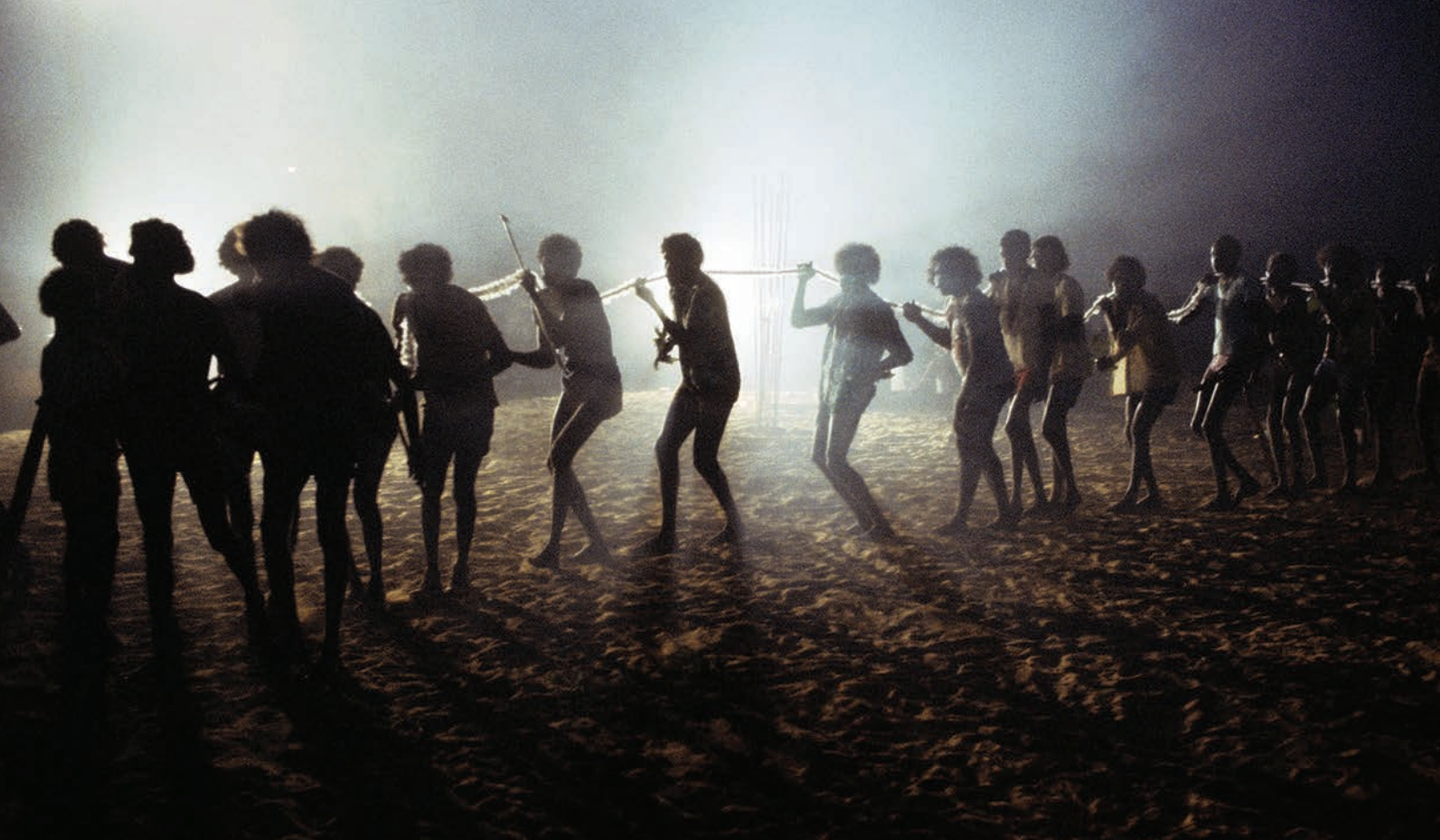
The term corroboree derives from one of the Aboriginal words for rituals (carriberrie) and indicates a ceremony. These ceremonies serve multiple functions within Aboriginal cultures.
Types of ceremonies
Dreaming ceremonies: Often centre on retellings of Dreaming stories through singing, dancing, music and mime. Performers' bodies are decorated to represent the spirits they portray.
Initiation ceremonies: Mark various life stages, particularly the transition to adulthood. A typical rite of passage includes:
- Testing of strength
- Revelation of special knowledge
- Removal of the child from the mother
- Seclusion period
- Giving of a new name or sacred object
- Time of survival in the wild
Balance rites: Rituals designed to bring about harmony in nature.
Death and burial rituals: These can be very elaborate. Death marks when the spirit leaves the body and returns to the ancestor spirits. Particular rituals encourage the spirit on its journey. Methods include cremation, burial or exposure, and in some areas, erection of elaborately decorated poles. Strict taboos associate with death rituals, reflected in television warnings about deceased persons being mentioned or pictured.
Example
Ceremonial Example: Initiation Rites
A young person undergoing initiation might experience:
Step 1: Separation - The initiate is removed from their family, particularly their mother, marking the end of childhood.
Step 2: Testing - Physical and mental challenges test strength, courage, and knowledge of tribal lore.
Step 3: Revelation - Secret knowledge about the Dreaming, sacred sites, and ceremonial responsibilities is revealed by elders.
Step 4: Transformation - The initiate receives a new name or sacred object, symbolizing their new status as an adult member of the community.
Step 5: Reintegration - After a period of survival in the wild, the initiate returns to the community with their new identity and responsibilities.
Obligations to the land and people
Aboriginal and Torres Strait Islander peoples have heavy individual obligations to both land and community. These obligations are interconnected through kinship and ceremonial life.
Network of obligations
Kinship laws create a complex network of dependence and support extending beyond family groups. Ceremonial lives refocus these interpersonal connections, with the togetherness of the group emphasised through ceremonial actions determined by Dreaming stories.
Land custodianship
Each Aboriginal group connects to the land they inhabit, for which they are custodians. This land is called their 'country' or ritual estate. The protection and custodianship of that land becomes integral to individual life and group culture. Because the land contains ancestor spirits, responsibility to care for and nurture it is taken very seriously. Aboriginal identity is closely linked to land - it is through the land that the Dreaming is lived and communicated.
Note
The concept of land custodianship differs fundamentally from European notions of land ownership. Aboriginal peoples see themselves not as owners who possess land, but as caretakers who have a sacred responsibility to protect and maintain it for future generations and for the ancestor spirits who dwell within it.
Implications of dispossession
As European settlement spread, many Aboriginal and Torres Strait Islander peoples were forced from their traditional lands. Throughout the nineteenth century, white Australians believed Aboriginal peoples would eventually die out or must be assimilated into white society to survive.
Terra nullius doctrine
Colonial Australians began dispossession through the empty land theory: terra nullius - a legal concept claiming the land was not owned by anyone when white settlers arrived. In popular thinking, Aboriginal peoples were considered racially inferior to Europeans, so their attitudes to land were dismissed.
Important
The Terra Nullius Myth
The doctrine of terra nullius was not just a legal technicality—it was a fundamental denial of Aboriginal peoples' existence, culture, and connection to the land. By declaring Australia "empty land," European colonizers justified theft of territory and destruction of cultures that had existed for over 65,000 years.
Factors contributing to cultural destruction
Several factors aided the destruction of Aboriginal worlds:
- Introduction of livestock
- Misuse of the original environment
- Diseases introduced by colonialists
- Removal of children of mixed heritage (once called 'half-caste' - now an offensive term) into state orphanages or foster care
Over time, the connection between Aboriginal peoples and land was broken through:
- Loss of language
- Loss of Dreaming stories
- Loss of totemic responsibilities
- Loss of identity communicated between community and land
Role of Christian missions
Christian missionaries sought to convert Aboriginal peoples, contributing to both breakdown and survival of culture. While missions contributed to language and culture loss, they paradoxically:
- Provided places where people could meet
- Documented and preserved elements of traditional culture
- Took on advocacy roles for Aboriginal rights
- Provided protection from some excesses of the white community
However, missions and protection policies did lead to dispossession and affected spiritual expression, primarily through separation from land and kinship groups.
Separation from the land
Land is intrinsic to Aboriginal and Torres Strait Islander peoples. The relationship between land and people is deeply symbiotic - people have responsibility to care for land through management, rituals and other actions that preserve it, and in return the land sustains them. This differs fundamentally from European concepts of land ownership.
Legal and political dispossession
By 1945, several major factors had resulted in removal of most Aboriginal peoples from their lands, especially when that land had economic value for white settlers:
- The terra nullius doctrine held that Australia belonged to no one when British arrived, making occupation and ownership legal
- Governments reclaimed reserve land and established control over people living on reserves
- Introduction of protectionism policies, supposedly to protect Aboriginal peoples but primarily to isolate them from land and communities
Traumatic effects of land separation
Separation from land meant:
- Unable to access food from the land
- Cultural practices and ceremonies associated with land could not be carried out
- Could not draw effectively on spiritual power of Dreaming and ancestor spirits
- Restricted access to sacred sites
- Loss of tribal lore and law
Important
The Spiritual Dimension of Land Loss
Land separation was not merely an economic or social problem—it was a spiritual catastrophe. Aboriginal spirituality is inseparable from the land. Without access to country, ceremonies could not be performed, Dreaming stories lost their meaning, and the connection to ancestor spirits was severed. This spiritual disconnection contributed to profound psychological trauma that continues to affect Aboriginal communities today.
Separation from kinship groups
Dispossession broke up Aboriginal nations and disturbed religious and cultural beliefs and practices. Many languages were lost or severely restricted. Ceremonies related to kinship were not enacted and were lost. The place and role of tribal elders were undermined, and cultural information regarding kinship obligations and taboos was lost.
Aboriginal peoples lost their sense of identity and belonging, not only to land but also to each other. This psychological effect was not perceived by most Europeans, who did not understand the deep cultural attachment to land and support networks of kinship groups.
The policy aimed to assimilate Aboriginal peoples, especially children, into dominant white culture, notably through separation of children from families, resulting in the Stolen Generations.
The Stolen Generations
The Stolen Generations refers to Aboriginal and Torres Strait Islander children, including those of mixed heritage, who were removed from their families to be cared for in missions, institutions (such as the Cootamundra Aboriginal Girls' Training Home), or fostered with white families.
Stated aims versus reality
The stated aims were to:
- Protect children from perceived abuses in their communities
- Ensure good education
- Help them assimilate into Western society
Given the high numbers of children removed, it is difficult to believe all had been in harmful family environments. The extent of actual neglect or abuse is difficult to prove.
Note
The sheer scale of child removal—estimates suggest between 1 in 3 and 1 in 10 Aboriginal children were removed between 1910 and 1970—raises serious questions about whether protection was truly the primary motive. Many historians now argue that the removals were part of a deliberate policy of cultural genocide.
Cultural impact
One of the greatest ongoing effects is the loss of Aboriginal cultures. As predominantly oral cultures, removing a generation from cultural transmission meant far fewer children received their complete cultural heritage. Instead, they were integrated to various extents into European culture. Today, many Aboriginal people have lost touch with specific knowledge and culture of their communities, feeling this loss deeply.
Bringing Them Home report (1997)
The National Inquiry into the Separation of Aboriginal and Torres Strait Islander Children from Their Families began in 1995 and published its report, Bringing Them Home, in 1997. The report was based on stories of Aboriginal children who had been forcibly separated from families and lost their language, culture, identity, links with land and thus their spirituality. In many cases, they never saw family members again.
Controversially, the report concluded that genocide had taken place. While removal was primarily a government initiative, Christian churches acknowledged complicity and have sought ways of repairing the damage done.
The apology (2008)
The Bringing Them Home report recommended an official Commonwealth Government apology to the Stolen Generations. Throughout the late 1990s, the Howard Liberal government chose not to deliver this apology, with Prime Minister John Howard believing that despite wrong actions, those who took Aboriginal children had right intentions.
One of the first acts by the Rudd Labor government, elected in 2007, was issuing the Apology to the Stolen Generations. On 13 February 2008, Prime Minister Kevin Rudd delivered this historic apology, acknowledging:
- The honour owed to Indigenous peoples as the oldest continuing cultures in human history
- Reflection on past mistreatment, particularly the Stolen Generations
- Apology for laws and policies inflicting profound grief, suffering and loss
- Specific apology for removal of Aboriginal and Torres Strait Islander children from families, communities and country
- Acknowledgment of pain, suffering and hurt of Stolen Generations, their descendants and families left behind
Important
The Significance of the 2008 Apology
The apology was a watershed moment in Australian history. It represented official government recognition of past wrongs and validated the pain and suffering of the Stolen Generations. While symbolic rather than providing material compensation, it was a crucial step toward reconciliation and healing. Many Stolen Generations survivors described feeling that their experiences were finally acknowledged and believed.
Continuing effects of dispossession
As time progressed, dispossession effects became evident in many aspects of Aboriginal community life:
- Health problems (kidney disease, loss of eyesight)
- Higher suicide rates
- Higher rates of incarceration
- Drug and alcohol problems
- Lack of education opportunities
- Inadequate housing
- Limited access to community services
- Profound sense of despair
Aboriginal and Torres Strait Islander peoples have been severely affected by dispossession, and by government policies, attitudes and lack of understanding that facilitated it.
Land rights movement
The land rights movement connects closely to Aboriginal rights generally and to spirituality particularly. Reclaiming land means reconnecting with cultures and Dreaming stories (if not already completely lost).
Historical resistance
There has long been resistance to European land takeover, including:
- Efforts of warriors (e.g., Wyndradyne in Bathurst area)
- Protests in 1938 at Australian sesquicentenary (150-year anniversary)
Wave Hill Station strike (1966-1975)
One of the most significant actions was the strike at Wave Hill Station in the Northern Territory. The station was owned by British company Vestys. The Gurindji people experienced:
- Being locked out of waterholes
- Kangaroos (their staple diet) being killed
- Working as stockmen and domestic help for cheap labour
The strike began in 1966 over pay but was evidently a demand for access to their land. It galvanised efforts to address land rights. In 1975, the Australian Government negotiated with Vestys to return a portion of land to the Gurindji people.
Example
Historical Example: The Wave Hill Station Strike
The Wave Hill strike demonstrates how land rights activism evolved from labor disputes to broader claims for justice:
Initial Catalyst (1966): Gurindji stockmen walked off the job demanding fair wages—they were paid far less than white workers for the same work.
Deeper Motivation: The strike quickly revealed its true nature as a land rights claim. The Gurindji were fighting not just for fair pay, but for their traditional country.
Duration and Persistence: The strike lasted nine years, demonstrating the Gurindji people's determination to reclaim their land.
Symbolic Victory (1975): When Prime Minister Gough Whitlam poured soil into Vincent Lingiari's hands, it became one of the most iconic moments in Australian land rights history, symbolizing the return of land to its traditional custodians.
The 1967 referendum
The 1967 referendum was a very important step in the movement for equality. On 27 May 1967, Australians voted on two questions:
Question 1 - Section 127 of the Constitution: Originally stated that in census population calculations, 'Aboriginal natives shall not be counted'. The referendum asked to overturn this so Aboriginal people would be counted in the census.
Question 2 - Section 51 of the Constitution: Originally stated the Commonwealth Government could pass laws about 'the people of any race other than the Aboriginal race in any state'. The referendum asked to overturn this so the Commonwealth would have power to make laws regarding Aboriginal peoples.
Key clarifications
The referendum was not about:
- Making Aboriginal peoples citizens (gained in 1961, as announced by Minister for Territories Paul Hasluck)
- Giving them the vote (received in federal elections in 1962)
Note
Common Misconceptions About the 1967 Referendum
Many Australians mistakenly believe the referendum granted citizenship or voting rights to Aboriginal peoples. In fact, these rights had already been granted in the early 1960s. The referendum's true significance lay in removing discriminatory clauses from the Constitution and giving the Commonwealth power to make laws for Aboriginal peoples, enabling national rather than just state-based policy.
Results
There was overwhelming support across the country. The 'yes' vote was supported by both the Holt Liberal government and Labor Party. Both questions were accepted by more than 90 per cent of Australian people and by every state and territory. It was a significant moral victory and one of the few successful referenda in Australia.
Native title
Since the 1970s, Aboriginal land rights has been significant in national politics, often misunderstood and causing sharp divisions among Australians.
Historical context
When European nations settled lands outside Europe, they usually signed treaties with original inhabitants (e.g., Treaty of Waitangi 1840 with Maori in New Zealand, treaties with Native American tribes). Treaties were often one-sided, but the principle of prior ownership was acknowledged.
If uninhabited land was discovered, it was declared terra nullius. Captain James Cook declared this when landing in eastern Australia in 1770, and Captain Arthur Phillip accepted the idea in 1788. They believed there were very few Aboriginal people, meaning they felt no treaty had to be signed.
Key developments
1963 - Yirrkala bark petition: The Yirrkala people from Gove Peninsula in Northern Territory sent a petition written on bark to Commonwealth Parliament, protesting being driven off their land for bauxite mining by Nabalco company. The petition failed as the Northern Territory Supreme Court confirmed terra nullius and argued the Yirrkala people had no special claim.
1972 - Aboriginal Tent Embassy: Set up on lawns in front of Parliament House, highlighting both claims for land rights and awful living conditions. It was a statement that Aboriginal peoples were aliens in their own land, receiving international attention. The Aboriginal flag was raised at this time.
1974 - Woodward Royal Commission: Delivered its report on Aboriginal land rights in federal territory.
1975 - Whitlam's gesture: Prime Minister Gough Whitlam travelled to Northern Territory and handed over to Vincent Lingiari and Gurindji people some land they had been denied in court (recall Wave Hill Station strike). Whitlam symbolically poured soil into Lingiari's hands.
1976 - Aboriginal Land Rights Act: Passed by Fraser government. Aboriginal peoples could now claim Crown land not being used by other people. An Aboriginal Lands Council was established to control this land.
1985 - Uluru ownership: Aboriginal peoples were handed ownership of Uluru.
State responses
During the 1980s, state governments moved on land rights. Western Australia and Queensland were largely unsympathetic, more concerned about maintaining rights of mining companies and pastoralists. Most Australian states opposed native title. Little was actually achieved in recognising land rights.
The Mabo case
Native title is a legal term recognising Aboriginal and Torres Strait Islander peoples' rights to use and occupy lands with which they have maintained a continuing, traditional connection.
Case background
In the 1970s, the Queensland Government began removing rights of Murray (Mer) Island people in Torres Strait. Eddie Mabo, one of the Meriam people, took the Queensland Government to court to stop this. He lost the case. The decision was appealed, eventually reaching the High Court of Australia in Canberra.
The 1992 decision
The High Court decided in favour of Meriam people and recognised the principle of native title (sadly, Eddie Mabo had died by this time). The 1992 Mabo decision was extremely important. By accepting native title, the notion of terra nullius was overturned.
Important
The Revolutionary Nature of the Mabo Decision
The Mabo decision fundamentally changed Australian law and national consciousness. For over 200 years, Australian law had been built on the false premise that the land belonged to no one before European arrival. The High Court's recognition of native title acknowledged that Aboriginal and Torres Strait Islander peoples had legally recognizable rights to land based on their continuous connection to it since before colonization. This overturned centuries of legal fiction and opened the door for Aboriginal peoples to reclaim their traditional lands.
The court decision stated that native title to land had existed before European settler arrival. The High Court affirmed that Native Title had not been extinguished on land where:
- It was not 'alienated by statute' (had not been sold or bought)
- The people had had an ongoing relationship with land since European settlement
Native Title Act 1993
In 1993, the Native Title Act was passed by the Australian government to codify the High Court Mabo decision. This Act accepted native title in law and recognised rights of freehold property owners. Nevertheless, pastoralists and miners remained concerned. Many leased property from government. Could Aboriginal peoples claim native title over these lands? The new law caused enormous insecurity.
The Wik case
This issue was addressed by the Wik decision of 1996. The High Court argued that native title could coexist with leaseholders' rights, although the leaseholder's title took priority where there was a conflict of interest.
However, pastoralists and mining companies who leased lands remained concerned that the court favoured native title too much. This led to the Native Title (Amendment) Act 1998 (sometimes called 'the 10-point plan') passed by Howard's Liberal government.
This Act stated that native title and leasehold rights could coexist but that, in any conflict of interest, leaseholders' rights would come first. This act returned some power to state governments who could extinguish native title in the national interest.
Note
The Wik decision and subsequent amendments reflect the ongoing tension between recognizing Aboriginal land rights and protecting the interests of pastoralists and mining companies. While the Wik decision was seen as a victory for Aboriginal peoples, the 1998 amendments significantly diluted its impact by prioritizing leaseholders' rights.
The importance of the Dreaming for land rights
The Dreaming is essential for Aboriginal and Torres Strait Islander peoples and their expression of spirituality. Similarly, land is essential for the Dreaming. They are inexorably linked. Thus, land rights build upon concepts of the Dreaming and are essential for its expression.
One of the major aims of the land rights movement is to allow for proper expression of the Dreaming. Land rights are important to the Dreaming as they:
- Allow for expression of rituals and ceremonies
- Identify sites that are part of the country of the people
- Maintain links to totems, language and ancestor spirits
- Address issues related to health, wellbeing, relationships and sense of identity that arose from land loss
The symbiotic relationship between Aboriginal peoples and land means that people have responsibility to care for land through management, rituals and other actions that preserve and maintain it, and in return the land sustains them. This differs fundamentally from European concepts of land ownership.
Important
Why Land Rights Are Spiritual Rights
For Aboriginal and Torres Strait Islander peoples, the fight for land rights is not merely about property ownership or economic opportunity—it is fundamentally about spiritual survival. Without access to country, the Dreaming cannot be properly expressed, ceremonies cannot be performed, and the connection to ancestor spirits is broken. Land rights enable the continuation of spiritual practices that have sustained Aboriginal cultures for over 65,000 years.
Remember!
Summary
Key Points to Remember:
-
The Dreaming is central to Aboriginal spirituality: It is inextricably connected to land, transcends time, and is communicated through art, song, dance, ritual and kinship
-
Kinship structures determine social relationships: Complex systems based on language groups, clans and moieties govern all aspects of Aboriginal social life
-
Dispossession had devastating effects: Separation from land and kinship groups through terra nullius, forced removals and the Stolen Generations caused profound loss of culture, identity and spirituality
-
Land rights movement achieved significant milestones: The 1967 referendum, Mabo case (1992) and Wik case (1996) overturned terra nullius and established native title, though challenges remain
-
The 2008 apology recognised past wrongs: Prime Minister Kevin Rudd's apology to the Stolen Generations acknowledged the pain and suffering caused by government policies of forced removal
-
Land and spirituality are inseparable: For Aboriginal peoples, land rights are not just about property but about maintaining spiritual connections, performing ceremonies, and preserving cultural identity for future generations