Shinto (HSC SSCE Studies of Religion): Revision Notes
📚Revision Notes
Shinto
Introduction to Shinto
Shinto is the indigenous religion of Japan, distinct from Buddhism and Confucianism which arrived from China. The term "Shinto" translates as "way of the Kami," where kami refers to gods or spirits. This ancient tradition centres on the worship of kami—spiritual beings involved in creating and maintaining Japan and its people.
Note
Unlike many world religions, Shinto has no single founder, no sacred scriptures, and few formal doctrines. Instead, it expresses itself through mythology, ritual practices, and cultural sensibilities focused on nature, harmony, balance, sincerity, virtue, and purity.
Historical timeline
Understanding Shinto's development requires knowledge of key historical moments:
Early period (250-1549 CE)
- 250 CE: The Shinto shrine of Naiku was established
- 550 CE: The term "Shinto" was introduced to distinguish the native religion from Buddhism and Confucianism
- 1549 CE: Catholic missionary Francis Xavier arrived in Japan
Edo period (1614-1790 CE)
- 1614 CE: The Tokugawa shogunate banned Christianity from Japan
- 1790 CE: Neo-Confucianism became the official state philosophy
Meiji restoration and state Shinto (1868-1945 CE)
- 1868 CE: The capital moved to Edo (renamed Tokyo) and Emperor Meiji was restored. His divine status was re-emphasised, Shinto became the official state religion (known as "State Shinto"), and was used to justify Japanese military expansion
- 1894 CE: Japan invaded China (First Sino-Japanese War)
- 1905 CE: Japan destroyed the Russian naval fleet at the Battle of Tsushima Straits
- 1940 CE: Japan signed the Axis pact with Italy and Germany
- 1941 CE: Japan attacked the US fleet at Pearl Harbor
- 1945 CE: Emperor Hirohito surrendered after atomic bombs were dropped on Hiroshima and Nagasaki. State Shinto was dismantled
Important
The State Shinto period (1868-1945) represents a dramatic transformation of Shinto from a traditional religion into a state ideology used to justify military expansion and nationalism. This period ended with Japan's defeat in World War II, after which Shinto was dismantled as a state institution.
Post-war period (1960 CE onwards)
- 1960 CE: Japan experienced enormous economic growth, becoming the world's second economic power after America
Core beliefs and concepts
The nature of kami
Kami are the central focus of Shinto worship. These spiritual beings can be:
- Benevolent or malevolent
- Kind or wrathful
- Associated with natural features, phenomena, or places
- Invisible but powerful presences
Kami are believed to have created the Japanese islands and pervade the land at every level. Different regions have their own kami, recognised in specific parts of the landscape:
Example
Regional Kami Examples:
- Yama-no-kami: Mountain deities who watch over mountainous regions
- Tano-kami: Field deities associated with agriculture and farmland
- Umi-no-kami: Sea deities connected to oceans and maritime activities
Each type of kami has specific duties related to their domain, and communities worship the kami most relevant to their geographical location and way of life.
Until recently, the Emperor of Japan, his ancestors, and outstanding Japanese heroes were all considered kami rather than human beings.
Animism and spiritual presence
Shinto can be described as a form of animism—a worldview where the entire environment is alive with spirits. Both impressive natural features (like Mount Fuji or the sun) and small everyday objects (like paper sheets or silk bolts) can have kami associated with them.
Note
This belief explains traditional Japanese arts like kimono folding and origami. Since cutting might disturb the kami within these materials, folding became the preferred method of shaping them. The concept of a thing having a presence or inspiring awe connects to the spirit of the kami.
Human nature and ethics
In Shinto understanding:
- Human beings are inherently good
- Evil is caused by evil spirits, not human nature
- There are no absolute moral rules or commandments
- Ethical behaviour emerges from sensibilities rather than theology
- Life should be lived according to personal guiding principles
Origins and creation mythology
Ancient texts
Two ancient Japanese texts contain the creation stories of Shinto:
- Kojiki (Record of Ancient Things) – 712 CE
- Nihongi (Chronicles of Japan) – 720 CE
The creation narrative
The primordial couple, Izanagi-no-Mikoto (male) and Izanami-no-Mikoto (female, also his sister), are associated with Japan's creation. They descended from heaven and gave birth to:
- The Japanese islands
- Various kami, most importantly Amaterasu, the sun goddess
Amaterasu's grandson, Ninigi-no-Mikoto, married the kami of Mount Fuji. Their great-grandson, Jimmu, became Japan's first emperor. This lineage means the Japanese imperial family are understood as descendants of the sun goddess herself.
Teachings within the myths
The creation myths reveal important cultural values:
Gender relations: When Izanagi and Izanami first met, Izanami (the woman) spoke first. This proved unacceptable to Izanagi. They separated and met again, with Izanagi speaking first on the second meeting. This narrative has been interpreted to suggest women should follow men's lead, though this interpretation comes from the myth rather than explicit doctrine.
Note
Death and purification: When Izanami gave birth to Kagi-Tsuchi, the kami of fire, she was burnt and died. Izanagi sought her in Yomi-no-Kuni, the land of the dead—a filthy, lightless realm. When he found her, she was rotting with worms inside her body. Izanagi fled from Yomi and bathed in ocean salt water to cleanse himself of death's pollution.
This myth explains Japanese attitudes toward death and cleanliness. Death is seen as polluting, and salt with washing are used in Japanese rituals to cleanse houses and spaces, ensuring purity from uncontrollable chaotic events like death.
Kami and supernatural elements
Types and characteristics of kami
Kami do not remain stationary at their places of worship but move around. Each kami has a duty associated with the place they inhabit. The variety of kami is vast:
- Powerful kami associated with major features (mountains, sun, fire)
- Lesser kami connected to everyday objects
- Regional and local kami
- Ancestral kami
Worship locations
Shinto shrines serve dual purposes:
- Places of worship
- Homes for the kami
These sacred spaces are where practitioners connect with the spiritual forces that created and maintain Japan.
Rituals and worship
Shinto rituals operate at three distinct levels, each serving different community needs.
Household level: Jinja Shinto
Homes contain a Shinto shrine called a kamidana (kami shelf). This domestic shrine typically takes the form of a mirror covered by a door. The mirror connects to the mythology of Ninigi-no-Mikoto, who received a mirror from his grandmother, the sun goddess Amaterasu.
At the household level, Shinto functions as a way for families to worship their ancestors. The most important domestic rituals occur during Shogatsu (Japanese New Year), when Toshigami, the year god, is believed to visit every home.
Local level: Minzoku Shinto
Local shrines house regional kami and serve as gathering places for communities. These shrines enable:
- Regional kami worship
- Community bonding
- Affirmation of group identity
- Local festivals and celebrations
Note
Local communities and other groups can affirm their togetherness in the presence of their local kami, strengthening social bonds and reinforcing shared cultural identity.
National level: Koshitsu Shinto
National shrines dedicated to the imperial family help Japan celebrate its unity as a nation. The most important national shrine is the Inner Shrine, Naiku, of the Ise Grand Shrine. This building demonstrates Shinto's commitment to renewal—it is dismantled and rebuilt on an adjacent empty lot every 20 years.
Example
The Kanname Festival:
The Ise shrine is dedicated to Amaterasu, the sun goddess. The most significant ritual performed here is the Kanname festival, where the year's first harvested crops are dedicated to the sun goddess.
This ceremony embodies the connection between:
- The imperial family (descended from Amaterasu)
- The agricultural cycle
- The spiritual sustenance provided by the sun
- The gratitude of the Japanese people to their divine ancestor
Shrine architecture and access
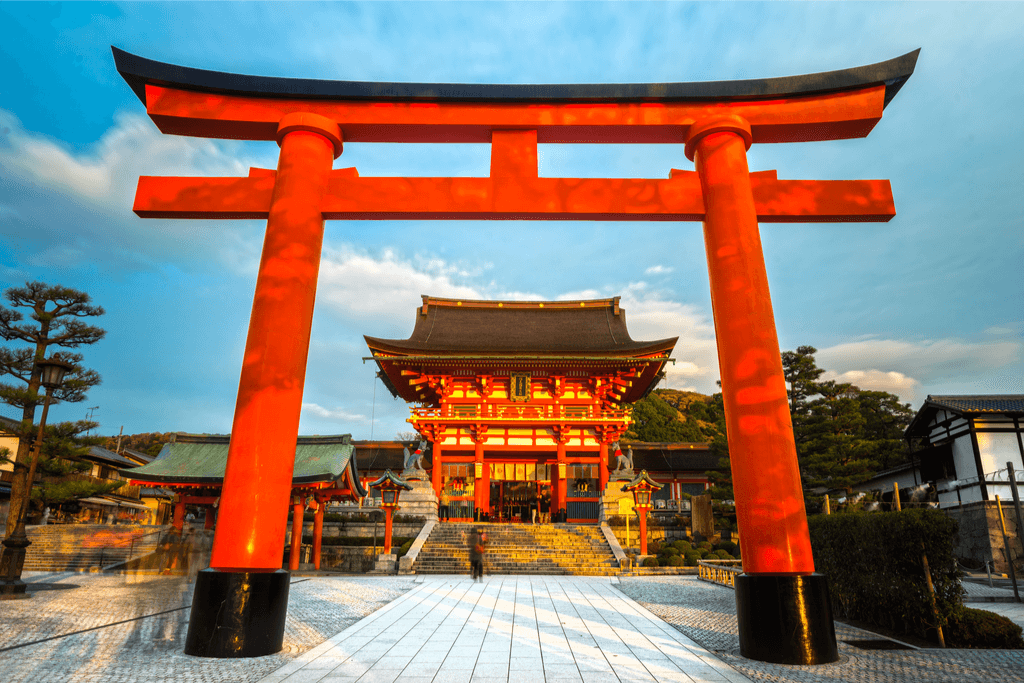
Shinto shrines are accessed through a torii (or tori)—a distinctive gate consisting of two columns and two beams. This gateway separates the sacred shrine area from the ordinary world outside, marking the threshold between profane and sacred space.
Purification rituals
Important
Purity is central to Shinto practice. Before entering shrines, worshippers use water tanks (temizuya) for purification. Salt and washing feature prominently in Japanese rituals to cleanse spaces and ensure purity from chaotic, uncontrollable events like death.
Influence on Japanese society
Pervasive cultural impact
Shinto pervades Japanese life at every level. Its influence is not primarily directed at making people act ethically in a prescribed way, but at helping them understand they live in a world full of powerful forces that must be appeased and remembered.
Rather than providing scriptures with prescriptions on how to live, Shinto:
- Inspires people to follow their ancestors' examples
- Uses festivals to reaffirm society at local levels
- Reminds people to be aware of their environment and place in society
- Connects Japanese people closely with their country
Relationship with Buddhism
From the 700s CE, Buddhism arrived in Japan from China and Korea. With its scriptures and philosophy, Buddhism became highly influential in Japanese life. For many centuries, Shinto and Buddhist rites were performed simultaneously, especially at funerals—a practice continuing today.
Note
During much of this period, Buddhism's more developed philosophical system pushed Shinto into the background of Japanese religious life. This syncretism demonstrates the Japanese approach to religious practice, where multiple traditions can coexist and complement each other.
The Meiji restoration and State Shinto (1867-1945)
The Meiji Restoration (1867-69) dramatically changed Shinto's role in society. A new power structure placed fresh emphasis on the emperor's importance, leading to:
- Increased Shinto influence and rejection of Buddhism
- Worship of the emperor as a great kami
- State Shinto—Shinto as official state religion
- Massive increase in national fervour and military action
During this period, Japan built a significant empire by invading Taiwan, China, and Korea. National kami worship was used to justify these military campaigns. Eventually, Japan joined World War II in 1941 by bombing the US Navy at Pearl Harbor. Japanese forces invaded South-East Asian nations and even bombed parts of Australia. State Shinto had become a tool for justifying war.
Post-war period (1945-present)
When Japan was defeated in 1945, Shinto lost most of its prestige. The religion was dismantled as a state institution. Today, Shinto has returned to its pre-Meiji status as Japan's general indigenous religion.
Note
Contemporary Shinto:
- Does not prevent Japanese people from being Buddhist or studying Confucianism
- Has shaped Japanese culture and traditional way of life
- Functions primarily at household and community levels
- No longer serves as state ideology
This return to traditional practice allows Shinto to fulfill its original role as a cultural and spiritual framework without the burden of nationalist ideology.
The human search for meaning
Finding meaning through Shinto
Shinto provides meaning not through moral codes, divine commandments, or rigid rules, but through:
- Living life to the fullest
- Appeasing forces that bring negativity
- Seeking to live a life of good actions
- Living at peace with others
- Living in harmony with the world
- Following one's own guiding principles
Important
Unlike religions focused on afterlife rewards or punishments, Shinto emphasises living this life in the best way possible. The focus is on present existence, proper relationships with spiritual forces, and harmonious integration with nature and community.
Connection to place and heritage
Shinto provides meaning by:
- Placing followers within a world full of spirits who, when worshipped correctly, can turn away evil forces
- Connecting Japanese people closely with their country at every level
- Providing ways to reflect on ancestors' talents
- Justifying the structure and order of Japanese society
Worship of creation
A distinctive feature of Shinto is worshipping all creation as part of a larger whole. This perspective encourages practitioners to see themselves as part of an interconnected web of spiritual forces, natural phenomena, and human community—all requiring respect, attention, and proper ritual observance.
Summary
Key Points to Remember:
-
Shinto means "way of the Kami"—it is Japan's indigenous religion focused on worshipping spirits (kami) who created and maintain Japan.
-
No founder, no scriptures, few doctrines—Shinto expresses itself through mythology, ritual, and cultural sensibilities around nature, harmony, purity, and balance.
-
Creation mythology—Izanagi and Izanami created the Japanese islands and kami, including Amaterasu (sun goddess), whose descendants became Japan's imperial family.
-
Three levels of practice—Household (Jinja Shinto with kamidana shrines), local (Minzoku Shinto at community shrines), and national (Koshitsu Shinto connecting to the imperial family).
-
State Shinto (1868-1945)—During the Meiji period, Shinto became the official state religion and was used to justify Japanese militarism and imperialism until Japan's defeat in World War II.
-
Animistic worldview—Shinto sees the entire environment as alive with spirits; kami can inhabit mountains, seas, fields, objects, and even exemplary people.
-
Purity and cleansing—Death is seen as polluting; salt and water rituals cleanse spaces and people from chaotic forces.
-
Meaning through harmony—Rather than seeking heavenly rewards, Shinto encourages living fully in this world, in harmony with nature, community, and spiritual forces.