Australian Aboriginal Beliefs and Spiritualities – The Dreaming (HSC SSCE Studies of Religion): Revision Notes
📚Revision Notes
Australian Aboriginal Beliefs and Spiritualities – The Dreaming
Introduction
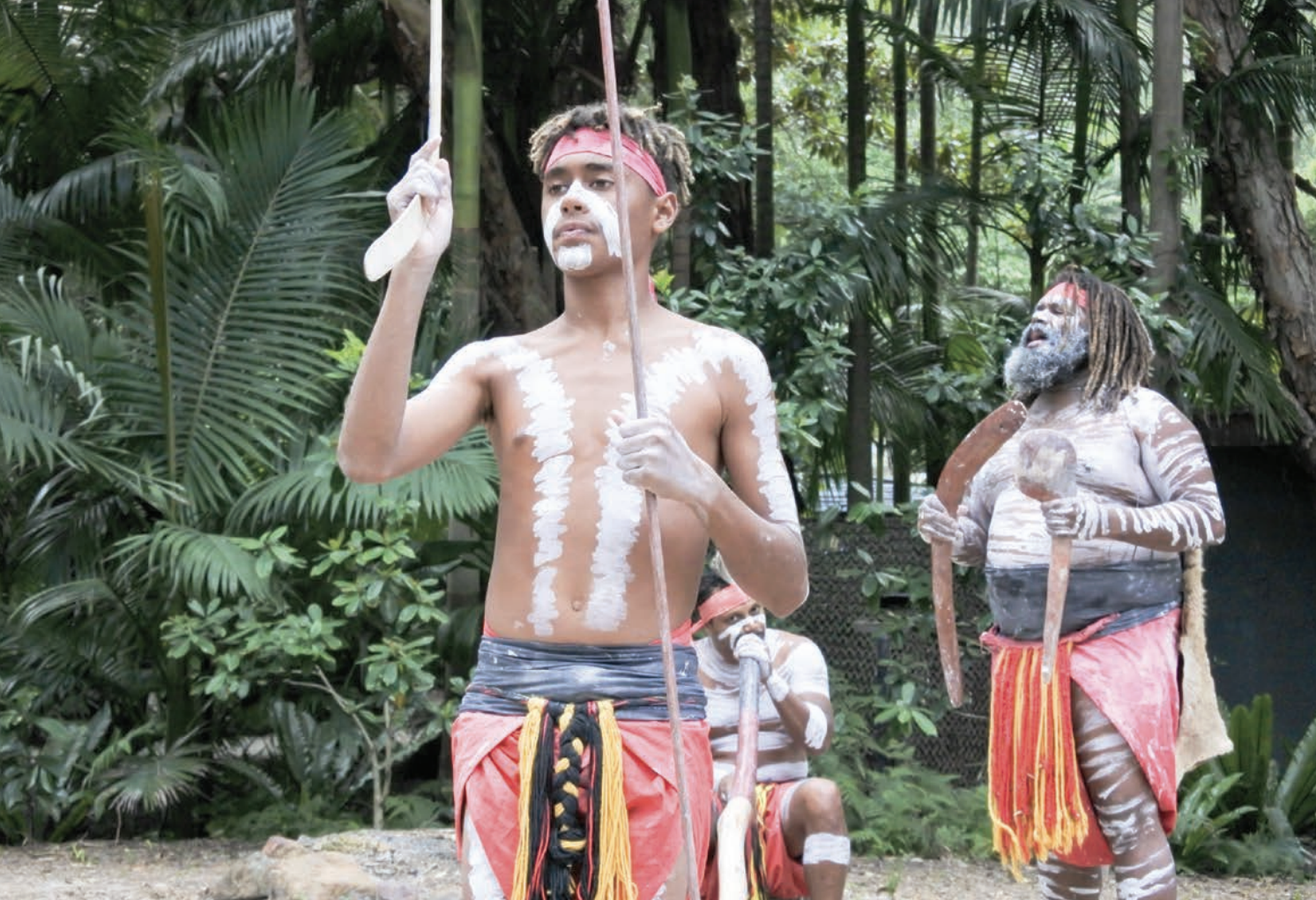
Aboriginal and Torres Strait Islander peoples' spirituality represents an essentially animistic religion that demonstrates the key characteristics of religion. This belief system is complex, comprising practices and beliefs that those initiated into their depths can fully understand. The Dreaming provides an excellent example for studying the nature of religion and understanding how belief systems shape worldviews.
When European settlement began in Australia, settlers failed to recognise Aboriginal culture. They saw no buildings, written texts, organised religious structures, fences, or cultivated crops that matched their expectations of civilisation. Early settlers heard Dreaming stories but dismissed them as mere fables, failing to understand their profound religious and cultural significance.
Note
The European settlers' failure to recognise Aboriginal culture stemmed from their limited understanding of what constitutes a civilisation. They looked for physical structures and written records, completely missing the sophisticated oral traditions, spiritual practices, and complex relationship with the land that characterised Aboriginal culture.
The nature of the Dreaming
Aboriginal peoples maintain a distinctive religious system characterised by its strong connection to the land. The land holds continuous religious significance, with its physical features demonstrating the truth of the myths and stories told about them. This relationship between landscape and belief creates a unique worldview.
The Dreaming functions as a complex system encompassing both beliefs and practices. It serves multiple purposes: explaining the Australian landscape, empowering people to live sustainably on the land, and promoting a distinctive understanding of reality and existence.
Important
A crucial concept to understand is that the Dreaming differs fundamentally from linear time. The Dreaming is not chronologically separate from the present; rather, it represents a different order of events from 'now'. This is why referring to 'Dreamtime' is incorrect and 'the Dreaming' is more appropriate – the Dreaming represents a class of events rather than a concept of time.
Dreaming stories follow a consistent pattern: something exists in the landscape (land, a site, rocks, a waterhole), and a story explains how an ancestor transformed this land into its current form.
During the Dreaming period, mythic beings (called ancestor spirits) shaped and humanised the environment. These beings often took animal or human forms and are considered eternal, even if they have travelled beyond the lands of the people who still honour them through song and story. These stories hold essential cultural value because they explain why things exist as they are, including landscape features, dietary restrictions, proper behaviour, and ritual practices. Dreaming stories contain comprehensive information needed to live successfully in a place, prosper, and understand the land's history.
Origins of the universe
Aboriginal peoples possess stories explaining how specific parts of the land came to be, but they lack a universal theory explaining the origin of everything. Many stories describe ancestors lying in a state of sleep who awaken and perform actions, but there is no general creation story encompassing the universe as Western science and theology conceive it. In most Dreaming stories, the universe already existed in some form.
This presents an interesting challenge regarding the concept of time. Scientific evidence shows Australian Aboriginal civilisation extends back 70,000 years or more, yet Aboriginal peoples traditionally did not maintain formal or written calendars. However, they did observe and follow events and changes meticulously.
Note
Aboriginal Understanding of Time
For example, the Arrernte people of central Australia identified 30 distinct changes occurring over 24 hours, including the Milky Way stretching across the sky's centre, bandicoots returning to burrows, variegated shadows, and the sky aflame with red and yellow.
Recognising these patterns throughout days and across years helped establish appropriate times for rituals. Each day repeats these patterns in varying forms, creating a rhythm that is neither linear nor cyclical, but more rhythmic or parallel.
Sacred sites
The term 'the Dreaming' translates variously into Aboriginal languages and refers to two interconnected things: events embodied in stories told about landscape features, and the actual physical features of that landscape. Sacred sites are places where significant events occurred or where ancestor spirits reside.
Example
Example: The Creator-Snake Ceremony
During one ceremony, elders sang a great creator-snake through the landscape. When night fell and they stopped singing, an observer (academic Tony Swain) asked what happened to the snake. The elders simply replied, "We leave him there until tomorrow when we sing him on again."
This demonstrates how the story and the land are inseparable – the snake exists both in the narrative and in the physical landscape itself.
Specific rituals often need to be performed in association with sacred sites, which must be treated with particular respect. Correct relationships with sacred sites involve responsibilities to care for the site, engage its power, and protect it from inappropriate use and contact. The Darling River, for example, functions as a sacred site with its own sacred story.
Stories of the Dreaming
Case study: The creation of the Darling River
Example
Case Study: The Creation of the Darling River
This creation story from Ngiyaampaa country also tells of the land belonging to Eaglehawk and Crow. The story follows a typical Dreaming pattern:
Step 1: Something already exists
- The landscape and ancestor spirits are present
Step 2: Something becomes active
- An inactive ancestor awakens and brings others into the story
Step 3: New awareness comes
- Through this awakening and movement, people gain understanding through ritual about the land and their relationship to it
The Main Plot: The story describes the Darling River's creation in western New South Wales, involving several ancestor spirits. Guthi-guthi, the creator-spirit, releases Weowie, the water serpent, who first creates the landscape's water features. Old Pundu the Cod and Mudlark also participate in this creative process, forming the Darling River.
Multiple Layers of Meaning: The story simultaneously tells of creating two groups, Eaglehawk and Crow, which include the Ngiyaampaa and Barkandji peoples. This establishes ongoing links between these groups with implications for their relationships. An underlying layer relates to relationships between groups and their totems, creating practical and ethical dimensions – it indicates which fish species should not be eaten and which people are taboo for marriage.
Layers of meaning in Dreaming stories
Important
Multiple Layers of Meaning in Dreaming Stories
Dreaming stories contain multiple layers of meaning that must be understood to appreciate their full significance:
- First layer: Simply describes creating a particular geographical feature, place, or animal
- Deeper layer: Refers to aspects of group life – appropriate behaviour and ethical guidance
- Deepest layers: Meanings that only group members, initiated individuals, or elders can access
Similarly, Aboriginal art can hold different meanings for different viewers.
Other stories provide hints about food locations and preparation methods, areas forbidden to men or women, and other life aspects including daily practical matters and ethical, moral, and tribal issues. Beyond telling of creation and group development, Dreaming stories function as law, an ethical reinforcement system. The rituals themselves mark the rhythmic progression of events, including each generation's growth from childhood into adulthood.
Through this process, the Dreaming creates a reality enabling people to inhabit the land and be at one with ancestors. Acknowledging these rights and responsibilities ensures wellbeing and allows people to rely on resources like the Darling River to provide for their needs.
The Darling River creation story comes alive through ritual. At the river site particularly, this story becomes central to action. The creation story may be sung completely through, with singers' or dancers' actions holding particular significance. Through this symbology, they re-enact the story, following its action as it moves around the site. Woven throughout is a range of laws and ideas. Remembering the story means remembering how to live according to tradition.
Symbolism and art
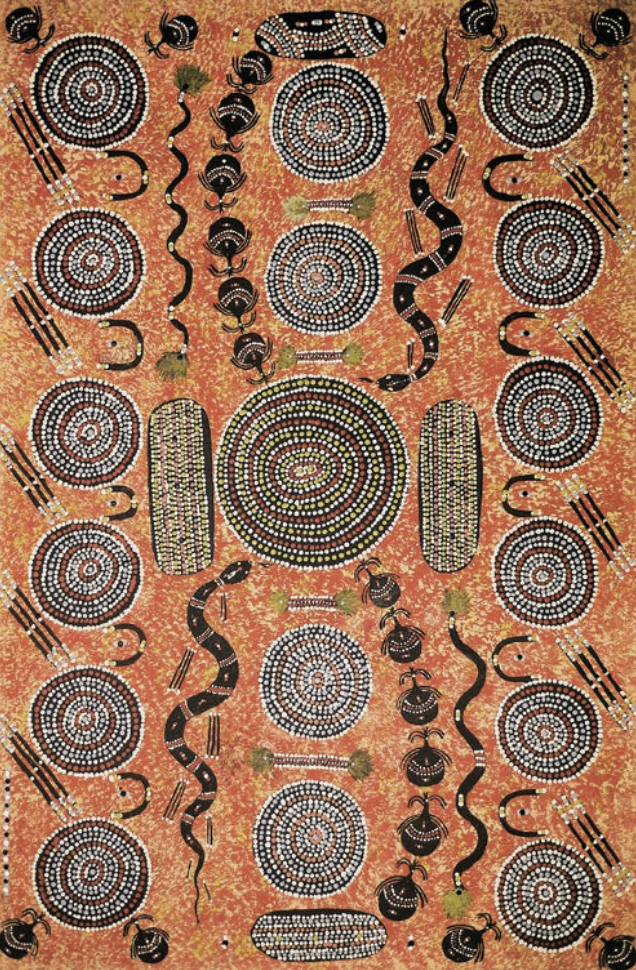
The art of storytelling in Ngiyaampaa country is supported by other art forms. Body painting reflects ancestor symbols. Similarly, creation stories can be drawn in sand or painted on various surfaces. As if viewing from above the site, ancestors and other elements can be brought alive in a map format.
Note
Aboriginal Art as Functional Maps
Aboriginal and Torres Strait Islander peoples' art often functions precisely as maps, indicating country features, food locations, or appropriate behaviour on that land. These maps, when created in colours on canvas or bark in particular styles, can sometimes be sold to art collectors for substantial sums.
Aboriginal and Torres Strait Islander peoples' art reflects aspects of life in the Australian landscape. A piece of art can serve as a map or tell a story. It can guide finding water or food, tell of a journey, or represent women's business. Simply viewing Aboriginal and Torres Strait Islander peoples' art as paintings is far too simplistic – these works hold multiple layers of meaning and practical function.
The diversity of the Dreaming
The Darling River creation story would make little sense if told at another site, because at the Darling River exist the river, rocks, waterholes, and trees that make the story real. Equally, the site lacks full meaning without the story. Therefore, the story becomes a passport to this part of the land.
Note
Stories as Passports to Country
The whole of Australia is divided into particular 'countries' for cultural groups. Each group has its own domain or 'country'. To pass through someone's country, you should know the Dreaming story attached to it. This creates a strong connection between knowledge, permission, and movement across the land.
Dreaming stories from the desert centre differ from those of the north Queensland rainforest or the Australian Alps peaks. The Dreaming reflects landscape diversity, yet significant common elements exist that enable studying the Dreaming as a whole, provided you remain aware of significant diversity as well.
Importance of the Dreaming
Dreaming stories present an entire worldview for Aboriginal peoples, covering ethics, hunting methods, art creation, making things, and performing practices like love magic. The Dreaming affects all aspects of life for Aboriginal peoples.
The Dreaming is intimately related to the land and prescribes rituals and responsibilities for caring for it. It governs life areas including:
- Kinship
- Ceremonies
- Rituals
- Totems
- Death itself
The Dreaming determines cultural responsibilities and how to handle conflict (such as tribal warfare) and cooperation between tribal groups. The Dreaming is Aboriginal peoples' life – it provides comprehensive guidance for living.
The inextricable connection of the Dreaming, the land and identity
Country and responsibility
Aboriginal and Torres Strait Islander peoples refer to the land they maintain as their 'country'. They hold obligations to country, to their group, and to ensuring the land provides for others. Groups inhabiting particular areas are responsible for specific animals that serve as their totems.
Example
Example: The Totem System in Practice
For example, the kangaroo people (those whose central symbol is the kangaroo) are responsible for ceremonies that symbolically increased and decreased kangaroo populations as needed for food. However, the kangaroo people never eat their own totem. They eat other foods that are totems of other groups.
Result: This system helped develop group interdependence, with little evidence of large-scale inter-group warfare. Each group's food supply depends on other groups' totems, who control that food source through their rituals. This creates a sophisticated system of mutual dependence and cooperation.
Connection to land and identity
Another way to understand the connection to country is examining relationships between land and people. Aboriginal peoples often say they are born from the land, not at particular sites. The land holds such importance that separation from it has significantly detrimental effects on people.
Increase rituals or singing ancestors through the landscape are traditions holding society together. These practices represent how societies create maps for understanding and making their views of reality work effectively.
Important
The Inextricable Link Between Dreaming, Land, and Identity
For Aboriginal peoples, a clear connection exists between the Dreaming, the land, and identity that cannot be separated. Through their ancestor spirits, Aboriginal peoples become part of country. The land is part of who they are. When their relationship with traditional land breaks, they lose their sense of meaning – their spirituality and identity become compromised.
The land is their ancestor – as long as the land lives, the ancestors live, and the people themselves live. This link between land, identity, and the Dreaming cannot be broken – it is inextricable. Separating these elements would fundamentally destroy the basis of Aboriginal identity and spirituality.
Remember!
Summary
Key Points to Remember:
-
The Dreaming is not 'Dreamtime' – it represents a class of events, not a concept of time
-
Sacred sites are inseparable from their stories – the physical landscape and the Dreaming stories that explain it are interconnected
-
Dreaming stories have multiple layers of meaning – creation stories, ethical guidance, practical instructions, and deeper meanings accessible only to initiated members
-
The connection between Dreaming, land, and identity is inextricable – these three elements cannot be separated without destroying Aboriginal spirituality and culture
-
The totem system creates interdependence – groups never eat their own totems but rely on other groups' totems for food, creating cooperation rather than conflict
Key Terms:
-
Dreaming: Complex system of beliefs and practices explaining the landscape and empowering people to live on the land
-
Totem: Object (animal, plant, landmark) linking Aboriginal peoples to the ancestral being responsible for their existence
-
Country: Land that Aboriginal peoples are responsible to maintain
-
Ancestor spirits: Mythic beings who shaped the environment during the Dreaming
-
Sacred sites: Places where significant events occurred or where ancestor spirits reside