Hominin Evolution (VCE SSCE Biology): Revision Notes
📚Revision Notes
Hominin Evolution
Introduction to hominins
Note
A hominin is any species, living or dead, that can be classified in the taxonomic tribe Hominini. This includes modern humans (Homo sapiens) as well as our upright-walking ancestors from genera such as Homo and Australopithecus.
The tribe Hominini has been evolving and developing over the last 7 million years. Modern humans are the last remaining members of this group. When we think of hominins, we include ourselves and all extinct members of the human lineage – our ancestors.
Many ancestral hominin species have left extensive fossil records. Familiar examples include:
- Homo neanderthalensis (Neanderthals)
- Homo erectus
- The australopithecines (various species of the genus Australopithecus)
Important
Key terms:
- Genus (plural: genera): a taxonomic rank above species and below family. Modern humans belong to the genus Homo.
- Biped: an individual that moves on two legs (upright-walking).
- Arboreal: living in or amongst trees.
- Foramen magnum: the hole in the base of the skull through which the spinal cord passes. A more centralised foramen magnum indicates bipedal locomotion.
Meet the hominins
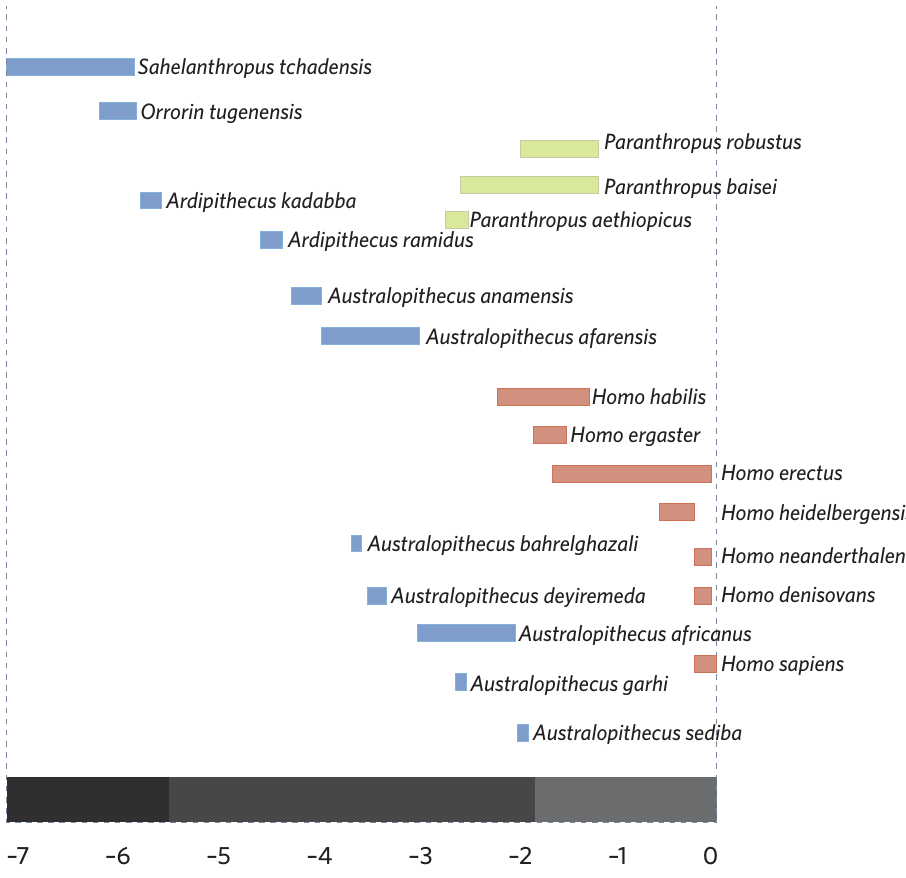
For VCE Biology, you need to understand the general trends in hominin evolution across time, starting with the genus Australopithecus (which existed around 4 million years ago) through to the genus Homo (which first appeared between 2 and 3 million years ago and continues to exist today).
Early hominins (7-4 million years ago)
Sahelanthropus tchadensis
- Found in Central Africa, dated to around 7 million years ago (mya)
- The oldest recognised human relative
- Identified as the first hominin due to a more centralised foramen magnum, suggesting bipedalism
Note
Orrorin tugenensis
- Found in East Africa, dated to 6 mya
- Both bipedal and partly arboreal
Ardipithecus ramidus
- Found in Ethiopia, dated to 4.4 mya
- Small chimp-sized brain
- Ape-like skull
- Bipedal
Genus Australopithecus (4.3-2 million years ago)
Australopithecus anamensis
- The earliest of the australopithecines
- Found in East Africa, dated to between 4.3-3.8 mya
- Arm bones show climbing ability, whilst leg bones indicate bipedalism
- Had smaller front teeth compared to earlier hominins
Note
Australopithecus afarensis
- Living around 3.9-2.9 mya
- Mixed both bipedal locomotion with an arboreal lifestyle
- Brain size was still chimp-sized
- Males weighed around 50 kg
Australopithecus africanus
- Lived around 3.3-2.1 mya
- One of the longest surviving australopithecines
- Had a slightly more human-like face compared to earlier ancestors
- Predominantly bipedal
Australopithecus sediba
- Living around 2 mya in South Africa
- Much more human-like face and hands
- More adept form of bipedalism
Genus Homo (2.3 million years ago-present)
Homo habilis
- Living between 2.3-1.6 mya in East/South Africa
- Had 50% larger brains than the australopithecines
- Smaller teeth and less protruding face
- Similar to australopithecines with long arms and shorter legs suitable for climbing
Important
Homo erectus
- Appeared 1.8 mya in Africa
- Later found throughout much of Asia and Europe
- Lived until as recently as 200,000-300,000 years ago
- Much more human-like than anything prior: bigger brain, longer legs, shorter arms
- Made more sophisticated tools
- Often credited with much of the migration out of Africa
Homo neanderthalensis
- Lived in Europe/West Africa from 200,000 to 27,000 years ago
- Short (males around 165 cm) and powerful
- Large brow ridges
- Brains slightly bigger than modern humans
- Expert toolmakers and hunters
- Thought to have interbred with modern humans
Homo sapiens
- Appeared 200,000 years ago
- Much more rounded skull with a vertical forehead
- Larger brain than most hominins
- Small brow ridge
- Small jaw with a pronounced chin
Note
The evolution to modern-day Homo sapiens has been complex, taking several million years for different species to evolve the characteristics we are familiar with today. Some general patterns include:
- Gradual movement from an arboreal lifestyle to complete bipedalism
- Shortening of arms and lengthening of legs
- Faces gradually became flatter
- Skulls became rounder and smaller
Important
Whilst these changes are not perfectly linear (one descendant may have had a smaller braincase than their direct ancestor), they represent overall directional trends in the 7 million years of hominin evolution.
Changes in brain size
Overview
Hominin brains increased in size over time, resulting in the evolution of higher cognitive processes such as planning, speech and abstract thinking.
Brain size evolution
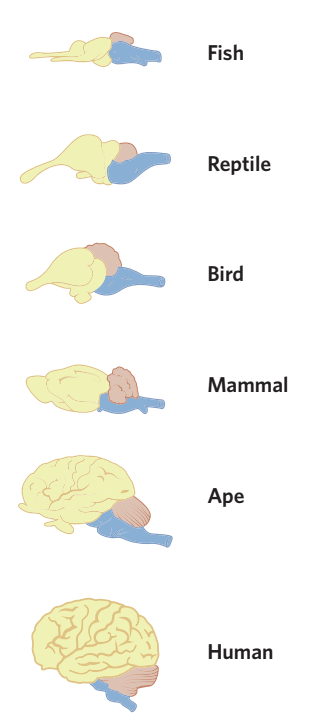
A defining feature of hominins is their large brains when compared to their body size. This has been an evolutionary trend that increased gradually across time, with almost every subsequent hominin species having a larger brain than their recent ancestors.
Scientists determine differences in brain size by examining fossils. Whilst brains themselves are comprised of soft tissue and do not fossilise, the volume of an extinct hominin's cranium (skull) can be estimated from recovered fossilised skulls. From studying the fossil record, we know that cranium volume (and therefore brain size) increased more than threefold from the earliest australopithecines to modern-day human beings.
Drivers of brain size increase
Note
Research disagrees on whether the evolution in brain size happened gradually over time or via brief episodes of rapid growth in response to environmental challenges and stressors (such as periods of climate change or migration to new environments).
One of the most commonly accepted drivers of change was the improved diet of hominin species over time:
- Earlier leaf-eating primates evolved into more recent hominins who incorporated more fruit and animal products into their diets
- The controlled use of fire around 800,000 years ago enabled our hominin ancestors to fuel brain growth through cooking and increased nutrition
Increased brain complexity
With an increase in hominin brain size came an increase in the complexity of brain structure. Specifically, the cerebrum of hominin brains became more folded.
Important
Cerebrum: the largest part of the brain, which comprises two-thirds of the brain's entire weight and is responsible for a large range of vital functions including sensory processing, motor control, and visual and spatial learning.
This increased folding led to:
- Increased total surface area of the brain
- More neurons
- More connections between brain cells
- Enhanced cognitive ability
The increased folding and brain cell connections enabled unique activities including:
- Speech
- Complex emotions
- Higher-order decision making
- Enhanced self-control
- Abstract thinking
- Planning
The expensive brain hypothesis
Larger brains with more complexity and folding require much more energy than smaller brains. They use more resources and have much higher metabolic requirements than other organs and tissues in our body.
Important
The expensive brain hypothesis tries to understand advanced cognitive ability in terms of:
Positive impacts:
- Lower predation vulnerability
- Group care and shared mothering
- Cooking and stable food production
Negative impacts:
- Higher energy needs
- Larger dietary requirements
- Higher complexity of childbirth

Changes to skull structure
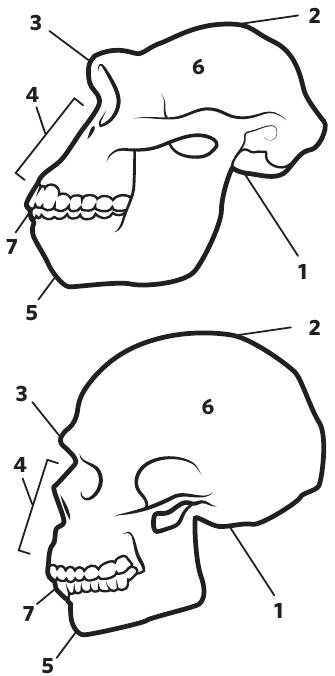
As well as increasing in cranium volume/size, the structure of the hominin skull has changed in several ways since the early australopithecines:
- A more centralised foramen magnum
- A shrinking of the sagittal crest (a ridge of hard bone running lengthwise along the top of the skull - a pronounced sagittal crest indicates strong jaw muscles)
- A lessening of the brow ridge
- A flattening of the face
- A less protruding chin
- A more domed skull
- Smaller teeth
Cultural evolution
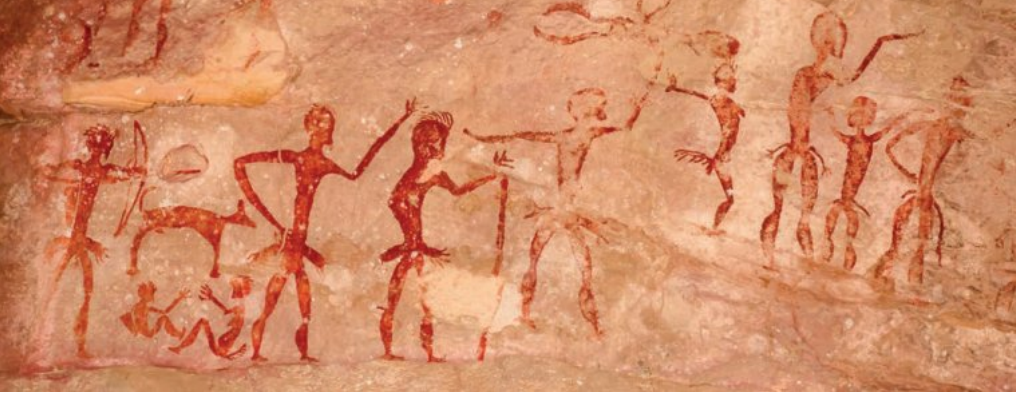
The structural, functional and cognitive changes in brain structure that took place in hominin evolution allowed hominins to create sophisticated cultures and transmit them to their offspring.
Note
Culture can be thought of as collective knowledge of languages, ideas, beliefs and customs of a society. By developing written and verbal language skills, hominins were able to pass on their culture in a process called cultural evolution.
Changes in limb structure
Overview
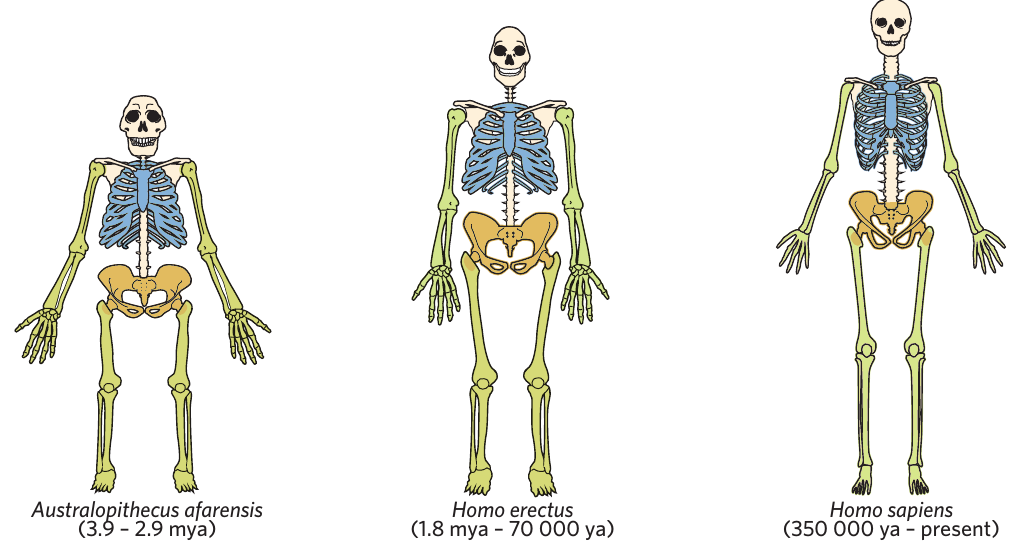
The arm to leg ratio of hominins decreased over time in response to an increased reliance on bipedal locomotion. The pelvis shape of hominins also changed in response to an increasingly upright-walking lifestyle.
Evolution of bipedalism
A major evolutionary change in hominins over time was a changing in limb structure, namely a decreasing arm to leg ratio.
Important
Arm to leg ratio: the ratio of arm length to leg length. Tree-dwelling hominids have longer arms and shorter legs (a larger arm to leg ratio).
Three related changes occurred:
- Shortening of the arms
- Lengthening of the legs
- Changing of the pelvis shape
The consensus is that all three changes were driven by the evolution of bipedalism from our earlier arboreal ancestors.
Shorter arms
Movement in trees requires all four limbs to be in contact with the external environment, grabbing and pushing off branches to move the body along. When our ancestors changed from arboreal living and began moving primarily on the ground, their forelimbs were no longer in contact with the external environment during locomotion.
This placed less need for available contact points on the forelimbs, 'freeing' the arms up for other tasks such as:
- Carrying children
- Preparing food
- Building tools
Note
The hands also developed:
- More robust first fingers
- Shorter lateral fingers
Longer legs
Longer legs were selected for in bipeds because:
- They positively affect stride length
- They make upright walking more energy efficient
- They lessen the intensity of the rising and falling motion that the body's centre of mass experiences with each step
- They reduce the volume of muscles activated as we walk
Note
Additional foot adaptations for bipedalism:
- Shorter toes with the big toe in line with the other toes
- Feet with two arches and a wide heel
These features make bipedalism more energy efficient.
Change to pelvis shape
The pelvis shape of hominins became shorter and more bowl-shaped over time. This shape provided hominins with:
- More support for the upper body whilst standing and walking upright
- In later hominin species, the leg attaches to the pelvis at an angle, allowing them to walk upright more easily
Important
Earlier hominin species had legs that attached to the pelvis in more of a straight line, meaning they had to swing their legs wide when walking. This method of walking made them slower and less energy efficient.
Further changes to pelvis shape occurred over time, largely due to different demands of childbirth as the cranial capacity of hominin babies increased. This mostly involved:
- A narrowing of the pelvis
- A more circular birth canal
- Overall narrowing of body shape
- More barrel-like chest of offspring
Theory summary
Summary
For VCE Biology, you need to be familiar with the general trends of hominin evolution, including the approximate periods and patterns of development from the earlier australopithecines to modern-day Homo sapiens.
Three main overarching trends over time:
-
Larger brain size – Over time, the hominin braincase tended to increase in size. This included other morphological changes, including a flatter face and a more domed skull.
-
Smaller arm to leg ratio – Modern humans have a smaller arm to leg ratio than our earlier ancestors. This was due to various reasons, including the fact that longer legs were more energy efficient for bipedalism.
-
Changing pelvis shape – Hominins evolved a narrower and more bowl-shaped pelvis over time, which developed in relation to our bipedal lifestyle and larger brain cases.
Remember!
Summary
Key Points to Remember:
- Hominins are members of the tribe Hominini, including modern humans and all our upright-walking ancestors over the last 7 million years.
- Hominin evolution shows three major trends: increasing brain size, decreasing arm to leg ratio, and changing pelvis shape.
- Brain size increased more than threefold from early australopithecines to modern humans, driven by improved diet and use of fire for cooking.
- Larger brains enabled advanced abilities like speech, planning and abstract thinking, but came with costs explained by the expensive brain hypothesis.
- The shift from arboreal to bipedal lifestyle drove changes in limb structure: shorter arms for tool use, longer legs for efficient walking, and bowl-shaped pelvis for upright support.