Human Migration (VCE SSCE Biology): Revision Notes
📚Revision Notes
Human Migration
Introduction
In 1974, archaeologists discovered the remains of an ancient human buried in Lake Mungo, New South Wales. This individual, named 'Mungo Man', had been carefully laid to rest on his back with his hands neatly crossed over his lap and red ochre sprinkled across his chest. This dignified and emotional burial raises important questions about the origins and history of human populations in Australia and around the world.
Note
The discovery of Mungo Man provides powerful evidence of ancient Aboriginal culture and sophisticated burial practices dating back over 40,000 years. This finding demonstrates the deep history and cultural complexity of Aboriginal Australians.
This topic explores how scientists use fossil and DNA evidence to understand the migration patterns of modern human populations, including the arrival of Aboriginal and Torres Strait Islander peoples and their deep connection to Country and Place.
Evidence for examining our evolutionary past
Scientists use two main types of evidence to understand human evolution and migration patterns. These methods help us trace the relationships between different species over time and track how populations moved across the globe.
The fossil record
Fossils provide physical evidence of relatedness between species. Scientists examine comparative anatomy, particularly looking for homologous structures (body parts with similar underlying structures but potentially different functions). By studying fossilised remains found in different locations and dating them accurately, researchers can map migration routes and understand when different populations existed in specific areas.
Molecular homology
DNA analysis offers another powerful tool for understanding human evolution. Scientists compare similarities in nucleotide sequences in DNA or amino acid sequences in proteins to demonstrate relatedness between populations. Mitochondrial DNA (mtDNA) is particularly useful because:
- It is inherited only through the maternal line
- It experiences little to no recombination, meaning variations are primarily due to mutations
- It has a high mutation rate that tends to be geographically restricted
- Ancient mtDNA can be extracted from museum specimens and fossil remains
- Mutations accumulate over time, allowing researchers to identify genetically distinct populations
Note
Why mtDNA is so valuable for tracking human migration:
Mitochondrial DNA acts like a molecular clock. Because it's passed down only from mothers to their children and rarely changes through recombination, scientists can track mutations that accumulate over time. These mutations create a genetic trail that leads back through maternal lineages, ultimately pointing to a common ancestor in Africa.
How Homo sapiens spread: human migration
Fossil evidence shows that the first hominins emerged in Africa around 4 million years ago. These early hominins, known as Australopithecines, remained exclusively in Africa and continued evolving, eventually giving rise to the earliest members of the Homo genus (such as Homo habilis).
However, it wasn't until approximately 2 to 2.25 million years later that any hominin species began migrating out of Africa into nearby regions of Europe and Asia. This migration was accomplished by small populations of Homo erectus, whose fossils were the first hominin remains discovered outside Africa (found in China and Indonesia).
Fast forward another 2 million years, and Homo sapiens are the only surviving species of the Homo genus. Our population has grown to nearly 8 billion individuals spread across almost all habitable land on Earth. This raises two key questions:
- How did this extraordinary geographical expansion of Homo sapiens occur?
- How can we use information from DNA and fossils to better understand these ancient migration patterns?
Two competing hypotheses
Scientists have proposed two main theories to explain the origin and spread of modern humans: the multiregional hypothesis and the Out of Africa hypothesis. Both theories agree that the Homo lineage originated in Africa and that Homo erectus expanded into Eurasia about 1.8 million years ago. However, they differ in explaining how modern humans (Homo sapiens) arose.
Important
The Central Question
Did Homo sapiens evolve as multiple separate populations from the existing hominin groups that had already left Africa, or did we evolve independently in Africa before migrating outward?
This fundamental question has shaped decades of research into human origins.
The central question is: Did Homo sapiens evolve as multiple separate populations from the existing hominin groups that had already left Africa, or did we evolve independently in Africa before migrating outward?
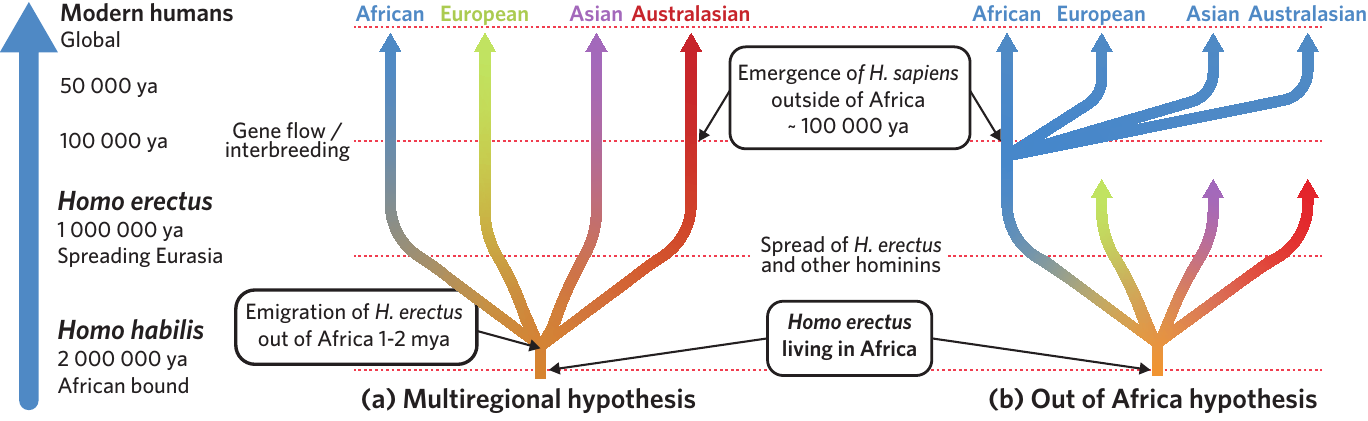
Almost all existing evidence supports the Out of Africa hypothesis, which is now the generally accepted model of human migration. The comparison with the multiregional hypothesis helps highlight the uncertainties and complexities in our understanding of the human fossil record.
Out of Africa hypothesis
The Out of Africa hypothesis is a model for the geographical spread of Homo sapiens which suggests that humans first developed and evolved in Africa before migrating outwards and expanding their colonies, replacing the earlier hominins that had spread prior. This model is also known as the African replacement model.
According to this hypothesis, Homo sapiens evolved in Africa around 200,000 to 300,000 years ago, long after Homo erectus had already departed for Eurasia. Modern humans remained in Africa for an extended period (approximately 100,000 years) before emigrating (leaving one place to settle permanently in another) in waves and replacing existing hominin species such as Homo erectus and Homo neanderthalensis in different parts of Europe and Asia, beginning about 150,000 years ago. This means that all modern human beings share African ancestry.
Evidence supporting the Out of Africa hypothesis
The evidence for this model is compelling and includes multiple lines of investigation:
Mitochondrial DNA analysis: Multiple large-scale studies of mitochondrial DNA from modern humans show that all our maternal lineages can be traced back to a common ancestor who lived in Africa between 150,000 and 300,000 years ago.
Genetic diversity patterns: Modern humans show remarkably little genetic diversity compared to other species. This limited variation is partly due to our relatively short existence as a species (~200,000 years) and suggests we originated from a small, centralised population. Additionally, African populations show the greatest genetic diversity, indicating there has been more time for spontaneous mutations to accumulate in mtDNA in this region where Homo sapiens first appeared.
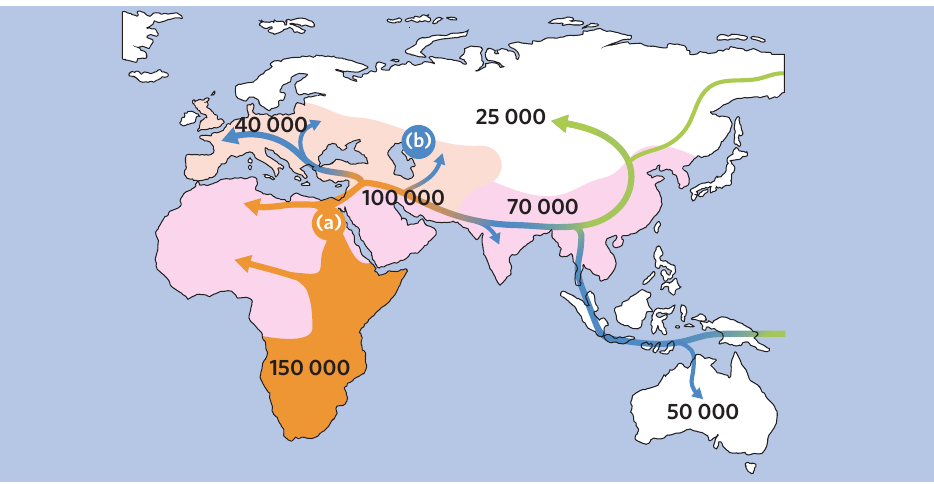
Fossil evidence: Although Homo sapiens fossils are limited due to our relatively recent emergence as a species, scientists have been able to model our first migratory wave from early fossilised remains found along the eastern coastline of Africa. Some of the oldest Homo sapiens fossils were discovered in East Africa and dated to around 160,000 years ago. Later fossils found in the Middle East have been dated to 100,000 years ago, suggesting migration into and out of Northern Africa.
Archaeological artifacts: Scientists have discovered stone tools, carvings, and cave paintings along migration routes that indicate increased complexity and cultural evolution. These artifacts can be dated to further map our migratory patterns throughout Eurasia. For example:
- Stone tools found in the United Arab Emirates dated to 80,000 years ago
- Stone tools discovered in India dated to 74,000 years ago
- Cave paintings and carvings found in western European regions dated to around 40,000 years ago
Example
Evidence Integration: How Multiple Lines Support One Theory
Consider how different types of evidence converge to support the Out of Africa hypothesis:
Step 1: mtDNA analysis reveals all modern humans trace back to African ancestors (150,000-300,000 years ago)
Step 2: Fossil evidence shows the oldest Homo sapiens remains are in East Africa (~160,000 years ago)
Step 3: Later fossils appear in the Middle East (~100,000 years ago), then progressively further from Africa
Step 4: Archaeological artifacts (tools, cave paintings) mark the path of migration with dates that match the fossil timeline
When independent lines of evidence all point to the same conclusion, it provides strong support for the theory.
Migration waves
The Out of Africa hypothesis proposes that modern humans left Africa in multiple waves. The first major wave occurred around 150,000 years ago, with humans travelling along the eastern coastline of Africa and into the Middle East via the northern tip around 100,000 years ago. A second wave of migration further into Eurasia occurred between 40,000 and 80,000 years ago, eventually reaching all corners of the globe.
Multiregional hypothesis
The multiregional hypothesis is an alternative model for the geographical spread of Homo sapiens which suggests that separate human populations evolved independently from earlier hominins that had spread throughout Eurasia and experienced gene flow. This model is also known as the regional continuity model.
This hypothesis proposes that the evolution from Homo erectus to Homo sapiens was an ongoing process across all regions of the world, with gene flow between different continental populations. In other words, Homo sapiens evolved from several different geographically separate groups of Homo erectus who had migrated across much of Africa and Eurasia in the million years before modern humans emerged. Under this model, all modern human beings are not of African descent, but rather descendants of smaller, localised populations of early hominins. For instance, modern Africans would have originated from early Africans that evolved from African hominins, whereas modern Asians would have descended from archaic Asians that evolved from Asian hominins.
Evidence for the multiregional hypothesis
Note
Limited Supporting Evidence
Unlike the Out of Africa hypothesis, the multiregional hypothesis has very limited supporting evidence. Most scientists today consider this hypothesis largely unsupported by current data.
There is limited evidence supporting the multiregional hypothesis today. Some proponents argue that the ancient fossil record demonstrates morphological clades (combinations of various physical characteristics that are unique to particular geographical regions across a wide timespan). For example, some researchers point to a morphological clade in the Chinese region characterised by ten features commonly seen in fossils from this area, including facial flatness and a non-depressed nasal root.
However, many critics argue that:
- The fossil record is too incomplete to rely on morphological clades
- Different studies do not include enough fossil specimens to be reliable
Aboriginal and Torres Strait Islander people's connection to Country and Place
Aboriginal Australians represent the longest continuous population on Earth. They maintain a profound Connection to Country that can be difficult for non-Aboriginal peoples to fully appreciate.
Migration to Australia
The second wave of migration proposed by the Out of Africa hypothesis is believed to have led to the emergence of Indigenous populations in the Oceanic region, including the arrival of Aboriginal Australians between 50,000 and 65,000 years ago. Research that has sequenced the genomes of Aboriginal Australians suggests that most of their genetic material can be traced back to the original 'Out of Africa' event when the first ancient humans spread throughout the globe.
DNA evidence indicates that around 50,000 to 65,000 years ago, a wave of migrants reached a prehistoric supercontinent called Sahul. This landmass was composed of present-day Australia, Tasmania, and New Guinea before the supercontinent separated due to rising sea levels around 10,000 years ago. DNA evidence also suggests that the first migrants to arrive were distinct groups that came from a single initial migration event. Upon arriving, these groups spread rapidly down the western and eastern coasts of the continent.
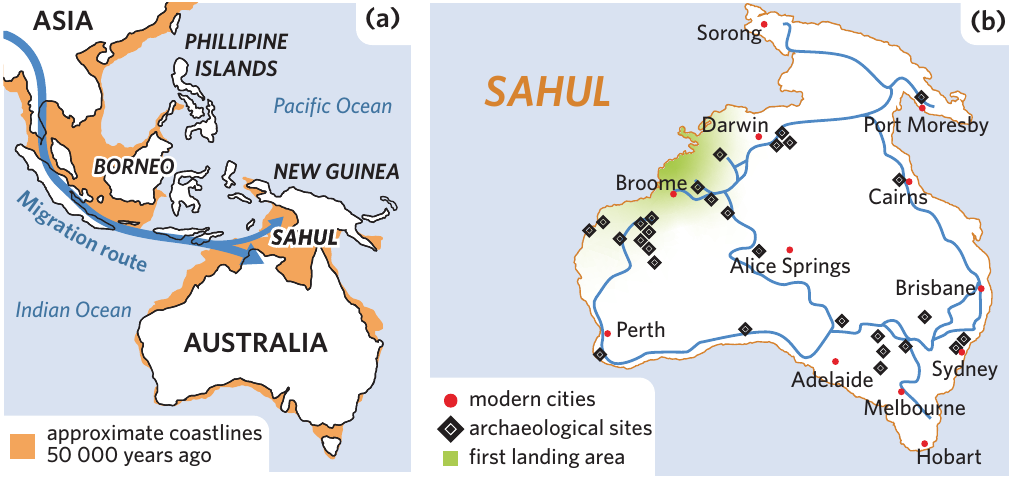
The rapid migration of modern humans across the continent is also evidenced by the extinction of Australian megafauna (large terrestrial animals) approximately 42,000 years ago. Current understanding of whether these groups interacted with each other is mixed. There is evidence for prolonged connection between certain groups and their areas, while other evidence from DNA and cultural artifacts suggests migration and gene flow between groups occurred.
Note
Australia's Geographic Isolation
The separation of the Sahul supercontinent made Aboriginal and Torres Strait Islanders (also known as First Nations people) geographically and genetically isolated. This isolation is thought to make them the world's oldest surviving civilisation.
The separation of the Sahul supercontinent made Aboriginal and Torres Strait Islanders (also known as First Nations people) geographically and genetically isolated. This isolation is thought to make them the world's oldest surviving civilisation. In other words, Indigenous Australian people represent the longest surviving population of modern humans to have lived continuously in a given location, and they are thought to have one of the strongest Connections to Country of any living population on Earth.
Understanding connection to Country
For many First Nations people, the land on which they live extends far beyond a simple physical environment. It is fundamental to their identity. The term 'Country' (with a capital C) refers to an area that is traditionally owned and looked after by an Aboriginal language group or community, or by certain people within that group. The term indicates more than simply a geographical area – it is also a concept that encompasses the spiritual meaning and feelings of deep connection and attachment associated with that area.
Connection to Country describes a reciprocal relationship between First Nations people and their ancestral lands and seas. This relationship works two ways: the land provides for the people, while the people manage and sustain the land through their culture, ceremonies, and care.
Important
Understanding the Reciprocal Nature of Connection to Country
Connection to Country is not a one-way relationship. The land provides for the people spiritually, physically, socially, and culturally, while the people have a responsibility to care for and sustain the land through their cultural practices and ceremonies. This mutual relationship has been maintained for over 50,000 years.
The words and descriptions that many Aboriginal language groups use when discussing Country express this living relationship. For example, Country may be referred to as mother or grandfather. Kinship terms like these impose a mutual responsibility of caring, knowledge transfer, and shared growth. Land sustains the lives of Indigenous Australians in every aspect – spiritually, physically, socially, and culturally. While this concept can be challenging for non-Aboriginal people to fully grasp, it is absolutely central to the lives of Aboriginal Australians.
The Dreaming and cultural practices
Dreaming (also known as The Dreamtime) is an Aboriginal philosophy that describes the time when Ancestral Spirits (Dreaming Beings) moved over the land and created life and important geographical sites. It explains the origins of the universe, as well as the relationships between humans, animals, and the land on which they live. The Dreaming is passed down through generations and governs familial, relational, communal and spiritual obligations for Aboriginal Australians.
Note
The Complexity of Dreaming
The Dreaming is a complex concept that may encompass different beliefs depending on the specific language group. For example, the Walpiri language group talks about 'Yiwirinngi', which is a person's 'Conception Dreaming'. This is defined as an individual's 'life-force or spirit which is localised in some natural formation and which may determine the spiritual nature of a person from conception and the relation of that person to the life-force'.
Totems are emblems or symbols that represent the spiritual connection (Dreaming) between Aboriginal people and Country. Totems can take many different forms, including animals, plants, and landscapes. Totemic relationships describe the shared kinship between specific totems and the family, clan, individual and/or language group.
Aboriginal societies have complex systems of avoidance and regulation, including:
- Skin naming systems
- Totemic relationships
- Moieties (a two-way division of society into maternal and paternal groups)
- Marriage responsibilities
These various classifications are associated with places, animals, and Dreaming figures and form part of systems that regulate both human and natural systems. Aboriginal people understand that these rules are part of the Dreaming and have been passed down since before time. One practical function of these systems is to help guard against inbreeding by carefully regulating marriage partners. This demonstrates a sophisticated understanding of heredity – the fact that characteristics are passed down through family lines has been strictly observed and understood in Aboriginal communities for countless generations.
Note
Aboriginal Understanding of Heredity
Long before Western science formally described heredity and genetics, Aboriginal communities developed complex marriage systems and social structures that prevented inbreeding. These systems demonstrate a deep, practical understanding of how characteristics pass through family lines – knowledge that has been maintained and applied for thousands of years.
Important cultural sites
Juukan Gorge
Juukan Gorge is located in the Pilbara region of Western Australia and holds particular importance for the Puutu Kunti Kurrama and Pinikura peoples, as well as Aboriginal Australians more generally. A 3,000-year-old lock of hair was found at the site and tested, showing it belonged to a direct ancestor of this community. The gorge was continually occupied by Indigenous Australians for over 50,000 years and had been used as rock shelters during the last ice age. This made it the only such site discovered in inland Australia with known continuous occupation through the last glacial period.
Important
The Destruction of Juukan Gorge
The cave was permanently destroyed by the multinational mining company Rio Tinto in May 2020 as part of their mine expansion plans. This destruction gravely damaged the relationship between the company and the Puutu Kunti Kurrama and Pinikura peoples.
Any damage to Country is incredibly harmful to Indigenous peoples, especially significant sites such as Juukan Gorge, which was thought to be the only site of its age with fossilised remains and stone tools – a direct example of Aboriginal lineage and a symbol of their Connection to Country.
Lake Mungo
Lake Mungo, located in south-western New South Wales, was the site where the oldest human remains in Australia were discovered. Three bodies were uncovered between 1969 and 1974 and dated at approximately 42,000 years old. To put this into perspective, when we think about ancient Egyptian civilisation, we are considering events from around 5,000 years ago. King Tutankhamun, for example, reigned over ancient Egypt around 3,500 years ago. Lineages like those of Aboriginal Australians are incredibly rare and important.
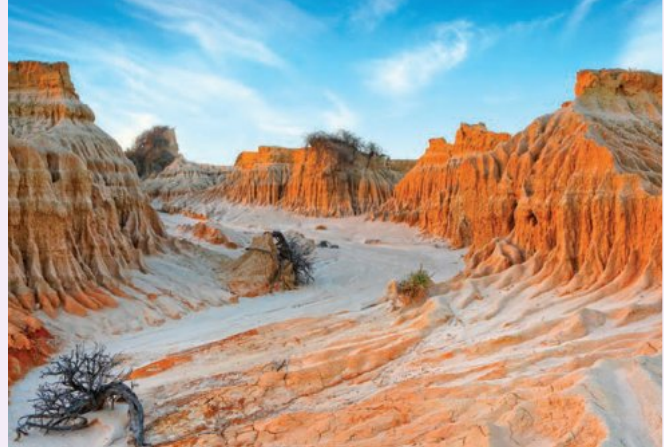
Two of these skeletons – named Mungo Man and Mungo Lady – were determined to have been ritualistically buried in a complex burial process. This places Lake Mungo as one of the earliest examples of ritualistic burial anywhere in the world. In 2003, 460 footprints were uncovered around the lake and dated to around 20,000 years old, representing the largest collection of fossilised footprints ever found in a single discovery anywhere in the world.
Note
Lake Mungo's Significance
The Lake Mungo area is now World Heritage listed and holds incredible significance for the Paakantji, Mutthi Mutthi and Ngyimpaa peoples. The skeletons have since been returned to the Aboriginal communities to which they belong.
Mungo Man was a 42,000-year-old Aboriginal man who lived around the shores of Lake Mungo with his family and died at approximately 50 years of age. He suffered from significant arthritis after a hard life as a hunter. He cared for his Country and kept the special men's knowledge of his people safe. His careful burial demonstrates the cultural sophistication and spiritual beliefs of Aboriginal Australians from this ancient period.
Parallel scientific understandings
Important
Respecting Multiple Perspectives
It is important to acknowledge the existence of two parallel scientific theories of early human migration. The Western scientific view presented in this topic describes migration out of Africa based on fossil and DNA evidence. While the observational framework of Indigenous scientific process is similar to the Western process, the way of explaining and communicating knowledge can be very different.
Neither understanding should be privileged, and both should be respected and communicated without bias.
It is important to acknowledge the existence of two parallel scientific theories of early human migration. The Western scientific view presented in this topic describes migration out of Africa based on fossil and DNA evidence. While the observational framework of Indigenous scientific process is similar to the Western process, the way of explaining and communicating knowledge can be very different.
For example, it is the understanding of some Aboriginal Australian language groups that their people have been in Australia since the beginning of time. Another example is the different meaning of Dreaming beings for Aboriginal language groups, who sometimes believe that children's spirits are present in the landscape and enter women's bodies when the child quickens (first moves). Neither understanding should be privileged, and both should be respected and communicated without bias.
The Out of Africa model, which places the arrival of Aboriginal Australians at around 50,000 to 65,000 years ago, diminishes the traditional view of many First Nations communities who believe their people have been in Australia since the time of creation. Genomic research carried out by non-Aboriginals into the origins of Aboriginal people can create tension in Indigenous communities for several reasons, including:
- A diminishment of their cultural connection to their creation story
- A challenge to their identity and status as First Nations people
- Potential risks regarding land rights and status within certain communities
Note
Diversity Among Aboriginal Peoples
It is crucial to remember that Aboriginal people's understandings, laws, and cultures are not consistent across Australia. Different peoples have very different beliefs and systems of social organisation. Where possible, specific language groups should be identified, and where generalisations are made, it should be noted that they do not apply to all Aboriginal cultural groups.
Remember!
Summary
Key Points to Remember:
-
Two main hypotheses explain human migration: The Out of Africa hypothesis (widely accepted) suggests Homo sapiens evolved in Africa 200,000-300,000 years ago and migrated outward in waves starting ~150,000 years ago. The multiregional hypothesis (largely unsupported) suggests Homo sapiens evolved from multiple separate Homo erectus populations across different continents.
-
Multiple types of evidence support the Out of Africa model: Mitochondrial DNA analysis traces all maternal lineages back to Africa, limited genetic diversity suggests a single small origin population, fossil evidence shows migration routes along African coastlines, and archaeological artifacts (tools, cave paintings) mark the path of human expansion across Eurasia.
-
Aboriginal Australians arrived 50,000-65,000 years ago: They reached the supercontinent Sahul (which included Australia, Tasmania, and New Guinea before separation) and spread rapidly across the continent, making them the world's oldest continuous population.
-
Connection to Country is fundamental to Aboriginal identity: This reciprocal relationship between First Nations people and their ancestral lands goes far beyond physical environment. Country (with capital C) encompasses spiritual meaning, kinship relationships, and deep attachment. The land provides for people, while people care for the land through culture and ceremony.
-
Cultural practices demonstrate sophisticated knowledge: Aboriginal societies developed complex systems including the Dreaming (explaining creation and relationships), totems (spiritual connections), totemic relationships, and moieties (social divisions). Marriage regulations prevented inbreeding, showing deep understanding of heredity passed down through countless generations.