The Human Fossil Record (VCE SSCE Biology): Revision Notes
📚Revision Notes
The Human Fossil Record
Introduction
The human fossil record provides crucial evidence for understanding our evolutionary history. However, interpreting this record presents significant challenges for scientists. The fossil evidence we have is incomplete, fragmentary, and sometimes difficult to classify. This leads to ongoing debates, refinements, and changes in our understanding of human evolution as new evidence emerges.
Note
The human fossil record is like an incomplete puzzle that scientists gradually piece together through new discoveries. Each new fossil can change our understanding of the relationships between different hominin species.
Why is interpreting the human fossil record so difficult?
The incomplete nature of the fossil record
The human fossil record represents an incomplete picture of our evolutionary history. Scientists can only study the fossilised remains that have been preserved and discovered, which represent a tiny fraction of all the hominins that have ever existed. This incompleteness arises from several key factors:
Reasons for an incomplete fossil record:
- Fossilisation requires specific environmental conditions that are rarely met when organisms die. Many individuals decompose completely or are consumed by scavengers before fossilisation can occur
- Rock layers containing fossils can erode over time, destroying the fossil evidence they contain
- Many rock layers remain inaccessible to palaeontologists, meaning countless fossils have yet to be discovered
Important
Definition of Inference
An inference is defined as conclusions or assumptions reached by analysing and extrapolating from evidence. Because the fossil record itself is incomplete, the inferences scientists make about human evolution are also limited and can be challenged when new evidence emerges.
Difficulties in classification and interpretation
When scientists discover new fossils, they face the challenge of determining which species the fossil represents. This becomes particularly problematic when a fossil shares characteristics with multiple known species.
Note
Classification Dilemma
Consider this scenario: Scientists discover a new fossil (Fossil A) in a cave. The fossil is dated to the same time period as two other hominin species (Species X and Species Y) that lived in the same area. Furthermore, Fossil A shares anatomical features with both Species X and Species Y.
This creates a dilemma: Does the fossil belong to Species X, Species Y, or does it represent an entirely new species (Species Z)?
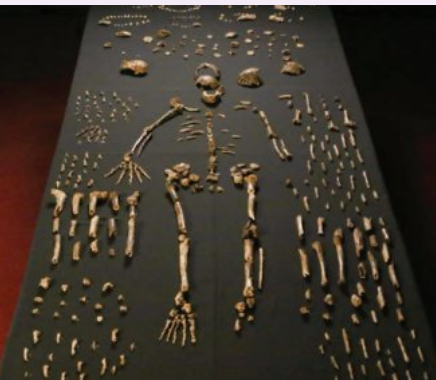
Case study: Homo naledi
Example
Worked Example: The Discovery of Homo naledi
The discovery of Homo naledi perfectly illustrates the difficulties in interpreting fossil evidence. In 2013, fossils of an unknown hominin species were uncovered in a cave in South Africa. These fossils displayed an unusual combination of features, showing characteristics of both modern humans (Homo) and older hominins (Australopithecus).
Step 1: Initial Classification Challenge
This led some scientists to propose that H. naledi might be a transitional fossil - a fossil that shows traits common to both its ancestral group and its descendant group.
Step 2: Analyzing the Features
The fossils showed a mix of primitive and modern characteristics:
| Australopithecus-like features | Homo-like features |
|---|---|
| More primitive shoulders | Rounded skull shape |
| Long, curved fingers suggesting tree-climbing | Hands well suited for object manipulation |
| Wider, flatter pelvis | Arched feet and smaller ankles |
| Small skull size | |
| Wide rib cage |
Step 3: The Dating Mystery
The fossils were not initially dated, which was a crucial missing piece of information. Intriguingly, the fossils were arranged in a peculiar pattern, suggesting possible burial rituals. If H. naledi proved to be older than the genus Homo, this would indicate that complex behaviours like burial evolved much earlier than previously thought.
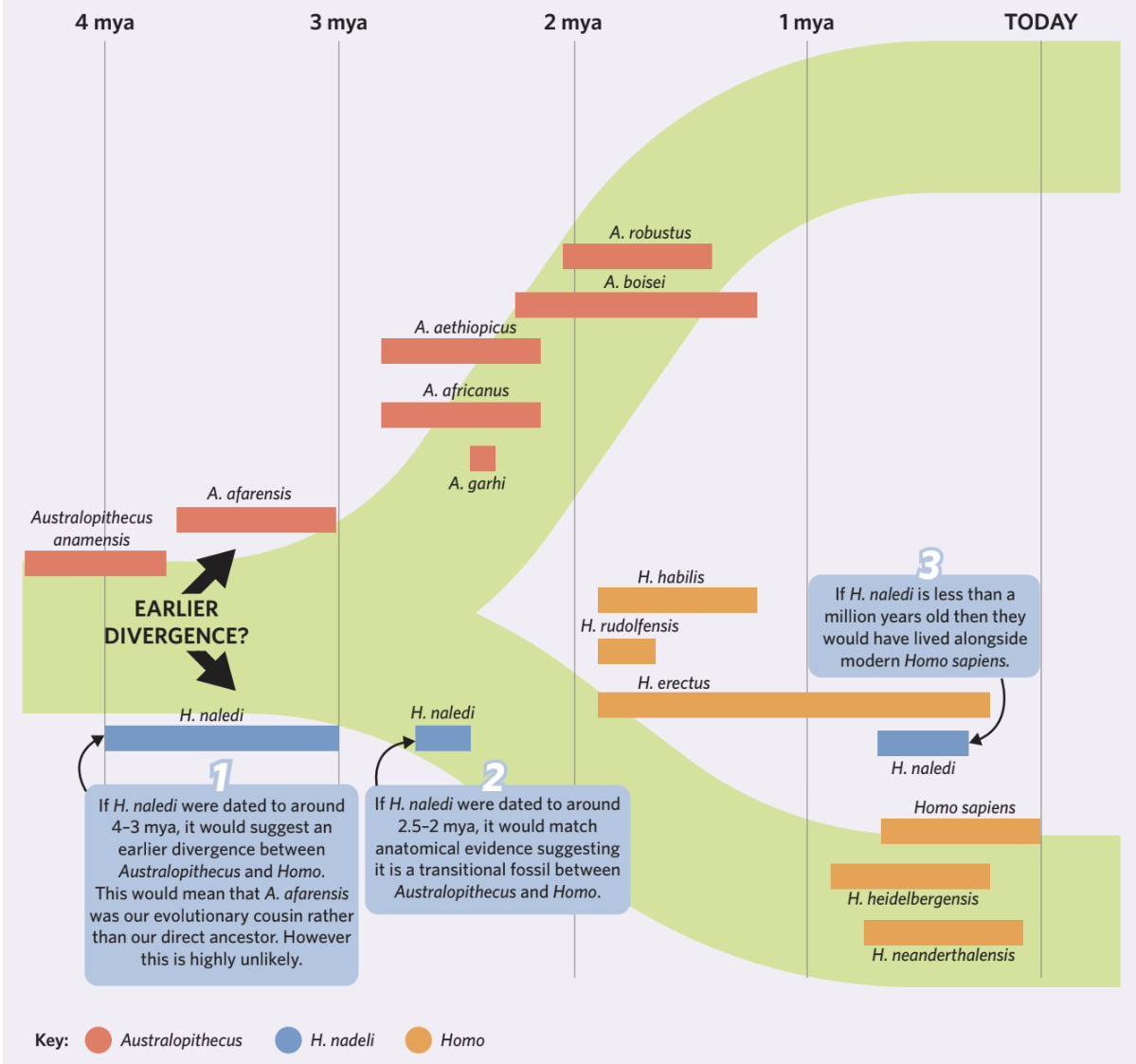
Three possible dating scenarios existed for H. naledi, each with different implications:
- 4-3 million years ago: Would suggest an earlier divergence between Australopithecus and Homo, making A. afarensis our evolutionary cousin rather than direct ancestor (though this was considered highly unlikely)
- 2.5-2 million years ago: Would match the anatomical evidence suggesting H. naledi is a transitional fossil between Australopithecus and Homo
- Less than 1 million years ago: Would mean H. naledi lived alongside modern Homo sapiens
Important
The Surprising Result
In 2017, the fossils were finally dated to approximately 250,000 years ago, confirming the third scenario. This discovery demonstrated that H. naledi was not as ancient as initially suspected and actually coexisted with modern humans.
This case exemplifies the uncertainty surrounding our evolutionary history and how new evidence can dramatically change our interpretations.
Important
Definition of Transitional Fossil
A transitional fossil is a fossil that shows traits that are common to both its ancestral group and its descendant group. They are particularly important when the descendant species is physically very distinct from the ancestral species, such that the transitional fossil can help demonstrate evolutionary changes between the two.
Changes in evolutionary trees over time
As new fossils are discovered and dating techniques improve, our understanding of human evolutionary relationships changes. Scientists do not always agree on the positioning of particular Homo species within the evolutionary tree, and significant gaps in the fossil record mean that new discoveries can substantially alter previous interpretations.
Note
Evolution of Understanding: 1997 vs 2013
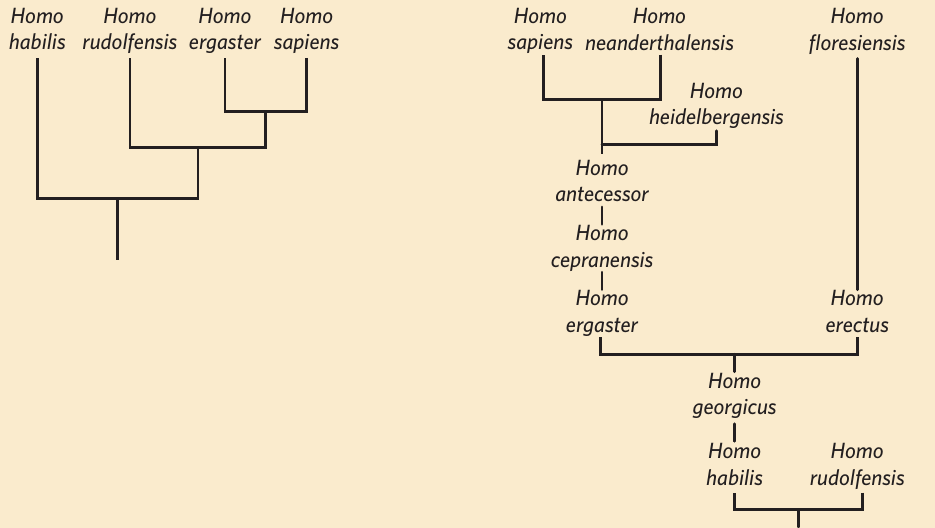
Comparing Homo evolutionary trees from 1997 and 2013 reveals substantial changes in just 16 years. Not only were many new Homo species discovered during this period, but the relationships between different species were also revised.
For example, the relationship between H. ergaster and H. sapiens changed significantly:
- In 1997, the two species shared a common ancestor but H. ergaster was not considered a direct ancestor of H. sapiens
- By 2013, H. ergaster was positioned as a direct ancestor to H. sapiens
- The two species were thought to share a more recent common ancestor in 1997 than in 2013
These changes demonstrate that the human fossil record is a classification scheme that remains open to different interpretations. Scientists contest, refine, or replace these interpretations when challenged by new evidence.
Did we breed with Neanderthals?
Introduction to Neanderthals
Homo neanderthalensis, commonly known as Neanderthals, were our close evolutionary cousins that inhabited Europe and Asia between 40,000 and 400,000 years ago. The first Neanderthal fossils were discovered in the Neander Valley in Germany in 1856, and fossil evidence has accumulated steadily since then.
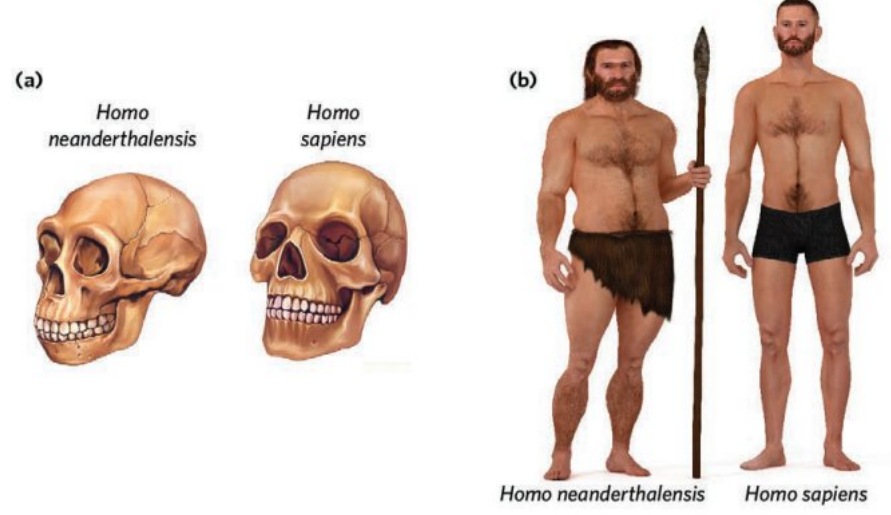
Mitochondrial DNA (mtDNA) extracted from Neanderthal fossils and compared with H. sapiens DNA suggests that we are separate species that shared a recent common ancestor approximately 400,000 years ago. Despite being closely related to humans, Neanderthals possessed several distinct physical characteristics.
Physical characteristics of Neanderthals
Neanderthals shared many features with modern humans but differed in several important ways:
- Wider nose
- Shorter limbs
- Stockier, more muscular build
- Flared rib cage
- Sloping forehead
- Enlarged brow ridge
- Larger cranial capacity
- Better resistance to cold climates
Note
These adaptations likely helped Neanderthals survive in the colder climates of Ice Age Europe and Asia. Their stockier build and wider nose may have been particularly advantageous for conserving heat in frigid environments.
Evidence for interbreeding
Important
Definition of Interbreeding
Interbreeding refers to the mating between different species, such as between Homo sapiens and other closely related species like Neanderthals and Denisovans. This is also known as crossbreeding.
Modern humans and Neanderthals lived in the same regions of Eurasia between 40,000 and 100,000 years ago. Recent DNA evidence strongly suggests that interbreeding occurred between our two species during this period.
Example
Evidence Supporting Human-Neanderthal Interbreeding
| Evidence | Inference |
|---|---|
| Nuclear DNA studies in 2010 revealed that approximately 1-4% of the human genome is identical to DNA found in Neanderthals. Importantly, this similarity was only found in non-African populations, not in sub-Saharan African genomes. | Neanderthals may have interbred with humans as they left Africa, somewhere in the Middle East around 65,000 years ago. They did not interbreed with African humans who remained on the continent. |
| 100,000-year-old DNA from Neanderthal fossils found in Siberia in 2016 contained a significant amount of ancient human DNA not found in other Neanderthal populations. | A population of Neanderthals in Siberia may have interbred with an early form of humans around 100,000 years ago, suggesting a second interbreeding event. |
Neanderthal DNA in modern humans
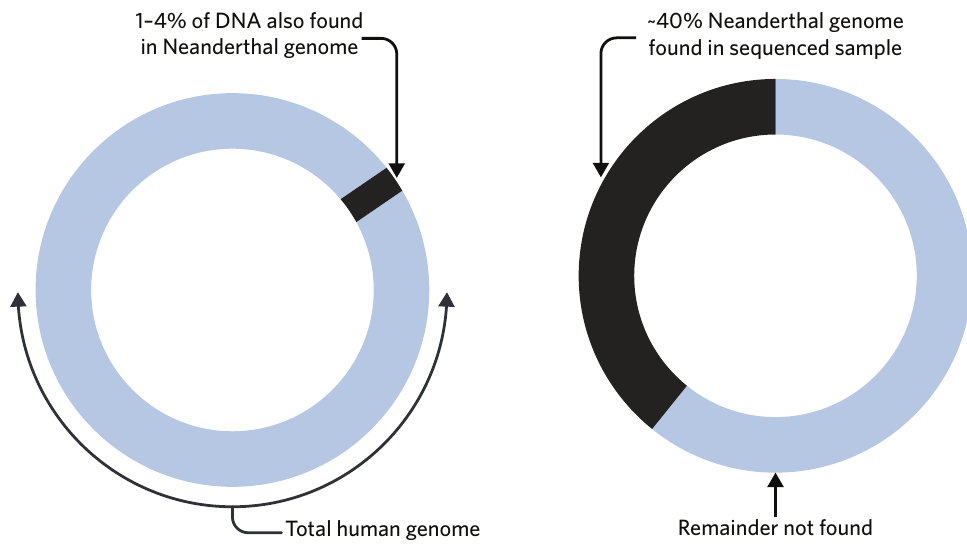
Although approximately 1-4% of some human genomes consist of Neanderthal DNA, the specific portion of the Neanderthal genome found in each person varies considerably. Researchers at Princeton University demonstrated this by recovering around 41% of the total Neanderthal genome from a sample of 2,500 individuals.
Note
Piecing Together the Neanderthal Genome
Rather than directly sequencing Neanderthal DNA from fossils, the researchers pieced together portions of the Neanderthal genome from the small segments of shared DNA found in different modern humans' genomes. This approach revealed that different people carry different segments of Neanderthal DNA, collectively preserving a substantial portion of the Neanderthal genome within modern human populations.
New hominin species
Homo denisova
In 2010, scientists reported discovering bone fragments of a new hominin species in Denisova Cave in Siberia. These bones were dated to approximately 40,000 years ago. Nuclear DNA analysis revealed that the bones were very closely related to Neanderthals but sufficiently different to represent a distinct species, named Homo denisova or Denisovans.
Note
Due to limited fossil evidence - only a few small teeth and a partial jawbone discovered in the Tibetan Plateau in 2019 - most inferences about Denisovans have been made primarily from DNA evidence rather than anatomical studies.
Interbreeding with Melanesians:
One particularly significant finding concerns the relationship between Denisovans and modern humans from Melanesia (a subregion of Oceania including Fiji, Vanuatu, the Solomon Islands, and Papua New Guinea). DNA analysis of Melanesian Homo sapiens revealed that they share 4-6% of their DNA with Denisovans, whilst other human populations do not. This interbreeding event likely occurred between 15,000 and 44,000 years ago as the ancestors of Melanesians migrated south through Southeast Asia.
Important
Evidence of Multiple Interbreeding Events
Interestingly, evidence also suggests significant interbreeding between Denisovans and Neanderthals themselves. About 17% of the Denisovan genome derived from fossils in Denisova Cave was identified as Neanderthal DNA.
Remarkably, scientists even discovered a first-generation hybrid individual with a Denisovan father and Neanderthal mother, nicknamed 'Denny'. This extraordinary find provides direct evidence that these two species interbred.
Homo luzonensis
In April 2019, researchers in the Philippines announced the discovery of a new hominin species. The discovery originated from a single metatarsal (long foot bone) uncovered in 2007 in Callao Cave in the northern part of Luzon, the largest island of the Philippines. The original bone was dated to 67,000 years old.
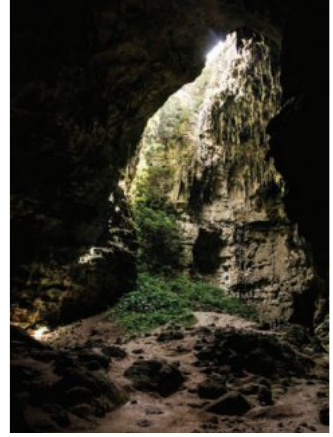
Since the initial discovery, return expeditions in 2011 and 2015 uncovered additional remains: two more toe bones, seven teeth, two finger bones, and part of a femur. Based on these fossils, scientists estimate that H. luzonensis was a relatively small-bodied hominin ancestor that lived on Luzon between 50,000 and 67,000 years ago.
Note
An Unusual Mix of Features
The fossils displayed an unexpected mixture of both ancient and modern hominin traits, making classification difficult. For example:
- The teeth were small in size and simple in shape, indicating a more modern hominin species
- The foot bones resembled those of the most ancient Australopithecus ancestors
The specimens showed a novel combination of features different from any other species in the genus Homo. This unique combination warranted classification as a new species, which was named Homo luzonensis.
Summary of interbreeding events
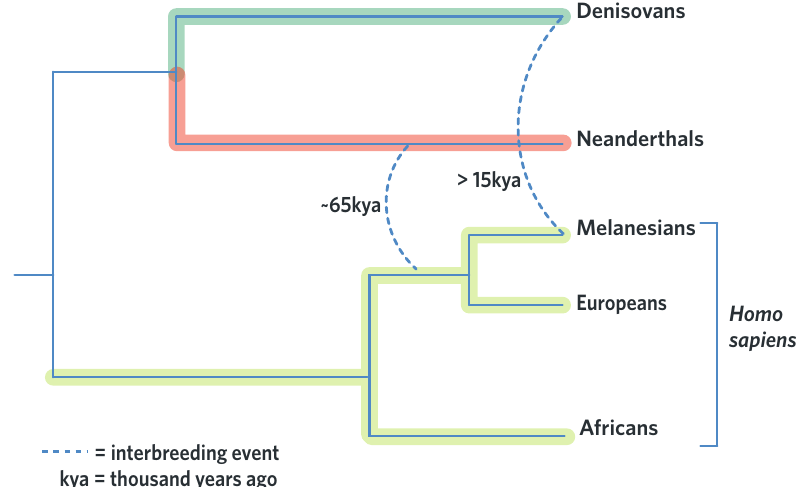
The phylogenetic tree above summarises the interbreeding events between modern humans, Denisovans, and Neanderthals:
- Neanderthals interbred with humans leaving Africa approximately 65,000 years ago
- Denisovans interbred with ancestors of Melanesians over 15,000 years ago
- These interbreeding events resulted in the DNA signatures we observe in modern human populations today
Remember!
Summary
Key Points to Remember:
-
The human fossil record is incomplete because fossilisation requires specific conditions, rock layers erode over time, and many fossils remain undiscovered
-
Scientists make inferences from fossil evidence, but these interpretations can change when new evidence emerges or when fossils are difficult to classify
-
Homo naledi demonstrates how dating uncertainties can lead to multiple possible interpretations about a species' place in human evolution - it was dated to 250,000 years ago, much younger than initially expected
-
DNA evidence shows that modern humans interbred with Neanderthals approximately 65,000 years ago, with non-African populations carrying 1-4% Neanderthal DNA
-
Homo denisova represents another hominin species that interbred with ancestral Melanesians, contributing 4-6% of their DNA
-
Recently discovered species like H. luzonensis continue to add new branches to our evolutionary tree, demonstrating that our understanding of human evolution remains incomplete and evolving