Cell Size and Shape (VCE SSCE Biology): Revision Notes
📚Revision Notes
Cell size and shape
Introduction
The human body contains approximately 37.2 trillion cells rather than being composed of one giant cell. This organisation into many small cells provides significant advantages for biological function, particularly in the transport of nutrients and removal of waste products.
Why are cells so small?
Variation in cell sizes
Cells differ greatly in both size and shape depending on their specific functions. The ovum, or egg cell, represents the largest human cell that can be observed without magnification. It measures approximately 0.1 mm in diameter and has an almost perfectly spherical shape.
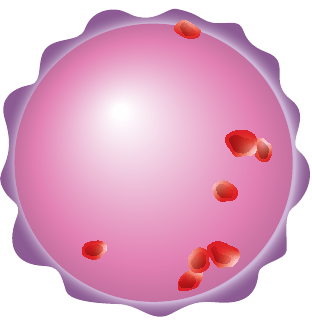
In contrast, red blood cells are much smaller, with a diameter of about 7 micrometres (µm), which equals 0.007 mm. These cells have a distinctive biconcave disc shape, appearing slightly indented on both sides rather than spherical.
Note
Key Cell Definitions:
Ovum (plural: ova) - a fully mature female egg cell which, when fertilised, can divide and give rise to an embryo.
Red blood cells - cells that transport oxygen through the bloodstream and do not contain a nucleus.
The difference in size between these cells relates directly to their different purposes. Ova need to be large because they store genetic information, organelles, and nutrients required to create an embryo. Red blood cells need to be small because they must squeeze through tiny blood vessels called capillaries to deliver oxygen throughout the body.
Benefits of small cells
Having many small cells instead of fewer large cells provides two important advantages:
Note
Two Key Advantages of Small Cells:
1. Efficient exchange of materials
Small cells can exchange materials with their surrounding environment more effectively. This includes taking in nutrients and oxygen whilst removing waste products and toxins. This efficiency results from having a high surface area to volume ratio, which will be explained in detail in the next section.
2. Faster intracellular transport
When cells are small, the distances molecules need to travel within the cell are reduced. This means materials can move around inside the cell more quickly. Think of the difference between running across a small room versus running the length of a football field - shorter distances mean faster journeys for molecules moving inside cells.
Surface area to volume ratio
Understanding surface area to volume ratio (SA:V) is essential for explaining why cells remain microscopic. A higher SA:V ratio allows cells to exchange materials with their environment more efficiently.
Understanding volume
Volume is the amount of space inside an object. It is always measured in cubic units such as mm³, cm³, or m³.
A useful conversion to remember: 1 mL = 1 cm³
This means an object with a volume of 1000 cm³ could hold 1 litre of liquid.
Calculating volume
For a rectangular prism (cuboid), the formula is:
All measurements must be in the same units before calculating.
Example
Worked Example: Calculating Volume
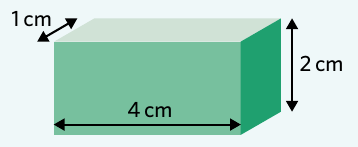
For a rectangular prism with:
- length = 4 cm
- width = 1 cm
- height = 2 cm
Solution:
This object could contain 8 cm³ (or 8 mL) of liquid.
Understanding surface area
Surface area is the sum of the area of all exposed sides of a three-dimensional shape. It is always measured in square units such as mm², cm², or m².
Calculating surface area
To calculate the surface area of a rectangular prism, follow these steps:
Example
Worked Example: Calculating Surface Area
Using the same rectangular prism as before (length = 4 cm, width = 1 cm, height = 2 cm):
Step 1: Identify the length, width, and height of the object
Step 2: Calculate the area of each unique face:
- Face A = length × width = 4 cm × 1 cm = 4 cm²
- Face B = length × height = 4 cm × 2 cm = 8 cm²
- Face C = width × height = 1 cm × 2 cm = 2 cm²
Step 3: Multiply each face area by 2 (because there are two of each face - front and back, top and bottom, left and right sides)
Step 4: Add all the face areas together
Solution:
Understanding ratios
A ratio is a comparison between two things to show proportions. Ratios work similarly to fractions in that we simplify them as much as possible.
Note
For example, if a fruit bowl contains 10 apples and 2 oranges, the ratio would be written as 5:1 (five apples for every one orange), not 10:2.
Calculating surface area to volume ratio
The surface area to volume ratio (SA:V) is a comparison of the amount of surface area per unit of volume. In biology, SA:V influences temperature regulation, and a high SA:V leads to more effective transport into and out of cells.
To calculate SA:V, follow these steps:
Step 1: Calculate the surface area
Step 2: Calculate the volume
Step 3: Divide surface area by volume (SA ÷ V)
Step 4: Express the answer as a ratio
Example
Worked Example: Calculating SA:V Ratio
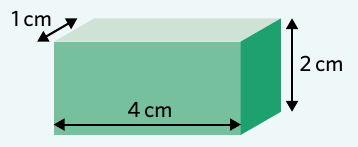
Using our rectangular prism (4 cm × 1 cm × 2 cm):
Step 1: Surface area = 28 cm²
Step 2: Volume = 8 cm³
Step 3: SA ÷ V = 28 ÷ 8 = 3.5
Step 4: Express as ratio: SA:V = 3.5:1
This means for every 1 cm³ of volume, there are 3.5 cm² of surface area.
How size affects SA:V
Important
Critical Principle: Smaller objects have larger surface area to volume ratios. This is a crucial principle in biology.
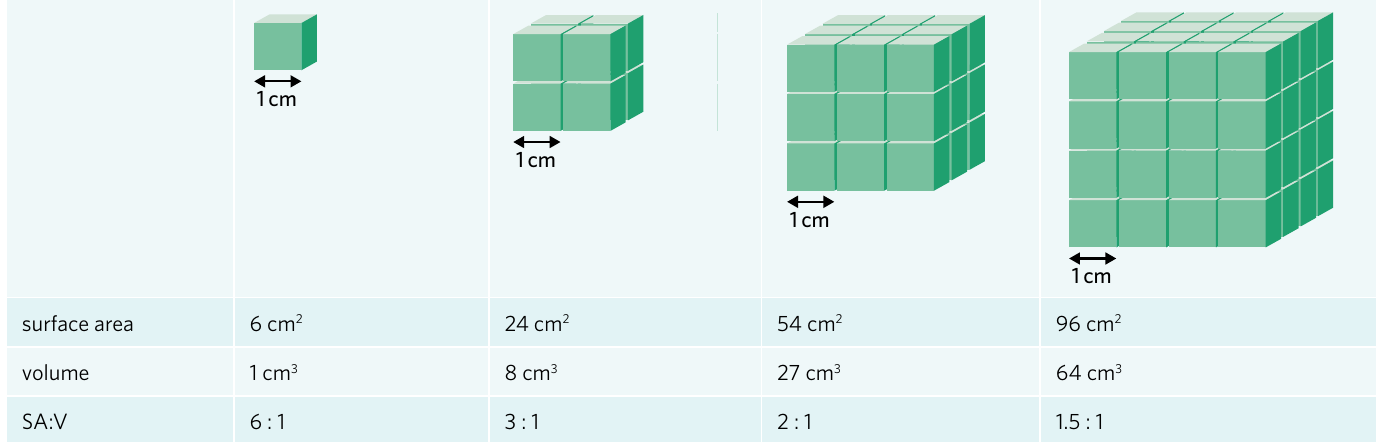
As objects increase in size, their volume increases faster than their surface area. Consider these cubes with 1 cm edges:
| Cube size | Surface area | Volume | SA:V ratio |
|---|---|---|---|
| 1 × 1 × 1 cm | 6 cm² | 1 cm³ | 6:1 |
| 2 × 2 × 2 cm | 24 cm² | 8 cm³ | 3:1 |
| 3 × 3 × 3 cm | 54 cm² | 27 cm³ | 2:1 |
| 4 × 4 × 4 cm | 96 cm² | 64 cm³ | 1.5:1 |
The smallest cube has the highest SA:V ratio (6:1), whilst the largest has the lowest ratio (1.5:1). This explains why cells must remain small to maintain efficient exchange of materials with their environment.
How shape affects SA:V
Shape also influences the surface area to volume ratio. Objects with the same volume can have different SA:V ratios depending on their shape.
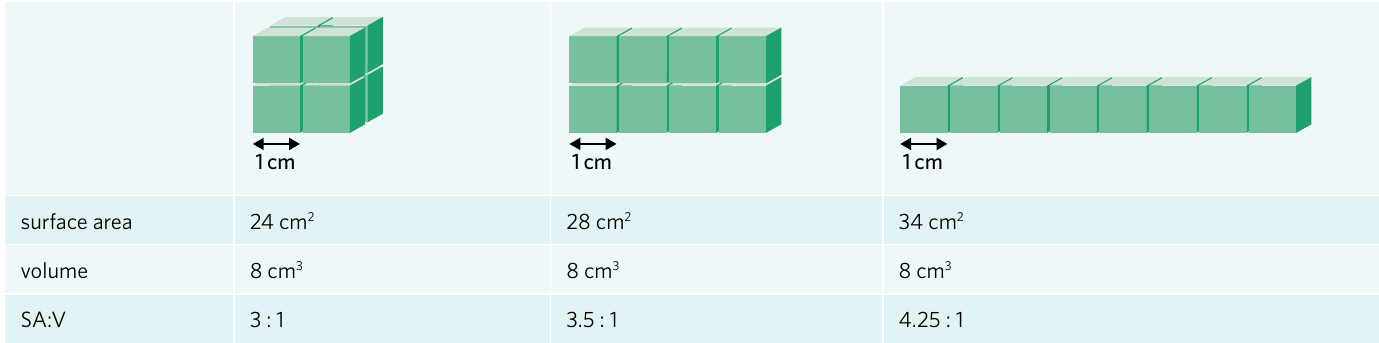
Compare these three shapes, each with a volume of 8 cm³:
| Shape | Dimensions | Surface area | Volume | SA:V ratio |
|---|---|---|---|---|
| Cube | 2 × 2 × 2 cm | 24 cm² | 8 cm³ | 3:1 |
| Rectangular prism | 1 × 2 × 4 cm | 28 cm² | 8 cm³ | 3.5:1 |
| Elongated prism | 1 × 1 × 8 cm | 34 cm² | 8 cm³ | 4.25:1 |
The general pattern shows that more compact objects have lower SA:V ratios, whilst elongated objects with long lengths and short widths have higher SA:V ratios.
Note
Exam Tip: When comparing shapes with the same volume, remember that elongated or flattened shapes have higher SA:V ratios than compact, cube-like shapes.
Cells and surfaces with high SA:V
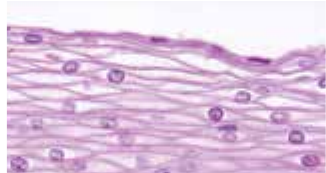
Both individual cells and tissue surfaces that need to exchange large amounts of materials tend to be small and elongated to maximise their surface area to volume ratio.
The small intestine example
The small intestine absorbs nutrients from digested food. To maximise absorption efficiency, the cells lining the intestine are organised into finger-like projections called villi. These structures dramatically increase the surface area available for nutrient absorption.
Note
Maximising Surface Area in the Small Intestine:
Some cells within the villi have even smaller projections on their surface called microvilli. These microscopic folds further increase the surface area of individual cells.
By having both villi (at the tissue level) and microvilli (at the cellular level), the small intestine achieves a much higher surface area to volume ratio compared to a smooth tube. This increased SA:V allows more efficient absorption of nutrients into the bloodstream.
Practical application
Consider cutting potatoes for cooking. Smaller pieces cook faster than larger pieces because they have a higher surface area to volume ratio, allowing heat to penetrate more quickly.
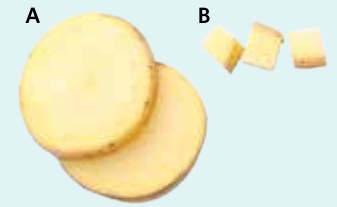
Similarly, cubed potatoes cook faster than thick slices because the cubed pieces have a higher SA:V ratio, even if the total amount of potato is the same.
Summary
Key Points to Remember:
- Human bodies contain approximately 37.2 trillion cells rather than one giant cell
- Small cells have two key advantages: efficient material exchange due to high SA:V and faster intracellular transport
- Volume is measured in cubic units (cm³, mm³) and calculated as length × width × height
- Surface area is measured in square units (cm², mm²) and calculated by adding the areas of all faces
- Smaller objects have higher SA:V ratios than larger objects of the same shape
- Elongated shapes have higher SA:V ratios than compact shapes of the same volume
- Biological structures like villi and microvilli maximise SA to improve nutrient absorption