Factors That Affect Enzymes (VCE SSCE Biology): Revision Notes
📚Revision Notes
Factors That Affect Enzymes
Enzyme activity is influenced by several environmental and molecular factors. Understanding these factors is essential for explaining how enzymes work in biological systems such as photosynthesis and cellular respiration. This note explores the key factors that affect enzyme function: temperature, pH, concentration, inhibitors, and coenzymes.
Temperature
Temperature has a significant impact on how well enzymes perform their catalytic functions. As temperature changes, so does the rate at which enzyme-catalysed reactions occur.
Optimal temperature
When temperature increases in living systems, molecules gain more kinetic energy. This means they move faster and collide more frequently. For enzyme-catalysed reactions, this results in more frequent collisions between enzymes and their substrates, which speeds up the reaction rate.
Note
The increase in kinetic energy at higher temperatures leads to more enzyme-substrate complex formation. Each collision between an enzyme and its substrate molecule presents an opportunity for binding and catalysis to occur.
However, this increase in activity only continues up to a certain point. Each enzyme has a specific optimal temperature at which it functions most effectively. The optimal is defined as "the point at which for a given condition (e.g. temperature), the maximum function of an enzyme occurs."
For human enzymes, the optimal temperature range is typically 36–38°C, matching normal body temperature of 37°C. Different organisms have enzymes adapted to their environments. For example, bacteria living in hot springs may have enzymes with optimal temperatures above 70°C.
Effects of high temperature
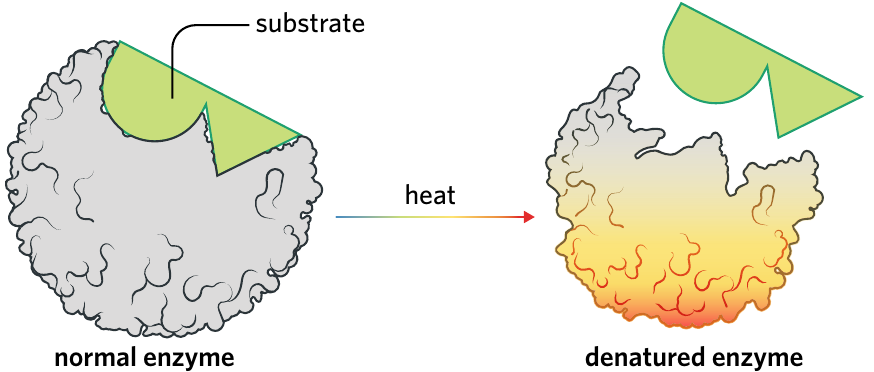
When temperature rises beyond the optimal point, enzymes are at risk of damage. Enzymes are primarily proteins, and proteins can be disrupted by excessive heat. Denature is defined as "the disruption of a molecule's structure by an external factor such as heat."
High temperatures break the bonds that maintain the enzyme's tertiary and quaternary structures. This causes a conformational change, which is "a change in the three-dimensional shape of macromolecules such as proteins." When the enzyme's shape changes, the active site no longer fits the substrate properly, preventing the reaction from occurring.
Important
Denaturation caused by high temperature is irreversible. Once an enzyme has been denatured by heat, it cannot regain its function even if the temperature decreases. Think of cooking an egg - you cannot "uncook" it back to its raw state.
Effects of low temperature
When temperature drops below the optimal point, enzyme activity decreases. This happens because molecules have less kinetic energy, move more slowly, and collide less frequently. Fewer enzyme-substrate complexes form, so the reaction rate slows down.
At very low temperatures, enzymes can freeze and lose function temporarily. However, unlike high-temperature denaturation, this effect is reversible. When the temperature increases again, the enzyme can regain its activity because no permanent structural damage has occurred. This is like freezing raw meat - you can thaw it back to raw meat.
Tolerance range
Beyond the specific optimal temperature, we can also describe the broader tolerance range. This is the wider range of temperatures within which an enzyme can still function, even if not at maximum efficiency. Outside this tolerance range, the enzyme becomes inactive.
Example
Real-World Example: Tolerance Range
An enzyme might have an optimal temperature of 58–60°C but a tolerance range of 30–70°C.
- Within this range (30–70°C), the enzyme functions to varying degrees
- Below 30°C, the enzyme might freeze and become inactive
- Above 70°C, the enzyme denatures and loses function permanently
Temperature and enzyme activity graph
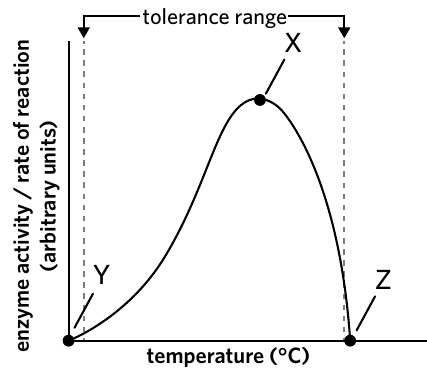
The relationship between temperature and enzyme activity can be represented graphically. This graph typically shows a curve that rises, reaches a peak, and then falls sharply.
Key points to understand from this graph:
- Point X represents the optimal temperature where enzyme activity is highest
- Point Y represents the lower temperature limit where enzyme activity is minimal due to reduced kinetic energy (freezing)
- Point Z represents the upper temperature limit where enzyme activity drops due to denaturation
- The tolerance range is marked between the dashed lines, showing the span of temperatures where the enzyme can function
Important characteristics:
- As temperature increases towards the optimal point, more enzyme-substrate complexes form due to increased kinetic energy
- As temperature decreases from the optimal point, fewer enzyme-substrate complexes form due to decreased kinetic energy
- Below the tolerance range, freezing occurs (reversible)
- Above the tolerance range, denaturation occurs (irreversible)
Important
Exam tip: You must be able to interpret temperature-enzyme activity graphs and identify optimal temperatures, tolerance ranges, and points where denaturation occurs.
pH
The acidity or alkalinity of the environment also significantly affects enzyme function. Each enzyme has specific pH conditions under which it works best.
The pH scale
The pH scale measures how acidic or alkaline a solution is, ranging from 0 to 14.
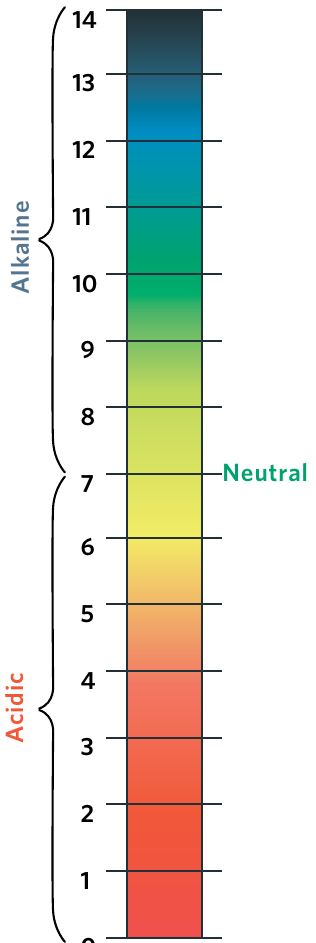
- Acidic solutions have pH values less than 7
- Neutral solutions have a pH of exactly 7
- Alkaline (basic) solutions have pH values greater than 7
Optimal pH
Just like with temperature, each enzyme has an optimal pH at which it functions most effectively. Different enzymes have different optimal pH values depending on where they work in the body.
Example
Examples of Enzyme pH Optima:
- Pepsin (found in the stomach) has an optimal pH of approximately 1.5–2, which suits the acidic stomach environment
- Pancreatic lipase has an optimal pH of around 8, which suits the more alkaline environment of the small intestine
pH extremes and denaturation
Unlike temperature (where only high temperatures cause denaturation), enzymes can be denatured by pH values that are either too acidic or too alkaline. Both extremes can disrupt the enzyme's structure and function.
Note
When pH moves away from the optimal point in either direction, the enzyme's activity decreases. The further from the optimal pH, the less active the enzyme becomes until denaturation occurs at both extremes.
At extreme pH values, denaturation occurs, causing permanent loss of function.
pH and enzyme activity graph
The relationship between pH and enzyme activity produces a symmetrical, bell-shaped curve.
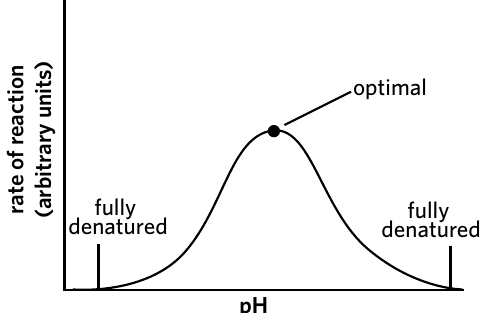
This graph shows:
- The optimal pH at the peak where enzyme activity is highest
- Regions of full denaturation at both the acidic and alkaline extremes
- A symmetrical decline in activity as pH moves away from the optimal point in either direction
Important
Exam tip: Remember that pH denaturation can occur at both extremes (too acidic OR too alkaline), whereas temperature denaturation typically only occurs at high temperatures.
Concentration
The concentrations of both substrates and enzymes play crucial roles in determining the overall rate of enzyme-catalysed reactions.
Substrate concentration
When enzyme concentration stays constant but substrate concentration increases, the reaction rate increases. This happens because more substrate molecules are available to bind with enzyme active sites, leading to more frequent collisions and more enzyme-substrate complexes forming.

However, this increase in reaction rate does not continue indefinitely. Eventually, a point is reached where substrate molecules continuously occupy all available active sites. This is called the saturation point, defined as "the point at which a substance (e.g. an enzyme) cannot receive more of another substance (e.g. a substrate)."
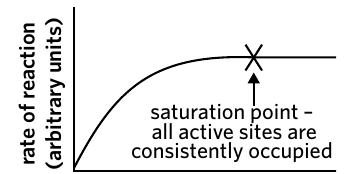
Once the saturation point is reached, adding more substrate does not increase the reaction rate further. All enzyme active sites are consistently occupied, so the enzymes are working at maximum capacity. The reaction rate plateaus and remains constant.
Note
It's important to note that at the saturation point, the reaction is still occurring very quickly - the rate simply cannot increase any further because all active sites are occupied.
Limiting factors and limiting reagents
Before reaching the saturation point, we can say that substrate concentration is a limiting factor. A limiting factor is defined as "a factor that prevents the rate of reaction from increasing."
When the limiting factor is specifically a reactant in the chemical equation, we call it a limiting reagent, defined as "a reactant that prevents the rate of reaction from increasing."
If we had more of the limiting reagent (substrate), the reaction rate would increase. However, once the graph plateaus at the saturation point, substrate concentration is no longer the limiting factor. At this stage, other factors such as temperature, pH, or enzyme concentration become the limiting factors preventing further increases in reaction rate.
Concentration versus total quantity of limiting reagents
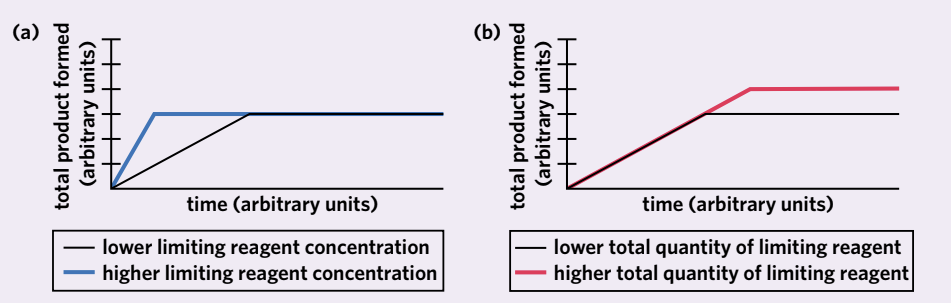
It's important to distinguish between the concentration of a limiting reagent and its total quantity.
Note
Understanding the Difference:
- Graph (a) shows that increasing the concentration of a limiting reagent increases the rate of reaction (the curve is steeper)
- Graph (b) shows that increasing the total quantity of a limiting reagent increases the maximum theoretical amount of product that can be produced, but not necessarily the rate
Enzyme concentration
Enzyme concentration also influences reaction rate. When substrate concentration is kept constant and enzyme concentration increases, the reaction rate increases. This occurs because more active sites are available for substrate molecules to bind to, leading to more enzyme-substrate complexes forming.
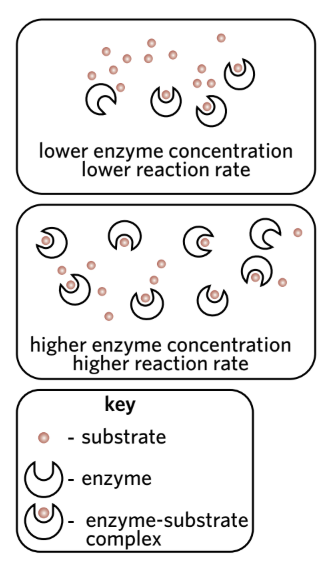
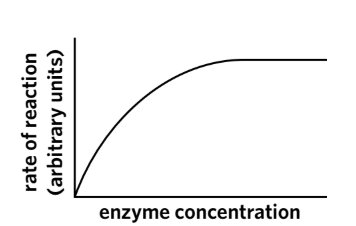
The relationship between enzyme concentration and reaction rate can be displayed graphically.
Key points:
- As enzyme concentration increases (with constant substrate), reaction rate increases
- This continues until enzymes are in excess, at which point the reaction rate plateaus
- At the plateau, adding more enzymes doesn't help because there isn't enough substrate available
Note
In biological systems, there is typically far more substrate than enzyme available, so increasing enzyme concentration usually increases the reaction rate. The graph shows this characteristic rising curve that levels off.
Important
Exam tip: Be able to distinguish between the four main graph shapes for factors affecting enzymes:
- Bell curve for temperature
- Bell curve for pH
- Saturation curve for substrate concentration
- Rising saturation curve for enzyme concentration
Competitive and non-competitive inhibition
Enzyme function can be reduced or prevented by molecules called inhibitors. There are two main types based on where they bind to the enzyme.
Enzyme inhibitors
An enzyme inhibitor is defined as "a molecule that binds to and prevents an enzyme from functioning." When an inhibitor is bound to an enzyme, the enzyme either cannot catalyse its reaction at all, or its function is greatly reduced.
Competitive inhibition
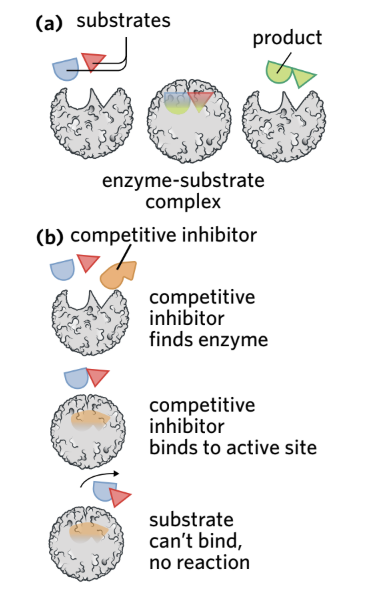
Competitive inhibition is defined as "the hindrance of an enzyme by blocking the active site and preventing the substrate from binding."
In competitive inhibition, an inhibitor molecule binds directly to the enzyme's active site. This blocks the active site, preventing the substrate from binding. Without substrate binding, no reaction can occur.
Note
For a competitive inhibitor to block an active site, it must have a shape that is complementary to the active site in some way. Therefore, competitive inhibitors share structural similarities with the substrate. However, unlike the substrate, when a competitive inhibitor binds to the active site, it does not trigger any reaction.
This type of inhibition is called "competitive" because both the substrate and the inhibitor are competing to bind to the same active site. They are in competition with each other.
Non-competitive inhibition
Non-competitive inhibition (also called allosteric inhibition) is defined as "the hindrance of an enzyme by binding to an allosteric site and changing the shape of the active site to prevent the substrate from binding."
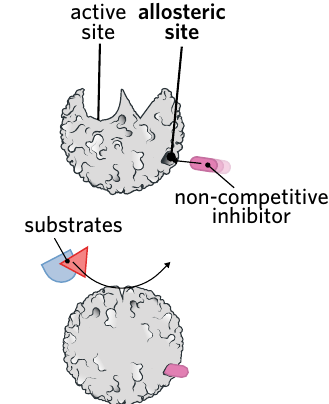
An allosteric site is "a region on an enzyme that is not the active site."
In non-competitive inhibition, the inhibitor binds to a site on the enzyme that is not the active site. This binding causes a conformational change in the enzyme's structure, which alters the shape of the active site. The changed active site can no longer bind the substrate properly, preventing the reaction from occurring.
Important
Unlike competitive inhibition, non-competitive inhibitors do not compete directly with the substrate for the active site. They work indirectly by changing the enzyme's shape from a different location.
Reversible and irreversible inhibition
Enzyme inhibitors can also be classified according to whether their effects are permanent or temporary. This depends on the strength of the bonds formed between the enzyme and inhibitor.
Reversible inhibition
Reversible inhibition is defined as "enzyme inhibition that involves weaker bonds that can be overcome."
In reversible inhibition, the inhibitor forms weak bonds with the enzyme. These weak bonds can be broken, allowing the enzyme to regain its function. The effects are not permanent and can be reversed.
Reversible inhibitors typically slow down the rate of an enzyme-catalysed reaction but do not stop it completely or indefinitely.
Note
A reversible, competitive inhibitor forms weak bonds with the enzyme's active site. These bonds can break, making the active site available again for substrate molecules or other inhibitors. This significantly slows enzyme action, but the effect can be overcome by increasing the substrate concentration. More substrate provides a greater chance that substrate (rather than inhibitor) will bind to the enzyme, increasing overall enzyme function.
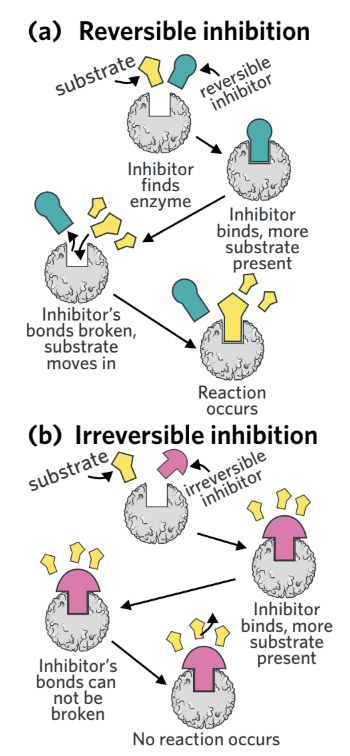
Reversible inhibitors can act either competitively or non-competitively. Unlike competitive inhibitors, non-competitive reversible inhibitors are not affected by changes in substrate concentration.
Irreversible inhibition
Irreversible inhibition is defined as "enzyme inhibition that involves stronger bonds that cannot be broken."
In irreversible inhibition, inhibitors form strong, permanent bonds with the enzyme. These bonds cannot be broken. If an irreversible inhibitor binds to an enzyme, that enzyme cannot bind with substrate or catalyse reactions ever again.
Important
This means that no matter how much extra substrate is present, the reaction cannot occur with that particular enzyme molecule. Most irreversible inhibitors bind to and permanently occupy the active site, so they are usually classified as competitive inhibitors.
Inhibition of biochemical pathways
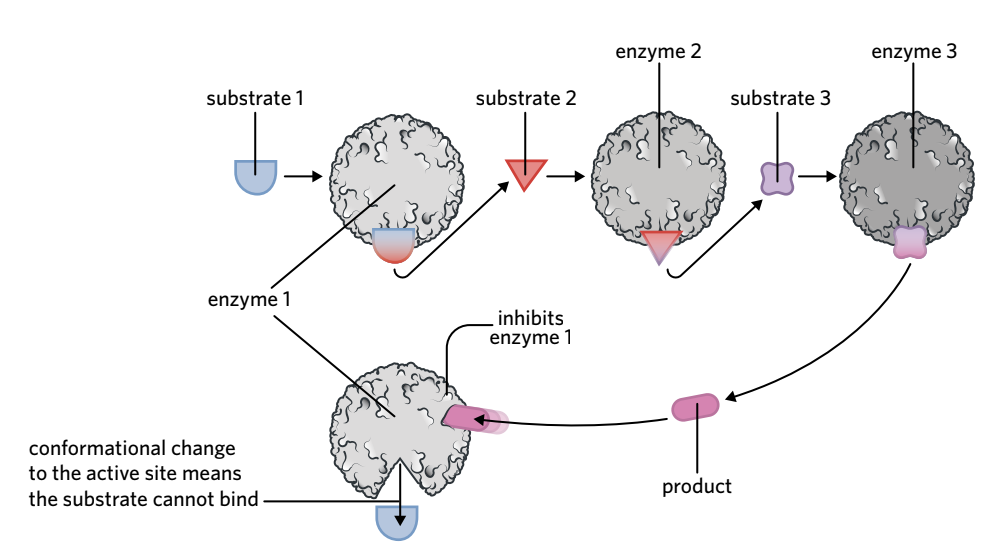
Enzyme inhibitors play important roles in regulating biochemical pathways. A biochemical pathway is defined as "a series of enzyme-catalysed biochemical reactions in which the product of one reaction becomes the substrate of the next reaction."
Example
Example: Feedback Inhibition Pathway
In this pathway:
- Substrate 1 is converted to Substrate 2 by Enzyme 1
- Substrate 2 is converted to Substrate 3 by Enzyme 2
- Substrate 3 is converted to a product by Enzyme 3
- The product non-competitively and reversibly inhibits Enzyme 1
This creates a self-regulating pathway. When enough product has been made, it inhibits Enzyme 1, which slows down the entire pathway. This prevents overproduction. When product levels decrease and Substrate 1 builds up, the pathway can resume.
This type of regulation ensures that cells produce only the amount of product they need at any given time.
Coenzymes
Some enzymes require additional helper molecules to catalyse their reactions effectively. These helpers are called cofactors, and a specific type of cofactor is the coenzyme.
Role of coenzymes
A cofactor is defined as "any organic or inorganic molecule, such as a coenzyme or metal ion, that assists enzyme function."
A coenzyme is defined as "a non-protein organic cofactor that assists enzyme function. They release energy and are recycled during a reaction."
Coenzymes are organic (carbon-containing), non-protein molecules that help enzymes catalyse reactions. They are a subset of cofactors.
Note
In coenzyme-assisted reactions, the enzyme itself remains unchanged throughout the process (as with all enzyme-catalysed reactions). However, the coenzyme does undergo structural changes.
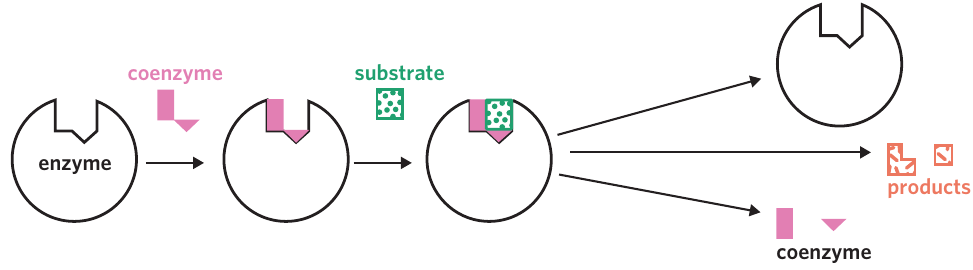
The process works as follows:
- The coenzyme binds to the enzyme's active site
- The substrate then binds
- The coenzyme donates energy or molecules during the reaction
- After the reaction, the coenzyme is released in a changed form
- The coenzyme must be recycled (restored to its original form) before it can assist in more reactions
This back-and-forth process is called coenzyme cycling and is essential for many biochemical processes in cells.
ATP and ADP
The most important coenzyme in cells is adenosine triphosphate (ATP) and its partner molecule adenosine diphosphate (ADP).
ATP is defined as "adenosine triphosphate, a high energy molecule that, when broken down, provides energy for cellular processes."
ADP is defined as "adenosine diphosphate, the unloaded form of ATP."
ATP is the main energy transfer molecule in cells. Cells constantly use ATP to donate energy for reactions.
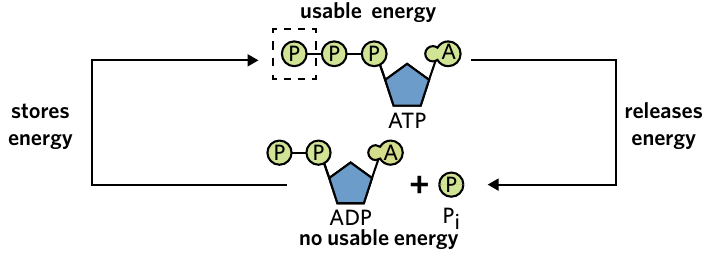
When ATP releases energy for a reaction, it loses one phosphate group and becomes ADP:
- ATP has three phosphate groups (triphosphate = tri = three)
- ADP has two phosphate groups (diphosphate = di = two)
Note
After becoming ADP, the molecule can have a phosphate group re-added to become ATP again. This allows it to participate in more energy-requiring reactions.
The conversion of ADP to ATP is called phosphorylation (adding phosphate). The conversion of ATP to ADP is called dephosphorylation (removing phosphate).
We can think of ATP as "loaded" with energy and ADP as "unloaded". This cycling between loaded and unloaded forms happens continuously in cells. The same ATP molecule can be cycled to ADP and back more than 1,000 times every day.
Example: hexokinase and glucose
An example of ATP functioning as a coenzyme is in the conversion of glucose to glucose 6-phosphate, catalysed by the enzyme hexokinase.

Example
Worked Example: ATP as a Coenzyme
In this reaction:
- Hexokinase is the enzyme
- Glucose is the substrate
- ATP is the coenzyme that provides energy
- Glucose 6-phosphate is the product
- ADP is the unloaded coenzyme that is released
The curved arrow in the diagram shows the action of the coenzyme providing energy to assist the enzyme.
Summary
Key Points to Remember:
- Each enzyme has an optimal temperature where it works best. High temperatures cause irreversible denaturation, while low temperatures cause reversible freezing
- Each enzyme has an optimal pH where it works best. Both acidic and alkaline extremes can cause denaturation
- Increasing substrate concentration increases reaction rate until the saturation point is reached, where all active sites are occupied
- Increasing enzyme concentration increases reaction rate (assuming sufficient substrate is available)
- Competitive inhibitors block the active site directly, competing with substrate molecules
- Non-competitive inhibitors bind to allosteric sites and cause conformational changes that prevent substrate binding
- Reversible inhibitors form weak bonds and cause temporary impairment, while irreversible inhibitors form strong bonds and cause permanent impairment
- Coenzymes like ATP assist enzyme function and must be recycled after releasing energy. ATP is the loaded form and ADP is the unloaded form