Factors Affecting the Rate of Photosynthesis (VCE SSCE Biology): Revision Notes
📚Revision Notes
Factors Affecting the Rate of Photosynthesis
Introduction
Plants require specific conditions to photosynthesise effectively. Several key factors influence a plant's rate of photosynthesis, and understanding these factors helps explain why plants sometimes struggle to survive despite appearing to receive proper care. The main factors affecting photosynthesis are light availability, temperature, pH, carbon dioxide concentration, water availability, and enzyme inhibition.
Note
The rate is the speed at which a chemical reaction proceeds. When we discuss the rate of photosynthesis, we're measuring how quickly the photosynthetic reactions occur within a plant.
Understanding limiting factors
A limiting factor is a factor that prevents the rate of reaction from increasing. Think of it as the 'weakest link' in the photosynthetic process. When you increase a limiting factor whilst keeping other factors constant, the overall reaction rate will increase. However, once a different factor becomes limiting, increasing the original factor will no longer affect the rate.
When examining graphs of photosynthesis rate, you'll often see the rate increase and then plateau. A plateau occurs when the reaction reaches a state where no further change occurs. This is similar to reaching the speed limit on a highway - your car is still moving at a fast rate, but it is no longer speeding up.
Important
A plateau can occur for two reasons:
- The maximum possible rate of photosynthesis has been reached (the saturation point), where enzymes within chloroplasts are operating at their full capacity
- Another factor has become the limiting factor
The saturation point is the point at which a substance (such as an enzyme) cannot receive more of another substance (such as a substrate).
Light
Light intensity
Light is essential for the light-dependent stage of photosynthesis to occur. Recall that light energises electrons in chlorophyll, initiating the entire light-dependent stage. The amount or intensity of light available determines the rate of photosynthesis.
The relationship between light intensity and photosynthesis rate follows a characteristic pattern:
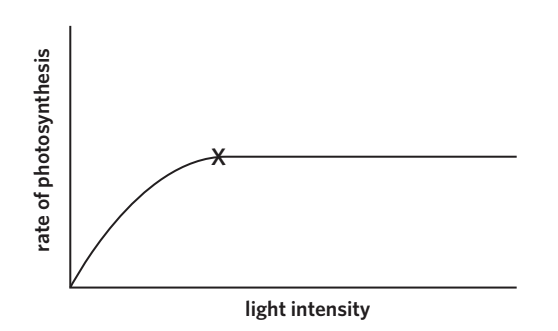
Initially, as light intensity increases, the rate of photosynthesis increases proportionally. This occurs because greater light energy can energise chlorophyll within more plant cells, increasing overall photosynthesis. However, the rate only increases up to a certain point (marked X on the graph).
Note
After point X, the rate of photosynthesis plateaus - it remains high but constant, no longer increasing despite additional light. This plateau occurs because:
- Either the maximum rate of photosynthesis has been reached (light saturation point), where enzymes are operating at full capacity
- Or another factor (such as temperature or carbon dioxide) has become the limiting factor
Before point X, light is the limiting factor. After point X, light is no longer limiting, and something else restricts the reaction rate.
In most natural environments, plants receive large amounts of light, so light is typically not a limiting factor unless the plant's habitat is unusually dark, such as in caves or deep underwater.
Light wavelength and colour
Not all wavelengths of light are equally effective for photosynthesis. The wavelength (and therefore colour) of light impacts the photosynthetic rate.
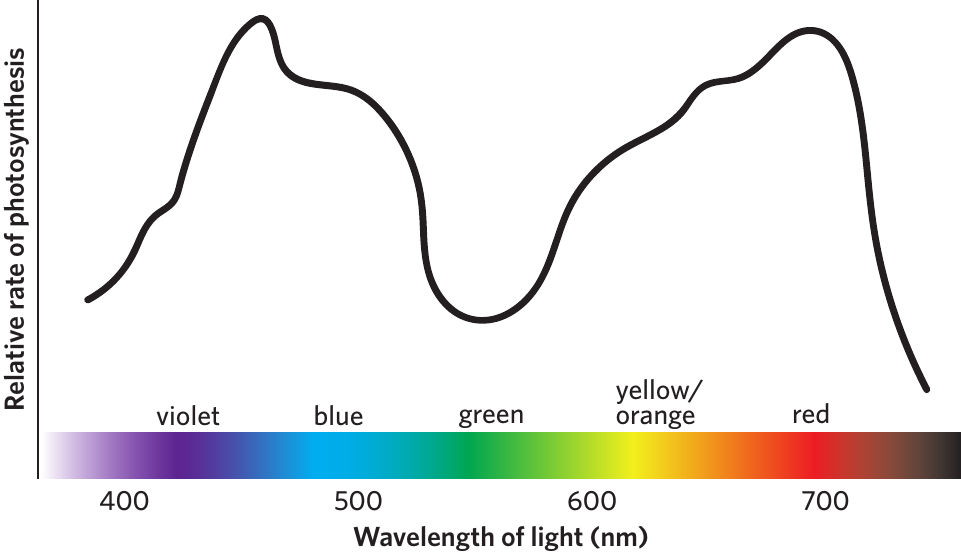
This diagram shows that:
- The greatest rate of photosynthesis occurs under violet or red light
- The rate of photosynthesis is relatively low under green light (most green light is reflected, which is why we see leaves as green)
Whilst light intensity (the amount of light) is the primary consideration when discussing light effects on photosynthesis, it's important to understand that wavelength also plays a role.
Effect on different plant types
Light affects C3, C4, and CAM plants in the same manner because all three plant types use the same light-dependent reactions. Their differences in photosynthetic pathways occur during the light-independent stage.
Note
C3 plants are plants with no evolved adaptation to minimise photorespiration.
C4 plants are plants that minimise photorespiration by separating initial carbon fixation and the remainder of the Calvin cycle over space.
CAM plants are plants that minimise photorespiration by separating initial carbon fixation and the remainder of the Calvin cycle over time.
Interpreting photosynthesis graphs
In examinations, you may encounter graphs with different axis labels that all measure the same thing - the rate of photosynthesis. The y-axis might be labelled as:
- Rate of photosynthesis
- Uptake of CO₂
- CO₂ consumed
- O₂ produced
- O₂ output
- Relative rate of photosynthesis
- Reaction rate
Similarly, the x-axis might show:
- Light intensity
- Availability of light
- Absorbed light
- Simply "light"
All these variations represent the same fundamental relationships.
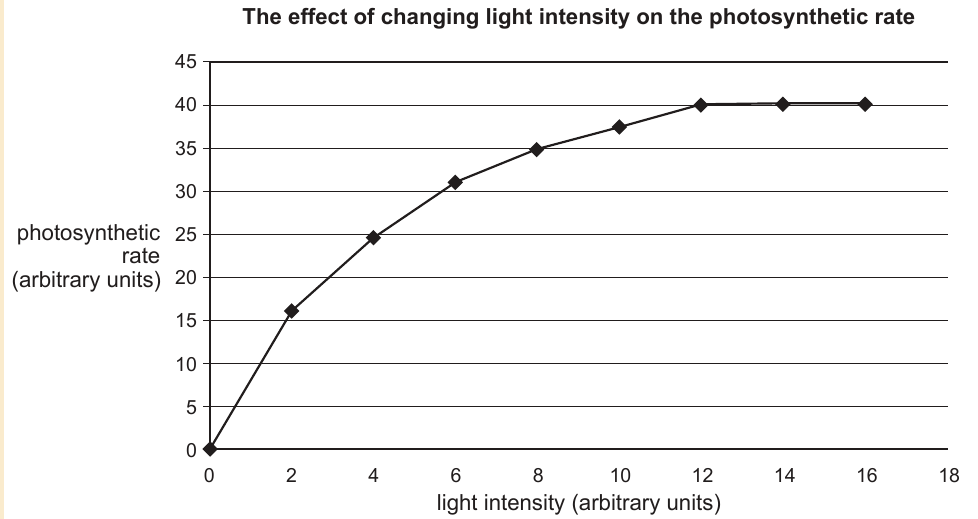
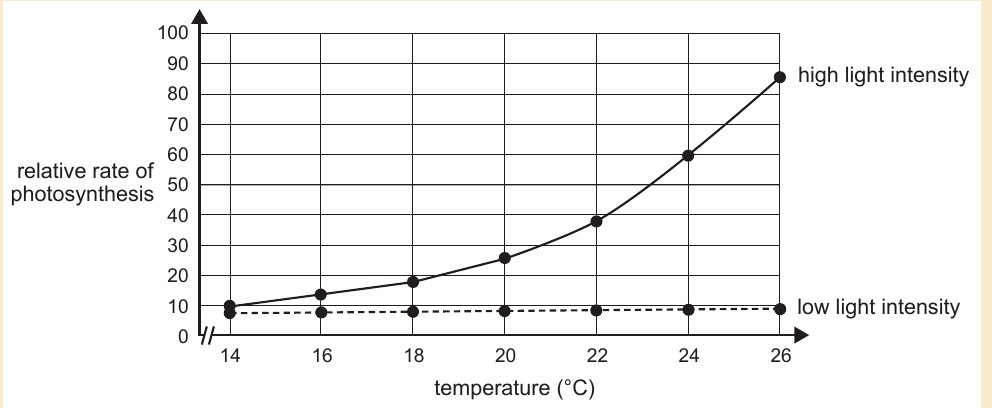
Important
The second graph demonstrates how both temperature and light intensity affect photosynthesis. Under high light intensity, photosynthesis rate increases substantially with temperature. However, under low light intensity, temperature changes have minimal effect because light is the limiting factor.
Temperature and pH
Temperature effects
An enzyme is an organic molecule, typically a protein, that catalyses (speeds up) specific reactions. Enzymes catalyse various reactions in both stages of photosynthesis. Because enzymes are affected by temperature, the rate of photosynthesis is also affected by temperature.
The optimal temperature is the point at which, for a given condition (such as temperature), the maximum function of an enzyme occurs. The rate of photosynthesis is greatest when the temperature matches the enzyme's optimal temperature.
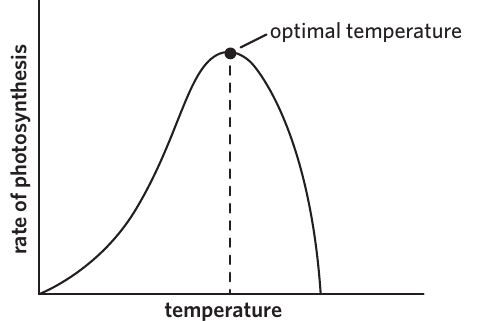
The relationship between temperature and photosynthesis rate follows this pattern:
- As temperature increases toward the optimal temperature, the rate of photosynthesis increases due to more frequent enzyme-substrate collisions
- At the optimal temperature, photosynthesis occurs at its maximum rate
- Above the optimal temperature, enzymes begin to denature (their structure becomes disrupted) and are unable to function properly
- This causes a steep drop-off in photosynthesis rate
Important
To denature means to disrupt a molecule's structure by an external factor such as heat. When enzymes denature, they can no longer catalyse reactions effectively.
pH effects
Enzymes also function best at their optimal pH, and photosynthesis occurs fastest under these conditions.
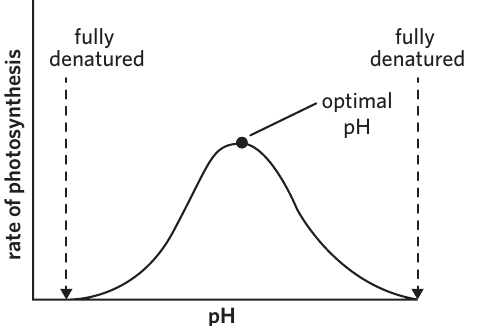
The relationship between pH and photosynthesis rate shows:
- At the optimal pH, photosynthesis occurs at its maximum rate
- Above and below the optimal pH, enzymes denature
- The pH graph is more symmetrical than the temperature graph because pH can denature enzymes both above and below the optimum
Note
Interestingly, enzymes in the thylakoid lumen must function well at pH levels as low as 4. This is necessary because protons are pumped into this space during photosynthesis, creating high acidity.
Effect on different plant types
C3, C4, and CAM plants are all impacted by temperature and pH because each photosynthetic pathway relies heavily on enzymes. However, each plant type has evolved to suit different environments, meaning their optimal temperature and pH values may differ.
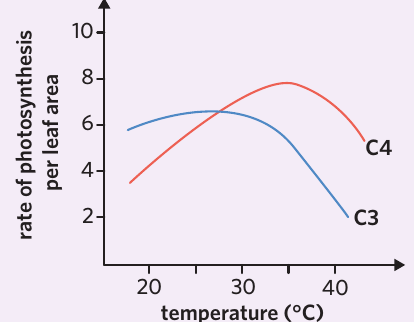
Generally:
- C4 and CAM plants are better adapted to hot and dry environments, with higher optimal temperatures
- C3 plants are better suited to cooler temperatures
The general shape of the temperature-photosynthesis relationship remains the same across all plant types, but the specific optimal values and ranges differ.
Carbon dioxide
Carbon dioxide concentration
Carbon dioxide is an input in the light-independent stage of photosynthesis, so its concentration impacts the photosynthetic rate. Plants take in CO₂ from the atmosphere via open stomata (small pores on the leaf's surface that open and close to regulate gas exchange) on their leaves.
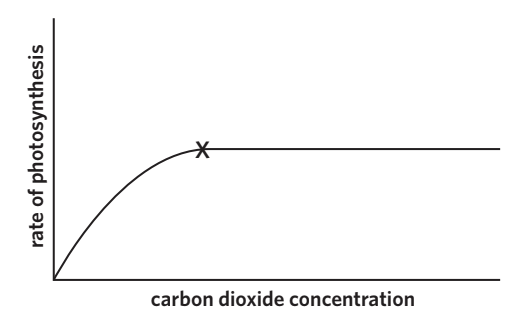
The relationship between CO₂ concentration and photosynthesis rate mirrors the light intensity relationship:
- As CO₂ concentration increases, the rate of photosynthesis increases
- This increase continues up to point X, where the rate plateaus
- The initial increase occurs because chloroplasts have a higher concentration of CO₂ molecules available for the light-independent stage
Note
The Cupcake Analogy
You can think of this relationship like sharing cupcakes with friends. If you increase the number of cupcakes, the rate of cupcake consumption increases. However, each person can only eat one cupcake at a time, so adding more cupcakes once everyone is already eating makes no difference to the consumption rate (which plateaus at its maximum).
The plateau occurs for similar reasons as with light:
- The theoretical maximum rate of photosynthesis is reached (assuming light and water are unlimited and temperature is optimal), with enzyme-catalysed systems fully saturated
- Another requirement (light, water, or temperature) has become the limiting factor
Photorespiration and Rubisco
When CO₂ concentrations within plant cells are low, plants become susceptible to undertaking photorespiration, a wasteful process in plants initiated by Rubisco that limits photosynthesis.
Important
Rubisco is a pivotal enzyme involved in initial carbon fixation during the light-independent stage of photosynthesis. Rubisco has an affinity (tendency to bind or react) for both CO₂ and O₂:
- Binding CO₂ initiates photosynthesis
- Binding O₂ starts photorespiration
Low CO₂ levels make it more likely that O₂ is bound and photorespiration occurs. This removes an opportunity for photosynthesis and decreases the overall photosynthetic rate.
Therefore, low CO₂ concentrations can be severely damaging to plants.
Effect on different plant types
C4 and CAM plants have evolved adaptations to counter photorespiration and expose Rubisco to greater levels of CO₂. Because of these adaptations:
- C4 and CAM plants are less susceptible to the impacts of low CO₂ concentration
- C3 plants, which have no strategy to combat photorespiration, are more severely affected by low CO₂ levels
Water
Water availability
Water influences the rate of photosynthesis in two main ways:
- Water is an input in the light-dependent stage of photosynthesis
- Water availability influences the opening and closing of stomata
Generally, plants have an adequate supply of water to photosynthesise, meaning water is not typically a limiting factor. However, in certain cases, plants may experience water stress caused by droughts, hot weather, or other environmental changes.
Stomatal closure and its consequences
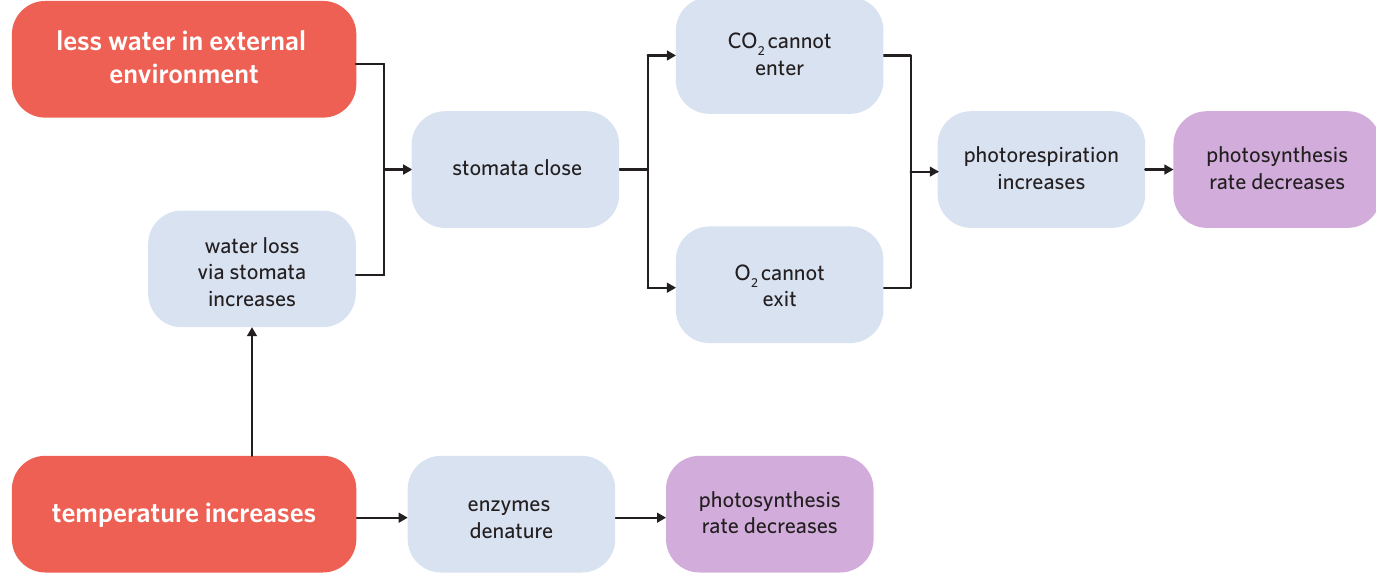
When plants experience water stress, they close their stomata to prevent water from evaporating out of the plant. However, this stomatal closure creates several problems:
Important
The consequences of stomatal closure include:
- CO₂ can no longer enter the leaves through open stomata to serve as an input for the light-independent stage
- O₂ produced in the light-dependent stage can no longer be released from the plant
With stomata closed, O₂ becomes more abundant than CO₂ inside the leaf. This means Rubisco is more likely to bind O₂ and initiate photorespiration rather than photosynthesis. The plant therefore wastes energy and loses opportunities to photosynthesise, decreasing the overall rate of photosynthesis.
Additionally, increased temperature can cause enzyme denaturation, further reducing photosynthesis rates.
Effect on different plant types
Decreased water availability leads to closed stomata and, consequently, decreased CO₂ and increased O₂ concentrations. This decreases the overall rate of photosynthesis.
Due to their evolved adaptations:
- C4 and CAM plants are not significantly affected by water availability unless conditions are extreme
- C3 plants are more susceptible to water loss and the resulting impacts on photosynthesis rate
Enzyme inhibition
Types of enzyme inhibitors
Enzyme inhibitors are molecules that bind to and prevent an enzyme from functioning. Two main types affect photosynthesis:
Note
- Competitive inhibitors - molecules that hinder an enzyme by blocking the active site and preventing the substrate from binding
- Non-competitive inhibitors - molecules that hinder an enzyme by binding to an allosteric site (a region on an enzyme that is not the active site) and changing the shape of the active site to prevent substrate binding
Enzyme inhibition can also be classified as:
- Reversible inhibition - enzyme inhibition involving weaker bonds that can be overcome
- Irreversible inhibition - enzyme inhibition involving stronger bonds that cannot be broken
Effects on photosynthesis
Many herbicide chemicals are inhibitors of enzymes involved in photosynthesis. For example, some herbicides can bind to proteins in the electron transport chain, severely disrupting photosynthesis and potentially killing the plant.
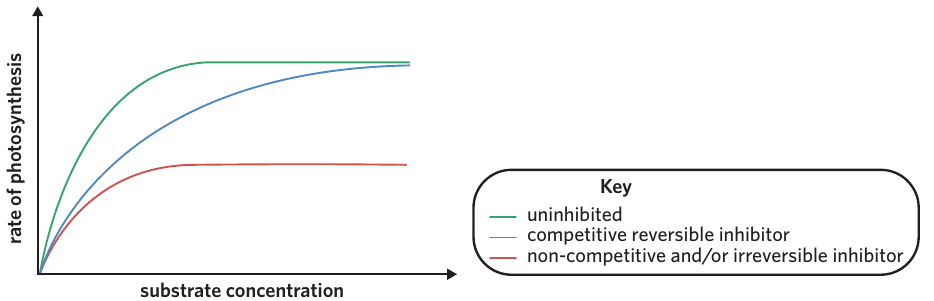
The presence of inhibitors generally lowers the rate of photosynthesis. However:
- The effect of competitive reversible inhibitors can be gradually overcome if substrate concentration is continually increased
- Increasing substrate concentration does not reduce the effect of irreversible inhibitors or reversible non-competitive inhibitors
- This means the maximum possible rate of reaction is permanently reduced in the presence of irreversible or non-competitive inhibitors
Effect on different plant types
Enzyme inhibitors can target enzymes within any part of both stages of photosynthesis. Therefore, all three types of plants (C3, C4, and CAM) are equally susceptible to the negative impact of inhibitors.
Summary of factors affecting photosynthesis
| Factor | Increasing the factor | Decreasing the factor | Differences in plant types |
|---|---|---|---|
| Light | Increases photosynthesis rate until a plateau is reached | Decreases photosynthesis rate | Same among all plants |
| Temperature | Increases rate when below optimal; decreases rate when above optimal | Decreases rate due to fewer enzyme-substrate collisions | C4 and CAM plants better suited to hotter environments; C3 plants better suited to cooler environments |
| pH | Increases rate when below optimal; decreases rate when above optimal | Increases rate when above optimal; decreases rate when below optimal | All can be affected |
| Carbon dioxide concentration | Increases photosynthesis rate until a plateau is reached | Decreases photosynthesis rate | C4 and CAM plants less impacted than C3 plants due to their ability to consistently expose Rubisco to CO₂ |
| Water | Typically in excess; increasing it increases photosynthesis by avoiding stomatal closure | Can result in closed stomata and lower CO₂ concentration, decreasing photosynthesis rate | C4 and CAM plants less impacted than C3 plants due to their ability to consistently expose Rubisco to CO₂ |
| Enzyme inhibition | Greater inhibitors decrease photosynthesis rate | Fewer inhibitors increase photosynthesis rate | All can be affected |
Practical plant care considerations
If you're caring for plants, consider whether they're receiving suitable conditions:
- Light - Is there enough light reaching the plant? Some plants require high light levels, whilst others prefer shade
- Temperature - Is the temperature suitable for the plant species? Optimal temperatures differ greatly between species
- CO₂ concentration - Can the plant exchange gases with the atmosphere? Access to fresh air is beneficial
- Water - Does the plant receive appropriate quantities of water regularly? Requirements vary by species
Summary
Key Points to Remember:
-
Light intensity increases photosynthesis rate until a plateau is reached, either due to enzyme saturation or another limiting factor. Violet and red wavelengths are most effective for photosynthesis.
-
Temperature and pH affect enzyme function. Each enzyme has an optimal temperature and pH where photosynthesis occurs fastest. Above or below these optima, enzymes denature and photosynthesis rate decreases.
-
Carbon dioxide is essential for the light-independent stage. Low CO₂ levels lead to photorespiration, particularly in C3 plants. C4 and CAM plants are better adapted to handle low CO₂ conditions.
-
Water stress causes stomatal closure, preventing CO₂ entry and O₂ exit. This increases photorespiration and decreases photosynthesis, especially in C3 plants.
-
Enzyme inhibitors reduce photosynthesis rate. Competitive reversible inhibitors can be overcome with increased substrate concentration, but irreversible and non-competitive inhibitors permanently reduce the maximum reaction rate.