Rubisco in C3, C4, and CAM Photosynthesis (VCE SSCE Biology): Revision Notes
📚Revision Notes
Rubisco in C3, C4, and CAM Photosynthesis
Introduction to Rubisco
Rubisco (ribulose bisphosphate carboxylase-oxygenase) is "a pivotal enzyme involved in initial carbon fixation during the light-independent stage of photosynthesis." This enzyme plays a crucial role in converting atmospheric carbon dioxide into organic compounds that plants can use. However, Rubisco has a significant flaw that affects photosynthetic efficiency, particularly under certain environmental conditions.
Note
Rubisco is considered one of the most abundant proteins on Earth due to its essential role in photosynthesis across nearly all plant species. Despite this abundance, its inefficiency has driven the evolution of specialized adaptations in many plant groups.
Photosynthesis stages review
Before exploring Rubisco's role, it's important to understand the two stages of photosynthesis:
Light-dependent stage: "the first stage of photosynthesis, where light energy splits water molecules into oxygen and hydrogen inside the thylakoid membranes." This stage produces ATP, NADPH, and oxygen.
Light-independent stage: "the second stage of photosynthesis where carbon dioxide is used to form glucose in the stroma of a chloroplast. Also known as the Calvin cycle, the dark stage, or the light-independent reactions." This stage uses the ATP and NADPH from the light-dependent stage to convert into glucose.
Note
The light-independent stage is often called the "dark stage," but this doesn't mean it only occurs in darkness. It simply means this stage doesn't directly require light, though it typically happens during daylight hours when ATP and NADPH from the light-dependent reactions are available.
Rubisco's role in the Calvin cycle
Rubisco controls the first reaction in the light-independent stage of photosynthesis. It catalyses the initial step of carbon fixation, where inorganic carbon dioxide is incorporated into organic molecules.
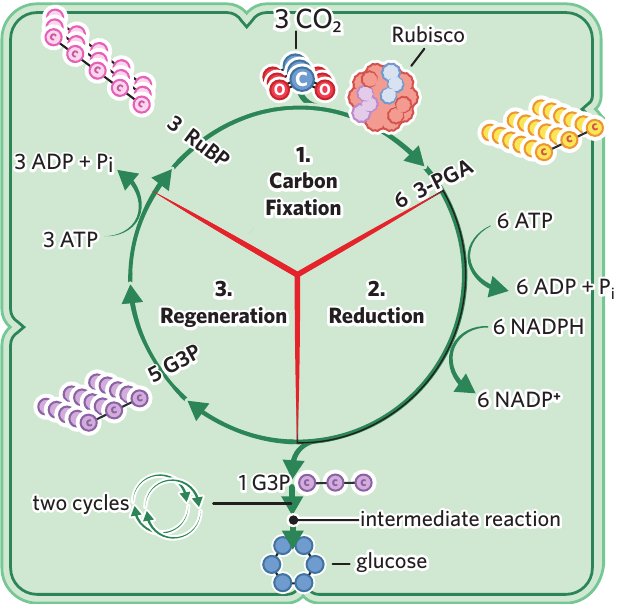
The Calvin cycle can be understood through three main stages:
1. Carbon fixation
Carbon fixation is "the process in living organisms where inorganic carbon, typically within carbon dioxide, is converted into organic compounds such as glucose."
Rubisco catalyses the reaction between and a five-carbon molecule called RuBP (ribulose bisphosphate) to produce six molecules of a three-carbon compound called 3-PGA (3-phosphoglycerate). The term "inorganic" refers to "a compound that does not contain a carbon-hydrogen bond, e.g. carbon dioxide," whilst "organic" describes "a compound containing a carbon-hydrogen bond, e.g. glucose."
2. Reduction
The 3-PGA molecules are converted into different three-carbon molecules called G3P (glyceraldehyde-3-phosphate) using ATP and NADPH from the light-dependent reactions. One G3P molecule exits the cycle to contribute to glucose production, whilst the rest continue in the cycle.
3. Regeneration
The remaining G3P molecules are recycled using ATP to regenerate the RuBP needed to restart the cycle.
Important
The cycle must turn twice (fixing 6 molecules total) to produce one six-carbon glucose molecule. This is because each turn of the cycle fixes only one molecule and produces one three-carbon G3P molecule. Two G3P molecules are needed to make one six-carbon glucose.
The problem with Rubisco: photorespiration
Whilst Rubisco typically performs its role effectively, it has a critical flaw. Sometimes, instead of binding to , Rubisco binds to oxygen (). When this occurs, a wasteful process called photorespiration takes place.
Photorespiration is "a wasteful process in plants initiated by Rubisco that limits photosynthesis."
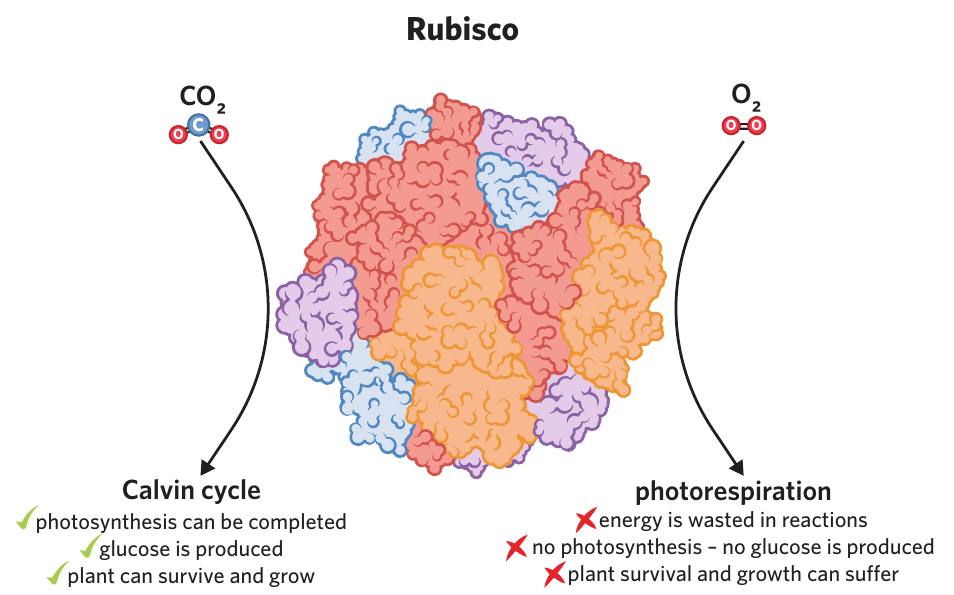
When Rubisco binds to instead of :
- The Calvin cycle cannot proceed
- No glucose is produced
- Energy is wasted in the photorespiration pathway
- Plant growth, survival, and reproduction are negatively affected
Important
Common Misconception: Photorespiration is completely unrelated to cellular respiration, despite the similar name. Cellular respiration is a productive process that generates ATP, while photorespiration is wasteful and reduces photosynthetic efficiency.
Factors affecting Rubisco binding
Two key factors determine whether Rubisco binds or :
Substrate concentration
A substrate is "the reactant of a reaction catalysed by an enzyme." The higher the concentration of a substrate, the more likely it will bind to an enzyme. Plants need:
- High concentration around Rubisco (to promote photosynthesis)
- Low concentration around Rubisco (to prevent photorespiration)
Stomata (singular: stoma) are "small pores on the leaf's surface that open and close to regulate gas exchange." When stomata open, enters whilst and water vapour exit. However, when plants close their stomata to conserve water, from the light-dependent stage accumulates inside cells, increasing photorespiration.
Temperature
Affinity is "the tendency of a molecule/atom to bind or react with another molecule/atom."
At normal or low temperatures, Rubisco's affinity for is much greater than for . However, as temperature increases, the bonds holding Rubisco together weaken, changing the enzyme's three-dimensional shape. This structural change causes Rubisco to have greater affinity for , leading to more photorespiration.
Note
Think of Rubisco as a lock that normally prefers the "key." When temperature increases, the lock's shape changes slightly, making it more likely to accept the wrong "key" instead.
When photorespiration increases
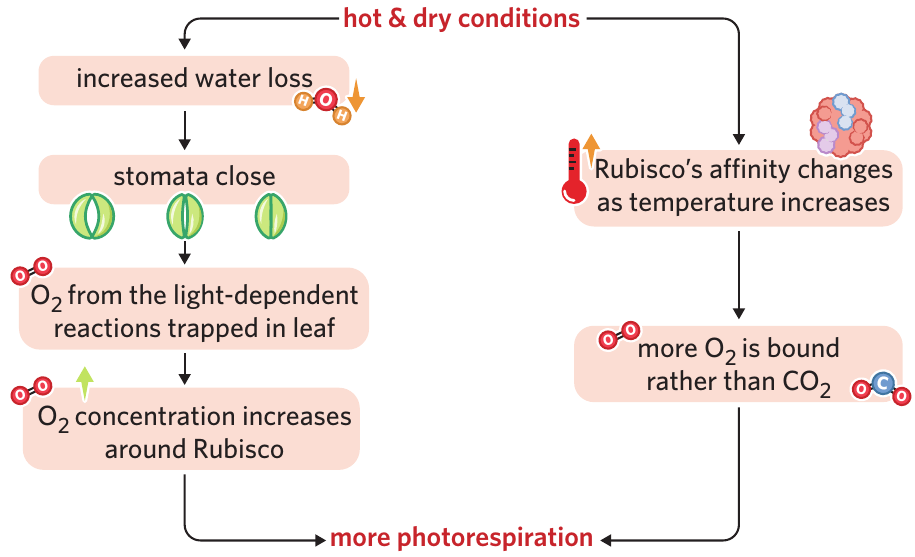
Photorespiration becomes more problematic in hot and dry conditions because:
- Increased water loss causes stomata to close
- Closed stomata trap from the light-dependent reactions inside leaves
- concentration increases around Rubisco
- Higher temperatures increase Rubisco's affinity for
- More is bound instead of , leading to increased photorespiration
To counter this problem, certain plants have evolved adaptations to increase the likelihood of Rubisco binding rather than . These adaptations classify plants into three groups: C3, C4, and CAM plants.
C3 plants
C3 plants are "plants with no evolved adaptation to minimise photorespiration."
C3 plants represent approximately 85% of plant species on Earth and undertake "standard" photosynthesis without any special adaptations to reduce photorespiration. The name "C3" comes from the three-carbon compound (3-PGA) produced during the initial carbon fixation step.
Characteristics of C3 plants
- All photosynthesis occurs within mesophyll cells (plant cells "found in leaves that contain large amounts of chloroplasts")
- No separation of carbon fixation steps
- Susceptible to photorespiration, especially in hot and dry conditions
- Most efficient in moderate, cool, or wet environments
Note
Examples of C3 plants:
- All trees (including eucalyptus)
- Cereals such as wheat and rice
- Most nuts, fruits, and vegetables
C3 plants dominate in temperate and cooler climates where photorespiration is less of a problem.
C4 plants
C4 plants are "plants that minimise photorespiration by separating initial carbon fixation and the remainder of the Calvin cycle over space."
C4 plants have evolved a spatial adaptation where different steps of photosynthesis occur in different cell types. This separation helps concentrate around Rubisco, reducing photorespiration.
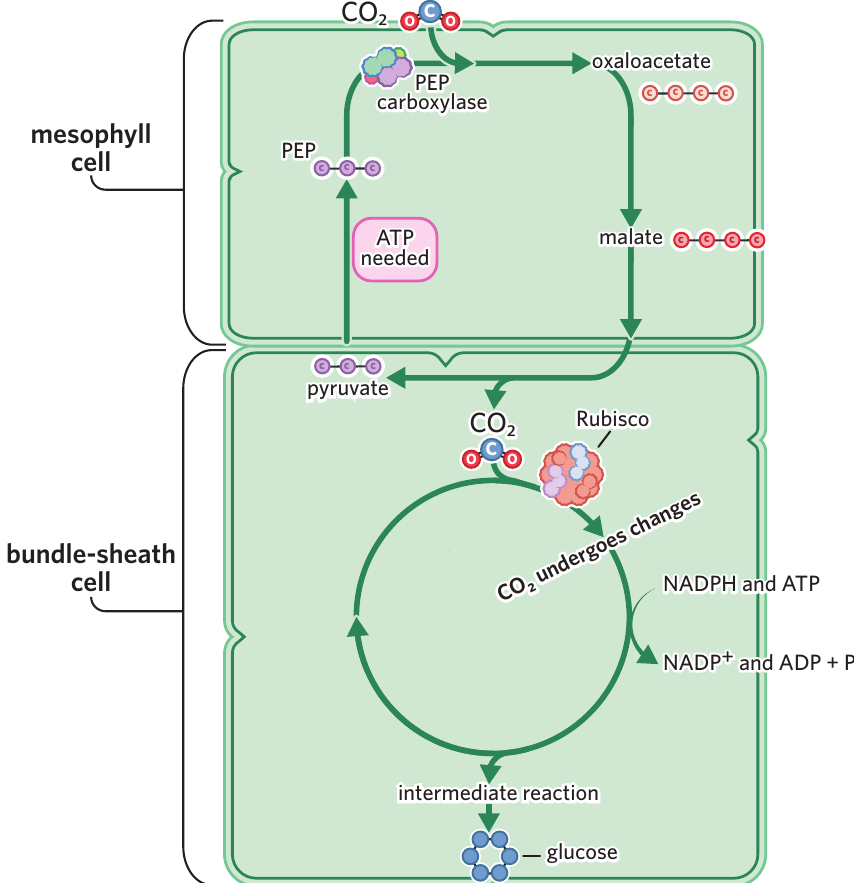
How C4 photosynthesis works
C4 plants separate the photosynthetic process between two cell types:
1. In mesophyll cells (initial carbon fixation):
- Atmospheric enters mesophyll cells
- An enzyme called PEP carboxylase (which cannot bind ) fixes to a three-carbon molecule (PEP)
- This produces a four-carbon molecule called oxaloacetate (hence "C4")
- Oxaloacetate converts to malate, another four-carbon molecule
- Malate is transported to bundle-sheath cells
2. In bundle-sheath cells (remainder of Calvin cycle):
- Bundle-sheath cells are "plant cell types that are the site of most of the Calvin cycle in C4 plants"
- Malate breaks down, releasing
- The released enters the Calvin cycle with Rubisco
- Glucose is produced
- Pyruvate (formed from malate breakdown) returns to mesophyll cells
- ATP converts pyruvate back to PEP, ready to fix more
Example
How C4 Plants Pump to Rubisco:
Step 1: Mesophyll cells act as " collectors"
- PEP carboxylase efficiently captures from the air
- Cannot accidentally bind , so always works correctly
Step 2: is packaged as malate (4-carbon molecule)
- Malate is like a " delivery truck"
- Transports to bundle-sheath cells
Step 3: Bundle-sheath cells receive concentrated
- Malate breaks down, releasing
- High concentration around Rubisco
- Result: Rubisco almost always binds , not
Advantages and costs of C4 photosynthesis
Advantages:
- Mesophyll cells continuously pump (as malate) to bundle-sheath cells
- High concentration around Rubisco minimises photorespiration
- Maximises photosynthesis in hot, sunny conditions
Cost:
- Requires extra ATP to convert pyruvate to PEP
- Uses more energy than C3 photosynthesis
- However, in hot environments, the benefits outweigh the energy cost
Note
Examples of C4 plants:
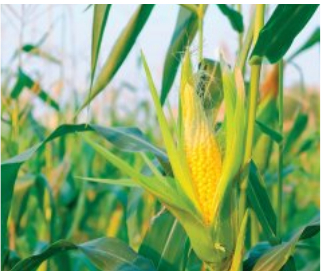
- Corn (maize)
- Sugarcane
- Switchgrass
- Several weed species
C4 plants are best adapted to hot, sunny habitats where C3 plants would suffer from excessive photorespiration. Think: "C4 for Corn in hot sunny places."
CAM plants
CAM plants are "plants that minimise photorespiration by separating initial carbon fixation and the remainder of the Calvin cycle over time."
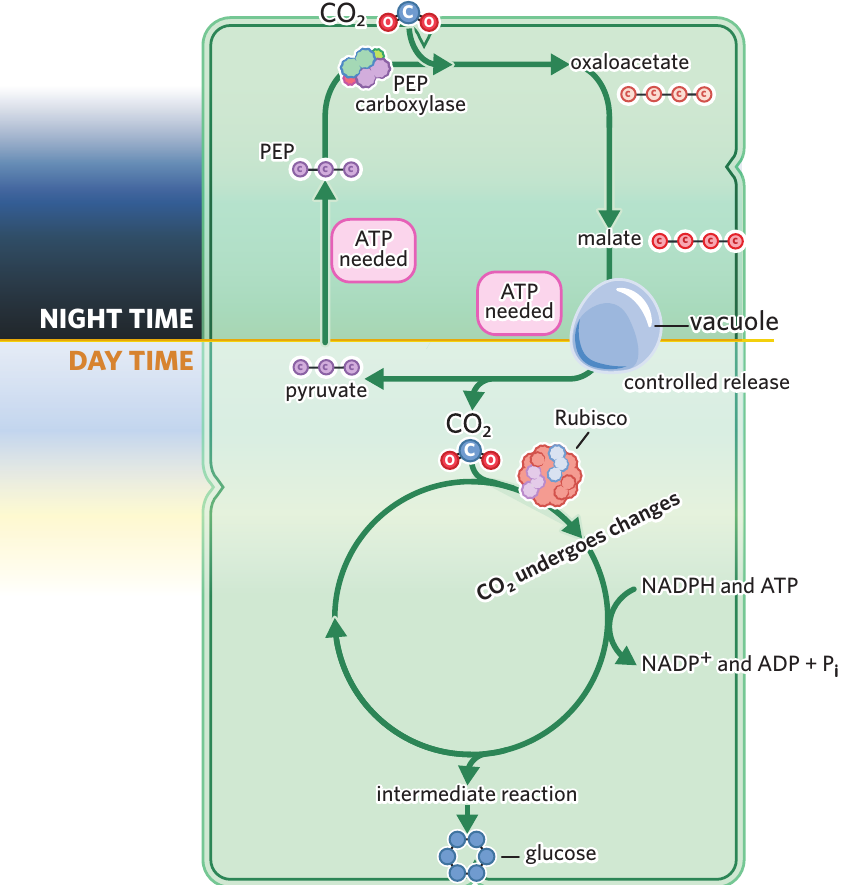
CAM stands for Crassulacean Acid Metabolism, named after the plant family where this pathway was first discovered. Instead of separating processes spatially like C4 plants, CAM plants separate them temporally (between night and day).
How CAM photosynthesis works
CAM plants separate photosynthetic steps between night and day within the same cells:
Night-time processes:
- Stomata open to allow to enter (when it's cooler and more humid)
- PEP carboxylase fixes to PEP, forming oxaloacetate (four-carbon molecule)
- Oxaloacetate converts to malate
- Malate is stored in vacuoles within mesophyll cells until daytime
Daytime processes:
- Stomata close to prevent water loss (critical in hot, dry environments)
- Malate exits vacuoles and breaks down, releasing
- Released enters the Calvin cycle with Rubisco
- Glucose is produced
- Pyruvate forms and is converted back to PEP using ATP
Important
Key Adaptation - Water Conservation:
CAM plants keep their stomata closed during the hottest part of the day, which is the opposite of C3 and C4 plants. This dramatically reduces water loss but requires storing as malate overnight. Remember: "CAM = Closing At Midday."
Advantages of CAM photosynthesis
Water conservation:
- Stomata only open at night when conditions are cooler and more humid
- Dramatically reduces water loss
- Critical advantage in desert environments
Reduced photorespiration:
- Controlled release of from vacuoles maintains high concentration around Rubisco
- Minimises photorespiration despite closed stomata during the day
Cost:
- Like C4 plants, requires extra ATP to regenerate PEP
- Uses more energy than C3 photosynthesis
Note
Examples of CAM plants:
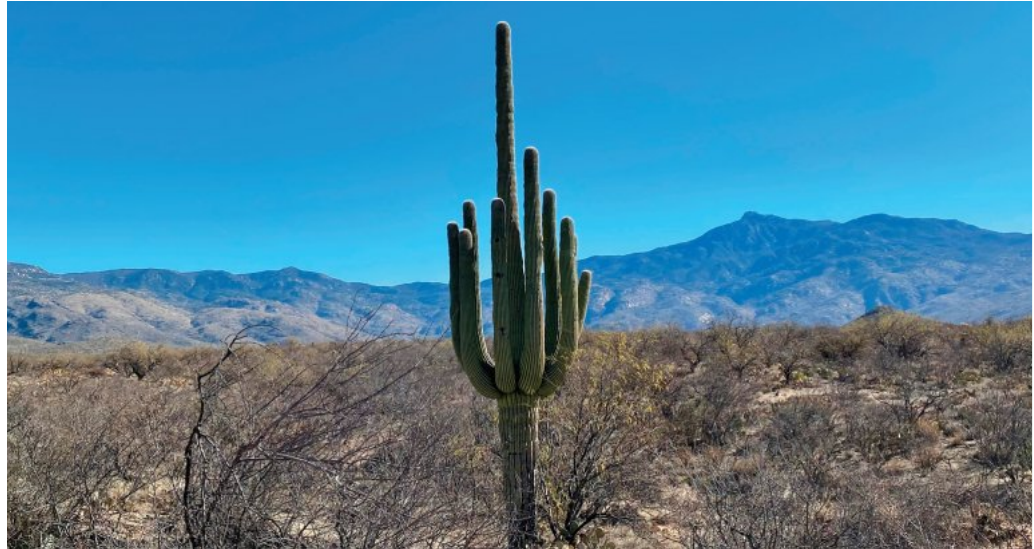
- Almost all cacti (including saguaro)
- Pineapples
- Vanilla
- Orchids
CAM plants are best adapted to very hot, dry habitats like deserts where water conservation is essential for survival. Think: "CAM for Cacti in deserts."
Comparison of C3, C4, and CAM plants
| Feature | C3 plants | C4 plants | CAM plants |
|---|---|---|---|
| Limits photorespiration | No | Yes | Yes |
| Separation of fixation and Calvin cycle | No separation | Between cells (spatial) | Between night and day (temporal) |
| Stomata open | During day | During day | At night |
| Advantages | Doesn't consume extra energy | Minimises photorespiration | Minimises photorespiration and reduces water loss |
| Disadvantages | Susceptible to photorespiration | Consumes extra energy | Consumes extra energy |
| Best adapted to | Moderate, cool, or wet environments | Hot, sunny habitats | Very hot, dry habitats |
| Examples | Most plants, wheat, rice, all trees | Corn, sugarcane, switchgrass | Cacti, pineapples, orchids |
Key differences explained
C3 plants perform all photosynthesis steps in one location with no special adaptations, making them vulnerable to photorespiration but energy-efficient when conditions are favourable.
C4 plants spatially separate initial carbon fixation (mesophyll cells) from the Calvin cycle (bundle-sheath cells), pumping concentrated to Rubisco and reducing photorespiration in hot, sunny conditions.
CAM plants temporally separate processes, fixing at night when stomata are open and completing the Calvin cycle during the day when stomata are closed, making them extremely water-efficient.
Summary
Key Points to Remember:
-
Rubisco is the enzyme that fixes in the first step of the Calvin cycle, but can mistakenly bind instead, causing wasteful photorespiration.
-
Photorespiration increases in hot and dry conditions due to closed stomata (trapping ) and temperature effects on Rubisco's shape (increasing affinity). Remember: "Hot and Dry → High → photorespiration."
-
C3 plants (85% of plants) have no adaptations to prevent photorespiration and work best in moderate, cool, or wet conditions. The name comes from the three-carbon first product (3-PGA). Examples: wheat, rice, trees.
-
C4 plants separate processes spatially between mesophyll and bundle-sheath cells, concentrating around Rubisco. The "4" refers to the four-carbon first product (oxaloacetate) and spatial separation across two different cells. Best for hot, sunny environments. Examples: corn, sugarcane.
-
CAM plants separate processes temporally, fixing at night and completing the Calvin cycle during the day with closed stomata. Best for very hot, dry environments where water conservation is critical. Examples: cacti, pineapples.