The Process of C3 Photosynthesis (VCE SSCE Biology): Revision Notes
📚Revision Notes
The Process of C3 Photosynthesis
Introduction to photosynthesis
Photosynthesis is the process of capturing light energy to power the production of glucose and oxygen from carbon dioxide and water. This remarkable biological process enables life as we know it by converting light energy from the sun into chemical energy stored in glucose molecules.
A photoautotroph is an organism capable of undertaking photosynthesis. Unlike animals that must consume food for energy, photoautotrophs manufacture their own energy. Plants, algae, and some bacteria (such as cyanobacteria) are all examples of photoautotrophs.
Note
Photosynthesis is the foundation of most food chains on Earth. The glucose produced provides energy not only for the photoautotrophs themselves but also for the organisms that consume them, ultimately supporting entire ecosystems.
Overview of C3 photosynthesis
The photosynthesis equation
The overall process of photosynthesis can be summarised by a chemical equation showing the reactants (inputs) and products (outputs). In its simplest form, photosynthesis converts carbon dioxide and water into glucose and oxygen, using energy from sunlight.
The complete equation shows that six molecules of carbon dioxide combine with six molecules of water to produce one molecule of glucose and six molecules of oxygen:
Sunlight provides the energy needed to drive this reaction forward.
In reality, photosynthesis is far more complex than this simple equation suggests. It involves a sophisticated series of biochemical reactions, each catalysed by specific enzymes, occurring across two distinct stages.
Plant structures involved in photosynthesis
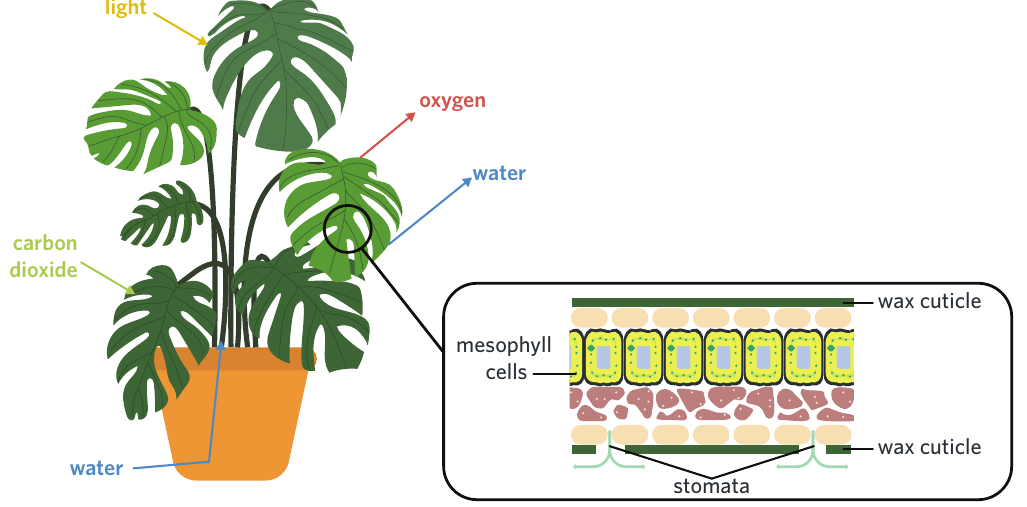
Several specialized plant structures work together to enable photosynthesis to occur efficiently.
Leaves are the primary site of photosynthesis in plants. They typically have a large, flat surface area to maximize the amount of light energy they can capture. Within leaves, several cell types perform different functions including structural support and transporting water and nutrients.
Mesophyll cells are the plant cell type found in leaves that contain large amounts of chloroplasts. These cells are the main photosynthetic cells in leaves and are where most of the actual photosynthesis occurs.
Chloroplasts are membrane-bound organelles only found in plant and photoautotroph cells that serve as the site of photosynthesis. These specialized organelles contain all the structures and molecules necessary for both stages of photosynthesis to take place.
Within chloroplasts is chlorophyll, a chemical found in the thylakoids of chloroplasts that is responsible for absorbing light energy in photosynthesis. Chlorophyll is what gives plants their characteristic green colour.
Stomata (singular: stoma) are small pores on the leaf's surface that open and close to regulate gas exchange. They allow carbon dioxide to diffuse into the leaf from the atmosphere and oxygen to diffuse out. Stomata can close during dry conditions to prevent excessive water loss.
Xylem is vascular tissue in plants responsible for transporting water and minerals from the roots to the leaves. Water absorbed by root hair cells from the soil travels through the xylem to reach the photosynthesizing cells in the leaves.
Chloroplast structure
Understanding the structure of chloroplasts is essential because different stages of photosynthesis occur in different locations within this organelle.
Chloroplasts have a double membrane system consisting of an outer membrane and an inner membrane. These membranes enclose the internal structures and help regulate what enters and exits the organelle.
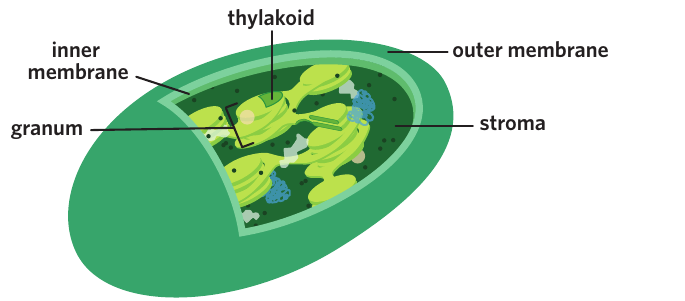
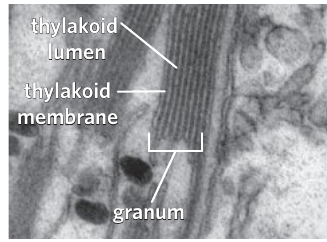
Inside the chloroplast are flattened, sac-like structures called thylakoids. Each thylakoid is made up of a chlorophyll-containing membrane enclosing a space called the lumen. Thylakoids are where the light-dependent stage of photosynthesis takes place.
Thylakoids stack on top of each other to form structures called grana (singular: granum). A granum is a stack of thylakoids. This stacking arrangement increases the surface area available for the light-dependent reactions.
Surrounding the thylakoids is the stroma, the fluid substance that makes up the interior of chloroplasts. The stroma is where the light-independent stage of photosynthesis occurs.
Note
Structure-Function Relationship
The organization of chloroplast structures is perfectly suited to their functions:
- Thylakoid membranes contain chlorophyll to capture light energy efficiently
- Stacking of thylakoids into grana maximizes surface area for light absorption
- The stroma provides a contained environment with the right enzymes for glucose synthesis
- The double membrane system maintains optimal internal conditions
The light-dependent stage
Location and requirements
The light-dependent stage is the first stage of photosynthesis, where light energy splits water molecules into oxygen and hydrogen inside the thylakoid membranes. As the name suggests, this stage only occurs when light is present.
The light-dependent reactions take place on the chlorophyll-filled thylakoid membranes within the grana. The primary purpose of this stage is to generate high-energy coenzymes that will power the second stage of photosynthesis.
Inputs and outputs
The inputs of the light-dependent stage are:
- 12 water molecules
- 12
- 18
The outputs of the light-dependent stage are:
- 6 oxygen molecules
- 12
- 18
The process of the light-dependent stage
The light-dependent stage involves several interconnected steps that work together to convert light energy into chemical energy.
Step 1: Light excitation and photolysis
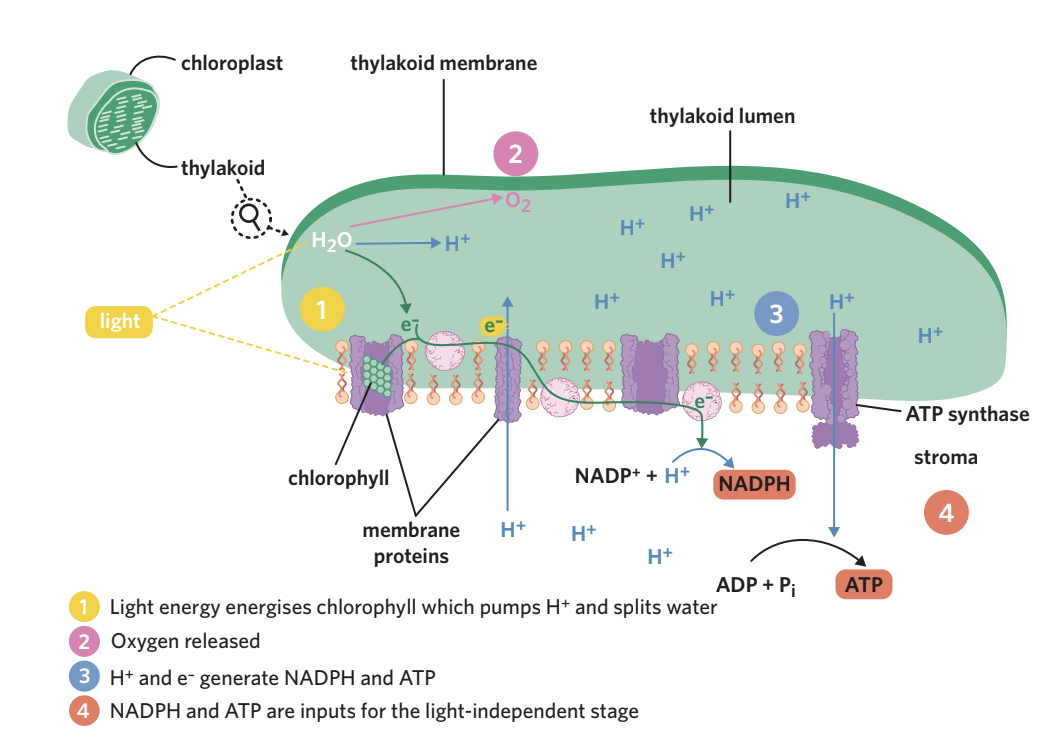
Inside the thylakoid, light energy excites electrons in chlorophyll molecules. These excited electrons move along protein complexes embedded in the thylakoid membrane. As the electrons travel, the energy they carry powers the active pumping of hydrogen ions into the thylakoid lumen.
Water molecules donate electrons to chlorophyll to replace the electrons that have been excited and moved away. This causes water to split into oxygen and hydrogen ions. This splitting of water by light energy is called photolysis, which means the process in which molecules are broken down by the action of light.
Step 2: Oxygen release
The oxygen produced from water splitting is released from the chloroplast. This oxygen either diffuses out through the stomata into the environment (which is the oxygen we breathe), or it can be used by the plant itself for cellular respiration.
Step 3: Production of NADPH and ATP
The hydrogen ions from water molecules combine with to generate the high-energy coenzyme NADPH . NADPH is a coenzyme that acts as a proton and electron carrier in photosynthesis.
Meanwhile, the movement of hydrogen ions down their concentration gradient (which was established by the electron-powered pumping in step 1) drives the production of ATP. ATP (adenosine triphosphate) is a high-energy molecule that, when broken down, provides energy for cellular processes. The enzyme ATP synthase catalyses the reaction: .
Step 4: Products move to the next stage
The ATP and NADPH coenzymes produced in the light-dependent stage then move into the stroma, where they will be used as inputs for the light-independent stage.
Important
The Critical Role of Photolysis
Photolysis (the splitting of water by light) is the key process in the light-dependent stage. Without photolysis:
- Electrons would not be replaced in chlorophyll molecules
- Hydrogen ions would not be available to produce NADPH
- Oxygen would not be released as a byproduct
This process is what makes photosynthesis possible and provides the oxygen that most life on Earth depends on.
Summary of the light-dependent stage
During the light-dependent stage:
- Sunlight excites electrons within chlorophyll
- Water absorbed by the plant's roots is split into and through photolysis
- The excited electrons and ions from water lead to the production of the coenzymes NADPH and ATP
- Oxygen is released from the chloroplast
- The coenzymes are ready for the second stage of photosynthesis
Note
Exam tip: Light is not considered an input molecule of photosynthesis - it is the energy source. NADP is an acceptable notation for , but NAD is not acceptable. Either ADP or both can be listed as inputs, as both are required to produce ATP.
The role of enzymes and coenzymes
Enzymes in photosynthesis
Enzymes catalyse most of the reactions that occur during photosynthesis. These biological catalysts speed up reactions and help control the process, allowing plants to metabolise efficiently.
One key example is ATP synthase, which catalyses the formation of ATP from ADP and inorganic phosphate . This enzyme uses the energy from the flow of hydrogen ions down their concentration gradient to drive ATP production.
Coenzyme cycling
The coenzymes NADPH and ATP cycle continuously between both stages of photosynthesis. This cycling is essential for converting the energy from sunlight into the chemical energy stored in glucose.
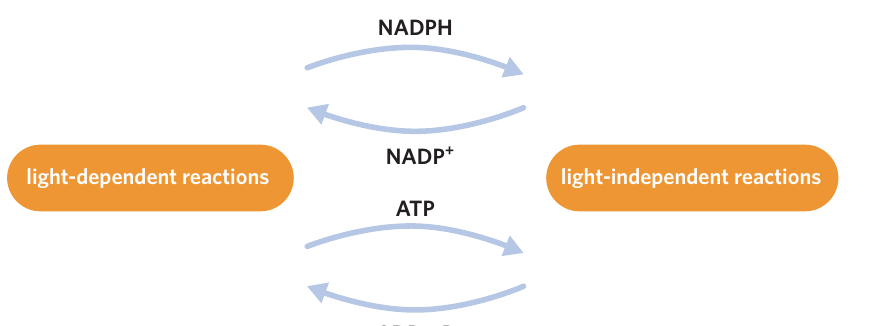
In the light-dependent stage, the starting forms and are converted into high-energy NADPH and ATP. These energy-rich molecules then become inputs for the light-independent stage.
During the light-independent reactions, the coenzymes donate their energy to help build glucose molecules. This returns them to their "unloaded" forms: and . These unloaded coenzymes then cycle back to the light-dependent stage, where they can be recharged with energy, and the process continues.
Note
Understanding Coenzyme Functions
The two coenzymes have distinct roles:
- NADPH transfers hydrogen ions - carrying both protons and electrons needed for building carbon compounds
- ATP transfers energy - providing the energy needed to drive the reactions that build glucose
This cycling system is remarkably efficient, allowing the same coenzyme molecules to be used repeatedly throughout photosynthesis.
Important
Exam tip: NADPH transfers hydrogen ions whilst ATP transfers energy. Understanding this distinction is important for exam questions about coenzyme function.
The light-independent stage
Location and requirements
The light-independent stage is the second stage of photosynthesis where carbon dioxide is used to form glucose in the stroma of a chloroplast. This stage is also known as the Calvin cycle.
Unlike the light-dependent stage, the light-independent stage does not require light to occur directly. Instead, the reactions are powered by the ATP and NADPH coenzymes produced during the light-dependent stage. However, without light, the light-dependent stage cannot produce these coenzymes, so photosynthesis as a whole still depends on light.
Note
Why "Light-Independent" Can Be Misleading
Although this stage is called "light-independent," it's important to understand that:
- The reactions themselves don't directly use light energy
- However, they absolutely require the products (ATP and NADPH) from the light-dependent stage
- Without light, no ATP or NADPH would be produced, and this stage couldn't occur
- So while the reactions don't directly need light, they indirectly depend on it
The reactions occur in the stroma (the fluid-filled space inside the chloroplast) and are facilitated by various enzymes. The process cycles through multiple reactions, which is why it's called the Calvin cycle.
Inputs and outputs
The inputs of the light-independent stage are:
- 6 carbon dioxide molecules
- 12
- 18
The outputs of the light-independent stage are:
- 1 glucose molecule
- 6 water molecules
- 12
- 18
The process of the light-independent stage
The light-independent stage involves a series of reactions that build up glucose from carbon dioxide molecules.
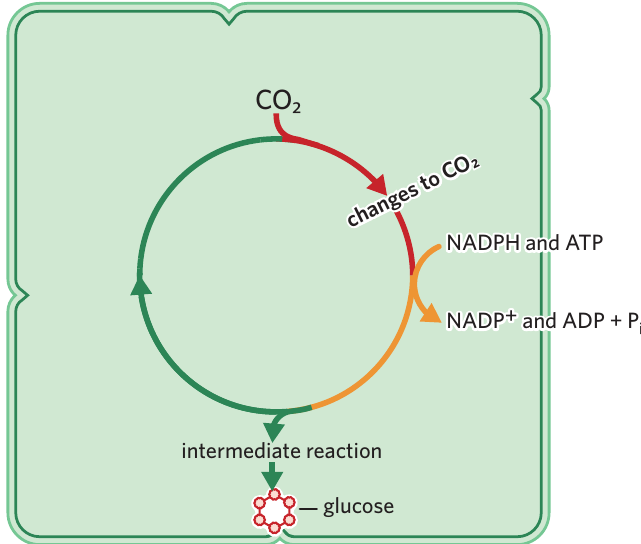
Step 1: Carbon dioxide enters the cycle
Carbon dioxide molecules diffuse into the leaf through stomata and enter the Calvin cycle in the stroma. During initial reactions, the carbon from combines with an existing five-carbon molecule. This six-carbon molecule then splits into two three-carbon molecules, which continue through the cycle.
Step 2: Energy donation from coenzymes
NADPH molecules produced in the light-dependent stage donate their hydrogen ions and electrons to the carbon molecules. ATP molecules break down into and , releasing energy that drives further changes to the carbon-containing molecules.
Step 3: Carbon molecule transformation and glucose formation
The carbon-containing molecules continue to change and rearrange as they move through the cycle. Eventually, a specific three-carbon molecule is produced that leaves the cycle. This molecule goes on to contribute to the formation of glucose. Because glucose has six carbon atoms and carbon dioxide has only one carbon atom, six molecules must enter the cycle to produce one glucose molecule.
Step 4: Water formation
Some oxygen atoms left over from the breakdown of molecules combine with hydrogen ions from NADPH to produce water molecules as an output of this stage.
Summary of the light-independent stage
During the light-independent stage:
- collected from the atmosphere through stomata enters a cyclic series of reactions
- Carbon from undergoes reactions powered by ATP and NADPH
- Carbon-based molecules are progressively transformed through the cycle
- Eventually, molecules that contribute to glucose formation are produced, along with water
The production of glucose is the main outcome of photosynthesis. Through the two stages, the plant has successfully converted light energy into chemical energy stored within the chemical bonds of a glucose molecule. This glucose can then be transported out of the chloroplast for immediate use in cellular respiration, stored as starch, or converted into more complex molecules such as cellulose.
Complete overview of photosynthesis
Photosynthesis involves two interconnected stages that work together to transform light energy into chemical energy in the form of glucose.
| Location | Inputs | Outputs |
|---|---|---|
| Light-dependent stage Grana/thylakoid membranes | 12 12 18 | 6 12 18 |
| Light-independent stage Stroma | 6 12 18 | 12 18 6 |
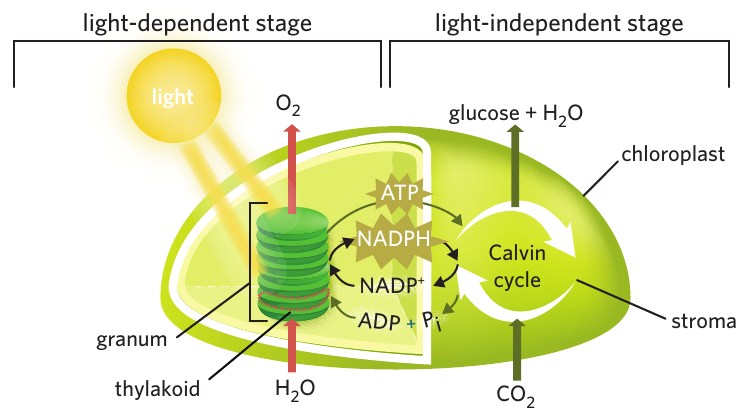
The complete process can be summarised as:
- The light-dependent stage occurs on the thylakoid membranes, using light energy to split water into oxygen and hydrogen, whilst producing the high-energy coenzymes NADPH and ATP
- The light-independent stage (Calvin cycle) occurs in the stroma, using along with NADPH and ATP to synthesize glucose
- The coenzymes cycle between both stages, carrying energy and hydrogen ions
- The overall process converts into using sunlight energy
Remember!
Summary
Key Points to Remember:
-
Photosynthesis converts light energy into chemical energy stored in glucose molecules using carbon dioxide and water as starting materials.
-
Two distinct stages work together: The light-dependent stage (on thylakoid membranes) produces NADPH and ATP whilst releasing oxygen. The light-independent stage (in the stroma) uses these coenzymes to fix into glucose through the Calvin cycle.
-
Location matters: Light-dependent reactions occur on thylakoid membranes within grana. Light-independent reactions occur in the stroma. Both stages take place within chloroplasts.
-
Coenzymes connect the stages: NADPH transfers hydrogen ions and ATP transfers energy. They cycle between both stages, being "charged" in the light-dependent stage and "discharged" in the light-independent stage.
-
The overall equation: (in the presence of sunlight). This seemingly simple equation represents a complex series of enzyme-catalysed reactions across two stages.