Sexual vs Asexual Reproduction (VCE SSCE Biology): Revision Notes
📚Revision Notes
Sexual vs Asexual Reproduction
Genetic diversity
Genetic diversity is a crucial concept in biology that refers to the variety of different genes and alleles present among individuals in a population. Understanding genetic diversity helps explain why some populations thrive whilst others struggle when environmental conditions change.
The gene pool
A gene pool represents the complete collection of all alleles found within a particular population. Think of it as the total genetic library available to that group of organisms. A gene is a section of DNA that carries the code to make a protein, whilst alleles are different versions of the same gene.
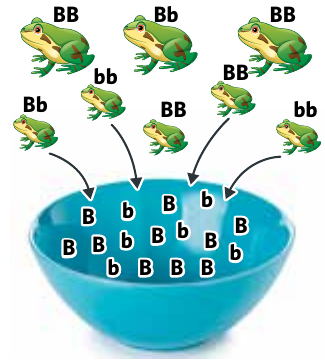
The size and diversity of a gene pool directly influences a population's characteristics. A larger, more diverse gene pool contains a greater variety of different genes and alleles, which means the population will display a wider range of genotypes (genetic makeup) and phenotypes (observable characteristics).
Why genetic diversity matters
Populations with larger, more diverse gene pools show greater resilience when facing environmental challenges. This is because diverse populations are more likely to contain alleles that provide advantages for surviving new threats such as diseases, predators, or climate changes.
Example
Understanding Population Vulnerability Through Flower Colour
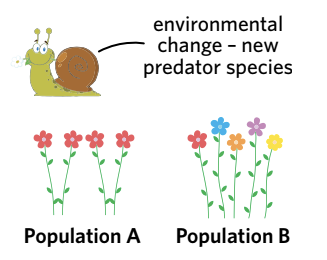
Consider two flower populations:
- Population A: Contains only red flowers (limited genetic diversity)
- Population B: Contains flowers of multiple colours (high genetic diversity)
If a new predator appears that specifically targets red flowers:
- Population A would be devastated, as all individuals are vulnerable
- Population B would survive, as individuals with different petal colours remain protected
This demonstrates how genetic diversity acts as insurance against environmental threats.
Note
The Roulette Analogy for Genetic Diversity
Imagine one population betting all its resources on a single number, whilst another population spreads its bets across twenty different numbers. The second population has a much higher chance of winning (surviving) when the ball falls. Similarly, populations with more alleles in their gene pool have better odds of surviving unexpected environmental changes.
Case study: Wild cheetahs
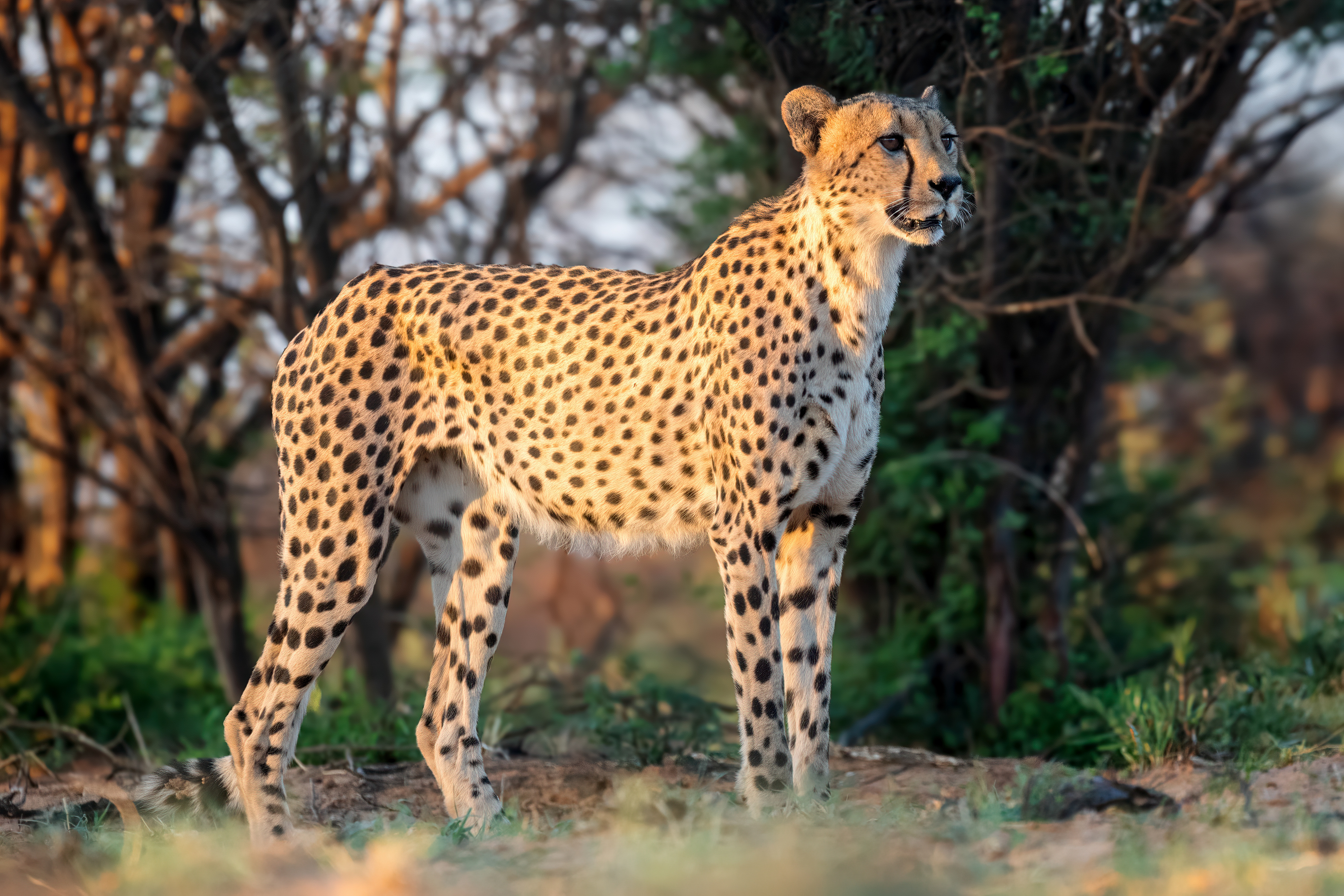
Cheetahs (Acinonyx jubatus) provide a striking example of the dangers of low genetic diversity. Around 12,000 years ago, at the end of the last ice age, the cheetah population experienced a massive collapse. This dramatic reduction left surviving cheetahs with very limited genetic diversity.
Important
The Consequences of Low Genetic Diversity in Cheetahs
Today's cheetah populations remain vulnerable to environmental changes due to their small gene pool. Increasing habitat loss and poaching continue to shrink the population further. The limited genetic variation has led to:
- Increased inbreeding between closely related individuals
- Significantly raised likelihood of birth defects in offspring
- Only around five per cent of cheetah cubs survive to adulthood
This demonstrates the serious long-term consequences of reduced genetic diversity.
Sexual reproduction
Sexual reproduction is the primary reproductive strategy for approximately 99% of eukaryotic organisms, including most animals and plants. This method involves combining genetic material from two parents to create genetically unique offspring.
What is sexual reproduction?
Sexual reproduction is the fusion of two distinct haploid gametes to produce a single diploid zygote composed of two sets of chromosomes. The process of combining these gametes is called fertilisation, and the resulting cell is called a zygote (the diploid cell formed by the combination of two haploid gamete cells).
Note
Reproductive Strategies
Reproductive strategies are adaptations that have evolved to improve reproductive success based on an organism's environment. These strategies vary widely between species, reflecting differences in factors such as:
- Resource availability
- Predation risk
- Climate conditions
- Parental care requirements
Types of sexual reproduction in animals
Sexually reproducing animals can be classified based on how their embryos develop. The two main categories are oviparity and viviparity.
Oviparity describes species where eggs are released into the external environment and embryos develop using nutrients stored in the yolk. Development occurs mostly outside the mother's body.
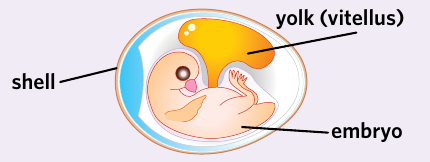
In most birds and insects, fertilisation occurs inside the mother before the eggs are laid. However, many fish species release unfertilised eggs into water, where they are fertilised externally by free-swimming sperm (a variation called ovuliparity).
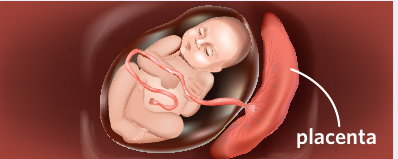
Viviparity describes species where the embryo develops inside the mother's body and is born after a gestation period. Fertilisation always occurs inside the mother.
Note
Variations in Viviparous Development
Many sharks and snakes retain eggs inside the mother's uterus during development (ovoviviparity). In most mammals, embryos develop inside a fluid-filled sac within the mother's uterus, receiving nutrients through the placenta.
Both oviparous and viviparous species invest substantial resources into reproduction. Oviparous mothers must allocate nutrients to produce eggs with yolk, whilst viviparous mothers support developing embryos inside their bodies from fertilisation until birth. Parental care often continues well beyond birth or hatching in both groups.
Sexual reproduction in plants
Around 90% of the approximately 400,000 known plant species are angiosperms (flowering plants with stems, roots, and leaves). These plants reproduce through pollination, a form of sexual reproduction that involves the fusion of pollen (male gamete) and ovule (female gamete), leading to seed production.
During pollination, pollen is collected by the stigma of a flower and fuses with the ovule. The resulting embryo develops into a seed containing nutrients that support the growth of a young plant under suitable conditions.
Pollen transfer typically relies on pollinators, which can be categorised as either biotic or abiotic.
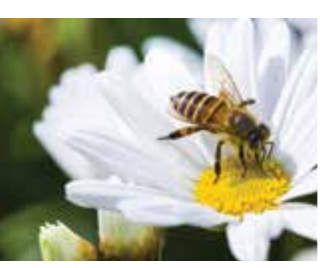
Biotic pollinators are living organisms such as insects or birds. These pollinators are attracted by brightly coloured petals, pleasant scents, and nutrient-rich nectar.
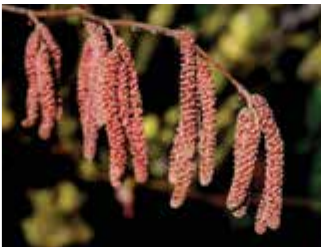
Abiotic pollinators use non-living methods such as wind or water to disperse pollen. Plants relying on abiotic pollination focus on maximising pollen dispersal rather than attracting animal pollinators. These plants often lack colourful petals and strong scents, and frequently hang downwards to facilitate wind dispersal.
Advantages and disadvantages of sexual reproduction
Sexual reproduction is complex and requires significant investment, yet it remains the dominant reproductive strategy for eukaryotes primarily because of its benefits for genetic diversity.
| Advantages | Disadvantages |
|---|---|
| Increases genetic diversity by producing recombinant offspring with new combinations of alleles | Time, energy, and resources required to attract and find a mate |
| Improves disease resistance by maintaining different alleles in the population | Risk of transmissible diseases through sexual contact |
| Combining genetic material from two parents reduces the chance of offspring inheriting genetic disorders carried by one parent | Risk of losing offspring to external factors such as embryo damage |
| Cost of producing male offspring who cannot themselves produce young |
Important
Why Sexual Reproduction Dominates Despite Its Costs
Although sexual reproduction requires more time, energy, and resources than asexual reproduction, the genetic diversity it produces provides crucial advantages:
- Protection against new diseases
- Adaptation to changing environments
- Reduced risk of inherited genetic disorders
- Greater evolutionary flexibility
Asexual reproduction
Whilst sexual reproduction dominates among complex organisms, some species can reproduce without fusing gametes. This alternative strategy is called asexual reproduction.
What is asexual reproduction?
Asexual reproduction involves producing offspring without the fusion of gametes. Organisms that reproduce asexually create offspring that are clones (genetically identical organisms) of the parent and each other.
All prokaryotes and a small percentage of eukaryotes use asexual reproduction. This reproductive strategy typically occurs in unicellular and simple multicellular organisms.
Types of asexual reproduction
Several distinct methods of asexual reproduction have evolved in different organisms. Each method produces genetically identical offspring but involves different biological processes.
Binary fission
Binary fission is a type of asexual reproduction where one organism divides into two identical organisms. This is the most common form of asexual reproduction, occurring primarily in simple prokaryotic organisms such as bacteria. However, binary fission also occurs in some multicellular organisms like polyps, where the organism splits into two equally sized clones.
Budding
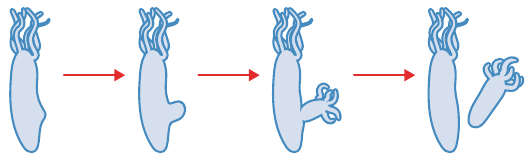
Budding is a type of asexual reproduction where a group of cells form a bud that breaks away from the original organism to form a clone. This method typically occurs in simple eukaryotes such as yeast, sponges, jellyfish, coral, and worms.
Note
The Budding Process
The process involves the formation of a bud through increased cell growth in one area of the organism. This bud develops and eventually breaks away from the parent organism, where it continues developing into a completely separate organism with identical DNA to its parent.
Fragmentation
Fragmentation is a type of asexual reproduction where a parent organism breaks into fragments, each of which may develop into individual clones. This process typically occurs in simple eukaryotes such as worms and sea stars, as well as many plant species.
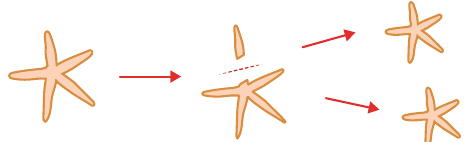
The breaking away of fragments may be intentional or accidental. Each fragment is capable of independently developing into a new organism that is genetically identical to the original. The parent organism typically regenerates to replace the lost fragments.
Vegetative propagation
Vegetative propagation is a type of asexual reproduction where a plant grows from fragments, such as stem or root cuttings, of its parent. This method allows plants to reproduce without producing seeds.
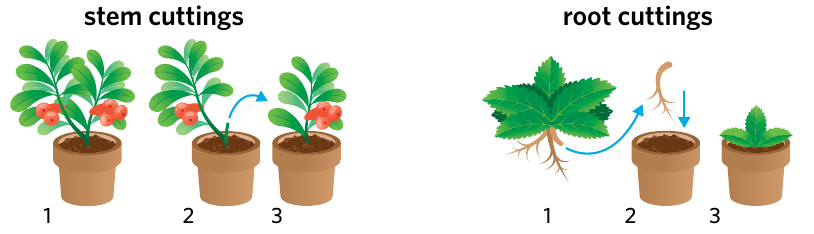
The process involves a vegetative section of the plant (such as roots or leaves) breaking away from the original plant and independently growing into a new plant. This separated section is called a 'cutting'. Vegetative propagation is widely used in horticulture and gardening to create new plants from existing ones.
Sporogenesis
Sporogenesis is a type of asexual reproduction where spores form on the surface of the organism and are dispersed into the surroundings where they may develop into individual clones of the original. This method typically occurs in many plants, fungi, algae, and moulds.
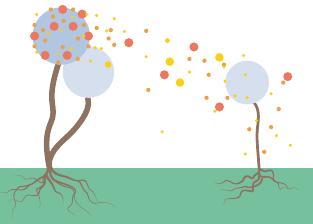
Spores are small haploid units that form on the organism's surface and are dispersed through water or air. Once in suitable conditions, spores grow into larger, multicellular, haploid organisms called sporelings.
Parthenogenesis
Parthenogenesis is a type of asexual reproduction where an embryo can develop from a single unfertilised gamete. This rare form is sometimes called 'virgin birth' and results in eggs produced through mitosis that develop into new organisms identical to the female parent.
Parthenogenesis occurs in less than 0.1% of all vertebrate species, making it extremely uncommon. Interestingly, some species that normally reproduce sexually may switch to parthenogenesis when mates are unavailable, particularly when kept in captivity.
Example
Facultative Parthenogenesis in Asian Water Dragons
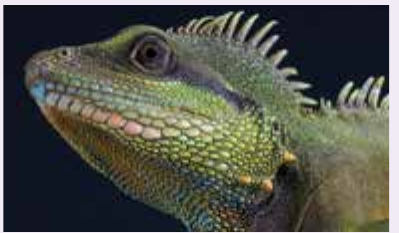
The Asian water dragon (Physignathus cocincinus) provides a remarkable example of facultative parthenogenesis:
Observation: At the Smithsonian National Zoo, a female water dragon had lived alone for over four years without any contact with males.
Result: Despite the absence of males, she produced fertile eggs and successfully raised at least nine offspring.
Significance: This demonstrates how some organisms can flexibly adapt their reproductive strategy based on environmental circumstances, switching from sexual to asexual reproduction when necessary.
Advantages and disadvantages of asexual reproduction
Although the vast majority of eukaryotic organisms reproduce sexually, asexual reproduction offers certain advantages in specific circumstances.
| Advantages | Disadvantages |
|---|---|
| Asexually reproducing populations grow faster than sexually reproducing populations | Genetic diversity is low, making populations vulnerable during rapid environmental change |
| Offspring are identical clones of the parent, preserving advantageous adaptations that are well-suited to a stable environment | |
| Does not require finding a mate, meaning organisms do not need to be mobile | |
| Requires minimal parental investment and eliminates the need to protect fragile offspring |
Comparing sexual and asexual reproduction
Sexual and asexual reproduction represent two fundamentally different strategies for creating offspring. Each approach offers distinct advantages and disadvantages that influence which organisms use them.
Note
Population Growth Rate Differences
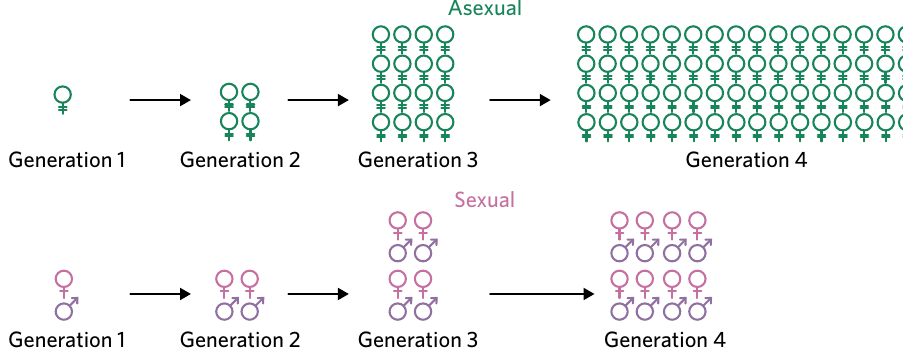
The diagram above illustrates a key difference between these strategies: population growth rate. Asexual reproduction allows faster population growth because every individual can produce offspring. In sexual reproduction, only females produce offspring, yet resources are invested in producing males who cannot themselves give birth (sometimes called "the cost of males").
Assuming each female produces four offspring per generation, asexual populations expand much more rapidly than sexual populations.
| Sexual reproduction | Asexual reproduction |
|---|---|
| Strengths: | Strengths: |
| - Increases genetic diversity of populations | - More frequent and energy-sparing reproduction |
| - Reduces risk of birth defects and genetic diseases through genetic recombination | - Fine-tuned to thrive in stable environments, as offspring are clones with proven successful traits |
| Weaknesses: | Weaknesses: |
| - More time-consuming and energetically expensive | - Hinders genetic diversity, leaving populations vulnerable to environmental changes |
Important
The Genetic Diversity Trade-Off
Despite the costs associated with sexual reproduction, the fusion of gametes from two parents helps maintain genetic diversity within species. For most complex organisms, the benefits of genetic diversity outweigh the disadvantages of sexual reproduction, such as the time and energy required to find mates and produce fewer offspring per generation.
This explains why sexual reproduction dominates in eukaryotes, even though asexual reproduction is more efficient.
Remember!
Summary
Key Points to Remember:
-
Genetic diversity measures the variety of alleles in a population's gene pool. Larger, more diverse gene pools provide greater resilience to environmental changes.
-
Sexual reproduction involves fertilisation (fusion of haploid gametes) to create genetically unique diploid offspring. This method dominates in eukaryotes because it maintains genetic diversity, though it requires more time and energy than asexual reproduction.
-
Asexual reproduction produces genetically identical clones without gamete fusion. Methods include:
- Binary fission
- Budding
- Fragmentation
- Vegetative propagation
- Sporogenesis
- Parthenogenesis This strategy is faster and requires less energy but results in low genetic diversity.
-
Sexual reproduction occurs through different strategies including oviparity (egg-laying) and viviparity (live birth) in animals, and pollination in flowering plants (angiosperms).
-
The key trade-off between these reproductive strategies is genetic diversity versus efficiency: sexual reproduction creates variation but is costly, whilst asexual reproduction is efficient but risky in changing environments.