Stoichiometry (VCE SSCE Chemistry): Revision Notes
📚Revision Notes
Stoichiometry
What is stoichiometry?
Stoichiometry is the branch of chemistry that deals with the quantitative relationships between substances in chemical reactions. It allows chemists to predict and measure the amounts of reactants needed and products formed in a chemical reaction.
The foundation of stoichiometry is the law of conservation of mass, which states that in a chemical reaction, the total mass of products equals the total mass of reactants. Put another way, atoms are neither created nor destroyed during a chemical reaction—they simply rearrange to form different substances.
Important
The law of conservation of mass is the fundamental principle that makes all stoichiometric calculations possible. Without this law, we couldn't predict the amounts of products formed from given reactants.
When you know the amount (in moles) of one substance in a chemical reaction and have a balanced equation, you can calculate the amounts of all other substances involved. These types of calculations are called stoichiometric calculations.
In volumetric analysis, stoichiometry is combined with titration data to determine the concentration of acids and bases in solution.
Understanding mole ratios
The coefficients (numbers in front of chemical formulas) in a balanced chemical equation reveal the mole ratio between reactants and products.
Consider this reaction between sodium carbonate and hydrochloric acid:
The coefficients tell us that:
- mole of reacts with moles of
- This produces moles of , mole of , and mole of
We can express these relationships as ratios:
The general mole ratio formula
For any stoichiometric calculation, the mole ratio between two substances is:
This can be remembered as UOK (Unknown Over Known):
`
Note
The UOK mnemonic is a helpful way to remember which coefficient goes on top of the fraction. You're trying to find the unknown substance, so its coefficient goes in the numerator. The known substance's coefficient goes in the denominator.
Important
Exam tip: Always clearly state the mole ratio you're using in your calculations. This is essential for showing your working and avoiding errors.
Worked example: using mole ratios
Example
Worked Example: Calculating Moles Using Mole Ratios
Key steps:
- Write the balanced equation
- Identify the known quantity (moles of mol)
- Determine the mole ratio from coefficients ()
- Calculate moles of unknown: mol
Solution volume-volume stoichiometry
When performing titrations in the laboratory, you need to calculate the number of moles of reactants using concentration and volume data. These calculations are called solution volume-volume stoichiometry.
Steps for volume-volume calculations
The systematic approach to these calculations involves four key stages:
- Write a balanced equation for the reaction
- Calculate the moles of the known substance using (Remember: volume must be in litres)
- Use the mole ratio from the equation to find moles of the unknown substance
- Calculate the required concentration or volume using:
- (to find concentration)
- (to find volume)
Note
Volume must always be converted to litres before using these formulas. To convert from millilitres to litres, divide by . This is one of the most common sources of errors in stoichiometry calculations.
Worked example: volume-volume calculation
Example
Worked Example: Volume-Volume Stoichiometry
The calculation shows:
- Balanced equation:
- Calculate moles of KOH: mol
- Use mole ratio to find moles of : mol
- Calculate volume: L mL
The final answer is rounded to mL (two significant figures, matching the least precise measurement in the data).
Important
Exam tip: Keep extra significant figures during intermediate steps to avoid rounding errors. Only round your final answer to match the least number of significant figures in the original data.
Calculations in volumetric analysis
Volumetric analysis uses titration data to determine the concentration of an unknown acid or base by reacting it with a standard solution (a solution of known concentration).
Understanding titration data
Here's typical data from a titration:
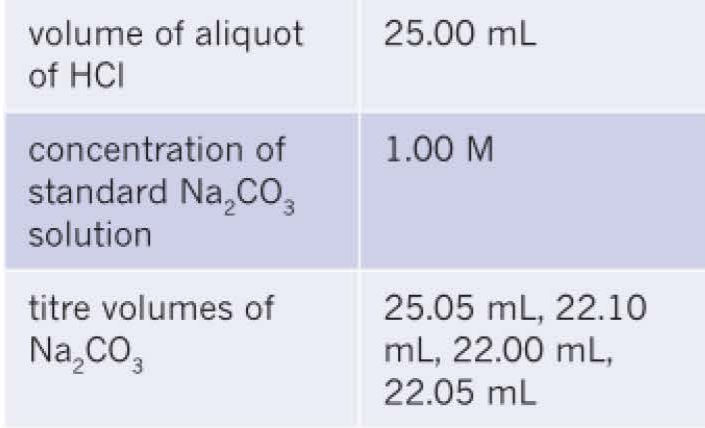
Note that multiple titre volumes are recorded. The values that are within mL of each other are called concordant titres. These should be averaged to find the titre volume to use in calculations.
Note
Understanding Concordant Titres
Concordant titres are results that are close enough together (within mL) to be considered reliable. The first titre is often a rough titre and may not be concordant with the others. Any values that differ by more than mL from the others should be excluded from the average calculation.
In the example above, mL is not concordant with the other values (it differs by more than mL), so it should be excluded from the average.
Steps for titration calculations
The process follows a logical sequence:
- Write a balanced chemical equation
- Determine the average volume of concordant titres
- Calculate moles of the standard solution using
- Use the mole ratio to find moles of the unknown substance
- Calculate the concentration of the unknown using
Worked example: titration calculation
Example
Worked Example: Determining Unknown Concentration
Write a balanced chemical equation for the reaction.
An acid is reacting with a metal hydroxide, or base, so the products will be a salt and water.
Determine the average volume of the concordant titres.
The titre of 25.05 mL is discarded as it is not concordant (i.e. it is not within a range of 0.10 mL from highest to lowest of the other titre volumes).
Calculate the amount, in mol, of the standard solution that was required to reach the end point.
Use the mole ratio in the equation to calculate the amount, in mol, of the unknown substance that would have reacted with the given amount, in mol, of the standard solution.
Determine the concentration of the unknown substance.
Express your answer to the appropriate number of significant figures.
Concentration of HCl = 0.882 M
The final result is rounded off to three significant figures, corresponding to the smallest number of significant figures in the original data. Four significant figures are used in the earlier steps of the calculation to avoid rounding off errors.
Key points from this example:
- The first titre ( mL) is excluded as it's not concordant
- Average of concordant titres: mL
- Moles of NaOH: mol
- Mole ratio is for
- Concentration of HCl: M
Titrations involving dilution
Sometimes a solution is too concentrated to titrate directly, so it must be diluted first. This ensures titre volumes fall within the burette's usable range (typically mL for accurate results).
Note
Why Dilution is Necessary
If a solution is too concentrated, the titre volumes would be very small (less than mL), making accurate measurements difficult. Diluting the solution ensures that the titre volumes fall in the optimal range where burette readings are most precise and reliable.
The dilution factor
When a solution is diluted, you need to account for this when calculating the original concentration.
The dilution factor is:
For example, if mL of concentrated solution is diluted to mL:
This means the undiluted solution is times more concentrated than the diluted solution.
Steps for dilution calculations
-
Write a balanced chemical equation.
-
Use the concentration of the standard solution to calculate the amount, in mol, of the known substance that reacted.
-
Use the mole ratio in the equation to determine the amount, in mol, of diluted unknown substance that reacted in the titration.
-
Determine the concentration of the diluted unknown substance.
-
Multiply the concentration of the diluted solution by the dilution factor to determine the concentration of the undiluted unknown substance.
After determining the concentration of the diluted solution (following the standard titration steps), multiply this concentration by the dilution factor to find the concentration of the original undiluted solution:
Worked example: titration with dilution
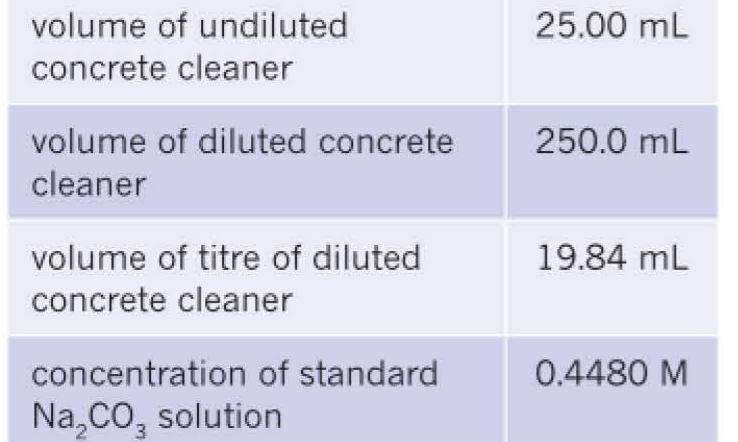
Here's data from a titration involving diluted concrete cleaner:
Example
Worked Example: Titration with Dilution
Write a balanced chemical equation.
A dilute acid is reacting with a metal carbonate so the products will be a salt, water and carbon dioxide gas.
Using the concentration of the standard solution, calculate the amount, in mol, of the known substance that reacted in the titration. Remember that volume must be expressed in litres.
Use the mole ratio in the equation to calculate the amount, in mol, of the diluted unknown solution that reacted in the titration.
Calculate the concentration of the diluted unknown solution reacting in the titration.
Multiply by the dilution factor to determine the concentration of undiluted concrete cleaner. Express your answer to the appropriate number of significant figures.
So undiluted (c(\mathrm{HCl}) = \text{diluted } c(\mathrm{HCl}) \times 10.00)
The final result is rounded off to three significant figures, corresponding to the smallest number of significant figures in the original data. Four significant figures are used in the earlier steps of the calculation to avoid rounding off errors.
Important
Exam tip: Don't forget to apply the dilution factor! A common error is calculating the concentration of the diluted solution but forgetting to multiply by the dilution factor to find the concentration of the original solution.
Equivalence point vs end point
In titration analysis, it's important to distinguish between two key concepts:
- Equivalence point: The point at which chemically equivalent amounts of reactants have been mixed. This is the theoretical point where the reaction is exactly complete.
- End point: The point at which the indicator changes colour to show the reaction is complete. This is what we observe in practice.
Note
The goal of choosing an appropriate indicator is to make the end point occur as close as possible to the equivalence point. This ensures that the observed colour change happens when the reaction is truly complete, making our calculations accurate.
Important formulas summary
| Formula | Use |
|---|---|
| Calculate moles from concentration and volume | |
| Calculate concentration from moles and volume | |
| Calculate volume from moles and concentration | |
| Determine mole ratio from balanced equation | |
| Calculate how much more concentrated the original solution is |
Note
Volume must always be in litres (L) when using these formulas. Convert millilitres to litres by dividing by .
Remember!
Summary
Key Points to Remember:
- Stoichiometry is based on the law of conservation of mass—atoms are neither created nor destroyed in chemical reactions
- The coefficients in a balanced equation show the mole ratio between substances
- Use the UOK mnemonic (Unknown Over Known) to remember the mole ratio formula
- For volume-volume stoichiometry, follow these steps: balanced equation → calculate moles of known → use mole ratio → calculate concentration or volume of unknown
- Always determine the average of concordant titres (values within mL of each other) and exclude outliers
- When dealing with diluted solutions, don't forget to multiply the calculated concentration by the dilution factor to find the original concentration
- Keep extra significant figures during calculations and only round your final answer to match the precision of the original data