Quantitative Analysis of Salts (VCE SSCE Chemistry): Revision Notes
📚Revision Notes
Quantitative Analysis of Salts
Quantitative analysis allows chemists to determine the precise amount of a specific salt in a sample. Unlike electrical conductivity measurements that only give total dissolved solids, quantitative methods can identify and measure individual salts. This is useful in many applications, from testing food products to analyzing water quality. This note covers two important laboratory techniques for measuring the mass of ionic compounds: determining water of hydration and gravimetric analysis through precipitation reactions.
Water of hydration
Understanding hydrated salts
Most salts form crystal structures where positive ions (cations) and negative ions (anions) are arranged in a regular, repeating pattern called a lattice. As these crystals grow, water molecules can become trapped between the ions, forming weak bonds with them. These water molecules become an integral part of the crystal structure and are called water of hydration.
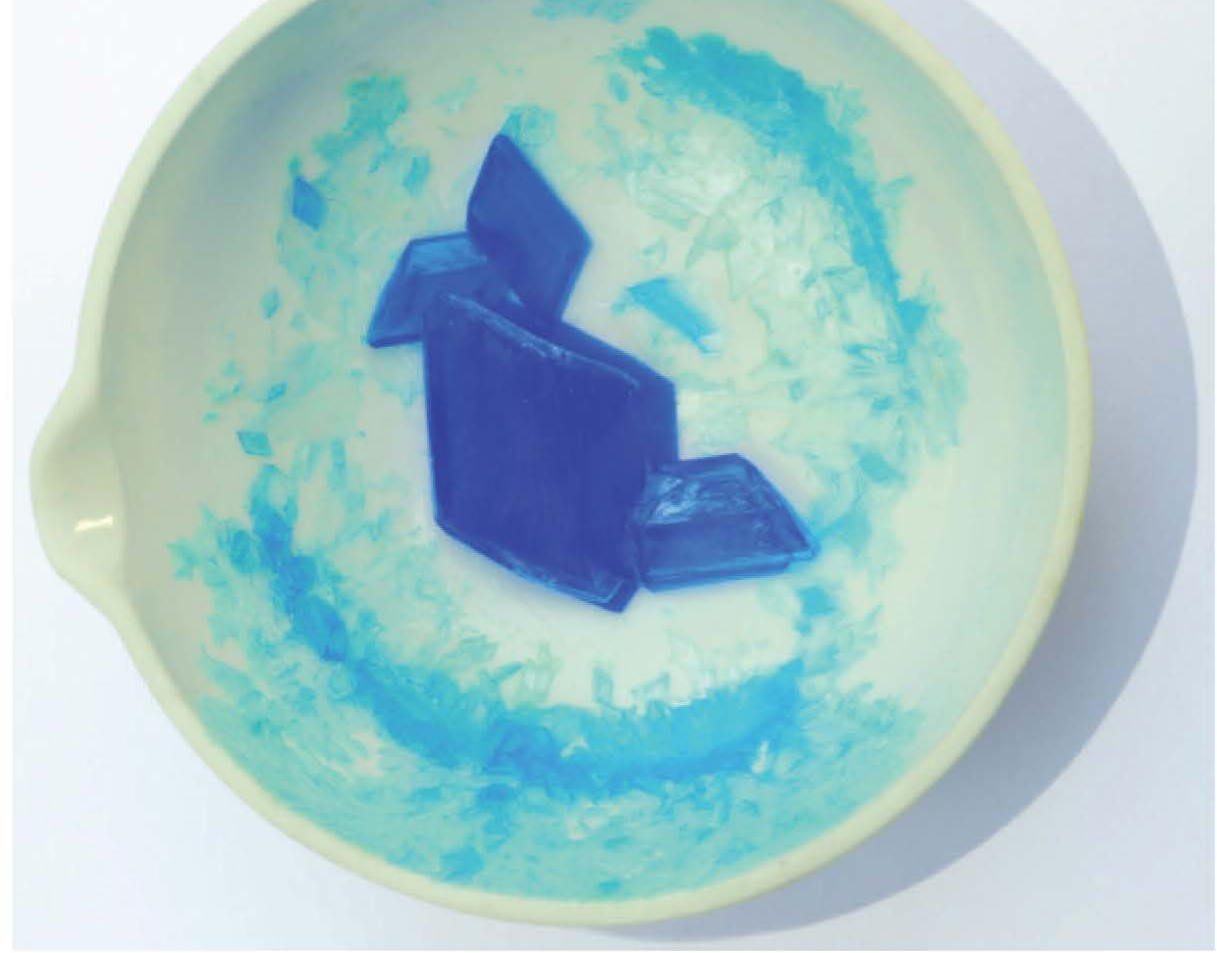
When you heat a salt crystal, the water molecules are released as steam. The crystal structure collapses, usually leaving the salt as a powder. This process is called dehydration.
Note
Key terminology:
- Hydrated salt: A salt crystal that contains water molecules as part of its structure (e.g., )
- Anhydrous salt: A salt without water molecules (e.g., )
The prefix "an-" means "without" - so anhydrous literally means "without water"!
For example, copper(II) sulfate crystals are brilliant blue when hydrated but become white powder when heated and dehydrated. The general dehydration reaction is:
where represents the number of water molecules per formula unit of .
Determining the formula of hydrated salts
The number of water molecules in a hydrated salt can be determined using gravimetric analysis. This involves weighing the crystal before heating, heating it to remove all water, then weighing the anhydrous salt that remains. The difference in mass tells us how much water was present.
Important
Calculation steps:
- Write a balanced equation for the dehydration reaction
- Calculate the number of moles of anhydrous salt using:
- Calculate the mass of water lost by subtraction
- Calculate the number of moles of water lost
- Use the molar ratio to find :
- Round to the nearest whole number to get the formula
Worked example: determining water of hydration in copper(II) sulfate
Example
Worked Example: Determining Water of Hydration
Problem: of blue hydrated copper(II) sulfate crystals was heated until it changed to a whitish powder. The mass of the anhydrous powder was . Calculate the molar ratio of water of hydration of the original blue crystals.
Solution:
First, write the balanced equation:
Calculate moles of anhydrous copper(II) sulfate:
Calculate mass of water lost:
Calculate moles of water:
Calculate the value of :
Rounding to the nearest whole number:
Answer: The formula is (copper(II) sulfate pentahydrate)
Why do some salts change color when dehydrated?
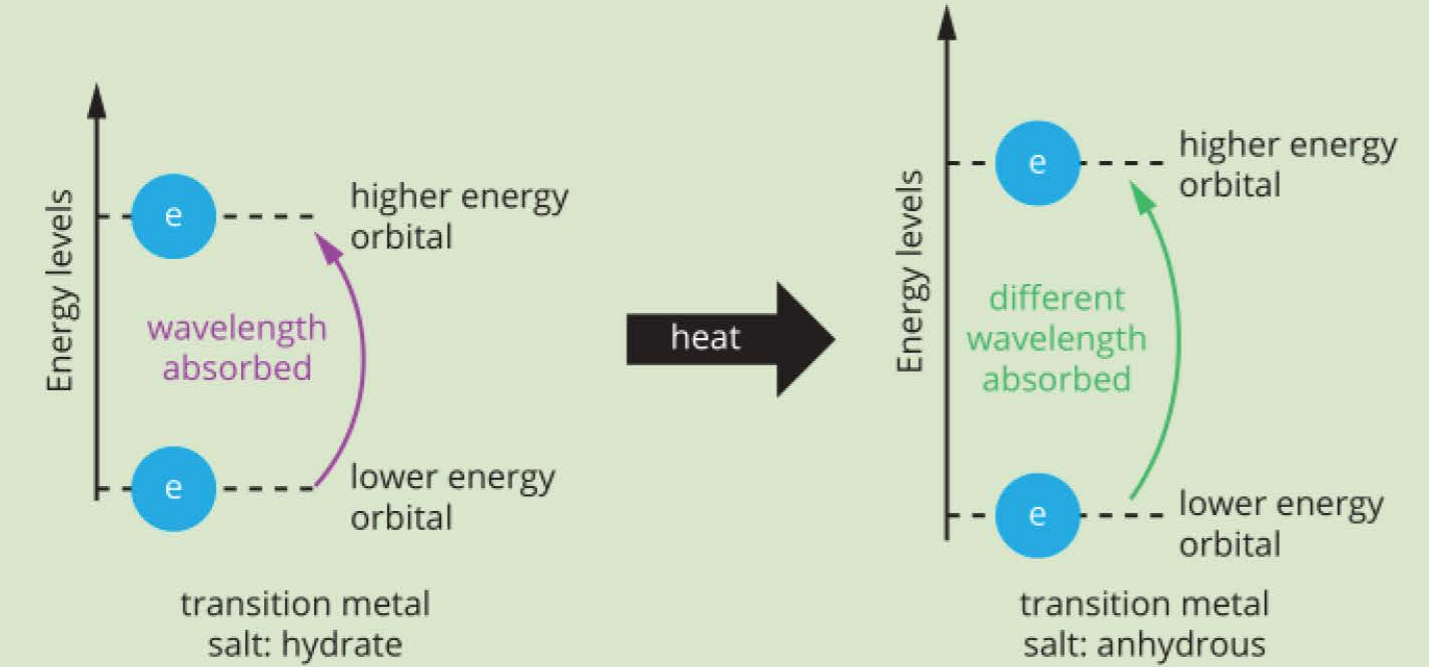
Many transition metals form colored crystal salts when hydrated. When the crystal is dehydrated by heating, the anhydrous salt sometimes appears as a different color. This color change occurs because of changes in electron energy levels.
The color of a salt is caused by electrons in the metal cations absorbing specific wavelengths of light and jumping to higher energy levels. The color we observe is from the wavelengths that are not absorbed. When water molecules are removed from the crystal, the energy levels of the electrons change. This means a different wavelength of light is needed to excite the electrons, so the salt appears as a different color.
Note
Examples of color changes:
- Hydrated copper(II) sulfate () is brilliant blue
- Anhydrous copper(II) sulfate () is white
- Hydrated nickel(II) chloride () is bright green
- Anhydrous nickel(II) chloride () is yellow
Mass-mass stoichiometry
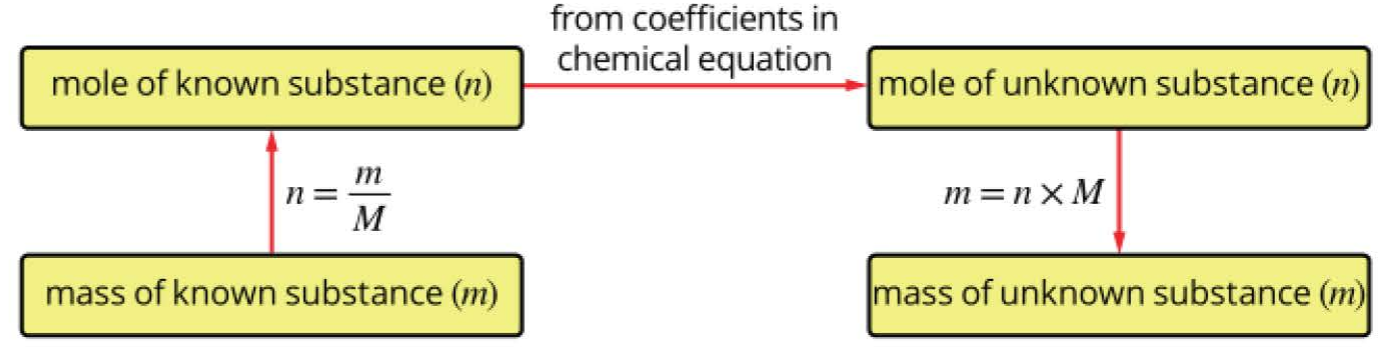
In laboratory work, chemists measure quantities in grams, not moles. Most calculations therefore require converting between mass and moles. The key relationship is:
where is the number of moles, is the mass in grams, and is the molar mass in .
To calculate mass from moles, we rearrange this formula:
Note
Memory aids for conversions:
- Mass to Moles: Divide by M ()
- Moles to Mass: Multiply by M ()
Calculating the mass of a salt from a precipitation reaction
Stoichiometry can be combined with precipitation reactions to find the amount of a salt in a solution. When you add a reagent that causes one ion to precipitate, you can weigh the precipitate and use stoichiometry to calculate how much of the original salt was present.
Important
General steps for mass-mass stoichiometry:
- Write a balanced equation for the precipitation reaction
- Calculate the number of moles of precipitate from its mass using
- Use the mole ratios from the balanced equation to calculate the number of moles of the salt in solution
- Calculate the mass of the salt using
Remember: Always work systematically from known substance → unknown substance using the equation coefficients to find mole ratios.
Note
Important: When analyzing salts using precipitation reactions, knowledge of solubility rules is essential to predict which combinations of ions will form precipitates.
Worked example: mass-mass stoichiometry with precipitation
Example
Worked Example: Determining Sodium Chloride in Peanut Butter
Problem: The silver chloride precipitate collected from a sample of peanut butter has a mass of . What is the mass of sodium chloride in the peanut butter, assuming all chloride ions are present as sodium chloride?
Solution:
Write the balanced precipitation equation:
Calculate moles of precipitate (the "known substance"):
Find the mole ratio from the equation:
Therefore:
Calculate mass of sodium chloride (the "unknown substance"):
Answer: The peanut butter contains 0.0457 g of sodium chloride.
Gravimetric analysis
Definition and applications
Gravimetric analysis is a laboratory technique that measures the mass of a precipitate to determine the quantity of an ion in solution using stoichiometry. It is one of the most versatile techniques for analyzing common inorganic substances.
Gravimetric analysis has been used in various industries to:
- Determine salt content in foods
- Measure sulfur content in ores
- Test impurity levels in water
- Check the accuracy of modern analytical instruments
Although modern automated techniques have largely replaced gravimetric analysis for routine work, it remains important for calibrating instruments and teaching fundamental analytical chemistry principles.
Principle of gravimetric analysis
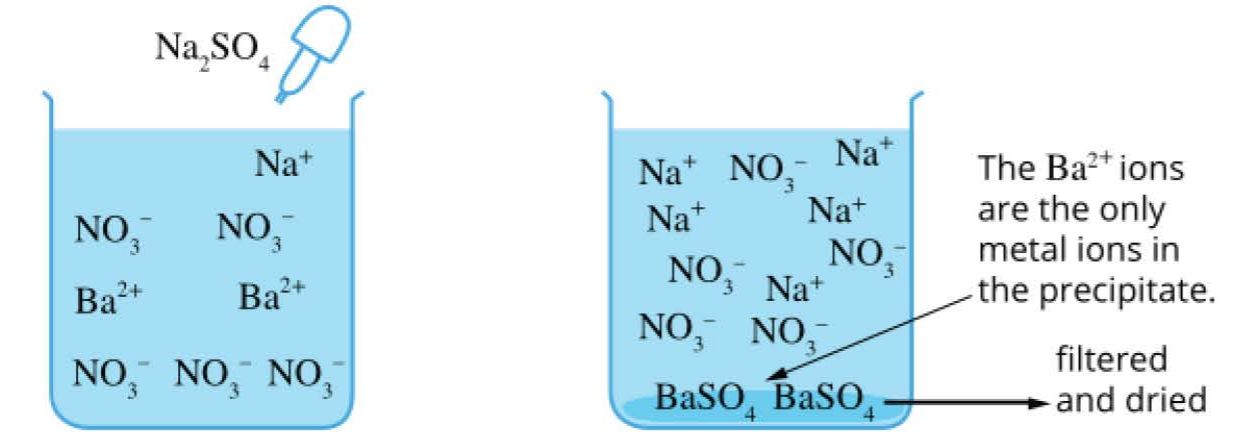
The aim of gravimetric analysis is to separate one specific ion (either a cation or anion) from all other ions in solution by forming a precipitate. The precipitate is filtered, dried, and weighed. Using mass-mass stoichiometry, the amount of the original salt can be calculated.
For example, to determine the concentration of barium ions in a solution containing barium, sodium, and nitrate ions, you would add sodium sulfate. The sodium and nitrate ions remain in solution, but barium sulfate precipitates. This precipitate can be separated, dried, and weighed. The mass of the precipitate allows calculation of the original barium ion concentration.
Note
Key requirements for gravimetric analysis:
- Knowledge of precipitation reactions and solubility rules
- A precipitate that is insoluble enough to form quantitatively
- The stoichiometry of the precipitation reaction must be known
Laboratory procedure for gravimetric analysis
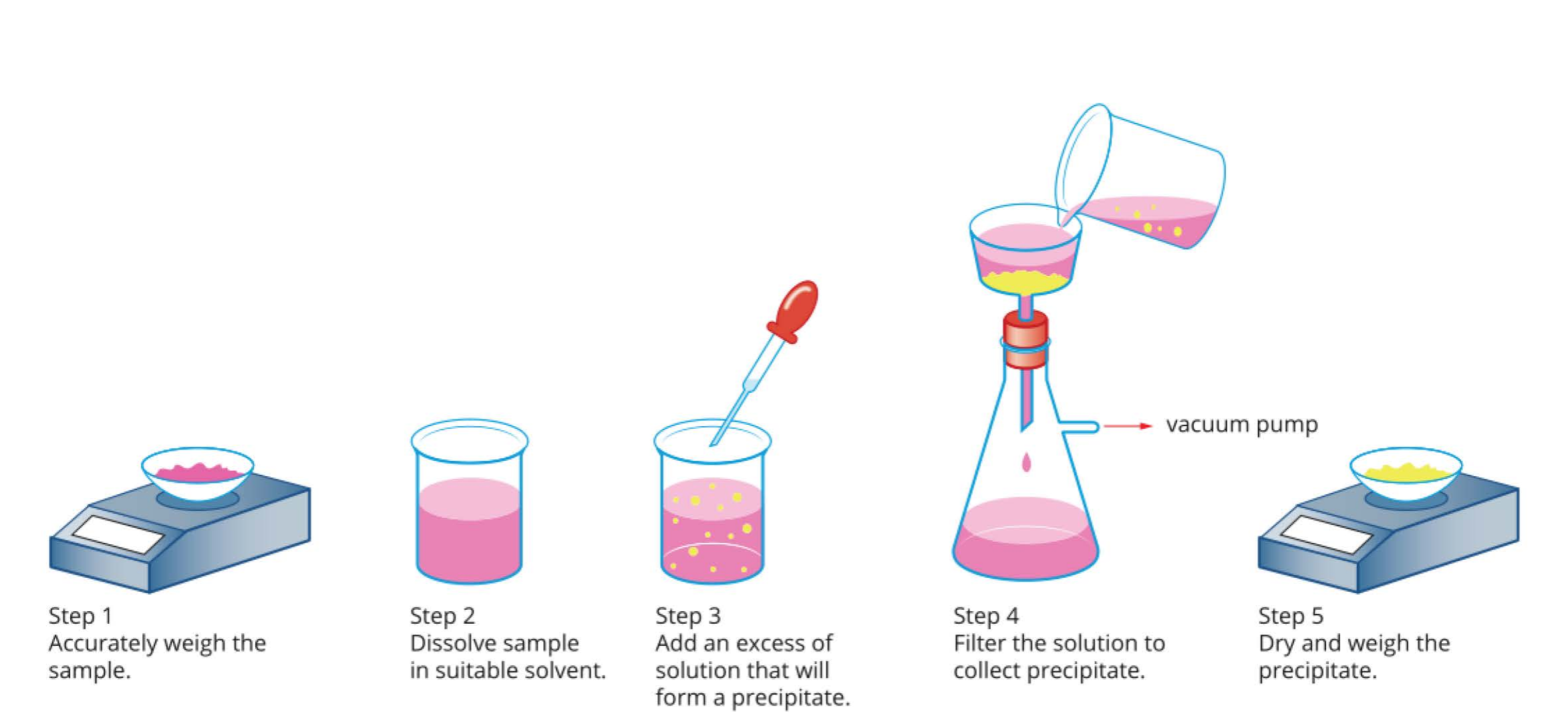
Regardless of which salt is being tested, gravimetric analysis follows the same five steps:
Important
Five-Step Procedure for Gravimetric Analysis:
Step 1: Weigh the sample Accurately weigh the sample using an analytical balance. Record the mass to the appropriate number of significant figures.
Step 2: Dissolve the sample Dissolve the sample in a suitable solvent (usually distilled water). Ensure complete dissolution by stirring or gentle heating if necessary.
Step 3: Add precipitating solution Add an excess of a solution that will form a precipitate with the ion you want to measure. Using excess ensures all of the target ion precipitates. For example, to precipitate chloride ions, add excess silver nitrate solution.
Step 4: Filter the solution Filter the solution to collect the precipitate. Vacuum filtration is often used to speed up the process and ensure complete collection. Wash the precipitate with distilled water to remove any soluble impurities.
Step 5: Dry and weigh the precipitate Dry the precipitate thoroughly (often by heating gently) to remove all water. Weigh the dry precipitate accurately. Use this mass in stoichiometric calculations to determine the amount of the original ion.
Note
Exam tip: In gravimetric analysis calculations, always identify which substance is the "known" (the precipitate you weigh) and which is the "unknown" (the ion you're measuring). Use the flowchart method to work systematically through the calculation.
Remember!
Summary
Key Points to Remember:
-
Water of hydration refers to water molecules trapped in salt crystals during formation. These can be driven off by heating, allowing determination of the salt's formula through mass measurements and stoichiometry.
-
Hydrated salts contain water molecules (), while anhydrous salts do not (). Many transition metal salts change color when dehydrated due to changes in electron energy levels.
-
Mass-mass stoichiometry converts between grams using the formulas and , combined with mole ratios from balanced equations. Always work systematically: mass of known → moles of known → moles of unknown → mass of unknown.
-
Gravimetric analysis determines the concentration of an ion by forming a precipitate, filtering and drying it, then using its mass to calculate the original concentration. The method requires knowledge of precipitation reactions and follows five steps: weigh sample, dissolve, add precipitating agent, filter, and dry and weigh precipitate.
-
When performing calculations, identify the "known substance" (what you have information about) and the "unknown substance" (what you need to find). Use balanced equations to determine mole ratios between them.