Emission Spectra and the Bohr Model (VCE SSCE Chemistry): Revision Notes
📚Revision Notes
Emission Spectra and the Bohr Model
Introduction
When fireworks explode in the night sky, they create brilliant displays of colored light. This colored light is produced by metal atoms that have been heated to very high temperatures by the explosion.

This phenomenon of colored light initially posed a major challenge for early scientists. The atomic models they were using at the time could not explain where this light came from. However, investigating this colored light eventually provided important clues that led scientists to develop a better understanding of how electrons are arranged in atoms.
Note
The study of colored light from heated atoms became a crucial turning point in our understanding of atomic structure. What seemed like a simple observation of pretty colors in fireworks turned out to hold the key to unlocking the secrets of electron behavior.
What are emission spectra?
Flame tests
When atoms are heated, they can produce colored light. You might have seen this in flame tests, which are used to identify certain metallic elements. Different metal compounds produce characteristic colors when heated in a flame.
Note
Common Flame Test Colors:
- Barium produces a yellow-green flame
- Lithium produces a crimson (deep red) flame
- Strontium produces a scarlet (bright red) flame
- Sodium produces a yellow flame
- Copper produces a green flame
- Potassium produces a lilac (purple) flame
These distinctive colors make flame tests a quick and useful way to identify metal elements in the laboratory.
How emission spectra are produced
When we pass the colored light from a flame test through a prism, something interesting happens. Instead of seeing a continuous rainbow of colors, we see a pattern of distinct colored lines on a black background. This pattern is called an emission spectrum (also known as a line spectrum).
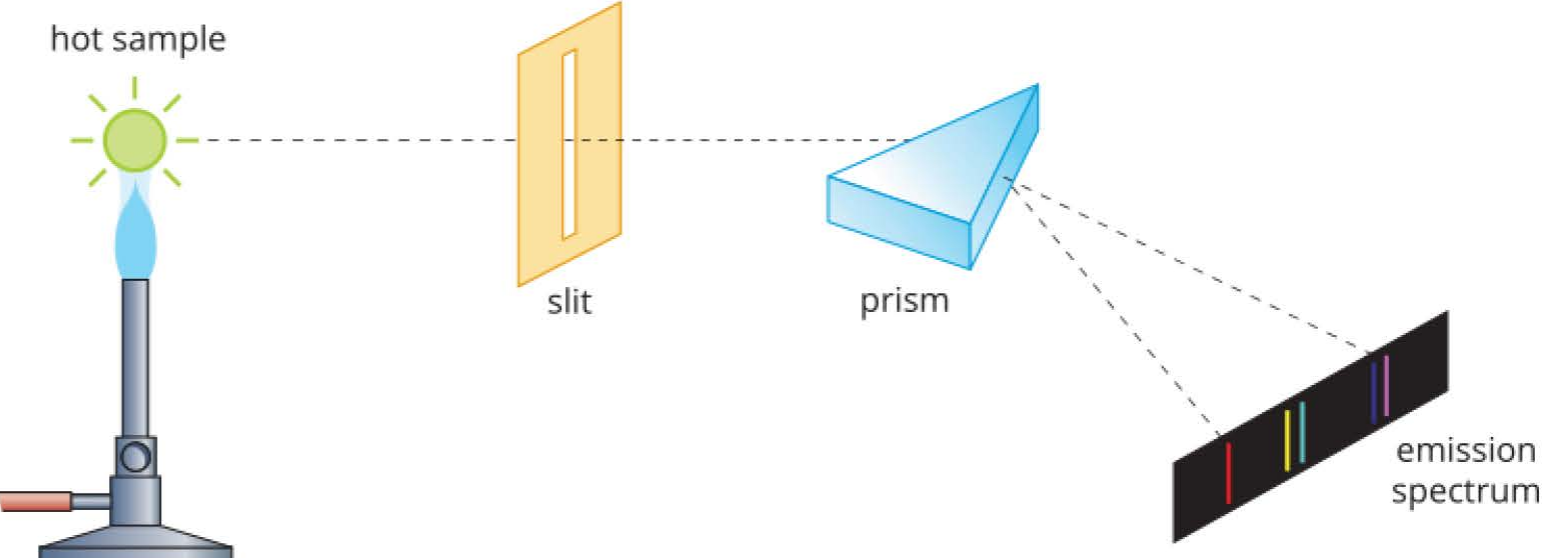
The apparatus shown above works like this:
- A sample is heated, producing colored light
- The light passes through a narrow slit
- The slit allows only a thin beam of light to pass through to a prism
- The prism separates the light into its component colors
- The separated colors appear as distinct lines on a screen
Characteristics of emission spectra
Each element has its own unique emission spectrum, like a fingerprint. This means we can identify unknown elements by analyzing their emission spectra.

The emission spectrum of helium, for example, consists of several distinct colored lines ranging from violet to red.
Important
Energy and Color Relationship
Each line in an emission spectrum corresponds to light of a specific energy. The color of the line tells us about the energy:
- Violet lines = highest energy light
- Blue lines = high energy light
- Green lines = medium energy light
- Yellow and orange lines = lower energy light
- Red lines = lowest energy visible light
This relationship between color and energy is fundamental to understanding how atoms emit light.
The Bohr model of the atom
Development of the model
In 1913, a Danish scientist named Niels Bohr developed a new model of the hydrogen atom. This model successfully explained the emission spectrum of hydrogen, which previous models could not do.
Key principles of the Bohr model
Bohr's model proposed that:
- Electrons move in fixed circular orbits around the nucleus, not in random paths
- Each orbit corresponds to a specific energy level in the atom
- Electrons can only exist in these fixed energy levels, not between them
- The larger the orbit, the higher its energy level
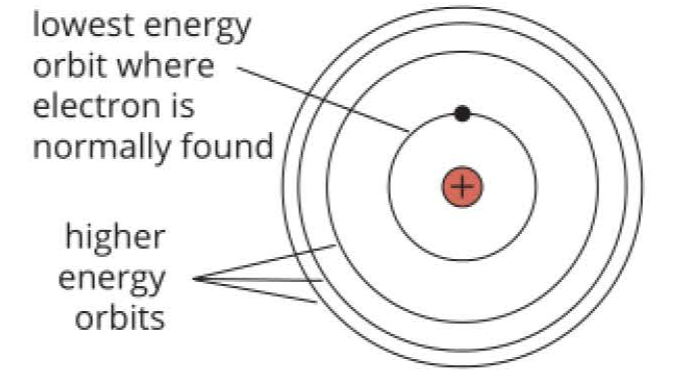
This model also explained that electrons can move between energy levels by either absorbing energy (moving to a higher level) or emitting energy (moving to a lower level). Bohr's calculations for the energies of lines in hydrogen's emission spectrum matched the observed values very closely, providing strong support for his model.
Note
Bohr's success with the hydrogen atom was remarkable because his calculated energy values matched experimental observations almost perfectly. This accuracy convinced many scientists that his model captured something fundamental about atomic structure, even though later quantum mechanics would refine and expand upon his ideas.
Electron shells and energy levels
Extending the Bohr model
Scientists quickly realized that Bohr's ideas about hydrogen could be applied to other atoms as well. They proposed that in all atoms, electrons are grouped into different energy levels called electron shells.
Shell numbering system
Electron shells are labeled using the number and so on.
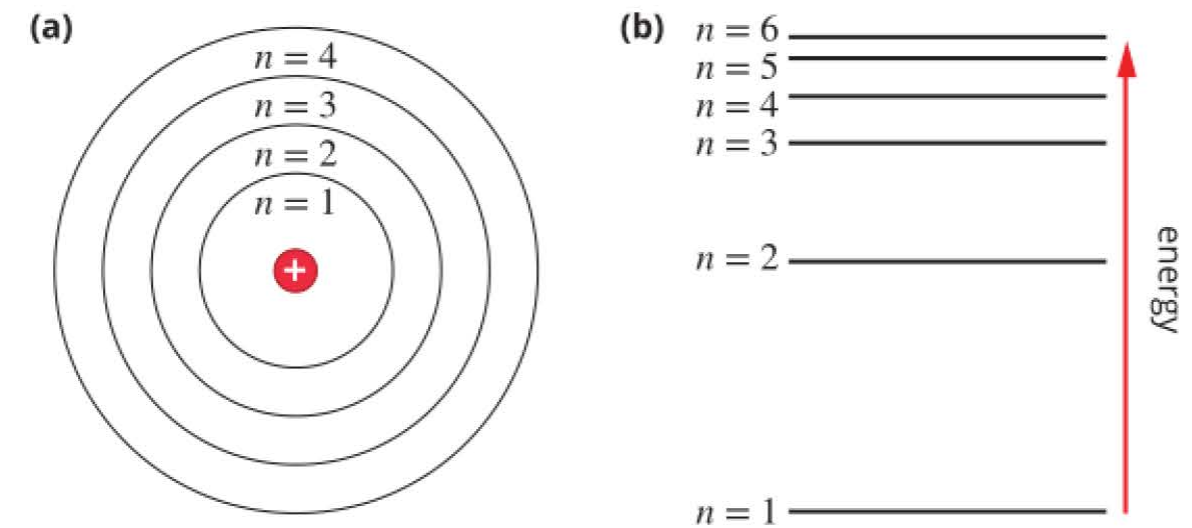
The diagram above shows two ways to represent the same information:
- Part (a) shows the electron shells as concentric circles around the nucleus
- Part (b) shows the shells as horizontal lines representing energy levels
Energy and shell number
The shell closest to the nucleus is shell 1 (). This is the lowest energy shell.
As the shell number increases, the energy level increases:
- Shell 1 () = lowest energy
- Shell 2 () = higher energy
- Shell 3 () = even higher energy
- Shell 4 () = higher still
Important
As the shell numbers increase, the energy levels get closer and closer together. This means the energy difference between shell 3 and shell 4 is smaller than the energy difference between shell 1 and shell 2. This pattern has important implications for how electrons behave in atoms.
Ground state and excited state
Under normal conditions, electrons in an atom occupy the lowest energy levels available. This is called the ground state of the atom. For a hydrogen atom with one electron, the ground state means the electron is in shell 1 ().
When an atom is heated, electrons can absorb energy and jump to higher energy levels. This is called an excited state. However, excited states don't last long. The electrons quickly return to lower energy levels.
How emission spectra relate to electron behavior
The excitation and emission process
The emission of colored light happens through this sequence of events:
- Excitation: When an atom is heated, an electron absorbs energy and jumps from a lower energy shell to a higher energy shell (excited state)
- Return: Shortly afterwards, the electron falls back down to lower energy levels
- Emission: As the electron falls to a lower energy level, it releases energy in the form of light
Important
The Key Principle:
The energy of the emitted light exactly equals the energy difference between the two shells. This is why each line in an emission spectrum corresponds to a specific energy - it represents a specific electron transition between two particular energy levels.
Multiple pathways
An electron doesn't have to return directly to the lowest energy level. It can take different pathways back to the ground state.
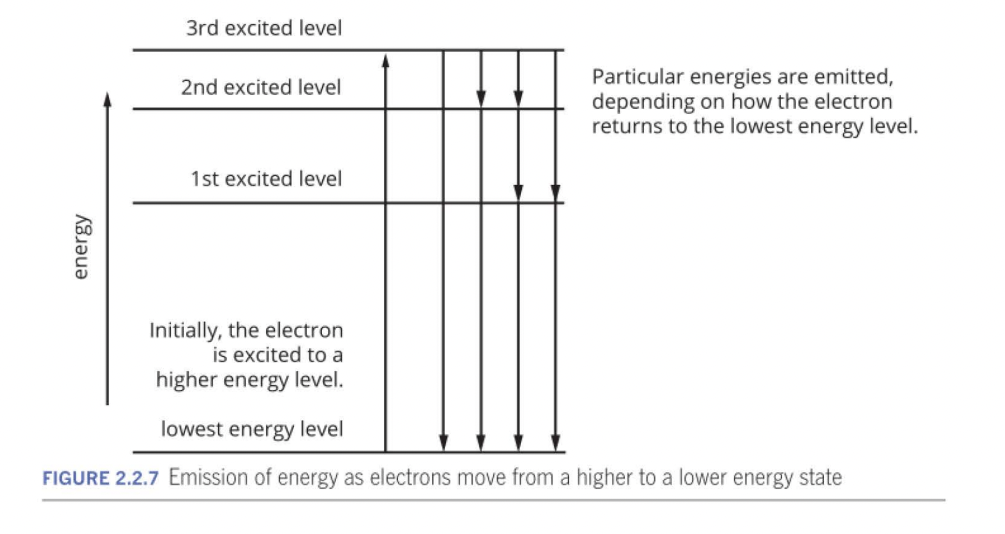
For example, an electron excited to the 3rd excited level could:
- Drop directly to the ground state
- Drop to the 2nd excited level, then to the 1st excited level, then to the ground state
- Drop to the 1st excited level, then to the ground state
Note
Each different pathway releases a different amount of energy, producing a different colored line in the emission spectrum. This is why emission spectra show multiple lines rather than just one. The variety of possible pathways creates the unique "fingerprint" pattern for each element.
Electronic configuration
What is electronic configuration?
The electronic configuration of an atom describes how electrons are arranged in the energy shells around the nucleus. Different shells can hold different maximum numbers of electrons.
Maximum electrons per shell
The maximum number of electrons that can fit in each shell follows a mathematical pattern:
Maximum electrons
where is the shell number.
| Electron shell () | Maximum number of electrons |
|---|---|
| 1 | 2 |
| 2 | 8 |
| 3 | 18 |
| 4 | 32 |
The valence shell rule
Even though shell 3 can hold up to 18 electrons (from the formula), there's an important exception. The valence shell (outermost shell) can only hold a maximum of 8 electrons. Once a valence shell reaches 8 electrons, the next shell starts filling, even if the valence shell could theoretically hold more.
Important
The Valence Shell Exception:
This is one of the most important rules to remember: the outermost shell can only hold a maximum of 8 electrons, regardless of what the formula might suggest. This rule explains why electrons start filling shell 4 before shell 3 is completely full. Understanding this exception is crucial for correctly determining electronic configurations.
Shell filling order
Electrons fill shells in a specific order. For atoms with up to 36 electrons, the pattern is:
- The first 2 electrons go into shell 1
- The next 8 electrons go into shell 2
- The next 8 electrons go into shell 3
- The next 2 electrons go into shell 4
- The next 10 electrons continue filling shell 3 (up to 18 total)
- Any remaining electrons continue filling shell 4
This unusual filling order (jumping to shell 4 before shell 3 is full) required more advanced quantum mechanical models to fully explain.
Note
Remember the "2-8-8-2" Pattern:
For the first 20 electrons, the filling pattern is easy to remember: 2, 8, 8, 2. This simple pattern covers many common elements you'll encounter. After this, shell 3 continues filling up to its maximum of 18 electrons.
Bohr diagrams
A Bohr diagram is a simple visual representation showing how electrons are arranged around the nucleus. In these diagrams, we only draw the shells that contain electrons.
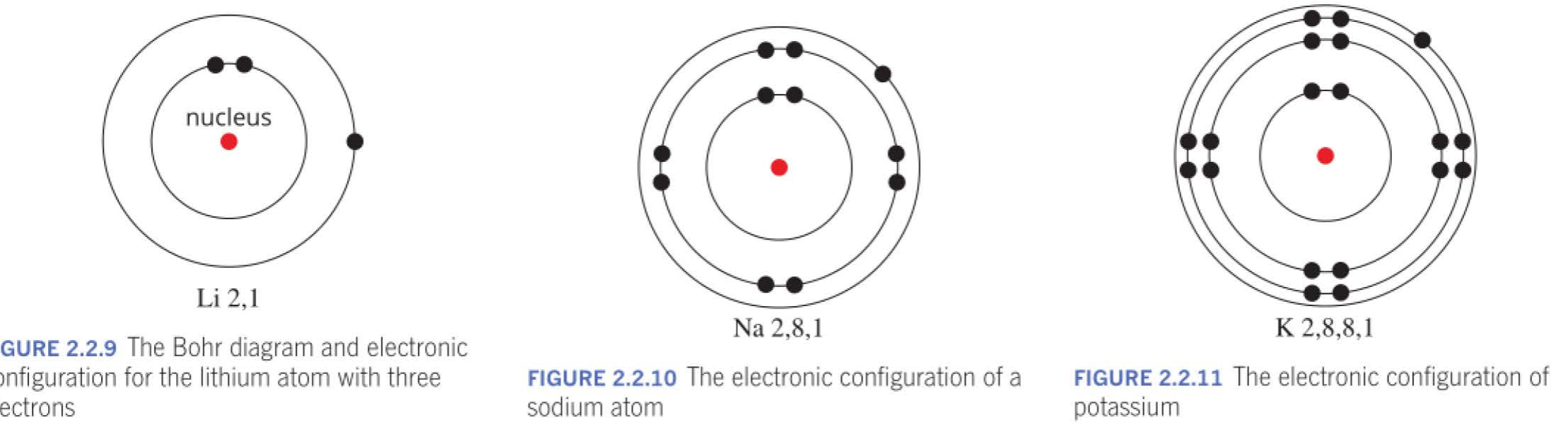
The diagrams above show three examples:
- Lithium (Li): 2 electrons in shell 1, 1 electron in shell 2
- Sodium (Na): 2 electrons in shell 1, 8 electrons in shell 2, 1 electron in shell 3
- Potassium (K): 2 electrons in shell 1, 8 electrons in shell 2, 8 electrons in shell 3, 1 electron in shell 4
Electronic configuration notation
We can write the electronic configuration as a series of numbers separated by commas. Each number represents how many electrons are in each shell, starting from shell 1.
Examples:
- Lithium: 2,1
- Sodium: 2,8,1
- Potassium: 2,8,8,1
- Magnesium: 2,8,2
Worked example: finding electronic configuration
Example
Worked Example: Determining Electronic Configuration for 28 Electrons
Let's work through how to determine the electronic configuration for an atom with 28 electrons.
Step 1: Recall the maximum number of electrons each shell can hold
| Shell () | Maximum electrons |
|---|---|
| 1 | 2 |
| 2 | 8 |
| 3 | 18 |
| 4 | 32 |
Step 2: Place the first 18 electrons in shells 1, 2, and 3
| Shell () | Electrons in atom |
|---|---|
| 1 | 2 |
| 2 | 8 |
| 3 | 8 |
| 4 | 0 |
We've placed 18 electrons. We have 10 more to place ().
Step 3: Place the next 2 electrons in shell 4
| Shell () | Electrons in atom |
|---|---|
| 1 | 2 |
| 2 | 8 |
| 3 | 8 |
| 4 | 2 |
We've now placed 20 electrons. We have 8 more to place ().
Step 4: Continue filling shell 3 with the remaining 8 electrons
| Shell () | Electrons in atom |
|---|---|
| 1 | 2 |
| 2 | 8 |
| 3 | 16 |
| 4 | 2 |
Shell 3 now has 16 electrons total (the original 8 plus the 8 we just added).
Step 5: Write the electronic configuration
The electronic configuration is: 2,8,16,2
Exam tip
When working out electronic configurations, always remember:
- Fill shells from lowest to highest energy
- Shell 1 holds maximum 2 electrons
- Shell 2 holds maximum 8 electrons
- After putting 8 electrons in shell 3, put the next 2 in shell 4
- Then continue filling shell 3 up to 18 electrons if needed
Summary
Key Points to Remember:
-
Emission spectra are unique patterns of colored lines produced when heated elements emit light. Each element has its own characteristic spectrum, making them useful for identifying elements.
-
The Bohr model explains that electrons orbit the nucleus in fixed energy levels (shells). Electrons can move between these levels by absorbing or emitting specific amounts of energy.
-
Electron shells are labeled , with shell 1 being closest to the nucleus and having the lowest energy. The maximum number of electrons in any shell is .
-
When electrons fall from higher to lower energy levels, they emit light. The energy (and therefore color) of this light depends on the energy difference between the levels. This process creates the lines we see in emission spectra.
-
Electronic configuration describes how electrons are distributed in shells. Shells fill in the order: 2 electrons in shell 1, then 8 in shell 2, then 8 in shell 3, then 2 in shell 4, then the rest in shell 3. We write this as comma-separated numbers (e.g., 2,8,8,1 for potassium).