The Atomic World (VCE SSCE Chemistry): Revision Notes
📚Revision Notes
The Atomic World
Introduction to atomic theory
Scientists have developed a deep understanding of the structure of atoms, which are the fundamental building blocks of all matter. Because atoms are incredibly small—too small to see even with the most powerful optical microscopes—much of our knowledge about atoms comes from theoretical models and indirect observations.
Note
A scientific model is a tool that scientists use to understand things they cannot observe directly. By studying their observations, scientists construct a theoretical picture of what they're trying to describe. As new evidence becomes available, these models can be refined and become more accurate. This process shows how scientific understanding develops over time.
Dalton's atomic theory
In , English scientist John Dalton presented the first comprehensive atomic theory of matter. Dalton proposed that all matter is made up of tiny spherical particles called atoms, which he believed were indivisible (could not be divided) and indestructible (could not be destroyed).
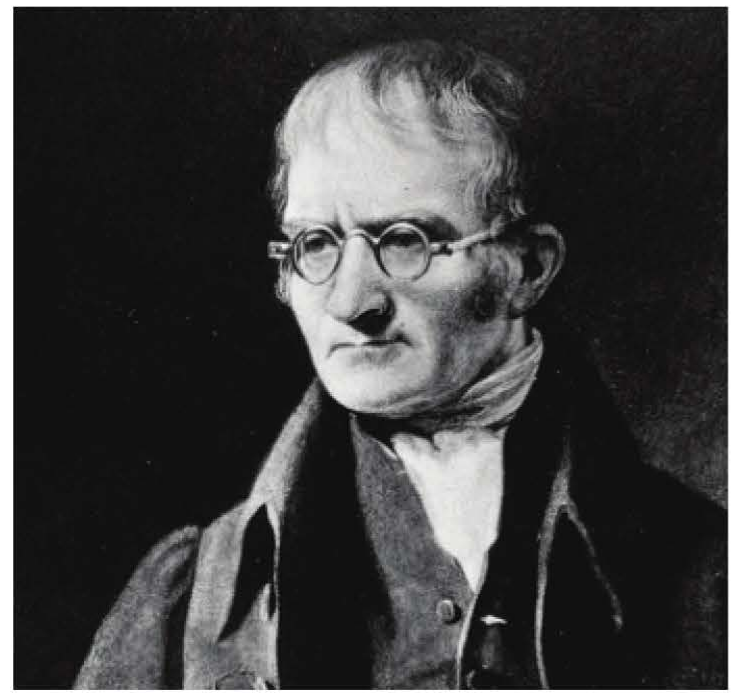
Dalton accurately described elements as materials containing just one type of atom, and compounds as materials containing different types of atoms in fixed ratios. This means that, for example, pure oxygen contains only oxygen atoms, whilst water contains hydrogen and oxygen atoms always in the same proportion.
Important
Later experiments showed that Dalton's atomic theory was mostly correct. However, scientists now know that atoms are not actually indivisible or indestructible. Atoms themselves are made up of even smaller particles called subatomic particles.
Viewing atoms
Dalton's atomic theory assumed that atoms are spherical in shape. However, there was no way to confirm this assumption until , when IBM researchers Gerd Binnig and Heinrich Rohrer developed the scanning tunnelling microscope (STM). This revolutionary technology allowed scientists to visualize individual atoms for the first time, confirming that atoms are indeed spherical.
Note
STMs work using an extremely sharp metal tip that detects atoms. The tip scans line-by-line across a crystal surface, measuring tiny height differences caused by individual atoms. This is similar to how someone with vision impairment uses their finger to sense braille on a page. The data from the tip is sent to a computer, which constructs an image of the atoms.
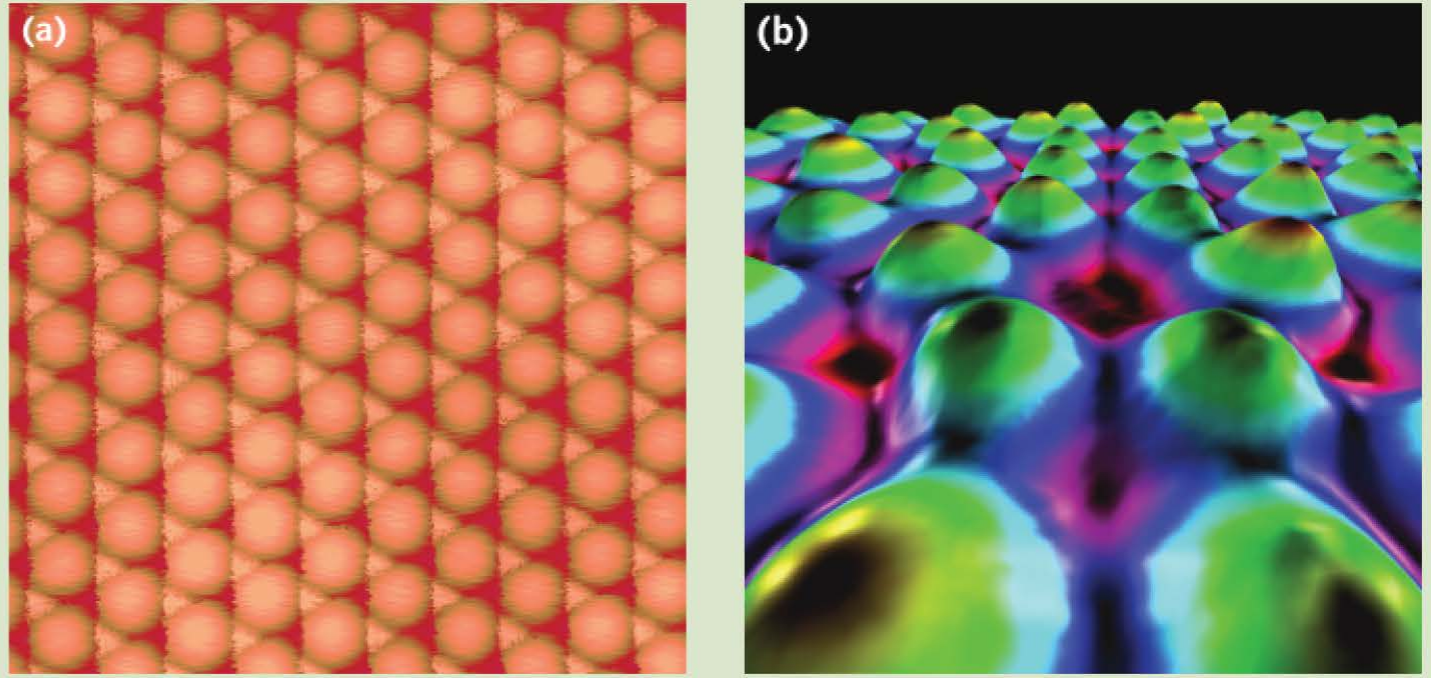
These images show copper atoms and silicon atoms on a silicon chip surface, as visualized using scanning tunnelling microscopy. The coloured representations help us understand the arrangement and structure of atoms in materials.
Structure of atoms
Overview
Atoms consist of a small, positively charged nucleus at the centre, surrounded by a much larger cloud of negatively charged electrons. The nucleus itself is made up of two types of subatomic particle: protons (which are positively charged) and neutrons (which have no charge).
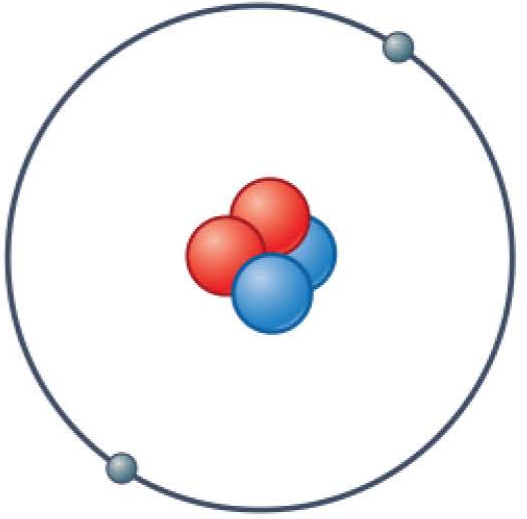
This simplified model shows a helium atom with two protons and two neutrons in the central nucleus, and two electrons orbiting around it. Whilst the diagram shows electrons in fixed orbits, evidence suggests they actually move throughout an area more like a cloud surrounding the nucleus.
Electrons
Electrons are negatively charged particles that form a cloud of negative charge around the nucleus. This electron cloud gives the atom its overall size and volume. Each electron is approximately times smaller than a proton or neutron, which means electrons contribute very little to the total mass of an atom. However, the space occupied by the electron cloud is to times larger than the nucleus itself.
Electrons are held to the nucleus by electrostatic attraction—the force between opposite charges. Negative particles attract positive particles, so the negatively charged electrons are attracted to the positively charged protons in the nucleus. The charge on an electron is equal but opposite to the charge on a proton. We say electrons have a charge of , whilst protons have a charge of .
Note
In certain circumstances, electrons can be easily removed from atoms. For example, when you rub a rubber balloon on a woollen jumper or dry hair, electrons transfer to the balloon, giving it a negative charge. You can observe this negative charge as an electrostatic force that can attract hair or even stick the balloon to a wall.

The electricity that powers lights and household appliances results from electrons moving through wires as an electric current. Sparks and lightning are also caused by electrons moving through air.
The nucleus
The nucleus of an atom is approximately to times smaller than the overall size of the atom. To put this in perspective, if an atom were the size of the Melbourne Cricket Ground, the nucleus would be about the size of a pea in the centre.

Important
Despite its tiny size, the nucleus contributes around of the atom's total mass. This means that atomic nuclei are extremely dense—very tightly packed with mass.
The subatomic particles in the nucleus—the protons and neutrons—are referred to together as nucleons. Protons are positively charged particles with a mass of approximately kg. Neutrons are almost identical in mass to protons, with a mass of approximately kg, but they have no electrical charge.
The table below summarises the properties of all three subatomic particles:
| Particle | Symbol | Charge | Mass relative to a proton | Mass (kg) |
|---|---|---|---|---|
| proton | p | |||
| neutron | n | |||
| electron | e |
Rutherford's gold foil experiment
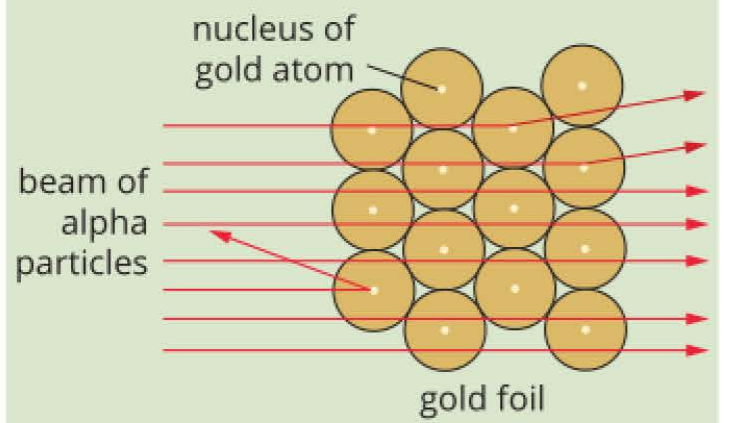
Between and , physicist Ernest Rutherford conducted experiments that revealed atoms are mostly empty space. He fired a beam of alpha particles (helium nuclei) at an extremely thin piece of gold foil. You can imagine this experiment as throwing pebbles at an object in the dark—by listening to whether the pebbles hit something or pass through, you can work out the object's shape.
Note
Rutherford observed that most alpha particles passed straight through the gold foil. Even more surprisingly, he found that a small number of particles bounced back, some almost directly back towards the source. From these observations, he concluded that gold atoms are made up almost entirely of empty space, with a small, extremely dense nucleus at the centre.
Element symbols
Atoms can be identified by how many protons they contain. An element is made up of atoms that all contain the same number of protons in their nucleus. Scientists have discovered different elements, with about of these occurring naturally. The remaining elements have only been observed in laboratory conditions.
Each element has a name and a unique chemical symbol. The chemical symbol consists of one or two letters, where the first letter is always capitalised and any subsequent letters are always lowercase.
Some common elements and their symbols include:
| Element | Symbol | Element | Symbol |
|---|---|---|---|
| aluminium | Al | mercury | Hg |
| argon | Ar | nitrogen | N |
| carbon | C | oxygen | O |
| chlorine | Cl | potassium | K |
| copper | Cu | silver | Ag |
| hydrogen | H | sodium | Na |
| iron | Fe | uranium | U |
In many cases, the chemical symbol corresponds to the element's name. For example, nitrogen has the symbol N, chlorine has the symbol Cl, and uranium has the symbol U.
Note
However, some chemical symbols don't seem to match the element's name. For example, sodium has the symbol Na, potassium has the symbol K, and iron has the symbol Fe. This is because these symbols are derived from the Latin or Greek names of the elements. In Latin, sodium is known as natrium, potassium is known as kalium, and iron is known as ferrum.
Representing atoms
Atomic number
The number of protons in an atom's nucleus is known as the atomic number and is represented by the symbol .
All atoms that belong to the same element must have the same number of protons and therefore the same atomic number. For example, all hydrogen atoms have , all carbon atoms have , and all gold atoms have .
Because all atoms are electrically neutral (have no overall charge), the number of electrons in an atom equals the number of protons. Therefore, the atomic number tells you both the number of protons and the number of electrons in a neutral atom. For example, carbon atoms with have six protons and six electrons.
Mass number
The total number of protons and neutrons in the nucleus is known as the mass number and is represented by the symbol . The mass number represents the total mass of the nucleus, because electrons contribute negligibly to the atom's mass.
Nuclide notation
A standard way of representing an atom shows its atomic number and mass number in nuclide notation:
where:
- = mass number (top)
- = atomic number (bottom)
- X = element symbol
For example, an aluminium atom would be written as:
From this representation, you can determine:
- The number of protons is (the atomic number, )
- The number of neutrons is (calculated as )
- The number of electrons is (equals the number of protons in a neutral atom)
Calculating subatomic particles
Important
Key formulas for calculating subatomic particles:
Number of protons = (atomic number)
Number of neutrons = (mass number minus atomic number)
Number of electrons = (for neutral atoms)
Example
Worked Example: Calculating Particles in an Argon Atom
Calculate the number of protons, neutrons and electrons for the atom:
Solution:
The number of protons =
The number of neutrons =
The number of electrons =
Isotopes
All atoms belonging to the same element have the same number of protons in the nucleus and therefore the same atomic number, . However, not all atoms of the same element have the same mass number, . This is because atoms of the same element can have different numbers of neutrons.
Isotopes are atoms that have the same number of protons (same atomic number) but different numbers of neutrons (and therefore different mass numbers). In other words, isotopes are different forms of the same element.
Hydrogen isotopes
Hydrogen provides a clear example of isotopes. Hydrogen atoms can have a mass number of , , or . This means hydrogen atoms may contain just a single proton, a proton and a neutron, or a proton and two neutrons.
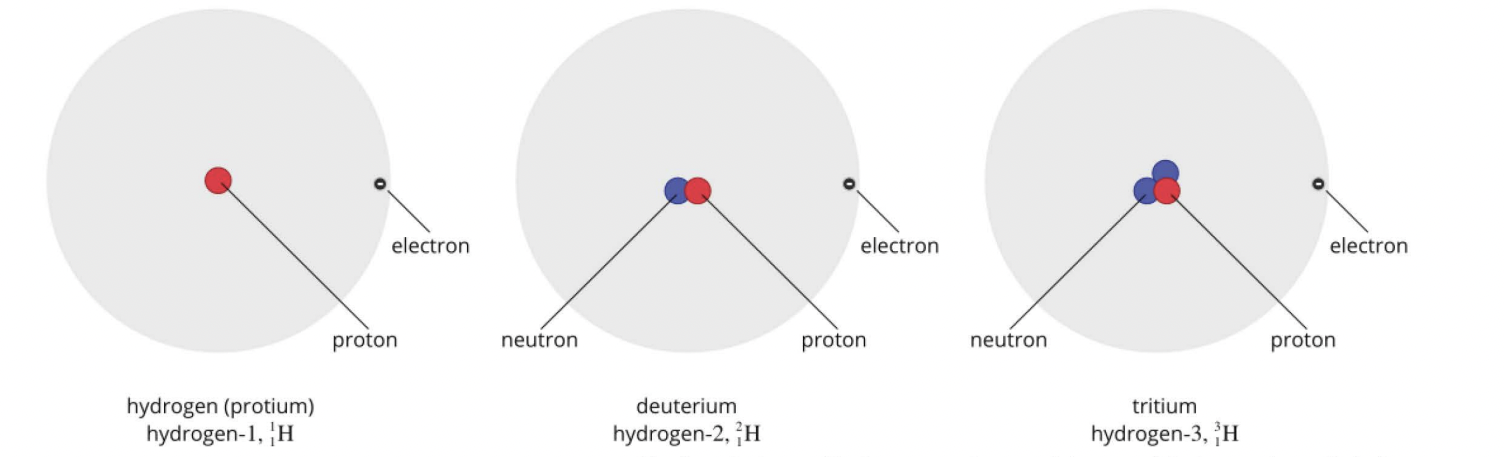
The three isotopes of hydrogen are given special names:
- Hydrogen-1 () or protium: one proton, no neutrons
- Hydrogen-2 () or deuterium: one proton, one neutron
- Hydrogen-3 () or tritium: one proton, two neutrons
All three isotopes have one proton and one electron, which means they are all hydrogen and have identical chemical properties.
Carbon isotopes
Carbon has three naturally occurring isotopes: carbon-, carbon-, and carbon-. These can be represented as:
All three carbon isotopes have six protons and six electrons, but they differ in their number of neutrons:
- Carbon- has neutrons
- Carbon- has neutrons
- Carbon- has neutrons
Properties of isotopes
Note
Isotopes have identical chemical properties but different physical properties such as mass and density. This is because chemical properties depend on the number and arrangement of electrons, which is the same for all isotopes of an element. Physical properties like mass depend on the total number of particles in the nucleus, which differs between isotopes.
Some isotopes are radioactive, meaning their nucleus is unstable and will break down naturally into a more stable form by emitting particles as radiation.
Applications: studying climate change
Scientists use isotopes to study climate change by analyzing frozen air bubbles deep within ice that has remained frozen for thousands of years. Ice-core studies have been conducted using samples from Greenland, Antarctica, and mountain peaks like Mount Kilimanjaro in Tanzania.
Note
By determining the ratio of oxygen- to oxygen- in ice-core water samples, scientists can determine the temperature when the water originally fell as rain. A larger amount of oxygen- indicates higher temperatures, whilst a larger amount of oxygen- indicates lower temperatures. The oldest ice cores collected have been years old, providing valuable data about past climate conditions.
Ions
Nuclide notation can also represent ions. Ions are atoms that have lost or gained one or more electrons, giving them an overall electrical charge. An atom that loses electrons becomes positively charged (because the positive charges in the nucleus now outnumber the negatively charged electrons). Similarly, an atom that gains electrons becomes negatively charged.
Atoms that lose electrons become positive ions (also called cations). Atoms that gain electrons become negative ions (also called anions).
Calculating subatomic particles in ions
Important
When calculating the number of particles in an ion, remember:
Number of protons = (atomic number—this never changes)
Number of neutrons = (mass number minus atomic number)
Number of electrons =
The charge appears as a superscript after the element symbol. For example, indicates a magnesium ion with a charge of .
Example
Worked Example: Calculating Particles in a Magnesium Ion
Calculate the number of protons, neutrons and electrons for the ion:
Solution:
The number of protons =
The number of neutrons =
Number of electrons in an uncharged atom =
Number of electrons in the ion =
The ion has lost two electrons, leaving it with electrons and a charge.
Summary
Key Points to Remember:
- Scientific models are tools scientists use to understand phenomena they cannot observe directly, and these models evolve as new evidence emerges.
- Atoms consist of a tiny, dense, positively charged nucleus (containing protons and neutrons) surrounded by a much larger cloud of negatively charged electrons.
- The atomic number () equals the number of protons and identifies the element. The mass number () equals protons plus neutrons.
- Isotopes are atoms of the same element (same number of protons) with different numbers of neutrons, giving them different mass numbers but identical chemical properties.
- Ions are charged particles formed when atoms gain or lose electrons. The number of protons never changes, but the number of electrons differs from a neutral atom.