The Schrödinger Model of the Atom (VCE SSCE Chemistry): Revision Notes
📚Revision Notes
The Schrödinger Model of the Atom
Limitations of the Bohr model
The Bohr shell model successfully explained the emission spectrum of hydrogen using mathematics. However, this model had important limitations that showed it was incomplete:
Important
Critical Limitations of the Bohr Model:
- It cannot accurately predict the emission spectra of atoms with more than one electron
- It is unable to explain why electron shells can only hold electrons
- It does not explain why the fourth shell accepts two electrons before the third shell is completely filled
These limitations meant scientists needed to think about electrons in an entirely different way.
A quantum mechanical view of atoms
Understanding quantum mechanics
Before Bohr, scientists believed electrons could orbit the nucleus at any distance, just as planets can orbit the Sun at any distance. Bohr's revolutionary theory proposed that electrons only occupy specific circular orbits. This was the first hint that physics inside atoms works very differently from physics in our everyday world.
The word quantum simply means a specific amount. In the Bohr model, electrons can only have specific amounts of energy depending on which shell they occupy. We say the energy of electrons is quantised.
Schrödinger's contribution
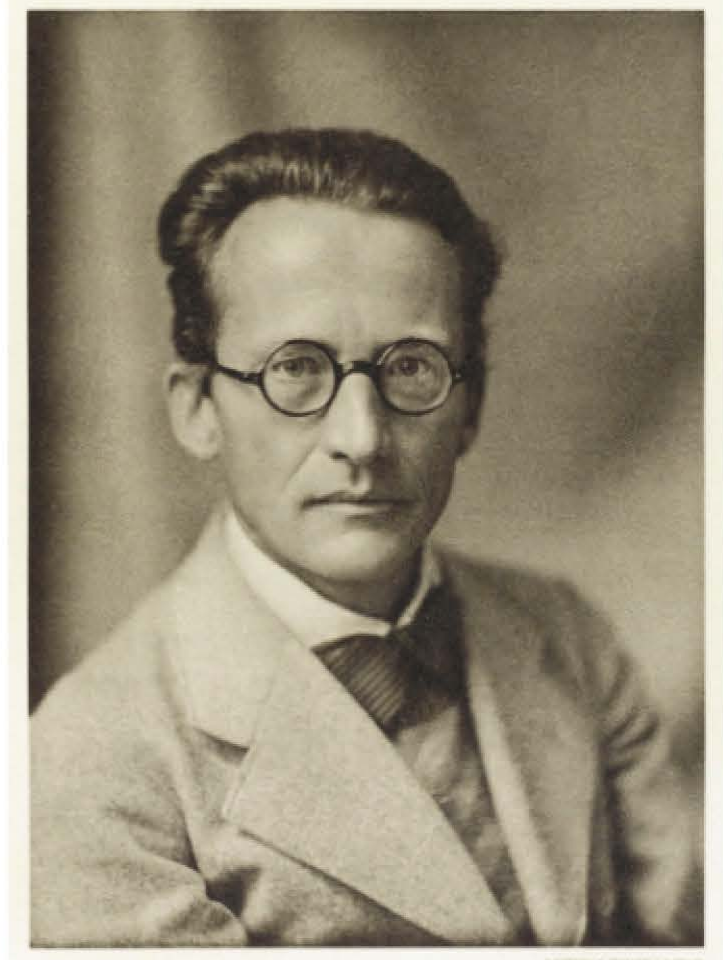
In 1926, Erwin Schrödinger proposed that electrons behave as waves around the nucleus. Using mathematics and wave theory, he developed a model called quantum mechanics. The Schrödinger model is the atomic model scientists use today.
Note
Quantum mechanics describes the behaviour of extremely small particles like electrons. Because we rarely experience quantum mechanics in everyday life, its predictions can be difficult to visualise. However, quantum mechanics accurately predicts how electrons behave in atoms.
The Schrödinger model
Key differences from the Bohr model
The fundamental difference between the Bohr and Schrödinger models is how they view electrons:
- Bohr model: Views electrons as tiny, solid particles that revolve around the nucleus in circular orbits
- Schrödinger model: Views electrons as having wave-like properties, similar to light. Electrons occupy three-dimensional spaces around the nucleus called orbitals
Shells, subshells, and orbitals
By treating electrons as waves, Schrödinger discovered that atomic structure has three levels of organization:
Note
The Three-Level Organization of Atomic Structure:
Shells are the major energy levels in an atom. For historical reasons, these are still called shells and numbered
Subshells are separate energy levels of similar energy within each shell. Schrödinger labelled these and . Each subshell can only hold a certain number of electrons:
- The first shell () contains only an s-subshell
- The second shell contains s- and p-subshells
- The third shell contains s-, p- and d-subshells
- This pattern continues for higher shells
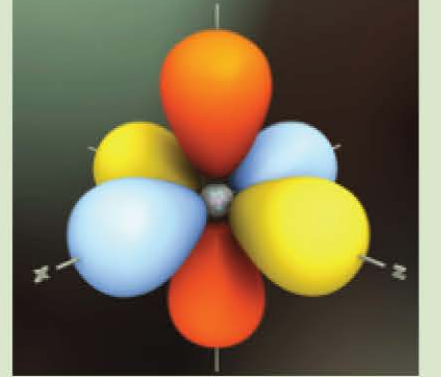
Orbitals are regions of space surrounding the nucleus where electrons may be found. Each orbital can hold a maximum of two electrons:
- An s-subshell has 1 orbital
- A p-subshell has 3 orbitals
- A d-subshell has 5 orbitals
- An f-subshell has 7 orbitals
Electron capacity
The total number of orbitals in a shell is given by . Since each orbital can contain two electrons, the maximum number of electrons per shell is .
Example
Worked Example: Calculating Electron Capacity
For the second shell ():
Step 1: Identify which subshells are present
- The second shell contains s- and p-subshells
Step 2: Count the total orbitals
- s-subshell: 1 orbital
- p-subshell: 3 orbitals
- Total: orbitals
Step 3: Calculate maximum electrons
- Each orbital holds 2 electrons
- Maximum electrons: electrons
This matches the formula: electrons
The table below summarizes the energy levels within an atom:
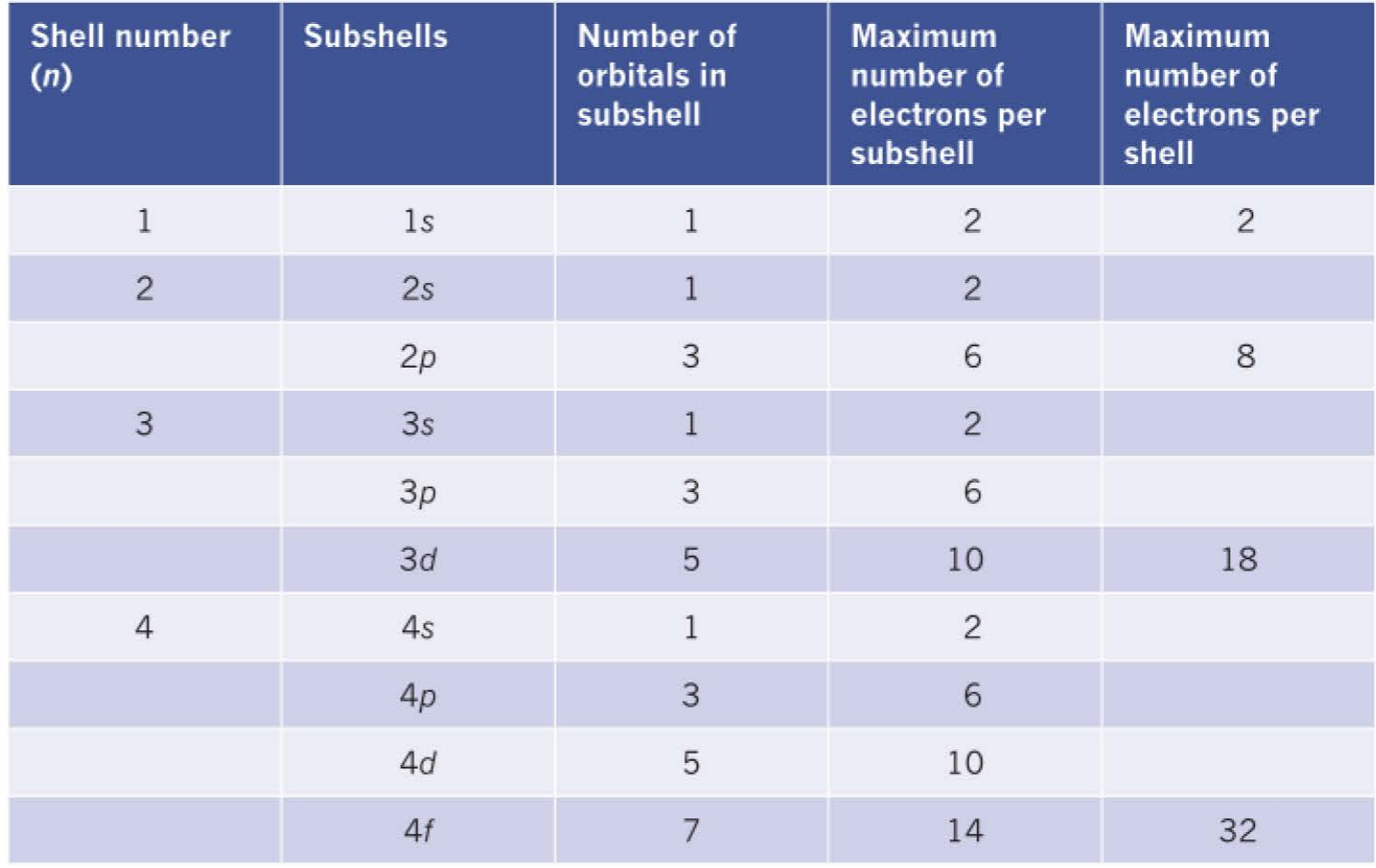
The Schrödinger model successfully explains the rule for maximum electrons per shell - something the Bohr model could not explain.
Writing electronic configurations
Subshell notation
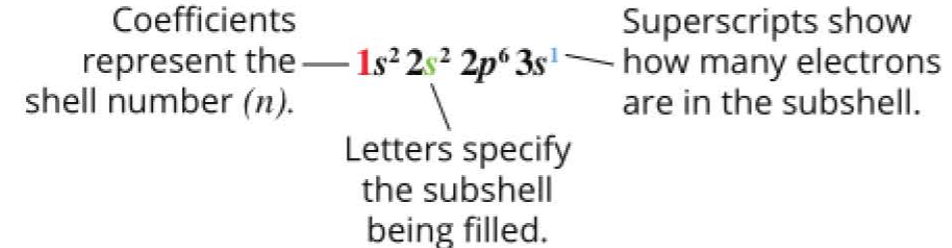
Electronic configurations for the Schrödinger model contain more detail than the shell model because they specify which subshells electrons occupy.
Example
Example: Sodium Electronic Configuration
Sodium has 11 electrons with the configuration . This tells us:
- 2 electrons in the s-subshell of the first shell
- 2 electrons in the s-subshell of the second shell
- 6 electrons in the p-subshell of the second shell
- 1 electron in the s-subshell of the third shell
Rules for writing configurations
The rules for constructing electronic configurations are straightforward:
- The lowest energy subshells are always filled first
- Each orbital contains a maximum of two electrons
Order of filling subshells
The energy order of subshells is:
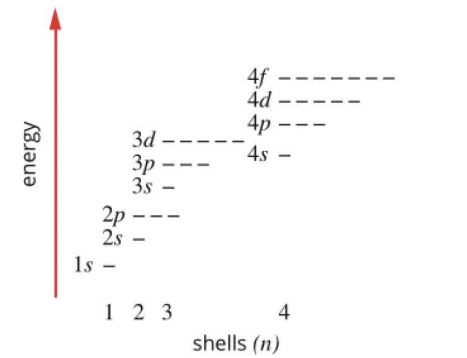
In this energy diagram, each dash represents an orbital that can hold two electrons.
Note
The Diagonal Rule
A convenient way to remember the filling order is the diagonal rule:
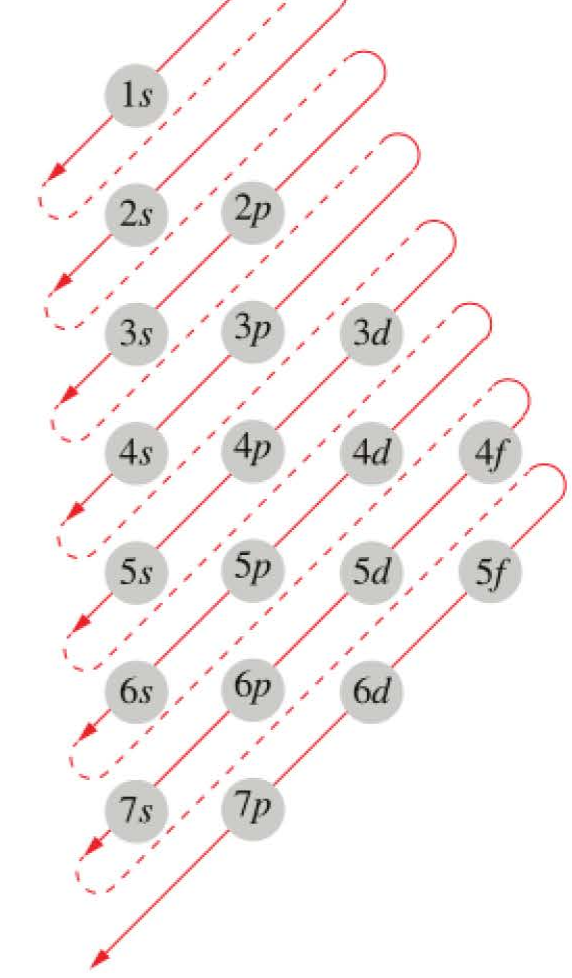
Note that the fourth shell starts filling before the third shell is completely filled. This occurs because the 4s-orbital is slightly lower in energy than the 3d-orbitals. Therefore, the 4s-orbital accepts two electrons after the 3s- and 3p-orbitals are filled, but before the 3d-orbital begins filling.
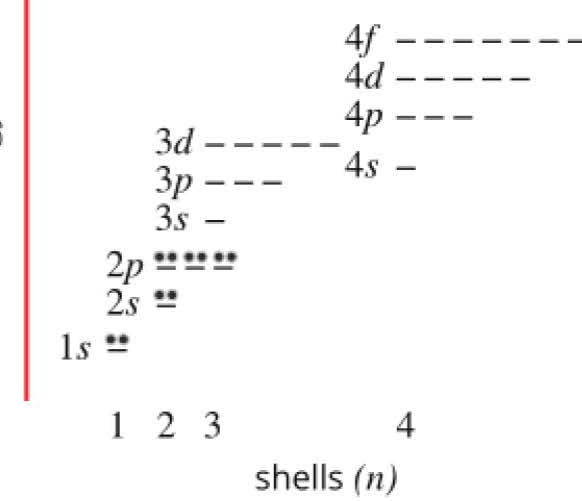
Example: Neon
The diagram below shows how energy levels are filled in a neon atom (10 electrons):
Example
Example: Neon Electron Filling
The first two electrons fill the 1s-subshell, the next two go into the 2s-subshell, and the last six fill the 2p-subshell.
The electronic configuration is written as .
Example: Krypton
Krypton has 36 electrons. According to the filling order, its configuration is:
Note
Although the 4s-subshell fills before the 3d-subshell, we usually group subshells from the same shell together when writing configurations:
Condensed electronic configurations
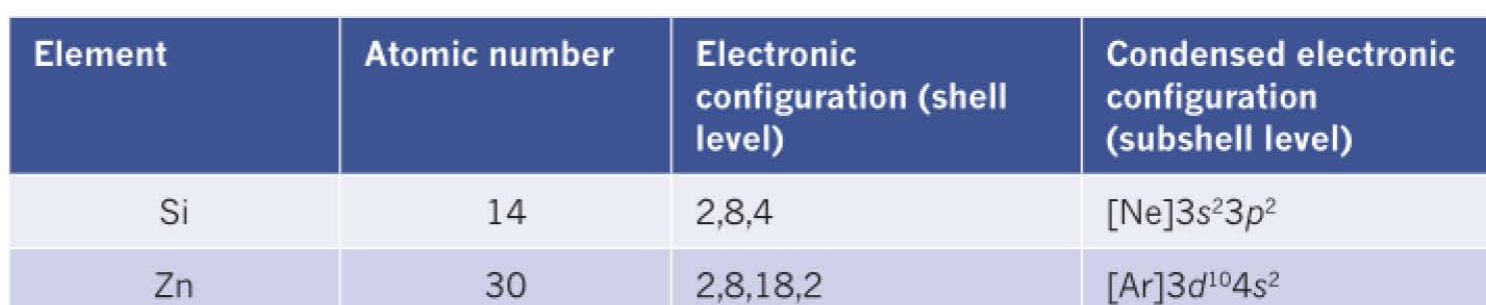
We can write electronic configurations more simply using condensed electronic configuration or noble gas notation.
Example
Example: Phosphorus Condensed Notation
Phosphorus has the configuration .
This can be written as , where represents (the electronic configuration of neon).
When writing condensed configurations, use the symbol of the noble gas from the period before the element (in square brackets). This simplifies the notation by not writing out the inner shell details.
Note
Advantages of Condensed Notation:
An advantage of condensed notation is that it emphasises the valence shell electrons, which are fundamental for understanding how atoms interact. It also allows subshell detail to be displayed where space is limited, such as on periodic tables.
Exceptions: Chromium and copper
Most elements follow the standard filling pattern, but chromium (element 24) and copper (element 29) are notable exceptions:

Important
Why Do These Exceptions Occur?
These exceptions occur because:
- In the d-subshell there are five orbitals that can hold 10 electrons total
- As a subshell fills, a single electron is placed in each orbital first, then a second electron is added to each orbital
- There is very little energy difference between 3d- and 4s-orbitals
- For chromium, the configuration (half-filled d-subshell) is slightly more stable than
- For copper, the configuration (completely filled d-subshell) is more stable than
Worked example: Writing electronic configurations
Example
Worked Example: Manganese Electronic Configuration
Question: Write the subshell electronic configuration for a manganese atom with 25 electrons.
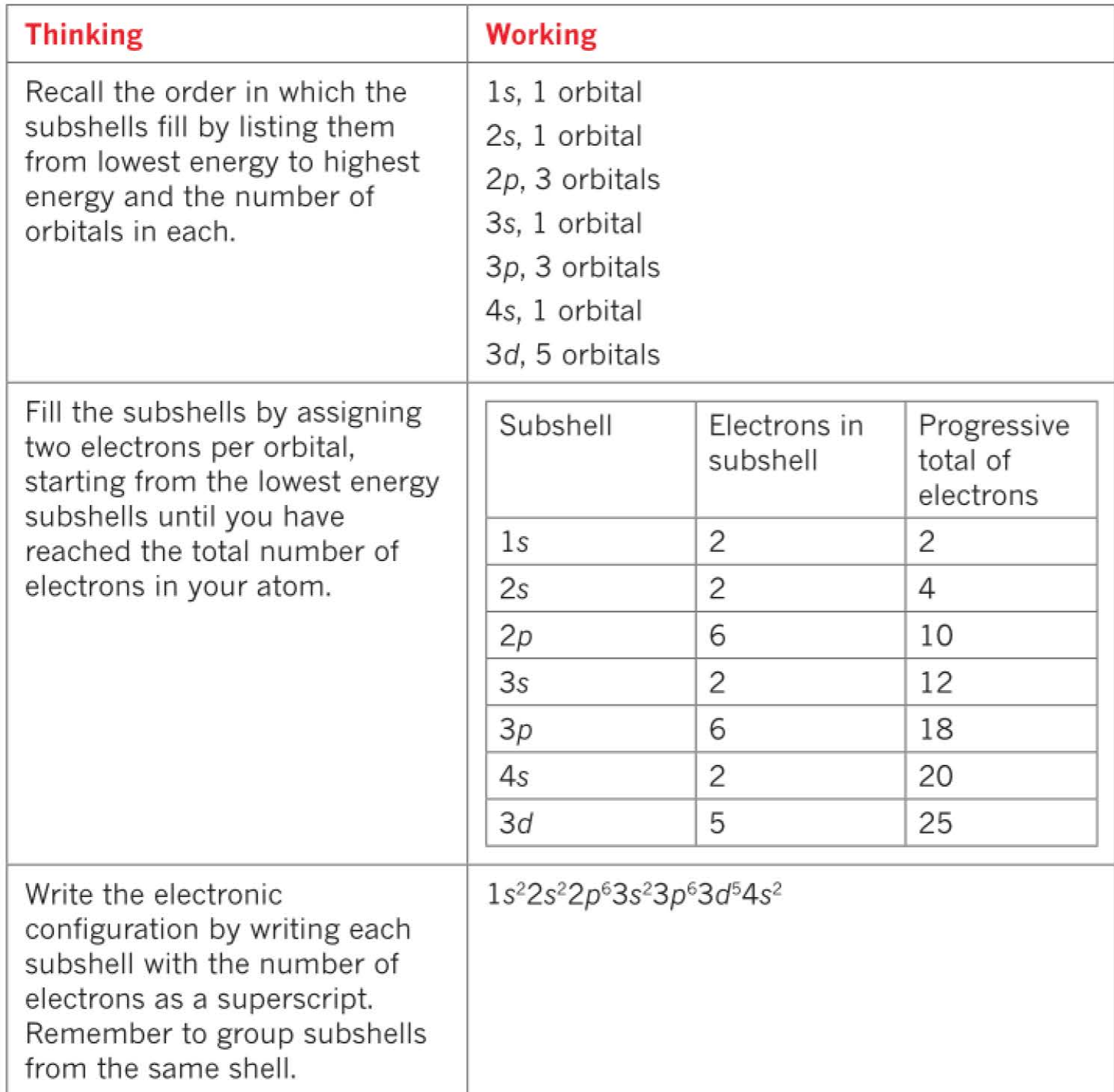
Answer:
Remember!
Summary
Key Points to Remember:
- The Schrödinger model views electrons as waves occupying three-dimensional orbitals, not particles in circular orbits
- Shells contain subshells (), which contain orbitals. Each orbital holds a maximum of 2 electrons
- Maximum electrons per shell is , which the Schrödinger model successfully explains
- Fill subshells from lowest to highest energy:
- The 4s-orbital fills before 3d because it has slightly lower energy
- Condensed notation uses noble gas symbols in brackets to simplify electronic configurations
- Chromium and copper are exceptions due to the extra stability of half-filled and completely filled d-subshells