Redox Titrations of Organic Compounds (VCE SSCE Chemistry): Revision Notes
📚Revision Notes
Redox Titrations of Organic Compounds
What is volumetric analysis?
Volumetric analysis is a powerful analytical technique used by chemists across many industries, including food production, mining, pharmaceuticals, petrochemicals, and wine-making. This method allows scientists to accurately determine how much of a dissolved substance is present in a solution.
The technique works by reacting a solution with an unknown concentration against a solution whose concentration is precisely known. While you may have encountered volumetric analysis in the context of acid-base reactions, this section focuses on using redox reactions to analyse organic compounds in solution.
Note
Volumetric analysis is one of the most widely used quantitative analytical methods in chemistry. Its applications range from quality control in manufacturing to environmental monitoring and clinical diagnostics. The precision and accuracy of this technique make it invaluable across numerous scientific and industrial fields.
Understanding concentration (revision)
What is molarity?
Concentration tells us how much solute is dissolved in a specific volume of solution. Chemists commonly express concentration as molarity (symbol M), which represents the amount of solute in moles dissolved in one litre of solution:
where:
- is concentration in (M)
- is amount in moles
- is volume in litres
Other units of concentration
Apart from molarity, chemists often use mass per unit volume to express concentration. Common examples include:
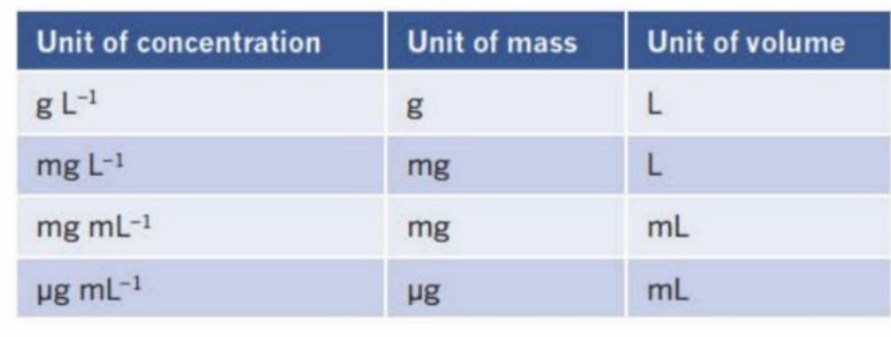
You can calculate these concentrations by dividing the mass of solute (in the appropriate unit) by the volume of solution (in the appropriate unit). For example:
Commercial products may also express concentration as:
- Percentage mass/volume (% m/v): grams per 100 mL
- Percentage by mass (% m/m): grams per 100 g
- Percentage by volume (% v/v): mL per 100 mL
Converting between concentration units
Different concentration units can be interconverted. A particularly useful conversion is between mol L⁻¹ and g L⁻¹:
Note
Converting between concentration units:
To convert from molarity to g L⁻¹, multiply by the molar mass of the solute.
To convert from g L⁻¹ to molarity, divide by the molar mass.
These conversions are essential for many practical calculations in volumetric analysis.
Solving stoichiometry problems involving solutions
When performing calculations with reactions in solution, follow these four main steps:
- Write a balanced equation for the reaction
- Calculate the amount (in moles) of the substance with known volume and concentration
- Use the mole ratio from the equation to calculate the amount (in moles) of the required substance
- Calculate the required volume or concentration to the correct number of significant figures
Note
The central concept connects the known substance to the unknown substance through the mole ratio from the balanced equation. You can calculate moles from concentration and volume using , or from mass using .
Primary standards and standard solutions
What is a standard solution?
To find the concentration of an unknown solution, you need to react it with a solution of accurately known concentration called a standard solution. Once you've determined a solution's concentration through titration, it becomes a standard solution.
What is a primary standard?
A primary standard is a pure substance where the amount in moles can be calculated accurately from its mass.
Important
Requirements for Primary Standards:
Primary standards should:
- Be readily obtainable in pure form
- Have a known chemical formula
- Be easy to store without absorbing water vapour or reacting with atmospheric gases like carbon dioxide
- Have a high molar mass to minimise weighing errors
Meeting these criteria ensures accurate and reliable concentration determinations.
Preparing a standard solution
You can prepare standard solutions by either:
- Dissolving an accurately measured mass of a primary standard in water to make an accurately measured volume of solution
- Performing a titration with another standard solution to determine its exact concentration
The steps to prepare a standard solution from a primary standard are:
- Weigh the pure solid on an electronic balance
- Transfer to a volumetric flask using a clean, dry funnel
- Rinse any remaining solid particles into the flask with deionised water
- Half-fill the flask and stopper it
- Swirl to ensure the solid particles dissolve
- Add deionised water up to the calibration line on the neck of the flask
- Stopper the flask and shake the solution to ensure an even concentration throughout
Standardised solutions
In practice, making a standard solution directly from a primary standard is only possible for a few chemicals. Many chemicals are impure because they decompose or react with atmospheric chemicals. When you need a standard solution of these 'impure' chemicals, you first react it (by titration) with a standard solution to accurately determine its concentration. This solution with a newly determined accurate concentration is called a standardised solution.
Conducting volumetric analyses
What is a titration?
During a titration, you mix a measured volume of a standard solution with a measured volume of a solution of unknown concentration. The solutions are combined until they have just reacted completely in the mole ratio indicated by the balanced chemical equation.
Important terms
Equivalence point: The point where the reactants have reacted in the exact mole ratio indicated by the balanced chemical equation.
End point: The point during the titration when the indicator changes colour.
Important
For accurate analysis, the end point should be very close to the equivalence point. A significant difference between these two points can lead to errors in your results.
Equipment and procedure
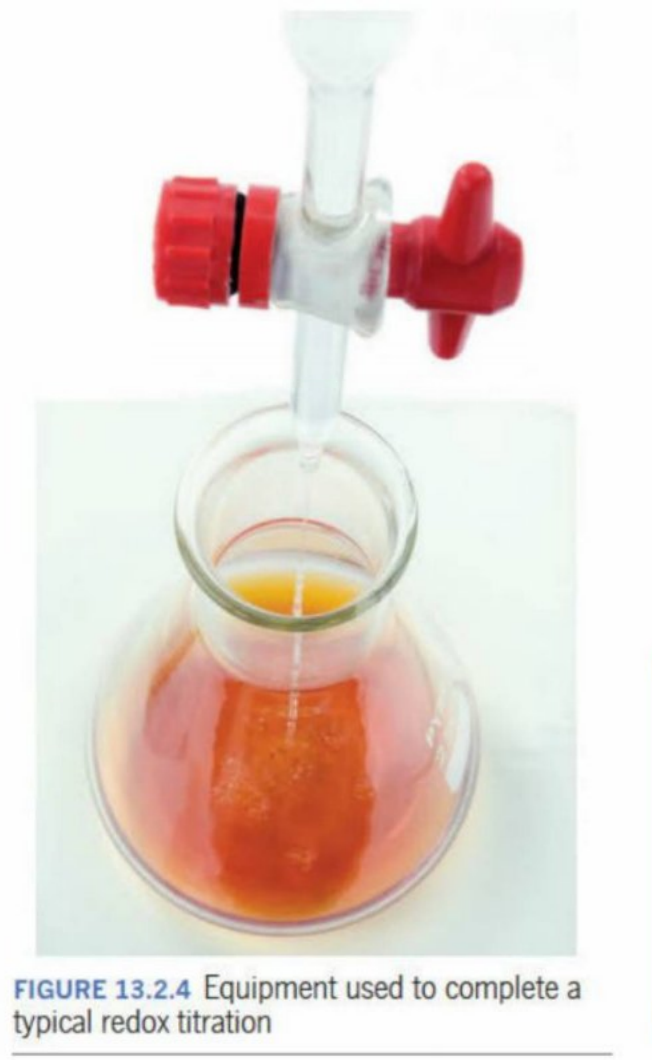
The steps in a titration are:
- Measure a known volume (called an aliquot) of one solution using a pipette and transfer it into a conical flask
- If using an indicator, add a few drops so that a colour change signals when to stop the titration
- Slowly dispense the other solution from a burette into the conical flask until the indicator changes colour permanently (end point). The volume delivered from the burette is called the titre
- Calculate the titre by subtracting the initial burette reading from the final burette reading. Always estimate burette readings to the second decimal place
- Repeat the titration several times and find the average titre. Usually three concordant titres are used to find this average
Note
Concordant titres are titres that fall within a range of 0.10 mL from highest to lowest of each other. This helps minimise random errors and ensures the reliability of your results.
Rinsing volumetric glassware
Before conducting a volumetric analysis, rinse all glassware to remove any trace chemicals. This makes the results more precise and accurate. However, you must use the correct rinsing liquid:
Important
Key Rinsing Principle:
- Conical flasks and volumetric flasks: rinse only with deionised water
- Burettes and pipettes: final rinse should be with the solution they will transfer
Rinsing burettes and pipettes with water would dilute the reactant solution. Rinsing flasks with reactants would introduce unmeasured amounts of chemicals that could affect the results.
Sources of error in volumetric analysis
The accuracy of volume measurements depends on the calibration of the equipment used. All measurements have associated uncertainties:
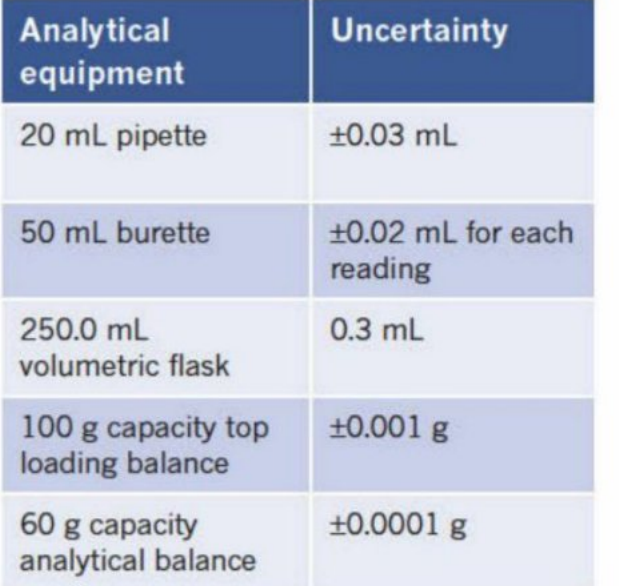
For comparison, less precise glassware includes:
- 50 mL measuring cylinder: uncertainty of ±0.3 mL
- 50 mL graduated beaker: uncertainty of ±5 mL
Note
Analytical chemists aim to produce results that are both precise and accurate. Where errors cannot be avoided, any discussion of results should refer to the level of inaccuracy. You should understand three types of experimental errors: mistakes, random errors, and systematic errors.
Redox reactions involving organic compounds
Oxidation is defined as the loss of electrons, while reduction is defined as the gain of electrons. Reactions involving the loss and gain of electrons are called redox reactions.
Redox reactions in everyday life
You can easily observe the effects of organic compounds undergoing redox reactions in daily life:
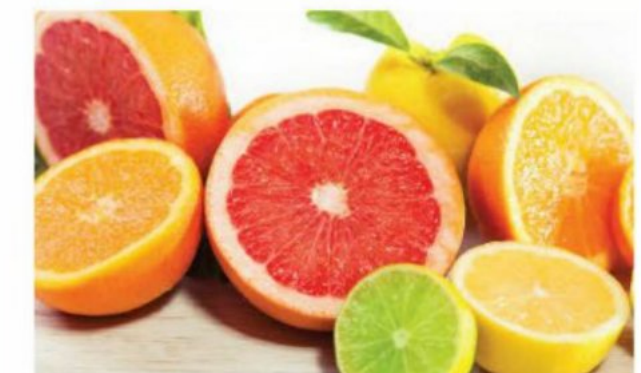
Oxygen from the atmosphere slowly oxidises molecules in fruit like apples and bananas, making them turn brown. You can prevent this by adding lemon or lime juice to cut fruit. The ascorbic acid (vitamin C) in the juice is preferentially oxidised by oxygen in the air, preventing the food from spoiling.
Within the human body, redox reactions in cells provide the body's energy. The capacity of some organic molecules to undergo redox reactions provides the basis for volumetric analysis.
Analysing organic compounds by redox titrations
What is a redox titration?
A redox titration involves the reaction of an oxidising agent with a reducing agent. You usually pipette one solution into a conical flask and dispense the other from a burette.
For some redox titrations, such as those involving the permanganate ion (MnO₄⁻), the equivalence point is indicated by a colour change in one of the reacting solutions. For other redox titrations, you must add an indicator, such as starch solution, to detect the equivalence point.
Applications of redox titrations
Volumetric analysis involving redox reactions can determine the composition of various substances, including organic chemicals in fruit juice and wine:
| Substance | Ingredient for analysis | Titrate with |
|---|---|---|
| Wine | Ethanol | Acidified potassium permanganate or potassium dichromate solution |
| Fruit juice | Vitamin C (ascorbic acid) | Iodine solution |
| Wine | Sulfur dioxide | Iodine solution |
Case study: Boab trees as a food source
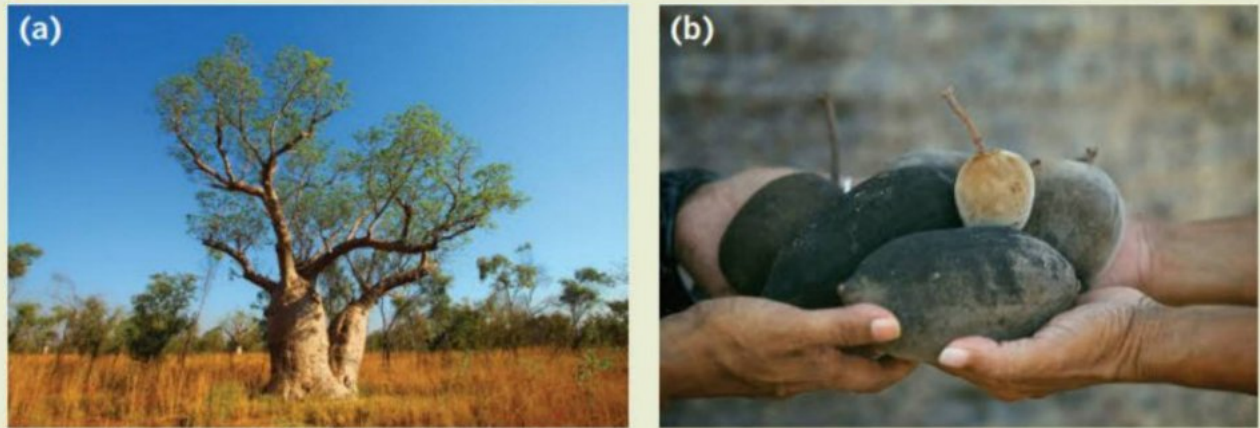
The larrkardiy, or Australian Boab tree (Adansonia gregorii), grows only in the Kimberley region of Western Australia and east into the Northern Territory. Some boab trees are more than 1500 years old, making them among Australia's oldest living organisms. As they age, they become hollow and use this space to store water within the trunk to survive harsh drought conditions.
Note
Indigenous Use of Boab Trees:
For thousands of years, Indigenous Australians have used boab trees in many ways:
- Obtained water from hollows in the tree
- Used the white powder inside seed pods as food
- Applied leaves for medicinal purposes
- Created decorative paintings or carvings on fruit and trunk surfaces
The dry powdery pulp inside the boab nut is rich in vitamin C (ascorbic acid), with 40 g of the powder providing 84-100% of the recommended daily intake. It also contains other vitamins (A, B1, B2 and B6), minerals (calcium, iron, magnesium and potassium), dietary fibre and amino acids. The nuts are lightweight and keep easily for over a year, making them a convenient food source for Indigenous Australians when moving around an area.
Volumetric analysis can determine the vitamin C content of the powder in the boab nut using either an acid-base titration with standardised sodium hydroxide solution or a redox titration.
Wine preservation with sulfur dioxide
Sulfur dioxide (SO₂, preservative number 220) has been used as a wine preservative since Roman times. It prevents oxidation and bacterial spoilage. Winemakers are allowed to add a maximum of 250 mg L⁻¹.
Sulfur dioxide is added either directly as compressed gas or via soluble metabisulfite salts such as K₂S₂O₅, which react with water to form SO₂. The primary function of SO₂ as an antioxidant is to prevent or limit the reaction of oxygen with ethanol to produce ethanoic acid.
Note
Higher levels of SO₂ are added to white wines as they are more susceptible to oxidation, whereas the tannins in red wine act as natural preservatives.
Analysing alcohols
Organic compounds with a hydroxyl functional group (-OH) belong to the family of molecules known as alcohols. Typical uses include fuels, alcoholic beverages, industrial solvents, and cleaning products.
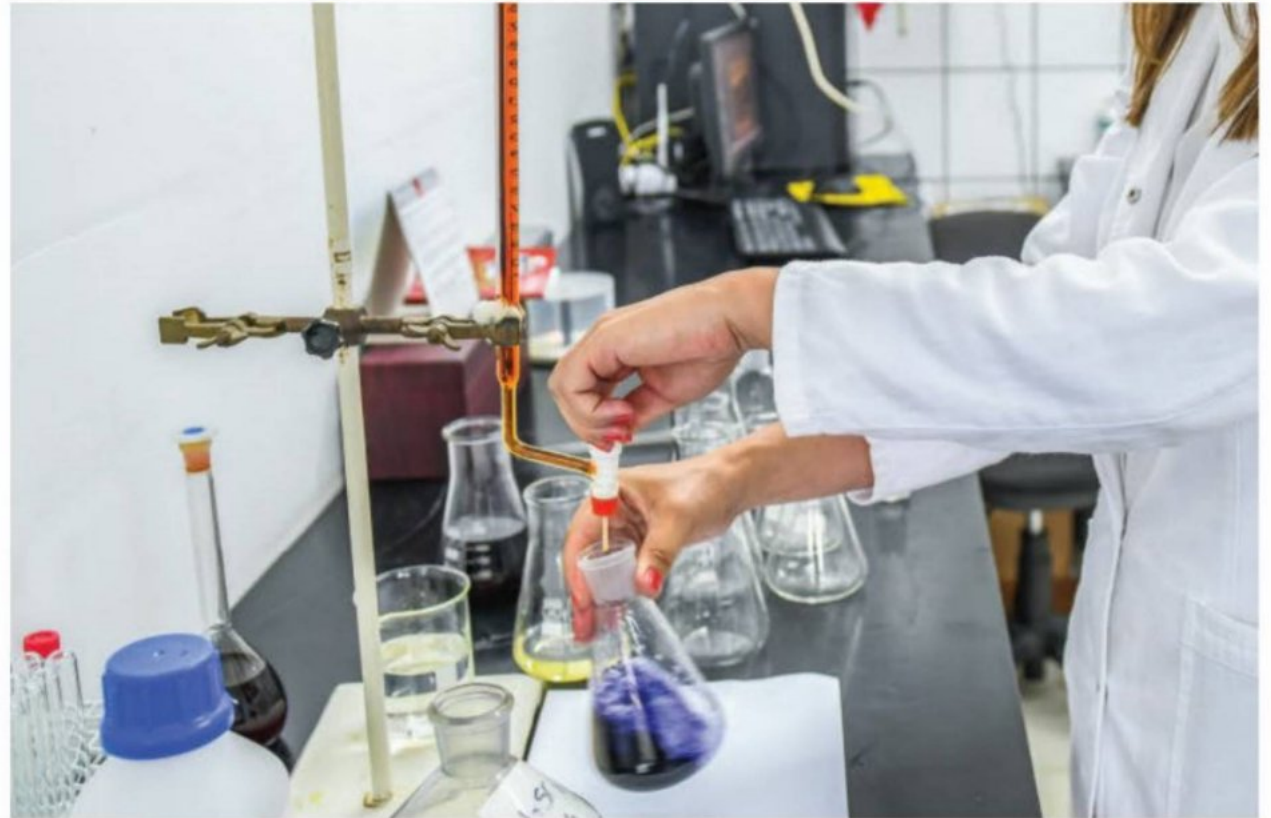
Typical wine laboratory analyses include testing for pH, sulfur dioxide content, and the concentration of both ethanol and malic acid.
Oxidation of alcohols
Alcohols can undergo oxidation and act as weak reducing agents. When a primary alcohol such as ethanol is oxidised, the hydroxyl functional group is converted into a carboxyl functional group (-COOH):
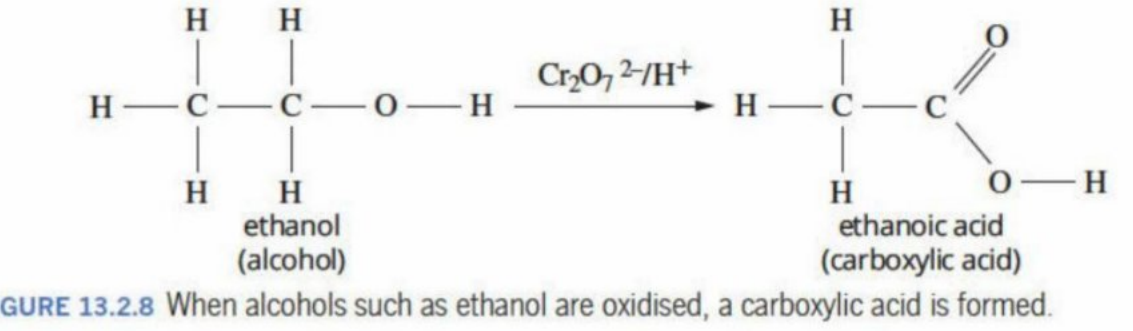
These oxidation reactions form the basis for volumetric analysis to determine the concentration of an alcohol in solution. Typically, a strong oxidising agent such as acidified potassium dichromate solution (K₂Cr₂O₇) or acidified potassium permanganate solution (KMnO₄) reacts with the alcohol in a titration.
Note
When ethanol is oxidised to ethanoic acid by acidified potassium dichromate, the dichromate ion participates in the reaction whereas the potassium ion is a spectator ion.
Calculations in volumetric analysis
Calculations in volumetric analysis usually involve several steps:
The process follows this sequence:
- Write a balanced chemical equation
- Determine the volume of the average titre
- Use the concentration and volume of the standard solution to calculate the amount (in moles) of the known substance
- Use the mole ratio in the equation to calculate the amount (in moles) of the unknown substance that reacted in the titration
- Use the amount (in moles) that reacted and the sample volume to determine the concentration of the unknown substance
Example
Worked Example: Determining Ethanol Concentration in Beer
A 20.00 mL aliquot of beer is titrated with 7.88 × 10⁻³ M acidified potassium dichromate solution. The balanced equation is:
Step 1: Calculate average titre
Discard non-concordant results (17.05 mL is outside the 0.10 mL range). Average the three concordant titres:
Step 2: Calculate moles of standard solution
Step 3: Use mole ratio
From the equation, the ratio is 3:2 (ethanol:dichromate).
Step 4: Calculate concentration
The final result is rounded to 3 significant figures, corresponding to the smallest number of significant figures in the original data.
Important
Avoiding Rounding Errors:
Keep all figures in the calculator throughout your calculations to avoid rounding errors. Only round your final answer to the appropriate number of significant figures based on the original data.
Selecting indicators for redox titrations
Selecting suitable indicators for redox titrations can be more difficult than for acid-base titrations. Redox indicators must behave as oxidising agents or reducing agents after the equivalence point has been reached when a small excess of solution from the burette is present. They must also be highly coloured in either oxidised or reduced form.
Starch indicator
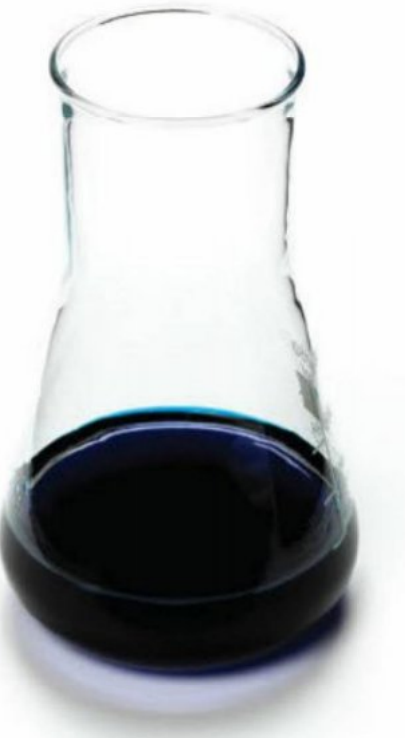
Starch is used as an indicator in titrations where iodine (I₂) is either a reactant or a product. When iodine is present in excess, it reacts with starch to form a dark blue complex.
Note
How the Starch-Iodine Test Works:
Starch is a carbohydrate polymer found in plants. There are two forms: a linear polymer called amylose and a branched polymer called amylopectin. Amylose is responsible for the dark blue colour in the presence of iodine.
The long amylose molecules coil into spiral-like helices that pack together tightly. Insoluble iodine is dissolved in water using soluble potassium iodide, forming the triiodide ion (I₃⁻). When added to starch, the triiodide ion slips inside the amylose coil, causing the dark blue colour.
Self-indicating titrations
Often one of the reactants in a redox titration is strongly coloured, such as the permanganate ion (MnO₄⁻) or the dichromate ion (Cr₂O₇²⁻).
The permanganate ion is purple while the manganese(II) ion is colourless:
(purple → colourless)
The dichromate ion is yellow while the chromium(III) ion (Cr³⁺) is green:
Note
Because of these colour changes, there is no need to use a redox indicator in titrations using permanganate or dichromate ions. The solution itself acts as the indicator, making these self-indicating titrations.
Volumetric analysis involving dilution
When and why to dilute
It's often necessary to dilute a solution by adding water before carrying out a titration. This reduces the concentration to obtain titres that fall within the range of the burette. When dilution is involved, record the following additional data:
- The volume of the aliquot of undiluted solution
- The volume of diluted solution that is prepared
Calculating the dilution factor
The dilution factor is calculated as:
Example
Example: Calculating Dilution Factor
If 25.00 mL of orange juice is diluted to 250.0 mL in a volumetric flask before taking aliquots for titration, the dilution factor is:
The undiluted juice will be 10.00 times more concentrated than the concentration of the aliquot.
Calculation steps for diluted solutions
The steps to calculate the concentration in the undiluted solution are:
- Write a balanced chemical equation
- Use the concentration of the standard solution to calculate the amount (in moles) of the known substance that reacted
- Use the mole ratio in the equation to determine the amount (in moles) of diluted unknown substance that reacted in the titration
- Determine the concentration of the diluted unknown substance
- Multiply the concentration of the diluted solution by the dilution factor to determine the concentration of the undiluted unknown substance
Example
Worked Example: Determining Sodium Hypochlorite Concentration in Bleach
A 20.00 mL sample of bleach is diluted to 250.0 mL with water. A 20.00 mL aliquot of the diluted bleach is treated with excess potassium iodide solution, producing iodine. The iodine is then titrated with 0.125 M sodium thiosulfate solution using starch indicator.
The two reactions involved are:
Step 1: Average concordant titres
Discard 26.68 mL (not concordant). Average:
Step 2: Moles of standard solution
Step 3: Moles of unknown in diluted solution
Using the 1:2 mole ratio:
Step 4: Concentration of diluted solution
Step 5: Concentration of undiluted solution
Dilution factor =
Undiluted concentration = M (rounded to 3 significant figures)
Important
Important Note on Significant Figures:
The final result is rounded to 3 significant figures based on the original data. Keep unrounded values in the calculator during intermediate steps to avoid rounding errors. This ensures your final answer is as accurate as possible.
Stoichiometry problems involving excess reactants
Apart from reactions during titrations (which stop at the equivalence point), in many reactions the reactants are not mixed in stoichiometric amounts. One reactant is often in excess.
Key principles
The limiting reactant is the reactant that is completely consumed in the reaction. The reactant that is not completely used up and has some remaining when the reaction stops is said to be in excess.
To solve these problems:
- Calculate the number of moles of each reactant
- Determine which is the excess reactant and which is the limiting reactant
- Use the amount of limiting reactant to work out the amount of product formed or the amount of reactant in excess
Example
Worked Example: Potassium Permanganate Reacting with Iron(II) Sulfate
The balanced equation for the reaction is:
A 20.00 mL sample of 0.0110 M KMnO₄ is mixed with 50.00 mL of 0.0245 M FeSO₄ in acidic solution.
Part a: Determining the limiting reactant
Step 1: Calculate moles of each reactant
Step 2: Calculate how much Fe²⁺ is needed to react with all the MnO₄⁻
From the equation, the ratio is 5:1 (Fe²⁺:MnO₄⁻)
Step 3: Compare
We have mol Fe²⁺ present, but only need mol.
Therefore, FeSO₄ is in excess and KMnO₄ is the limiting reactant.
Part b: Calculating mass of product formed
Step 1: Find mole ratio
From the equation, 5 Fe³⁺ are produced for every 1 MnO₄⁻. Since 2 Fe³⁺ ions combine with 3 SO₄²⁻ to form Fe₂(SO₄)₃, the ratio of Fe₂(SO₄)₃ to KMnO₄ is 2.5:1.
Step 2: Calculate moles of product
Step 3: Calculate mass
g mol⁻¹
Case study: Determination of vitamin C content
Background: The Ribena investigation
In 2004, two 14-year-old New Zealand students, Jenny Suo and Anna Devathasan, conducted a science fair project investigating the link between vitamin C content and the cost of popular fruit juice products. They hypothesised that cheaper brands would have lower vitamin C content than expensive products.
From advertisements, Jenny and Anna were confident that Ribena would have a higher vitamin C content than pure orange juice, as the manufacturers claimed "the blackcurrants in Ribena contain four times the vitamin C of oranges."
Note
A Student Investigation with Real Impact:
Using volumetric analysis to measure vitamin C content, Jenny and Anna were surprised to find that Ribena had a much lower vitamin C content than the other brands tested. After repeating the experiment several times to ensure reliability, they found Ribena's vitamin C content was higher than only the cheapest orange fruit juice drink tested.
The students contacted the manufacturer with no response, then approached the consumer television programme Fair Go and finally New Zealand's Commerce Commission. Three years after their science fair project, the manufacturer was fined more than $160,000 and required to publicly apologise for misleading consumers.
This case demonstrates the power of careful scientific investigation and the importance of accurate product labeling.
Practical investigation: Vitamin C tablet analysis
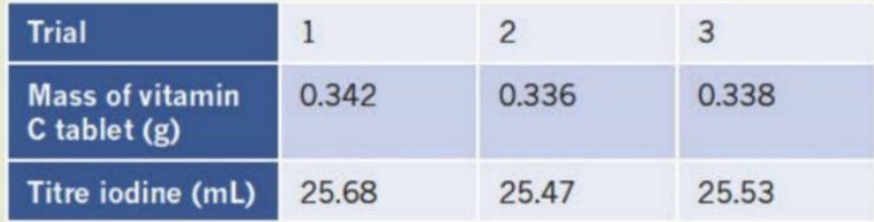
A similar investigation involves determining the ascorbic acid content of vitamin C tablets through redox titration.
Procedure:
- Weigh one vitamin C tablet and transfer it to a 100 mL conical flask
- Crush the tablet, add about 50 mL of deionised water, and stir to dissolve
- Add 1 mL of starch indicator to the conical flask
- Fill a burette with standardised iodine solution
- Titrate the ascorbic acid solution with iodine until the indicator shows a permanent dark blue-black colour
- Repeat twice more
The reaction:
Results: Using a 0.0525 M standardised iodine solution, three trials gave titres of 25.68, 25.47, and 25.53 mL with tablet masses of 0.342, 0.336, and 0.338 g respectively.
Note
Analysis considerations:
- The iodine is called 'standardised' because its concentration was accurately determined through titration with another standard solution
- The calculated mass of ascorbic acid may be lower than the manufacturer's claim of 500 mg per tablet due to various sources of error
- Proper safety equipment (PPE) should include safety glasses and gloves, as iodine solution causes serious eye irritation and is harmful in contact with skin
- Other substances in the tablet might include binding agents, coating materials, flavourings, or preservatives
Summary
Key Points to Remember:
- Volumetric analysis uses titrations to accurately determine the concentration of a dissolved substance by reacting it with a solution of precisely known concentration
- Standard solutions have accurately known concentrations and can be prepared from primary standards or by titrating with another standard solution
- Primary standards are pure substances where the amount in moles can be calculated accurately from their mass
- Concordant titres fall within 0.10 mL of each other and are used to calculate average titre values
- Redox titrations involve reactions between oxidising and reducing agents, often used to analyse organic compounds like alcohols and vitamin C
- When rinsing glassware: use deionised water for flasks, but use the reactant solution for burettes and pipettes
- Dilution factor = volume of diluted solution ÷ volume of undiluted solution
- In problems with excess reactants, identify the limiting reactant (completely consumed) to calculate product amounts