Measuring Solubility (VCE SSCE Chemistry): Revision Notes
📚Revision Notes
Measuring Solubility
Understanding how much of a substance dissolves in water is crucial in many fields, from medicine to food preparation. This note will help you understand solubility and how to measure it accurately.
What is solubility?
Solubility describes how much of a substance will dissolve in a given amount of solvent. In chemistry, solubility has a very specific meaning: it refers to the maximum amount of a solute that can be dissolved in a given quantity of solvent at a particular temperature. The standard quantity used is typically of water.
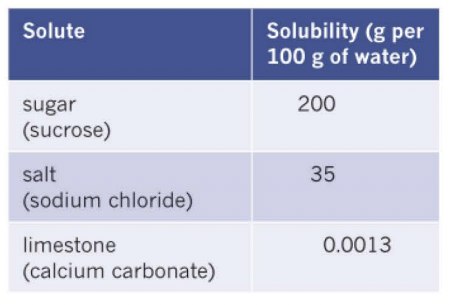
Different substances have vastly different solubilities. For example, glucose is very soluble in water, which is why your body can use it as a readily available energy source. On the other hand, most rocks are made of minerals that are insoluble in water. However, limestone (containing calcium carbonate) is slightly soluble, which is why caves form in limestone areas over long periods. This slight solubility can even lead to the formation of sinkholes.

The table below shows the solubility of some common substances in of water at :
Important
Always note the temperature when discussing solubility values, as solubility changes with temperature.
Types of solutions
When you dissolve a solute in a solvent, you can create three different types of solutions:
Saturated solution
A saturated solution is one in which no more solute can be dissolved at a particular temperature. The solution has reached its maximum capacity for that solute at that temperature. Any additional solute added will simply remain undissolved.
Unsaturated solution
An unsaturated solution contains less solute than is needed to make the solution saturated. This means the solution can still dissolve more solute if you add it. There's still "room" for more solute particles.
Supersaturated solution
A supersaturated solution is an unstable solution that contains more dissolved solute than a saturated solution would normally hold at that temperature. This is a special case that requires careful preparation. If you disturb a supersaturated solution, some of the solute will separate from the solvent as a solid.
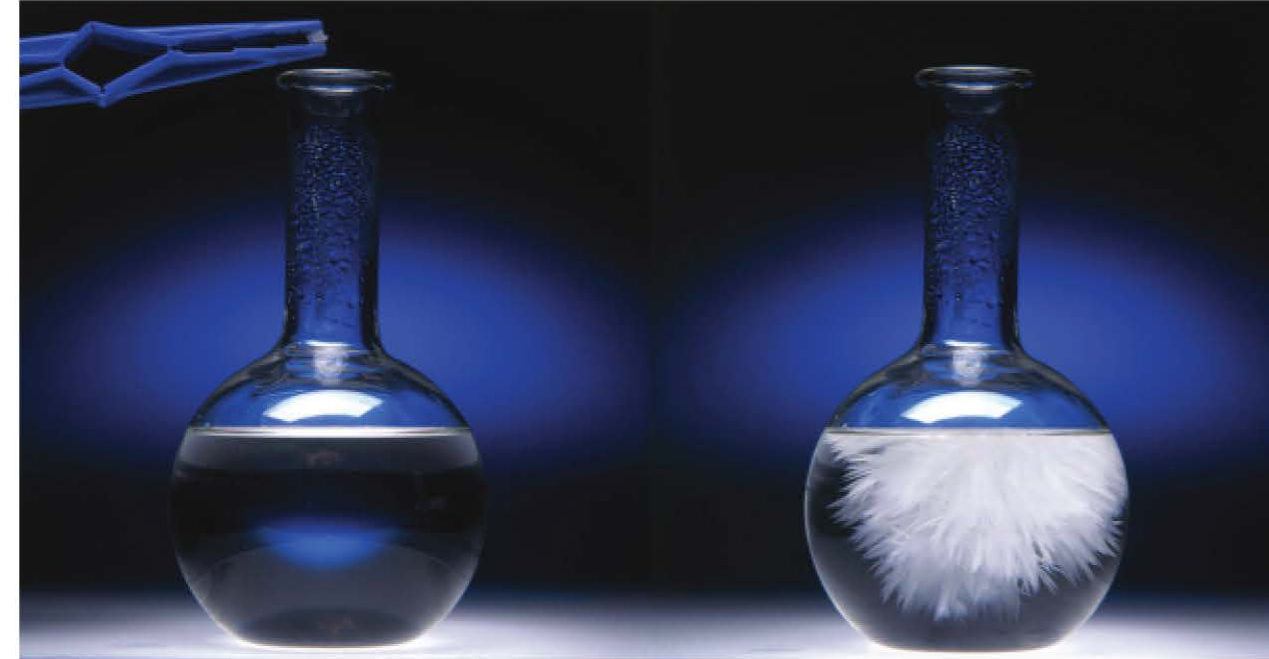
To create a supersaturated solution of sodium ethanoate, you need to cool a saturated solution very carefully so that solid crystals don't form. Adding a small seed crystal to the supersaturated solution causes the solute to crystallise (form solid crystals), returning to a saturated solution.
Note
Key distinction: Think of it this way:
- Unsaturated = "wants more" solute
- Saturated = "just right" amount of solute
- Supersaturated = "too much" solute (unstable)
Solubility curves
The solubility of many substances changes significantly as temperature changes. You've probably noticed this yourself - you can dissolve more chocolate powder in hot milk than in cold milk.
For most solid solutes, increasing the temperature increases the solubility in a liquid. This happens because at higher temperatures, both the solute and solvent particles have more energy to overcome the forces of attraction holding the solid particles together.
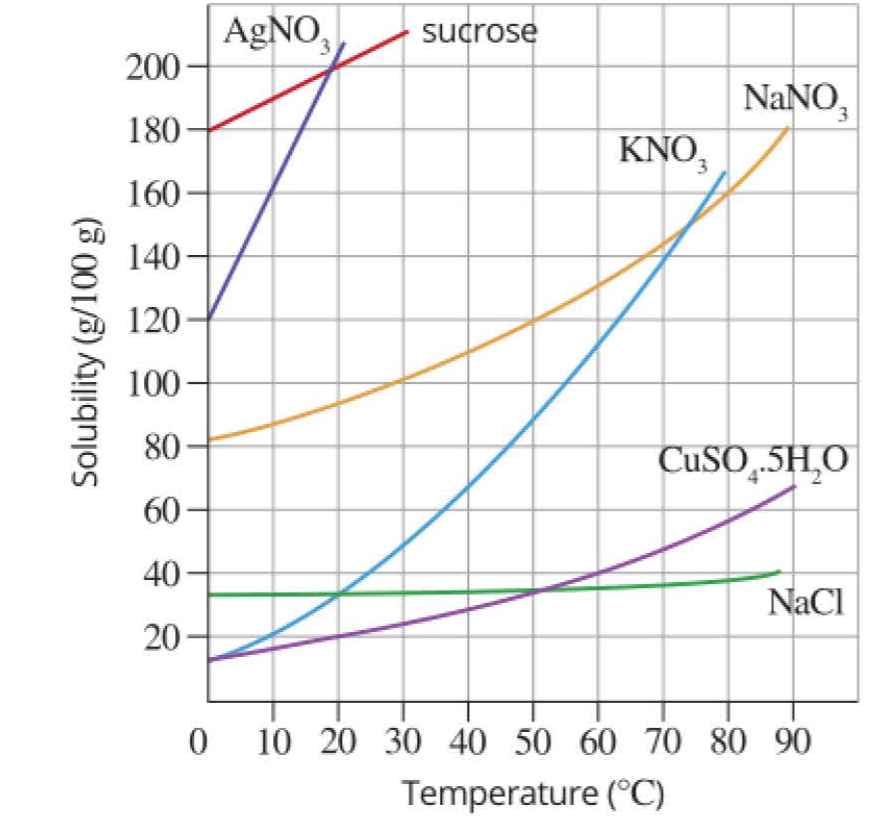
A solubility curve is a graph that shows the relationship between solubility and temperature.
Note
When reading solubility curves, remember these important points:
-
Each point on a curve represents the maximum amount of solute that can be dissolved in of water at a particular temperature. Therefore, each point on the curve represents a saturated solution.
-
Any point below a curve represents an unsaturated solution (not enough solute to saturate the solution at that temperature).
-
Any point above a curve represents a supersaturated solution (more solute than should normally dissolve at that temperature).
-
For most solids, as temperature increases, solubility increases (the curves slope upward).
Reading solubility curves
To find the solubility of a substance at a particular temperature:
- Draw a vertical line from the required temperature on the horizontal axis up to the solubility curve for that substance.
- Draw a horizontal line from this intersection point to the vertical axis.
- Read the solubility value where this horizontal line meets the vertical axis.
Calculations with different quantities of water
Solubility curves directly show the mass of compound that dissolves in of water. However, you can use these curves to calculate solubilities for other quantities of water.
Note
Important relationship: Since the density of water is , the mass of water in grams equals the volume in millilitres. For example, of water weighs .
Example
Worked Example: Calculating with Different Water Quantities
An sample of sodium nitrate () is added to of water at . How much more must be added to make the solution saturated?
Solution:
Step 1: Find the solubility at from the curve: per of water.
Step 2: Since we have () of water, twice as much solute can dissolve:
Step 3: We've already added , so the extra mass needed is:
Answer: of must be added.
Crystallisation
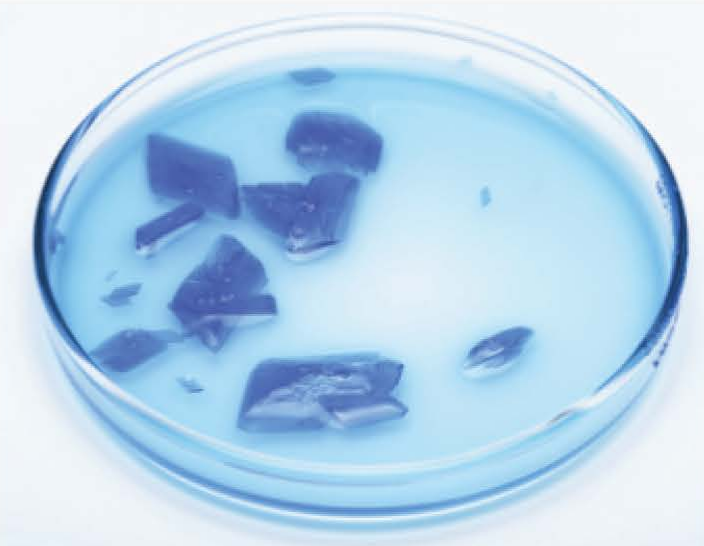
Crystallisation occurs when an unsaturated solution becomes saturated and crystals form. This commonly happens when you cool a solution.
When you cool a solution, the solubility of the dissolved solute typically decreases. At some point, not all of the dissolved substance can remain in solution. When this happens, the solution becomes saturated, and further cooling will cause crystals to form.
Calculating crystallisation
You can predict how much of a compound will crystallise from a solution using solubility curves.
Example
Worked Example: Calculating Crystallisation
of potassium nitrate () is dissolved in water at . What mass of crystals will form if the temperature is reduced to ?
Solution:
Step 1: Mass of originally in solution =
Step 2: From the solubility curve, the maximum mass that will remain dissolved at is .
Step 3: Mass of crystals formed = original mass - remaining mass
Answer: of crystals will form.
Note
Key concept: The difference between what's dissolved initially and what can stay dissolved at the lower temperature gives you the mass that crystallises out.
Removing impurities from water using precipitation
Precipitation reactions are commonly used to remove or reduce impurities in drinking water and wastewater. The process involves converting soluble ionic compounds into insoluble ones by adding solutions containing ions that will combine with the soluble impurity ions to form a precipitate. The precipitate can then be removed by filtering or settling.
Removing phosphates from sewage
Phosphate ions can cause eutrophication (excessive algae growth) in waterways. To remove phosphates from sewage water, solutions of aluminium sulfate or iron(III) chloride are added. These react with phosphate ions to form insoluble precipitates.
For example, the reaction with iron(III) ions:
Note
Nitrates cannot be removed by precipitation because nitrate compounds are soluble in water. Nitrate levels are reduced using biological methods instead.
Removing heavy metals from industrial wastewater
Industrial processes can produce wastewater containing dissolved heavy metal cations (such as lead, copper, chromium, nickel, and zinc). These must be removed before the water is discharged into waterways.
Calcium hydroxide is commonly used because it's relatively inexpensive. The hydroxide ions react with metal ions to form insoluble precipitates.
For example, with lead ions:
The precipitate settles to form a sludge, which is separated from the purified wastewater.
Important
Remember that precipitation removes soluble ions by converting them to insoluble compounds. Know the common anions that form insoluble compounds: hydroxide, carbonate, sulfide, and phosphate.
Case study: Melbourne's water purification
Melbourne's water is among the cleanest in the world because most reservoirs have protected catchments, preventing contamination from fertilisers and pesticides.
However, Sugarloaf Reservoir takes water from the Yarra River, which flows through farmland and is prone to contamination. This water requires treatment at the Winneke treatment plant.
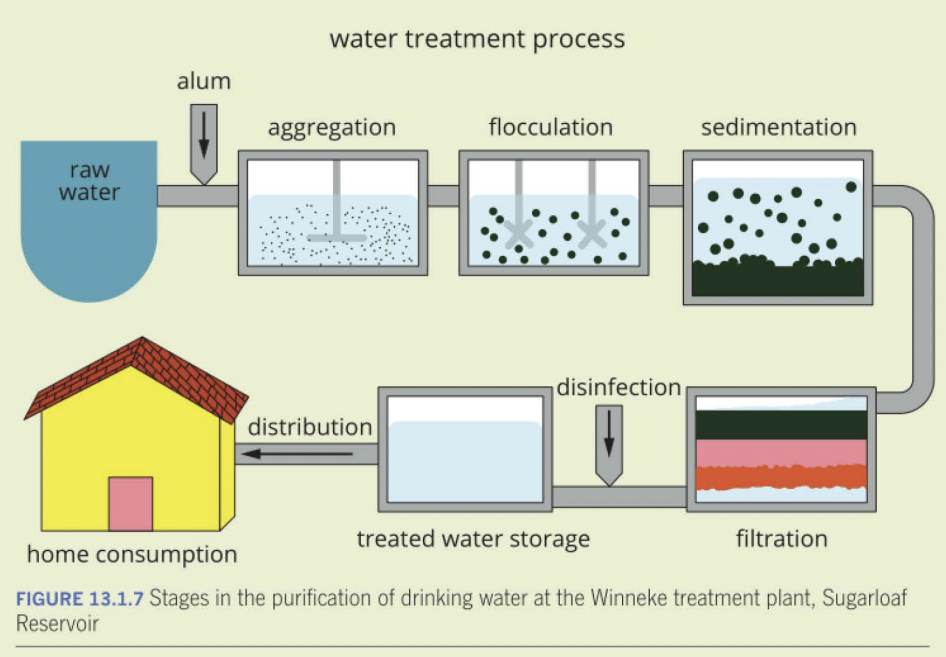
The treatment process:
- Aggregation: Alum (aluminium sulfate) is added. Aluminium ions combine with hydroxide ions in the water to form aluminium hydroxide precipitate:This precipitate traps fine particles and microorganisms.
- Flocculation: A positively charged polymer is added, causing fine particles to accumulate into larger particles.
- Sedimentation: The larger particles settle to form sediment.
- Filtration: The clear water is filtered.
- Disinfection: Chlorine is added to remove microorganisms, and fluoride is also added.
- Distribution: Treated water is distributed to holding reservoirs across the city and then gravity-fed to homes, schools, and industries.
Important
If the water pH is too low, lime (calcium oxide) can be added to provide hydroxide ions before the alum treatment.
Solubility of gases in water
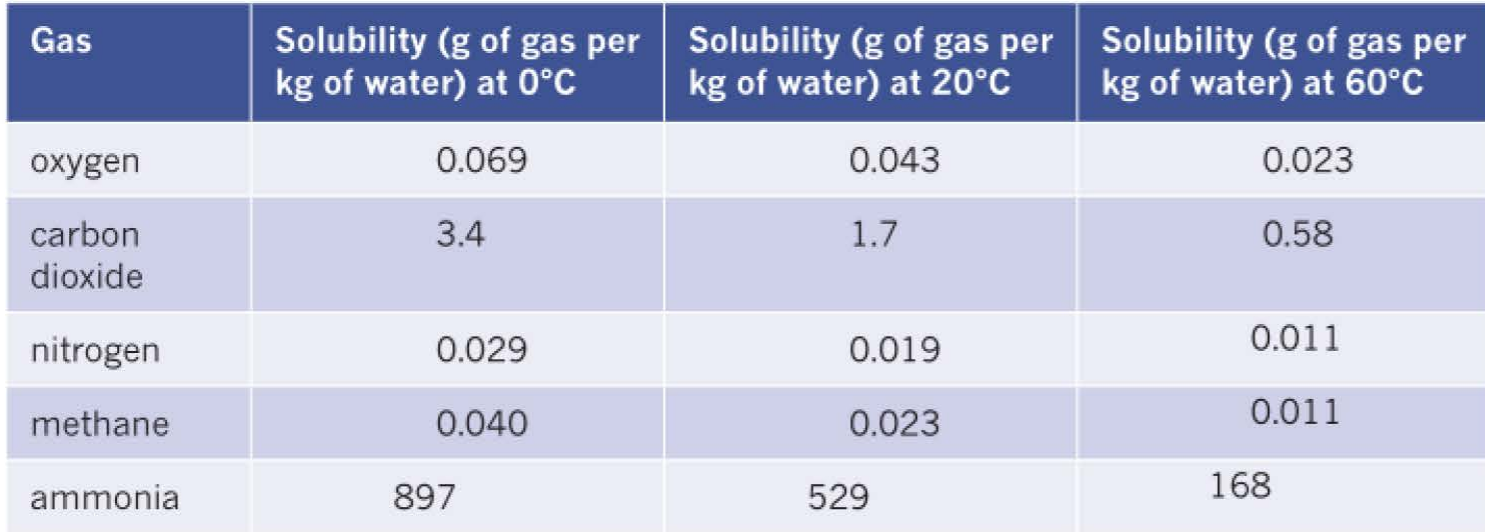
Unlike solids, gases generally become less soluble as temperature increases. This is an important difference to remember.
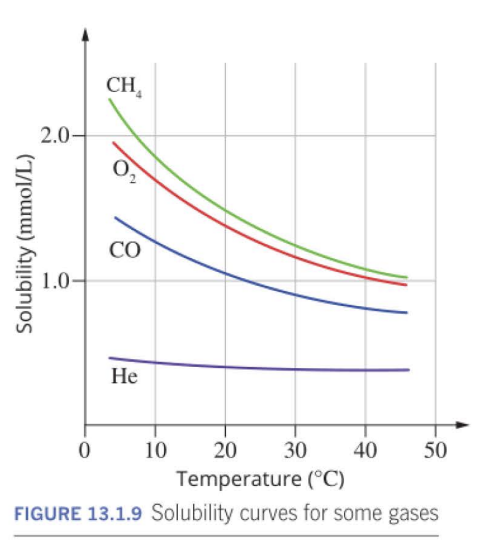
The table below shows how gas solubility decreases with increasing temperature:
Everyday observations
You can observe this principle in daily life:
- When you heat water, bubbles appear before it boils. These aren't steam bubbles but air bubbles - dissolved air coming out of solution as the temperature increases.
- Soft drinks left in the sun go "flat" quickly because dissolved carbon dioxide comes out of solution as the drink heats up.
Environmental implications
The effect of temperature on gas solubility has important environmental consequences:
Impact on aquatic life: If water temperature in rivers, lakes, and oceans increases even slightly, it will contain less dissolved oxygen. This can be devastating for oxygen-breathing aquatic organisms like fish.
Therefore, hot water from power stations and industries must be cooled before discharge into waterways. Even a small temperature increase can cause oxygen levels to drop below what's necessary for aquatic life to survive.
Note
Climate change effects: Increasing ocean temperatures have affected ecosystems like the Great Barrier Reef. Higher temperatures cause:
- Direct stress on corals (bleaching)
- Decreased dissolved oxygen levels in reef waters
- Impact on small organisms in the reef ecosystem
- Effects on larger animals like the green sea turtle, whose food sources may be affected
Important
Remember the key difference - for most solids, solubility increases with temperature; for gases, solubility decreases with temperature.
Remember!
Summary
Key Points to Remember:
-
Solubility is the maximum amount of solute that dissolves in a given quantity of solvent at a specific temperature.
-
Three types of solutions: saturated (maximum solute dissolved), unsaturated (can dissolve more), and supersaturated (unstable, contains more than normal maximum).
-
Solubility curves show points on the curve as saturated solutions, points below as unsaturated, and points above as supersaturated.
-
Temperature effects: For most solids, solubility increases with temperature. For gases, solubility decreases with temperature.
-
Precipitation reactions convert soluble impurities to insoluble precipitates, which can be removed from water by filtering or settling.