Catalysts (VCE SSCE Chemistry): Revision Notes
📚Revision Notes
Catalysts
Introduction
Catalysts are substances that dramatically increase the rate of chemical reactions without being consumed in the process. They play crucial roles in many areas of chemistry, from industrial manufacturing to environmental protection. For example, catalysts are essential in petroleum refineries for breaking down large hydrocarbon molecules into smaller, more useful compounds, and in catalytic converters to reduce air pollution from vehicle exhaust.
Understanding how catalysts work requires knowledge of collision theory and the energy changes that occur during chemical reactions. This note explores the mechanism by which catalysts increase reaction rates and examines their practical applications.
How catalysts work
Understanding activation energy
Before we can understand catalysts, we need to revisit the concept of activation energy. The activation energy () is the minimum amount of energy that reactant particles must possess for a chemical reaction to occur. Think of it as an energy barrier that must be overcome for reactants to transform into products.
Note
On an energy profile diagram, the activation energy is measured from the energy level of the reactants up to the peak of the curve (the transition state). The enthalpy change () represents the overall energy difference between reactants and products, and can be positive (endothermic reaction) or negative (exothermic reaction).
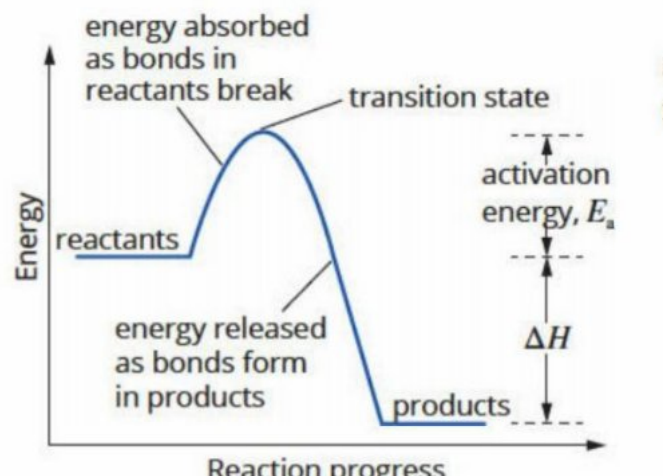
Some reactions occur readily at room temperature because they have very low activation energies—only a small amount of energy is needed to break the bonds in the reactants. However, many reactions have high activation energies and proceed very slowly under normal conditions. This is where catalysts become important.
The role of catalysts
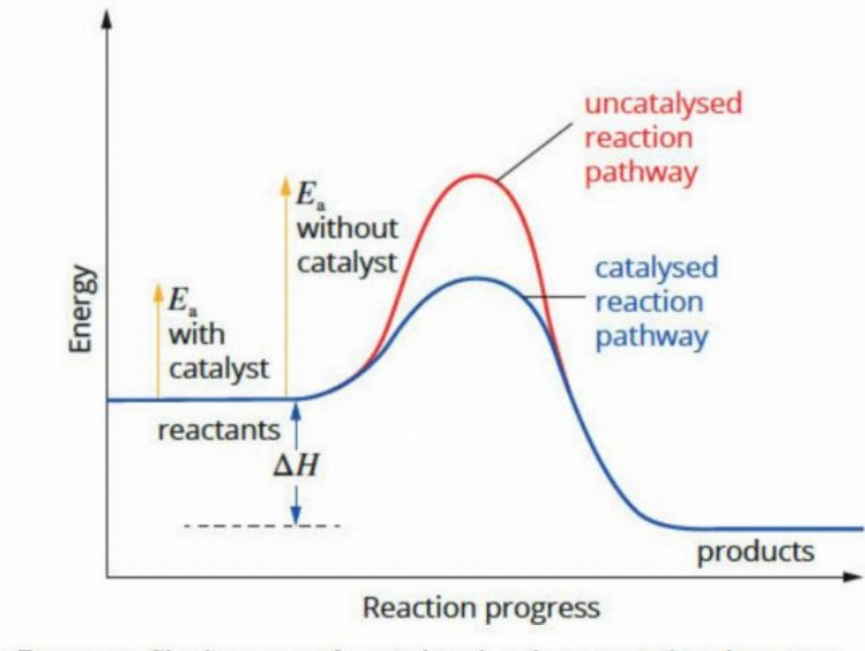
Catalysts work by providing an alternative reaction pathway that has a significantly lower activation energy than the uncatalysed reaction. This is the key to understanding their effectiveness.
When a catalyst is present:
- The reaction can proceed via a different route with a lower energy barrier
- More colliding particles have sufficient energy to exceed this reduced activation energy
- A greater proportion of collisions are successful (result in product formation)
- The overall reaction rate increases substantially
Important
While catalysts lower the activation energy, they do not change the enthalpy change () of the reaction. The energies of the reactants and products remain the same—only the pathway between them changes. This means that catalysts affect the rate of reaction but not the position of equilibrium or the amount of product ultimately formed.
Because catalysts are not consumed during the reaction, they do not appear as reactants or products in balanced chemical equations. A small amount of catalyst can facilitate the conversion of large amounts of reactants.
The mountain analogy
Note
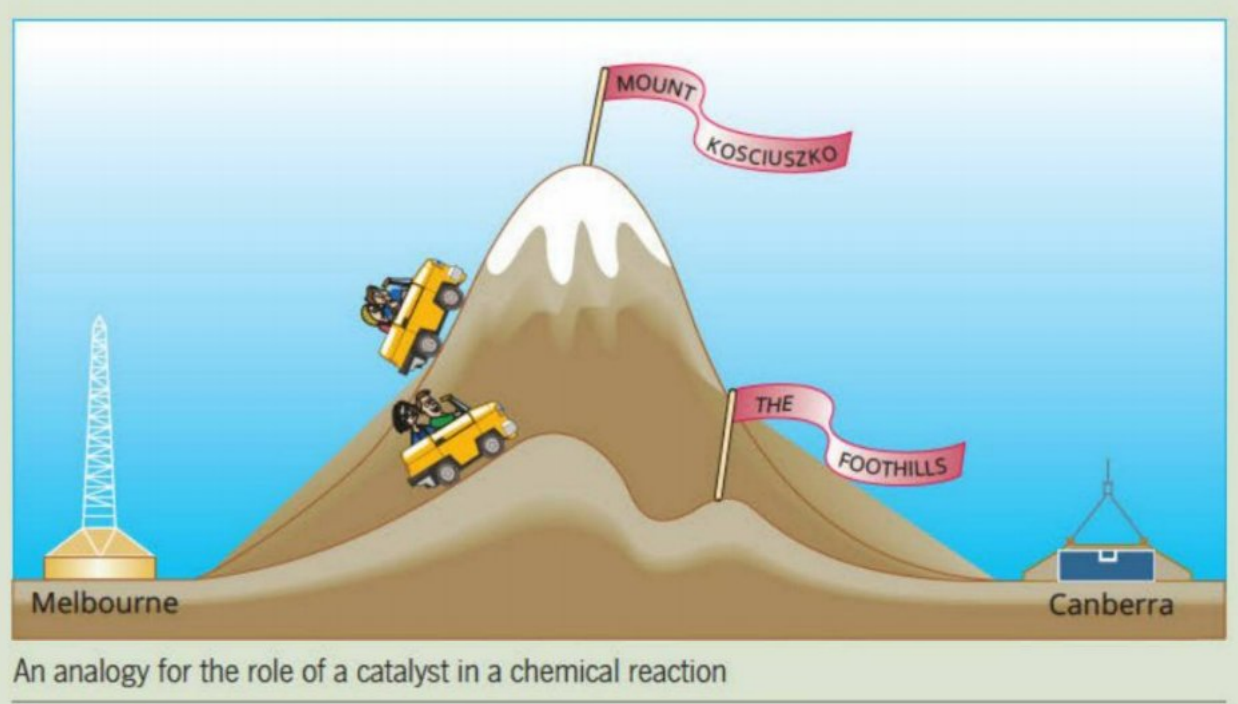
A helpful way to visualise how catalysts work is to imagine travelling from Melbourne to Canberra. Without a catalyst, it's like taking a route that goes directly over the top of Mount Kosciuszko—you need lots of energy to climb to the summit before descending to your destination. With a catalyst, it's like taking an alternative route through the foothills that bypasses the tall mountain. You still arrive at the same destination (the products), but you get there more quickly and with less energy expenditure because you avoided the high energy barrier.
Types of catalysts
Catalysts can be classified into two main categories based on their physical state relative to the reactants and products:
Homogeneous catalysts
Homogeneous catalysts are in the same physical state (solid, liquid, or gas) as the reactants and products they are catalysing.
Example
Example: Ozone Layer Depletion
A significant environmental example of homogeneous catalysis occurs in the upper atmosphere and has contributed to ozone layer depletion. Chlorine atoms in the gaseous state act as catalysts for the decomposition of ozone gas () into oxygen gas (). Both the catalyst (chlorine atoms) and the reactants/products (ozone and oxygen) are all gases. These chlorine atoms often originate from chlorofluorocarbons (CFCs) released from refrigerators and air conditioners.
Heterogeneous catalysts
Heterogeneous catalysts are in a different physical state to the reactants and products of the reaction they catalyse.
Example
Example: Hydrogen Peroxide Decomposition
The decomposition of hydrogen peroxide solution () can be catalysed by manganese(IV) oxide (), which is a black powder. The hydrogen peroxide is in liquid solution, while the catalyst is a solid—making this heterogeneous catalysis.
Catalysts in industry
Why heterogeneous catalysts are preferred
The chemical industry extensively uses catalysts to improve efficiency and reduce costs. For industrial processes, heterogeneous catalysts are generally preferred over homogeneous catalysts because they offer several practical advantages:
- Easier separation: Because they are in a different physical state, heterogeneous catalysts can be more easily separated from the reaction products
- Reusability: Once separated, heterogeneous catalysts can be reused multiple times, making them more economical
- High temperature stability: Many heterogeneous catalysts can withstand the high temperatures often required in industrial processes
The importance of surface area
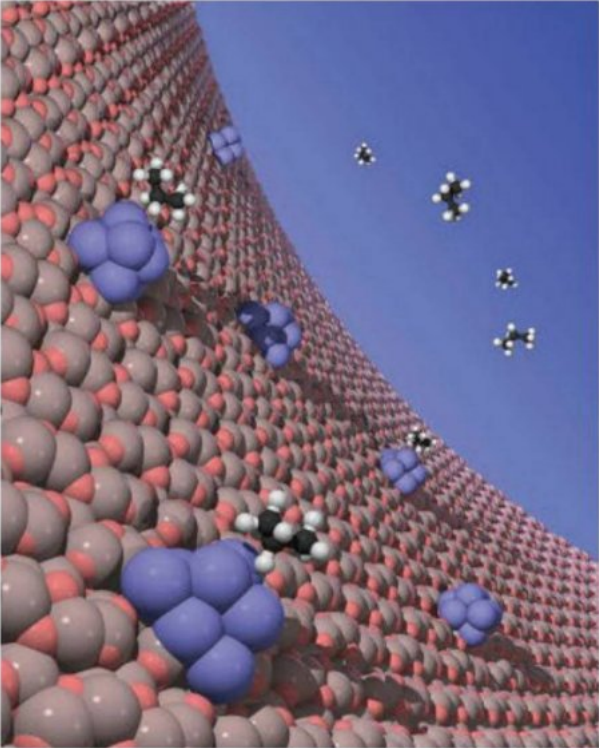
Heterogeneous catalysts work through a process called adsorption. Particles at the surface of certain solids can form bonds with gas molecules that collide with the surface. When reactant molecules adsorb onto the catalyst surface, their bonds become distorted or may even break completely. This makes it much easier for the reaction to proceed.
Important
The catalyst surface essentially provides a new reaction pathway with significantly lower activation energy. Because the catalytic reaction occurs at the surface, the surface area of the catalyst is crucial to its effectiveness:
- Catalysts are often used in powdered or sponge-like forms to maximise surface area
- A larger surface area means more reactant molecules can adsorb simultaneously
- More adsorption sites lead to faster reaction rates
This is why industrial catalysts are often designed with porous structures or are supported on materials with high surface areas, such as honeycomb ceramics.
Case study: heterogeneous catalysts in industry
Catalytic converters in cars
Since 1986, all new cars sold in Australia must have a catalytic converter fitted between the engine and the exhaust pipe. This device uses heterogeneous catalysis to clean exhaust gases and significantly reduce air pollution.
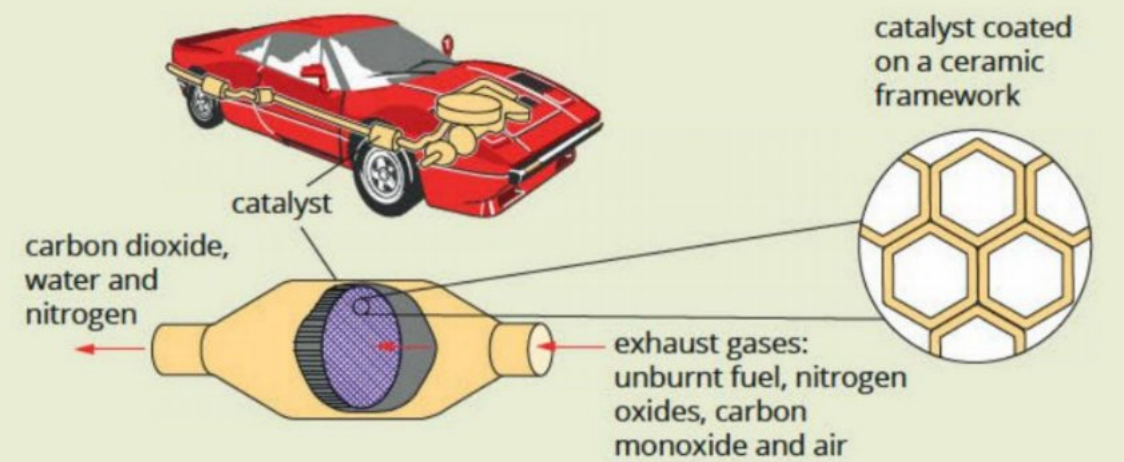
The catalytic converter's purpose is to convert toxic gases produced during combustion into less harmful substances:
Example
Key reactions occurring in catalytic converters:
The catalyst typically consists of a mixture of platinum, palladium, and rhodium metals coated onto a honeycomb-shaped ceramic support. The honeycomb structure creates millions of tiny pores, providing an enormous surface area for the catalytic reactions.
As exhaust gases flow through the catalyst chamber, they pass over the metal surfaces where the harmful gases (carbon monoxide, nitrogen oxides, and unburnt hydrocarbons) are converted to less harmful products (carbon dioxide, nitrogen, and water). The catalyst remains unchanged and can function effectively for many years without replacement.
Note
This is an excellent example of heterogeneous catalysis because the catalyst is a solid while the reactants and products are gases, demonstrating the practical benefits of this type of catalyst in environmental protection.
The Haber process
The Haber process is one of the most important industrial chemical reactions, producing ammonia () which is used to manufacture fertilisers, nylon, explosives, and some pharmaceuticals. This process also employs heterogeneous catalysis.
Example
The Haber process reaction:
The reaction uses powdered iron as a heterogeneous catalyst. Here's how the catalytic process works:
- Hydrogen () and nitrogen () gas molecules adsorb onto the iron surface
- As they attach to the surface, the strong covalent bonds within the molecules break
- The individual hydrogen and nitrogen atoms are now much more reactive
- These atoms readily combine on the catalyst surface to form ammonia molecules
- The ammonia molecules then leave the iron surface, freeing up sites for more reactant molecules
- The iron catalyst remains unaltered and continues to facilitate the reaction
Without the iron catalyst, the reaction between nitrogen and hydrogen would be extremely slow because the triple bond in nitrogen gas is very strong and requires significant energy to break. The catalyst provides an alternative pathway that makes this bond-breaking process much easier.
Important
While the catalyst dramatically increases the rate of ammonia production, it does not change the enthalpy change () of the reaction, which remains at -92 kJ mol⁻¹.
Remember!
Summary
Key Points to Remember:
- Catalysts increase reaction rates by providing an alternative reaction pathway with lower activation energy, allowing more particles to have sufficient energy for successful collisions
- Catalysts are not consumed in reactions and can be used repeatedly, making them economical for industrial processes
- Catalysts do not change —they affect the rate of reaction but not the energy difference between reactants and products
- Homogeneous catalysts are in the same physical state as reactants/products, while heterogeneous catalysts are in a different state
- Surface area is crucial for heterogeneous catalysts—powdered or porous forms maximise the number of active sites where reactions can occur
- Industrial applications like catalytic converters and the Haber process demonstrate the practical importance of catalysts in environmental protection and chemical manufacturing