Perimeter and Area (VCE SSCE General Mathematics): Revision Notes
📚Revision Notes
Perimeter and Area
Introduction to mensuration
Mensuration is the branch of mathematics concerned with measuring length, area, and volume. The word comes from the Latin mensura, meaning 'measure'. In this topic, we focus on finding the perimeter and area of two-dimensional shapes, as well as learning to work with composite shapes and circles.
Perimeters of regular shapes
What is perimeter?
The perimeter of a two-dimensional shape represents the total distance around its outer edge. To find the perimeter of any shape, you add together the lengths of all its sides.
Example
Worked Example: Finding the perimeter of a shape
Let's find the perimeter of this house-shaped pentagon. The same dashes on sides indicate they have equal length.
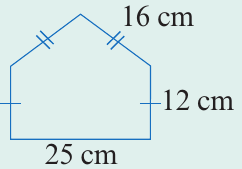
Working:
To calculate the perimeter, we add all the side lengths:
Note
Exam tip: When a diagram uses matching marks (like dashes) on sides, this tells you those sides are the same length. Always look for these visual clues before starting your calculation.
Areas of regular shapes
What is area?
The area of a shape measures the amount of space enclosed within its boundaries. When calculating area, your answer must always be expressed in square units, such as mm², cm², m², or km².
Area and perimeter formulas for common shapes
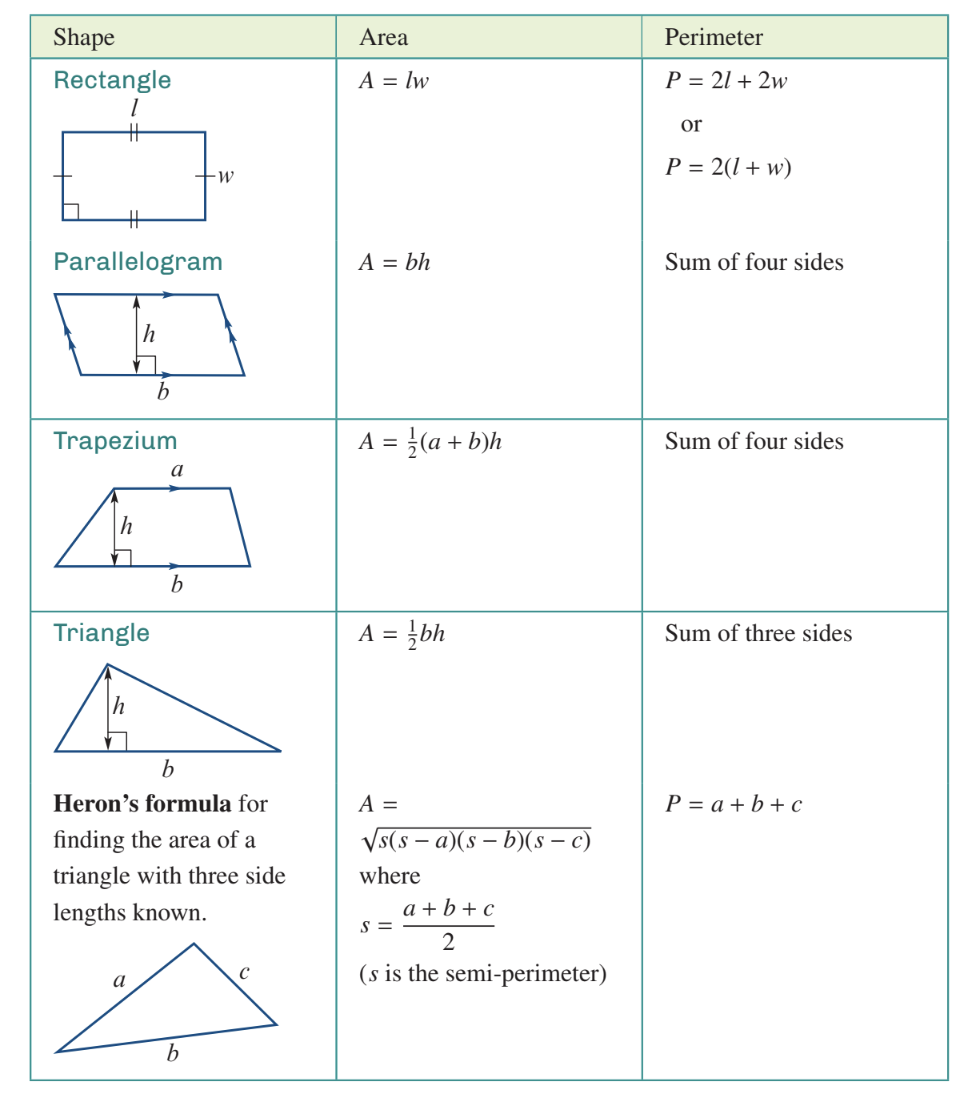
The table above shows the standard formulas you need to know for finding both area and perimeter of regular shapes.
Note
Key points about the formulas:
- Rectangle: Area equals length times width (). Perimeter can be found by adding twice the length and twice the width ().
- Parallelogram: Area equals base times perpendicular height (). The height must be measured at right angles to the base.
- Trapezium: Area equals half the sum of the parallel sides multiplied by the perpendicular height ().
- Triangle: Area equals half the base times the perpendicular height ().
Heron's formula for triangles
When you know all three side lengths of a triangle but don't know its height, you can use Heron's formula to find the area.
Heron's formula states:
where is the semi-perimeter (half the perimeter):
The variables , , and represent the three side lengths of the triangle.
Example
Worked Example: Finding the perimeter of a rectangle
Find the perimeter of this rectangle:
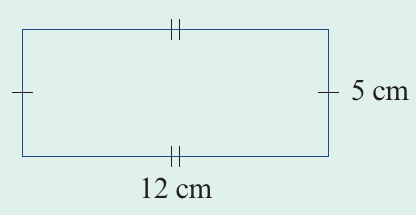
Working:
Since this is a rectangle, we use the formula:
Substituting the length () and width ():
The perimeter is cm.
Example
Worked Example: Finding the area of a trapezium
Calculate the area of this trapezium:
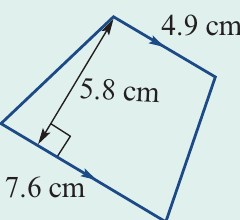
Working:
For a trapezium, we use the formula:
Substituting the values (, , ):
The area of the trapezium is cm².
Example
Worked Example: Using Heron's formula
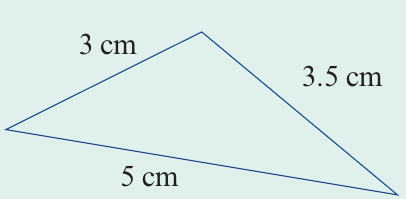
Find the area of this triangle, giving your answer to two decimal places:
Working:
Since we know all three sides but not the height, we must use Heron's formula:
First, find the perimeter by adding the three side lengths:
Next, calculate the semi-perimeter by dividing by :
Now substitute into Heron's formula:
The area of the triangle is cm² to two decimal places.
Important
Heron's formula is particularly useful when you cannot easily determine the height of a triangle from the given information. This often occurs when you're only given the three side lengths.
Example
Worked Example: Practical problem with area and perimeter
A classroom display board measures cm by cm.
a) If ribbon costs $0.55 per metre, how much will it cost to add a ribbon border around the display board?
b) The display board will be covered with yellow paper. What area needs to be covered? Give your answer in m² to two decimal places.
Working:
Part a:
To find the ribbon length needed, calculate the perimeter of the rectangular board:
Convert to metres by dividing by :
Calculate the cost by multiplying the length by the price per metre:
The ribbon will cost $2.64.
Part b:
Calculate the area using the rectangle formula:
Convert to square metres by dividing by (since ):
The area to be covered is m².
Important
Unit conversion:
- To convert cm to m: divide by
- To convert cm² to m²: divide by (not by !)
This is a common mistake - remember that area units require you to square the conversion factor!
Composite shapes
What are composite shapes?
A composite shape is a shape made up of two or more basic shapes joined together. To find the perimeter or area of a composite shape, you need to break it down into simpler shapes that you can work with using standard formulas.
Example
Worked Example: Perimeter and area of a composite shape
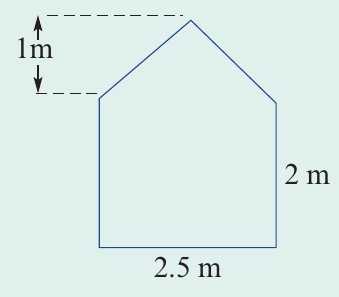
A gable window at a venue is m wide. The rectangular section is m high, and the triangular gable is m high.
a) Calculate the length of LED lights needed for the perimeter (excluding the bottom edge), to two decimal places.
b) Find the total area of the window to two decimal places.
Working:
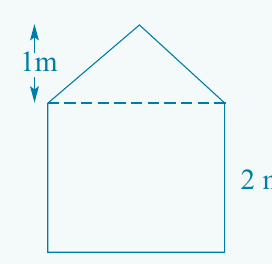
The window consists of two shapes: a rectangle and a triangle.
Part a: Finding the perimeter
First, we need to find the length of the slanted edges of the triangle. We can use Pythagoras' theorem.
The base of the triangle is half the total width:
For the slanted edge :
Now add all the outside edges (excluding the bottom):
We need m of LED lights.
Part b: Finding the area
Calculate the area of the rectangle:
Calculate the area of the triangle:
Find the total area by adding both parts:
The total window area is m² to two decimal places.
Note
Strategy for composite shapes:
- Identify the basic shapes that make up the composite shape
- Calculate measurements for each component separately
- Combine the results appropriately (add for area, add selected edges for perimeter)
The circumference and area of a circle
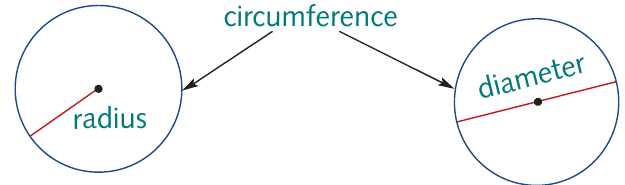
The perimeter of a circle has a special name: the circumference.
Circle terminology
Important terms you need to know:
- Radius (): The distance from the centre of the circle to any point on its edge
- Diameter (): The distance across the circle through its centre (diameter radius)
- Circumference (): The distance around the circle (its perimeter)
Circle formulas
| Measurement | Formula |
|---|---|
| Area | where is the radius |
| Circumference | where is the radius |
| OR | |
| where is the diameter |
Note
The symbol (pi) is a mathematical constant approximately equal to
Most calculators have a dedicated button for accurate calculations.
Example
Worked Example: Finding circumference and area of a circle
For a circle with radius cm, find:
a) the circumference to one decimal place
b) the area to one decimal place
Working:
Part a: Circumference
Use the formula:
Substitute :
The circumference is cm to one decimal place.
Part b: Area
Use the formula:
Substitute :
The area is cm² to one decimal place.
Important
Always check whether the question gives you the radius or diameter. If given the diameter, you must divide by 2 to find the radius before using the formulas.
This is one of the most common mistakes in circle questions!
Summary
Key Points to Remember:
- Perimeter is the total distance around the edge of a shape. Add all the side lengths together.
- Area measures the space inside a shape and must always be expressed in square units (cm², m², etc.).
- For composite shapes, break them into simpler shapes, calculate each part separately, then combine your results.
- Heron's formula allows you to find a triangle's area when you know all three sides: where
- For circles, use for circumference and for area. Make sure you're using the radius, not the diameter!